Home Blog Page 43

Canada Backs Mercury-Free Gold Drive Through Planet Gold Zimbabwe

0

Canada has reaffirmed its commitment to supporting Zimbabwe’s artisanal and small-scale gold mining (ASM) sector, pledging continued backing for initiatives that aim to eliminate mercury use through the Planet Gold Zimbabwe programme, Mining Zimbabwe can report.

By Ryan Chigoche

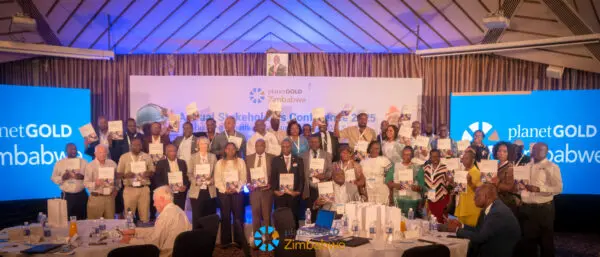
This commitment was highlighted during the Planet Gold Zimbabwe Inaugural Stakeholder Conference in Harare, which brought together government officials, development partners, and artisanal miners from across the country.

The conference focused on strategies to promote mercury-free technologies and strengthen environmental and social standards in the gold sector, providing a platform for collaboration between government, civil society, and the mining community.

Speaking at the event, Canada’s Ambassador to Zimbabwe, Adler Aristilde, said responsible and sustainable natural resource management is key to addressing challenges that span peace, security, and economic growth.

“Responsible and sustainable natural resource management is key to so many issues, from peace and security to economic growth and development. It is vital in ensuring that the benefits of mining reach local communities and that the environment, climate, and human rights are safeguarded,” said Aristilde.

Aristilde further noted that Canada remains deeply committed to advancing global standards in mining through environmental, social, and governance (ESG) frameworks. He explained that these principles underpin Canada’s development partnerships and guide its approach to working with resource-rich nations.

“Aligning mining practices with environmental, social, and governance objectives is a matter of significant interest to Canada. That is why Canada supports IMPACT and initiatives like this one. Planet Gold demonstrates the immense potential of clean technology in the gold mining sector, helping thousands of local miners make their practices more efficient, cleaner, more inclusive, and of course, reducing the use of mercury,” he added.

The ambassador also linked Canada’s support for Planet Gold to the country’s wider international climate finance strategy, through which Ottawa doubled its commitments to US$5.3 billion to help developing countries respond to the impacts of climate change.

The funding supports projects ranging from biodiversity conservation and renewable energy development to climate resilience across Africa.

Beyond environmental interventions, Canada has provided long-term support for initiatives that empower women in artisanal mining and promote traceable, responsible mineral supply chains. Such efforts, Aristilde said, reflect Canada’s broader commitment to ethical sourcing and sustainable resource management.

The ambassador commended the strong presence of artisanal miners at the Harare gathering, describing them as essential partners in Zimbabwe’s journey toward sustainable mining. He said their growing participation in discussions around clean technologies and formalisation reflected a positive shift in the country’s small-scale mining landscape.

He further applauded the ongoing collaboration between Planet Gold Zimbabwe, the Ministry of Mines and Mining Development, and the Ministry of Environment, Climate and Wildlife, noting that their efforts were laying the groundwork for a more responsible and resilient gold sector.

Planet Gold Zimbabwe, launched in 2019, aims to cut mercury use by several tonnes over five years while promoting safer and more profitable methods for small-scale miners. This year, the programme selected 72 sites across the country where mercury-free gold-processing technologies will be tested beginning in 2026.

Gold buying prices in Zimbabwe per gram/ ounce, 29 October 2025

Gold buying prices in Zimbabwe per gram/ ounce, 29 October 2025, from the official gold buyer and exporter Fidelity Gold Refinery (FGR).

1 oz = 31.1035 g

CategoryPrice ($/g)Price ($/oz)
SG 90% and ABOVE119.963,734.56
SG 85% and above but below 90%118.693,695.21
SG 80% and above but below 85%117.423,655.86
SG 75% and above but below 80%116.153,616.51
Sample 5g and above but below 10g114.253,557.12
Fire Assay CASH120.593,752.31


Note: The Fire Assay cash price applies to gold above 100g, with no sample deduction.

A sample of not more than 10g is deducted for the Fire Assay Transfer price.

Mining Windfall Masks Fragile Recovery in Zimbabwe’s Economy

0

The International Monetary Fund (IMF) has projected a strong rebound for Zimbabwe’s economy in 2025, estimating growth of 6.0 per cent and a widening fiscal surplus by 2026. But behind the upbeat numbers lies an uneasy truth: the recovery is being fuelled mainly by short-term gains in mining and agriculture rather than lasting structural reforms, Mining Zimbabwe reports.

By Ryan Chigoche

In its October 2025 Regional Economic Outlook for Sub-Saharan Africa, the IMF presents Zimbabwe as a country on the mend, crediting higher mineral output—especially in gold and platinum—for much of the expected growth.

Analysts, however, describe the improvement as a cyclical bounce rather than a transformation, noting that the country is merely recovering from the drought-induced slowdown of 2024.

The Fund itself acknowledges that growth will likely moderate to 4.6 per cent in 2026, slightly above the Sub-Saharan average, showing the fragile base on which this optimism rests.

Mining remains Zimbabwe’s biggest foreign currency earner and a crucial contributor to exports.

Yet this dependence is also the economy’s greatest vulnerability. Any dip in global commodity prices or production disruptions could quickly unravel the projected rebound.

The recent 6.3 per cent plunge in gold prices, the sharpest since 2019, underscored how sensitive the country’s prospects are to market swings.

Analysts argue that without clear policies that promote investment stability, beneficiation, and transparent governance, mining will continue to provide only intermittent relief rather than sustainable growth.

The IMF expects inflation to fall sharply from 736.1 per cent in 2024 to 89 per cent in 2025, and further to 18.2 per cent the following year.

But even at that reduced level, prices would still rise far faster than the regional average, eroding profits for mining companies facing high local costs.

The Fund also commends Zimbabwe for an anticipated fiscal surplus of 3.1 per cent in 2025 and 4.4 per cent by 2026, but independent economists warn that the surplus is misleading.

It reflects unpaid domestic arrears and delayed payments to suppliers and contractors, including those serving the mining industry.

By postponing these obligations, the government reduces recorded expenditure but simultaneously strangles local business liquidity.

The same doubts extend to debt figures. The IMF predicts that the public debt-to-GDP ratio will decline from 73 per cent in 2024 to 41.6 per cent in 2026.

Yet this statistical improvement, critics note, results more from currency rebasing and inflation effects than from genuine repayment.

Zimbabwe remains in debt distress, burdened by arrears to the World Bank, IMF, and African Development Bank—an obstacle that continues to block access to affordable credit.

Monetary conditions remain equally restrictive. Broad money supply is below 10 per cent of GDP, compared to an average of over 35 per cent across the region.

While this may suggest tight monetary discipline, it instead highlights how little liquidity circulates in local currency.

In a largely dollarised economy, most transactions bypass the formal financial system, leaving miners and other businesses struggling to secure local financing.

The current account surplus cited by the IMF offers some comfort, supported by gold, tobacco, and platinum exports alongside strong diaspora remittances.

However, Zimbabwe’s foreign reserves remain alarmingly low—less than one month of import cover against the recommended three months.

Without that buffer, any drop in global mineral prices or remittance inflows could quickly destabilise the economy again.

Although the IMF’s projections suggest optimism, Zimbabwe’s growth story remains largely a reflection of commodity price movements rather than homegrown reform.

The mining sector is carrying the recovery, but its gains are temporary and vulnerable to global shifts.

True stability will require credible fiscal management, settlement of domestic and foreign arrears, and policies that convert mineral wealth into lasting economic transformation.

For now, the economy’s rebound is not a sign of deep reform, but a familiar cycle—an upswing powered by ore and optimism, with fragility never far beneath the surface.

President Mnangagwa Declares War on Irresponsible Mining

0

President Emmerson Mnangagwa has issued a stern warning to mining companies that disregard environmental laws, pledging that his government will not hesitate to weed out irresponsible operators from the sector, Mining Zimbabwe can report.

By Ryan Chigoche

Delivering his State of the Nation Address (SONA) at the New Parliament Building in Mt Hampden, President Mnangagwa said that while Zimbabwe’s mining sector continues to attract massive investments in gold, lithium, iron, and steel production, environmental protection and community welfare remain non-negotiable.

“My Government is committed to weeding out irresponsible mining stakeholders who cause pollution, degradation of the environment, and damage to critical infrastructure,” said the President.

He emphasised that as the country welcomes both local and foreign investors, it expects them to operate responsibly and in line with Zimbabwe’s laws and traditional values.

“As we welcome investors in our jurisdiction, we expect that they will adhere to the Constitution and laws of our country, while also respecting our people, customs, and culture,” he added.

His call comes barely a month after his Deputy, Dr. Constantino Chiwenga, echoed the same sentiments at the latest edition of Mine Entra, where he emphasised that the country was “Open for Business, not for Extraction,” a stern warning to would-be offenders.

In Zimbabwe, while mining has immensely contributed to the economy through foreign currency earnings, it has also had negative social and environmental impacts on communities where resources are extracted. Recent reports indicate that, to date, more than 10,000 graves have been desecrated as mining activities encroach on burial sites and sacred lands, sparking outrage and calls for stronger protection of cultural heritage.

The President’s remarks come at a time when the government is tightening regulations in the extractive sector through the Mines and Minerals Amendment Bill, which he said has already been gazetted and is expected to be finalised during the current parliamentary session. The Bill seeks to modernise the legal framework governing mining, promote accountability, and ensure communities benefit from mineral wealth.

Mnangagwa also highlighted that the mining industry has seen significant growth, with new processing plants, independent power projects, and energy parks being commissioned to support value addition and beneficiation. These developments, he said, are contributing to job creation and GDP growth.

Mnangagwa’s comments reflect a growing recognition of the need to balance mining expansion with sustainable environmental practices. Zimbabwe has in recent years faced challenges with unregulated artisanal mining, river pollution, and deforestation linked to extractive activities.

By signalling a crackdown on “irresponsible” players, the government appears keen to project a new era of accountability in the mining sector — one that prioritises sustainable development alongside economic growth.

Zimbabwe Leads Africa in Reducing Mercury Use in Gold Processing

0

Zimbabwe is positioning itself as a continental leader in reducing mercury use in gold processing, having made notable progress toward eliminating the toxic substance from small-scale mining operations, Mining Zimbabwe can report.

By Ryan Chigoche

This was revealed by the Ministry of Mines and Mining Development’s Chief Government Mining Engineer (CGME), Michael Munodawafa, during the Planet Gold Zimbabwe Inaugural Annual Stakeholders Conference held in Harare.

Mercury has long been used by artisanal and small-scale gold miners (ASGM) in Zimbabwe to extract gold from ore. However, the practice poses serious health risks to miners and nearby communities while contributing to widespread environmental pollution through soil and water contamination.

Recent studies estimate that Zimbabwe’s artisanal and small-scale gold mining sector uses and releases over 24 tonnes of mercury annually, making it one of the largest sources of mercury pollution in the region. Nearly 96 percent of artisanal gold sites still rely on mercury for gold recovery, with some operations using up to 100 kilograms per month.

Recognizing this challenge, the government, in collaboration with Planet Gold Zimbabwe, launched a five-year project aimed at reducing mercury use by 4.85 tonnes through training, awareness campaigns, and the introduction of mercury-free gold processing technologies.

Speaking at the conference, Eng. Munodawafa highlighted that Zimbabwe is progressing well toward meeting and potentially surpassing its mercury reduction targets.

“We are also trying to eliminate the use of mercury, but I think we are moving in that direction fast. Soon we will be the flagship for Africa and for the world, because I think at our pace we are moving faster than most of the other countries that have been interacting with regard to the reduction in the use of mercury. But I think we can surpass our target—we will confirm the moment we start collecting proper statistics,” Munodawafa said.

Joanne Lebert, the Executive Director at IMPACT, echoed the same sentiments, adding that Zimbabwe’s Planet Gold Project could be used as a model for similar projects to be undertaken globally.

“I’m really very confident that we’ll exceed that target that was set. It’s always better to put the target a little lower and exceed it rather than put it too high and fall short. So, I really think Zimbabwe has the potential to go way beyond what the targets are of the project. I’m sure that together we can achieve and possibly exceed those targets, and that Planet Gold Zimbabwe can be a model for other Planet Golds and other initiatives globally,” she said.

At the same event, Planet Gold Zimbabwe launched its policy report titled “Strengthening the Mines and Minerals Bill: Advancing Reforms for the Benefit of Artisanal and Small-Scale Gold Miners.” One of the points related to the reduction of mercury is the phased formalization of the ASM sector.

Munodawafa emphasized that formalization not only improves environmental management but also strengthens economic accountability.

“The Ministry also recognizes the pivotal role being played by artisanal and small-scale miners in creating employment and improving the livelihoods of our local communities. It is therefore vital for us to continue to move from informality. Most of our artisanal miners have been operating informally, but we are aiming to move them, through the help of Planet Gold, into responsible, inclusive, and sustainable mining,” he said.

The formalization of artisanal and small-scale miners has become a key strategy in these efforts. By helping miners operate legally and responsibly, the government and Planet Gold Zimbabwe can better regulate mercury use, provide access to cleaner technologies, and ensure that gold production is traceable and sustainable.

Funded by the Global Environment Facility (GEF) and led by the United Nations Environment Programme (UNEP), Planet Gold Zimbabwe is implemented by IMPACT in partnership with the Ministry of Mines and Mining Development and the Ministry of Environment, Climate and Wildlife.

Over its five-year period, the programme aims to reach 7,500 artisanal miners across 72 sites, promote safer working conditions, and enhance environmental stewardship across 76,000 hectares of mining areas affected by mercury use.

Death of a River: My Journey into the Heart of Makaha’s Gold Frenzy

0

The map is a lie. It shows the Manyuchi River as a graceful blue vein curling through the belly of Makaha. But the map doesn’t show the pits. It doesn’t show the mountains of discarded rubble. It doesn’t show the Chinese excavators—metallic insects chewing at the riverbed until the earth itself is reshaped.

By Rudairo Mapuranga

I had heard the whispers—of a river vanishing, of a landscape being rewritten by force. So I went to see the corpse for myself. My journey from Mutondo, through Chipangure and Kambanje, was a funeral procession. The air, once carrying the scent of water and wild mint, is now a gritty cocktail of diesel and dust. The soundscape is no longer of birds and breeze, but a relentless, industrial dissonance—the grinding of machinery, the shouts of men, the sickening crunch of earth being torn apart.

I stood on the bank, looking down into the trench that was once a river. A young man, his face and clothes painted the same dull grey as the earth, saw my disbelief. He climbed up to meet me, his boots kicking loose a cascade of pebbles into the abyss below.

“You are looking for the river?” he asked, not unkindly. “It’s gone. To call this a river is to tell a story about a man who is already dead.” He pointed a dusty finger at the chaotic scene. “This? This is just a mine now. The water comes only with the angry rains, and when it does, it struggles to find its path. But for now, this dust is what feeds our children.”

His name was Tafara, and for the last eight months, he has worked here, in the belly of the dead river. He is one of hundreds—a chaotic mix of local artisanal miners and organized Chinese operations—who have descended upon Manyuchi in a frantic rush for lithium and gold.

“When the Chinese machines came, everything changed,” he explained, his voice dropping. “Before, we would dig with shovels. It was hard, but the river could recover. Now, these machines work day and night. They go deeper than any man can. They change the very bones of the land. They are not just digging in the river; they are digging out its soul.”

I followed him down into the trench. The scale of destruction was breathtaking. It wasn’t just mining; it was systematic erasure. The riverbed was carved into a labyrinth of deep pits and precarious ledges. Most strikingly, I saw it with my own eyes: Chinese-operated excavators were systematically dumping loads of waste rock and rubble directly back into the river channel. They were not just taking from the river; they were using its ancient course as a landfill for their spoil, burying the riverbed under metres of sterile rock.

The community’s mood is a complex, bitter brew. I spoke to an elderly woman, Mai Tsitsi, who remembers the river of her youth. “We used to fetch water here. Children played here. Now, look,” she said, her eyes filled with a deep, weary sadness as she gestured towards the monstrous piles of rubble. “They are filling it with stones. They are burying it. When the rains come, where will the water go? It will flood. It will destroy what is left. These miners, they bring money for some, but they leave us with a grave where our river used to be.”

The environmental crime here is one of physical suffocation. By dumping vast quantities of mining waste directly into the river, the operations are fundamentally altering its hydrology. The river’s natural channel and flow are being obliterated. When the rains do come, the water will not flow; it will pool unpredictably, flood surrounding areas, and struggle to navigate the man-made obstacles, causing erosion and further devastation downstream towards the Manyuchi Dam.

The most haunting words came from a site supervisor for a Chinese operation, who spoke to me on condition of anonymity. Through a translator, he told me, “We are here because the minerals are here. The land is rich. We must move the earth to get to it. Where else should we put the waste rock but in the empty space? The river is dry now. It is a practical solution.”

It is a practical solution. That single sentence, delivered with chilling pragmatism, encapsulates the entire tragedy. The Manyuchi River is not a lifeblood to be preserved; it is a convenient dumping ground. Its future is not a consideration; it is an obstacle to be overcome.

As I left Makaha, the dust coated my skin and the back of my throat. I carried the taste of the dying river with me. The map may still show a blue line, but on the ground, there is only a scar being filled with rubble. The frantic mining continues—a race for riches in a graveyard of their own making. When the rains finally come, they will not bring renewal, but chaos—the confused, angry backlash of a natural order that has been ruthlessly dismantled, stone by stone.

Gold buying prices in Zimbabwe per gram/ ounce, 28 October 2025

Gold buying prices in Zimbabwe per gram/ ounce, 28 October 2025, from the official gold buyer and exporter Fidelity Gold Refinery (FGR).

1 oz = 31.1035 g

CategoryPrice ($/g)Price ($/oz)
SG 90% and ABOVE120.643,753.47
SG 85% and above but below 90%119.363,713.00
SG 80% and above but below 85%118.083,672.51
SG 75% and above but below 80%116.813,632.05
Sample 5g and above but below 10g114.893,572.32
Fire Assay CASH121.283,771.47


NB: Fire Assay cash price is for gold above 100g, no sample is deducted.

A sample of not more than 10g is deducted for the Fire Assay Transfer price.

Gold buying prices in Zimbabwe per gram/ ounce, 27 October 2025

Gold buying prices in Zimbabwe per gram/ ounce, 27 October 2025, from the official gold buyer and exporter Fidelity Gold Refinery (FGR).

1 oz = 31.1035 g

CategoryPrice ($/g)Price ($/oz)
SG 90% and ABOVE124.703,878.61
SG 85% and above but below 90%123.383,837.97
SG 80% and above but below 85%122.063,797.32
SG 75% and above but below 80%120.743,756.68
Sample 5g and above but below 10g118.763,694.91
Fire Assay CASH125.363,899.18


NB: Fire Assay cash price is for gold above 100g, no sample is deducted.

A sample of not more than 10g is deducted for the Fire Assay Transfer price.

Convicted Chinese Miner Accused of Fresh Fraud Scheme to “Steal” Gold Ore Dump, Ministry and Court Papers Reveal

0

Fresh evidence from the Ministry of Mines, police dockets, and High Court applications reveals that the Chinese investor recently convicted of a massive gold ore theft is now at the centre of a sophisticated new alleged fraud scheme designed to illegally seize the very same ore dump he was ordered to return to the victim, Mining Zimbabwe can report.

By Rudairo Mapuranga

This follow-up investigation, building on Mining Zimbabwe’s landmark exposé of the Reajin Mines theft case, uncovers a multi-layered campaign involving a new entity—the Zhangveng Syndicate—which the Ministry of Mines has confirmed to police is not the owner of the disputed dump and is under investigation for falsifying survey documents.

The new scheme alleges that Zheng Zhangxian, the convicted owner of Reajin Enterprises, has ganged up with new local partners to continue his fight against miner Emmanuel Ndemera through the courts, using what the Ministry has declared an illegal corporate vehicle and allegedly falsified paperwork, in a brazen attempt to circumvent his recent conviction and a US$875,667.67 restitution order.

The New Syndicate: A “Corporate Veil” for a Convicted Entity?

Just days after the Mutoko Regional Magistrates Court delivered its verdict against Reajin Mine on 8 September 2025, a new entity, the Zhangveng Syndicate, was formalised on 8 September 2025. Its directors are Vengai Kurarama (a Zimbabwean) and Zheng Zhangxian, the same Chinese national convicted for the theft of over 5,000 tonnes of ore from Ndemera’s claim.

According to a source close to the investigation, “The syndicate was created in order to take the dump. The day they were given a verdict by the Magistrates is when they created the syndicate.”

Critically, a Ministry of Mines investigation has found that this very structure is illegal. The Ministry has pointed out that the law requires foreign nationals to be cleared by the Zimbabwe Investment Development Agency (ZIDA) and to form proper companies, not informal syndicates, with locals. Zhangveng, as a syndicate between a foreigner and a local, contravenes this provision.

“Zhangveng Syndicate contravenes a section that a Zimbabwean and a foreigner cannot be a syndicate; it was supposed to be a registered company, not a syndicate,” a legal expert familiar with the case noted.

This raises immediate questions about the legitimacy of the entity now pursuing the dump. “It appears that Reajin and Zhangveng are the same because Zheng Zhangxian is a director of both,” the source added, highlighting a potential “corporate veil” being used to continue operations.

The Core of the New Fraud: Falsified Coordinates and a Ministry Sting

The dispute over the dump’s location has now escalated into a criminal investigation.

A crucial letter from the Ministry of Mines and Mining Development, dated 6 October 2025, resulted from a fact-finding mission to the Zhangveng site. The mission, which included Ministry surveyors, used a hand-held GPS to pinpoint the exact location of the contested dump.

The Ministry’s finding was unequivocal: the dump lies approximately 1.6 km away from the nearest corner beacon of Zhangveng’s registered block of claims.

This finding is the foundation for serious criminal charges now being investigated by the police. A case was reported at Mutoko Police Station under case number CR 68 09 of 25.

The charges laid include:

  1. Contravening Section 376 of the Mines and Minerals Act: “Position of beacons and pegs may not be altered.” The Ministry’s letter explicitly states that “Zhangveng Mining Syndicate altered their position of beacons.”

  2. Contravening Section 383 (False Declaration): Zhangveng is accused of “declaring survey grade coordinates falsely” and “lying that their block is 20 hectares from 10 hectares registered.”

In simple terms, the syndicate is accused of moving its boundary beacons on paper to fraudulently claim the dump was on its property and lying about the size of its claim to the authorities.

A Ministry of Mines letter, confirmed to have been sent to the police, explicitly states that the dump was being stolen from Ndemera’s mine and that Zhangveng is not its owner, directly contradicting the syndicate’s claims.

The High Court Gambit and Allegations of Perjury

Undeterred by the police investigation, Zhangveng Syndicate took the fight to the High Court. They filed an urgent chamber application against Ndemera under case number HC 4522 of 2025, seeking to stop him from interfering with the dump.

A source alleges this application was built on falsified documents. “It means they should be investigated for perjury, for giving a High Court judge false papers,” the source stated.

The application also allegedly contained another falsehood. “It is alleged that they lied through the papers that Ndemera doesn’t have an EIA (Environmental Impact Assessment). It was discovered that the EIA is there; EMA discovered everything.” This suggests a pattern of submitting misleading information to the courts.

A Pattern of Behaviour and Political Smears

The notes from the complainant paint a picture of a relentless campaign. “The Chinese is ganging up with local people to steal, he ganged with Takura, now ganging up with this one. All he wants is to steal,” the source said, characterising the repeated partnerships as a method for illegal acquisition.

The notes also reveal frustration with the legal process, alleging that “the lawyer to the accused is protecting the accused from arrest.”

This new chapter in the long-running saga presents a critical test for Zimbabwe’s mining governance. It questions whether a convicted entity can simply create a new, legally dubious vehicle to continue its fight for disputed assets through what authorities have evidence to suggest is fraud.

The case now sits at a complex intersection:

  1. An active police investigation for falsifying coordinates and documents.
  2. A parallel High Court case allegedly built on those same falsified documents, raising questions of perjury.
  3. A Ministry of Mines that has consistently provided technical evidence supporting the original victim, Ndemera.

Zimbabwe’s Mining Sector Mourns Senior Director Tariro Ndhlovu

0

The Mining community is in mourning following the passing of Mr Tariro Ndhlovu, the Ministry of Mines and Mining Development‘s Provincial Mining Director (PMD) for Matabeleland South, who passed away this morning at his rural home in Mazhou Zvishavane, Mining Zimbabwe can report.

By Rudairo Mapuranga

An official from the Ministry confirmed the sad news, revealing that Mr Ndhlovu had been on long sick leave. Although an official cause of death has not been released, it is believed he succumbed to a battle with cancer.

Mr Ndhlovu was a seasoned and experienced administrator within the mining sector. His career was marked by significant postings across the country, having previously served as the Provincial Mining Director for both Mashonaland Central and Midlands provinces. He was subsequently transferred to lead the Matabeleland South Mining Province, a role he held until his passing. This trajectory underscores his versatility and the trust placed in him to manage diverse and critical mining regions.

The internal announcement from the Ministry expressed “profound sadness” and extended its deepest condolences to his family, friends, and colleagues, concluding with, “May his soul rest in eternal peace.”

In his capacity as Provincial Mining Director for Matabeleland South, a region abundant in mineral resources, Mr Ndhlovu was a central figure in the oversight and regulation of the mining industry. His passing represents a substantial loss to the nation’s mining fraternity and public service.

Funeral arrangements for the late director are still being finalised and will be communicated to the public in due course. He is mourned by a wide circle of colleagues, friends, and communities from Gokwe to the various provinces he served throughout his distinguished career.