South Africa’s National Union of Mineworkers (NUM) on Wednesday said that wage negotiations with Kumba Iron Ore, owned by Anglo American, were deadlocked and the union had declared a dispute, a move that is one step short of a strike.
NUM, the majority union at Kumba, said the company had agreed on a wage increase of 8% for the lowest-paid workers and 6.5% for the highest-paid, but the two parties had disagreed over sick leave.
“The company policy on sick leave provides workers with 120 days. To our dismay, in a round of negotiations, the company wants to do away with the benefit,” the NUM said in a statement.
The union’s declaration of a dispute means that a protected strike could go ahead if conciliation talks between the parties mediated by the Commission for Conciliation, Mediation, and Arbitration fail to break the impasse.
Kumba, which has mining operations in the Northern Cape province and port operation in Saldanha Bay, said it was continuing negotiations with NUM.
“We trust that we will be able to reach an amicable solution soon, which will be in the best interest of both the employees and the company,” Kumba Iron Ore said in an emailed statement.
Negotiations with the two other unions, the Association of Mineworkers and Construction Union (AMCU) and Solidarity, which are represented at Kumba’s operations, have been concluded_Mining.com
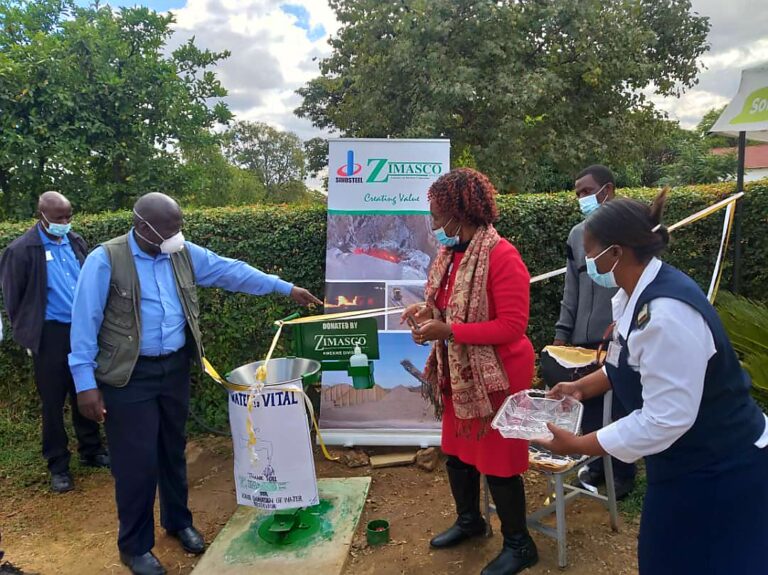
Zimbabwe’s biggest ferrochrome producer, Zimasco has thrown a lifeline to struggling Kwekwe General Hospital after it donated an assortment of medical equipment today.
The US$110 000 donation is going towards overhauling a maternity ward adopted by the ferrochrome producer.
Speaking at the handover ceremony Minister of State for Midlands Provincial Affairs Senator Larry Mavima hailed Zimasco for capacitating the district’s referral hospital which caters for over 300 000 people. Mavima said the ferrochrome producer was complimenting the government’s effort in this COVID19 pandemic era.
“Government remains resolute towards COVID19 mitigation and control and has adopted an inclusive approach in this fight. “In this regard allow me to express my sincere gratitude to corporates, Zimasco in particular, for their sterling efforts towards improving our health delivery system.
“The equipment donated here will go a long way towards addressing capacity issues at Kwekwe General Hospital,” he said.
The hospital has been facing critical shortages of equipment and the donation by Zimasco comes in handy as it includes electrocardiography (ECG) machines, defibrillators (devices used to restore normal heartbeat if the heart suddenly stops), beds, medicine trollies, computers, solar heaters, air conditioners, and television sets amongst others. Senator Mavima said the equipment will guarantee provision of quality health services at the facility which also caters for patients from as far as Mashonaland West province.
Senator Mavima called on other corporates to emulate what Zimasco has done by capacitating the hospital which is facing an acute shortage of service vehicles_Midlands Observer.
The Zimbabwe dollar slid 0.58 percent against the greenback to $83.40 at Tuesday’s weekly auction, the central bank has said.
This is the 10th consecutive week the local dollar has depreciated against the United States dollar since it was floated late June.
But in the past two weeks, the rate of depreciation has massively slowed down as the local unit finds it true value.
Last week it traded at $82.92.
At Tuesday’s auction the highest rate on offer was $88 while the lowest accepted rate was $75.
At least US$15 million was allocated for bidders at both the main and the small to medium enterprises auction where a combined total of 224 bids were received out of which 43 were disqualified for various reasons.
“Bids, which were not eligible in terms of the priority list were disqualified,” the central bank said.
“Bids with overdue CD1s, outstanding Bills of Entry, and those with sufficient foreign currency account balances were also disqualified.”
Raw materials, machinery, and equipment, consumables, pharmaceuticals, and chemicals, services such as loans and dividends, fuel, electricity, and gas are major items on the priority list that got the bulk of the funds.
New Ziana
ZIMBABWE’S second-largest diamond miner, RioZim Limited, sees demand picking up after the coronavirus pandemic forced the business to halt sales in March amid the slump in gem prices.
With jewelry stores closed, cutters and polishers stuck at home and global travel at a standstill, the diamond industry ground to a halt over the past six months. While De Beers, the number one producer, decided to cut the price of its diamonds this week in a bid to spark sales, RioZim said consumer demand for polished stones is already recovering.
“It has in fact picked up with a vengeance in some parts of the world,” Wilson Gwatiringa, a spokesman for RioZim, said by email. “As a result, we expect an imminent bounce back in the demand for rough diamonds.”
With the gem market in crisis, RioZim shareholders have kept the company going through bridge financing, while production from its Murowa Diamonds unit has been stockpiled, according to Gwatiringa. Growth projects have also been put on hold, though RioZim is now contemplating at two-phase expansion that will more than double diamond output, he said.
A first phase, costing $52 million, would extend the life of the Murowa mine — 348 kilometers (217 miles) southeast of the capital, Harare – by four years from the current 14 months, Gwatiringa said. A second $400 million phase, currently being planned, would see the construction of Zimbabwe’s largest underground diamond mine.
That would increase production to 2.5 million carats, 10 times the amount produced when the mine was owned by Rio Tinto Group. The life of the operation would also be extended by at least another 10 years, Gwatiringa said.
Mining is a key foreign exchange earner for Zimbabwe, which is struggling with food and fuel shortages, soaring inflation, and a weak currency. RioZim stopped production at its gold mines in June, saying it can no longer meet costs because of the government’s foreign-exchange policy.
Zimbabwe Environmental Law Association (ZELA) is taking a massive step in ensuring that former machete-gangs are rehabilitated into the mining sector in order to reduce violence.
According to ZELA Deputy Director Shamiso Mtisi, the organization is testing a machete gang rehabilitation model on which they would use to the rest of the country in ensuring that the sector is violent free.
“Rehabilitation of former machete and gold gang members to become responsible gold miners and diggers is a replicable model across the country. In Shurugwi this approach is being tested” Mtisi said.
Mtisi said that due to the effects of the Covid-19 pandemic which closed many avenues of money generation, many people have ventured into the artisanal and small-scale mining sector. Artisanal and Small-Scale gold mining now sustains many communities in the country than before the pandemic. This has promoted fear that violence in the sector would return leading ZELA to establish a rehabilitation program.
“There has been a massive upsurge of people moving into artisanal and small-scale gold mining as Covid-19 Lockdowns impact negatively on other economic sectors,” he said.
The ZELA Deputy Director also said that his organization in light of government inaction on formalizing artisanal miners has created a model of formalizing these miners through tributary engagements.
“In light of Government inaction on the formalisation of artisanal mining, modelling profit-sharing schemes for licenced miners and artisanal diggers using tributary agreements with fair terms is a good option as being tested by some ASM groups in Shurugwi,” Mtisi said.
The gold price has risen by 34% since the start of the year, and early this month broke through the $2,000 an ounce barrier and kept rising, as investors worry about Covid-19. This has made the gold mining sector a sort after sector due to its high returns.
A Bulawayo miner lost US$23 000 to three unidentified bogus anti-corruption commission officers early this month.
According to the Zimbabwe Republic Police (ZRP) official Twitter handle, the victim was duped by the three unknown men who presented themselves to him as officers from the Zimbabwe Anti-Corruption Commission (ZACC).
The victim allegedly allowed the three unidentified men to search in his house without a search warrant leading them to find a gold detector and the cash.
The man allegedly took the bag of cash and promised the man that they would return it after a few hours.
“A Bulawayo man lost US$23 000-00 on 4 August 2020, to three unknown male suspects impersonating anti-corruption commission officers. The three men searched the victim’s house and found a gold detector and cash. The suspects demanded a licence which he failed to produce. The trio took a bag with the cash and promised to return it after a few hours. Complainant reported to Police on 21/08/20 #notocrime.” said the Police.
Recently two Harare police officers were arrested for extorting Zvishavane gold miner Richard Dindani of Phiri Gold Mining Syndicate who was in possession of fine gold worth US$22,000, making off with US$15 620 and leaving him holding US$6 480.
The police officers are said to have demanded a bribe from Dindani after arresting him at Avondale Shopping Centre for alleged illegal possession of gold on August 17.
1/2 A Bulawayo man lost US$23 000-00 on 4 August 2020, to three unknown male suspects impersonating anti-corruption commission officers. The three men searched the victim’s house and found a gold detector and cash. The suspects demanded for a licence which he failed to produce.
— Zimbabwe Republic Police (@PoliceZimbabwe) August 25, 2020
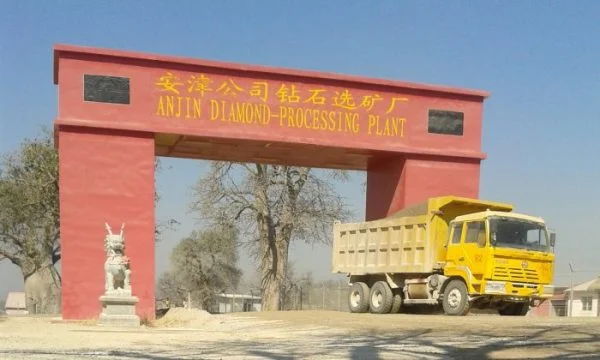
Chinese diamond mining company, Anjin is yet to compensate nearly 500 families that it displaced from their traditional homes to Arda Transau.
According to Arda Transau residents, the outstanding Bill and Liabilities for Anjin diamond mining company to settle for households relocated from Marange includes compensation for 476 families, title deeds for houses, irrigation, Pastures and electrification of houses.
The firm which operated in the area from 2009 – 2016 before its license was revoked by the Mugabe regime leading to the formation of the Zimbabwe Consolidation Diamond Company (ZCDC) has been accused of looting the country’s diamonds with the state getting very little in return.
Its return during the second republic era sparked a lot of controversies with villagers calling the government to halt the company’s mining operations claiming that the company has a dark past including human rights abuses.
According to the villagers, Anjin mining operations destroyed the community infrastructure such as roads, bridges, schools, degraded farming land, sacred areas and contaminated sources of (drinking) water.
The villagers claimed that over 4 000 cattle were lost after falling into mining pits, gullies and slime dams, around 450 families were relocated to Arda Transau without secured livelihoods and compensation for their losses.
The relocated families also called upon the government to immediately halt new mining developments in Marange and move with speed to implement some reforms such as undertaking a human rights due diligence process for the people of Marange to claim compensation for adverse impacts caused by Anjin Diamond mining.
The results of Trevali Mining’s prefeasibility study on an expansion of the Rosh Pinah zinc-lead-silver underground mine in Namibia, to 1.3 million tonnes per year from 700,000 tonnes per year, suggest potential for increased production at lower operating costs starting in 2023.
The proposed 11-year mine would produce an average of 132 million lb. of payable zinc, 21.8 million lb. of payable lead and 286,000 oz. of payable silver each year, at all-in sustaining costs of $64¢ per zinc lb. With a project capital cost estimated at $93 million, the net present value estimate for the development is $142 million, at an 8% discount rate and based on $1.11 per lb. zinc, $93¢ per lb. lead and $19.81 per oz. silver. The internal rate of return stands at 65%.
“Over Rosh Pinah’s 50-year operating life, the mine has processed close to 30 million tonnes and today we have 16 million tonnes in resource, inclusive of reserves, with several advanced exploration targets ready to drill,” Ricus Grimbeek, the company’s president and CEO, said in a release.
LAST YEAR, ROSH PINAH GENERATED 92 MILLION LB. OF PAYABLE ZINC, 12.1 MILLION LB. OF PAYABLE LEAD AND APPROXIMATELY 200,000 OZ. OF PAYABLE SILVER
“To match this exceptional orebody, the RP2.0 PFS recommends an 86% expansion to the existing production capacity by sizing the infrastructure to a nominal throughput of 1.3 million tonnes per annum.”
Grimbeek added that the resulting all-in sustaining cost of $64¢ per zinc lb. positions Rosh Pinah in the bottom half of the industry’s cost curve.
The study suggests upgrades to the comminution and processing circuits, as well as an additional portal and decline to the WF3 deposit, alongside a new paste fill plant and additional mobile equipment to increase throughputs and lower operating costs.
Grimbeek also suggested that the underground infrastructure and paste plant additions, as well as processing upgrades would “allow us to modernize the mine and produce more metal faster and at a significantly lower operating cost, all while working more safely and reducing our environmental footprint.”
Trevali now plans to complete additional optimization work ahead of a feasibility study, which would start in the first quarter of next year. Optimization opportunities include determining the best underground infrastructure placement, work to improve lead recoveries though additional flotation studies and upgrading inferred resources for scheduling optimization.
Any future construction would start in the first quarter of 2022 ahead of commercial production from the expanded operation by the first half of 2023.
As a result of the prefeasibility, Trevali has updated the reserve and resource statements for Rosh Pinah – reserves now total 11.2 million tonnes, at 6.26% zinc, 1.33% lead and 19 g/t silver, based on a $104 per tonne net smelter return cut-off.
The 90%-owned Rosh Pinah mine has been operating since 1969 and produces zinc and lead sulphide concentrates, which also contain copper, silver and gold, shipped to spot markets off of the Namibian coast.
Last year, Rosh Pinah generated 92 million lb. of payable zinc, 12.1 million lb. of payable lead and approximately 200,000 oz. of payable silver.
The Botswana government said there was no guarantee that it would be able to renew a new 10-year sales agreement with De Beers before the end of December, when the current one expires, as the coronavirus pandemic has delayed negotiations.
“The ideal situation would be to end the talks by December but there are no guarantees that will happen,” said Mmetla Masire, Permanent Secretary in the Ministry of Minerals told Reuters in an interview late on Monday.
The deal is necessary for the Debswana Mining Company, jointly held by the world’s biggest producer De Beers and the Botswana government, as it provides the country with around two-thirds of its foreign exchange and makes up a fifth of its GDP.
IN 2011, DE BEERS AGREED A DEAL TO TRANSFER ITS GLOBAL SIGHTHOLDER SALES, WHICH ACCOUNTS FOR 90% OF ITS TOTAL DIAMOND SALES, FROM LONDON TO GABORONE
For De Beers, a new deal would mean another 10 years of clarity on the terms of its revenue stream from a country from where it sources 70% of its diamonds and 90% of its sales.
The wealth from diamond mining has helped transform the country from primarily a agri-based economy to one of Africa’s richest countries.
A delay would set back President Mokgweetsi Masisi’s efforts to boost a fledgling diamond polishing and cutting industry and create jobs in a country of 2.2 million with high unemployment.
Masire said the government had resumed talks for a new deal, but travel restrictions have kept the progress slow.
In 2011, De Beers agreed a deal to transfer its global sightholder sales, which accounts for 90% of its total diamond sales, from London to Gaborone, creating thousands of jobs and investment in the southern African country.
Botswana’s government would want a higher allocation of diamonds produced by Debswana for sale from the current 15% agreed in 2011, or get a larger share of rough stones, said Avi Krawitz, an analyst from Israel-based diamond information provider Rapaport.
“This will be a sticking point for De Beers,” he said.
Masire declined to divulge specific terms being negotiated in the talks.
De Beers, a subsidiary of Anglo American Plc, is an important business division for its parent contributing a fifth of its revenue.
De Beers has not responded to an emailed request for comment sent on Monday_Mining.com
Zambia’s state-owned mining investment company (ZCCM-IH) is seeking a controlling stake in Glencore subsidiary Mopani Copper Mines, Mines minister Richard Musukwa said on Tuesday.
Mopani, which produced 119,000 tonnes of copper in 2018, is 73.1% owned by Glencore, 16.9% by First Quantum Minerals and 10% by ZCCM-IH.
A 10% stake was “not sufficient” to determine Mopani’s future, Musukwa said in a statement, and ZCCM-IH was therefore seeking a larger stake “with a view to holding a controlling stake in Mopani”.
The mines minister told Reuters ZCCM-IH was seeking a 51% shareholding “or even more”.
Asked about ZCCM-IH seeking a controlling stake in Mopani, a Glencore spokesman declined to comment.
ON JULY 16, THE COMPANY SAID IT WOULD APPEAL THE MINES MINISTRY’S DECISION TO REJECT ITS PROPOSAL TO SUSPEND THE OPERATIONS
“Glencore can confirm that it is in discussions with existing Mopani shareholder ZCCM-IH and other shareholders regarding the potential acquisition of additional shares by ZCCM-IH from Glencore,” the company said.
“The discussions are progressing and further updates will be issued as appropriate.”
A majority stake would require Glencore selling more than 41% of the company to ZCCM-IH.
In April, Zambia’s government threatened to revoke Mopani’s mining licenses and temporarily blocked Mopani’s chief executive officer Nathan Bullock from leaving the country saying the company did not give enough notice before suspending its mining operations during the coronavirus crisis.
In May, Mopani said it would resume mining operations for 90 days but still expected to go into care and maintenance.
On July 16, the company said it would appeal the mines ministry’s decision to reject its proposal to suspend the operations and that would continue activities pending the outcome of the appeal process_Mining.com
To provide the best experiences, we use technologies like cookies to store and/or access device information. Consenting to these technologies will allow us to process data such as browsing behavior or unique IDs on this site. Not consenting or withdrawing consent, may adversely affect certain features and functions.
Functional
Always active
The technical storage or access is strictly necessary for the legitimate purpose of enabling the use of a specific service explicitly requested by the subscriber or user, or for the sole purpose of carrying out the transmission of a communication over an electronic communications network.
Preferences
The technical storage or access is necessary for the legitimate purpose of storing preferences that are not requested by the subscriber or user.
Statistics
The technical storage or access that is used exclusively for statistical purposes.The technical storage or access that is used exclusively for anonymous statistical purposes. Without a subpoena, voluntary compliance on the part of your Internet Service Provider, or additional records from a third party, information stored or retrieved for this purpose alone cannot usually be used to identify you.
Marketing
The technical storage or access is required to create user profiles to send advertising, or to track the user on a website or across several websites for similar marketing purposes.