Home Blog Page 526

Machete gang raids mine, shoot Bulawayo guard dead

0

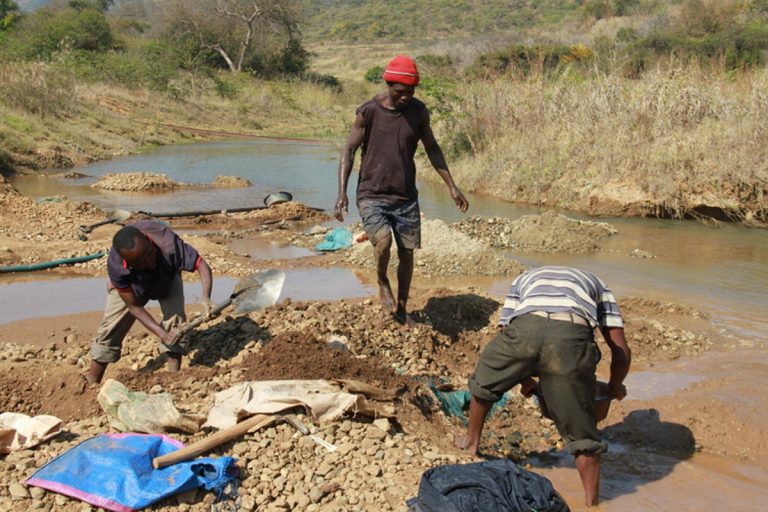
A 54-year-old Bulawayo security guard was killed while his colleague was left nursing a serious head injury after eight gold panners set upon them with machetes.

The assailants got away with a loaded 303 rifle.

Mr. Ernest Dube died on duty at Adar Bali Mining Compound along Victoria Falls Road on Thursday and his colleague Mr. Ashley Manyemba (20) who reported his death is in a critical condition at Mpilo Central Hospital.

Police in Bulawayo has arrested four of the suspects who will appear in court today facing murder and attempted murder charges.

The four are Tobias Dube from Nkayi, Nkosilathi Ncube from Magwegwe, Loud Ngulube and Givemore Ngwenya from Insuza.

Dube was the first to be arrested after a tip-off and upon investigations, he implicated the other three.

On Thursday around 9.30 PM, Mr. Manyemba who was on duty with the deceased left the premises unarmed intending to have his supper.

On his way back he met a group of at least eight men who were armed with machetes.

The gang pounced on him and one of them struck him with a machete and left him for dead.

Mr. Manyemba gained consciousness after a while and staggered to his colleague whom he found lifeless in a pool of blood.

He also noted that Dube’s rifle, shoes and uniform were missing and a report was made to the police.

Investigations led police to the four and they recovered the rifle which had four rounds of ammunition missing and they are yet to establish where these were used.

The police national spokesperson Assistant Commissioner Paul Nyathi confirmed the incident yesterday and said investigations are underway. “We have arrested four men in connection with the murder of a security guard in Bulawayo and the attempted murder of his colleague which occurred on Thursday. The four were arrested on Friday after a tip-off and police are still investigating as they were found in possession of a rifle,” said Asst Comm Nyathi.

“We appeal to members of the public with information that may lead us to more suspects to contact their nearest police station.”_Chronicle

MMCZ to widen gemstone market

0

Minerals Marketing Corporation of Zimbabwe (MMCZ) is looking to broaden the Zimbabwean Gemstone market by creating both a virtual and a physical market where gemstone buyers and sellers would meet for transactions under its supervision.

By Rudairo Mapuranga

Speaking to Mining Zimbabwe, MMCZ General Manager Mr. Tongai Muzenda said his organization was looking forward to market gemstones from Zimbabwe on an international market.

“The gemstone market in Zimbabwe is relatively small but we are looking regionally and yonder,” he said.

The MMCZ boss said that it was of importance for his organization to assist gemstone producers in finding a good market for their produce so that the sector would grow.

“It is our belief that by assisting the producer in the buying and selling of their products, markets ill be developed,” Muzenda said.

Muzenda said that MMCZ Public Relations and Marketing departments were working towards creating a virtual market for all gemstones in from Zimbabwe.

“As a matter of fact, the PR and Marketing functions are working on the internet-based selling,” the MMCZ boss said.

MMCZ recently announced that was going to appoint mineral agents for semi-precious stones to empower small-scale miners to extract and trade in the gemstones while also boosting the mining sector’s contribution to the fiscus.

Over the years, it has been observed that the country was losing millions of dollars in potential revenue through well-orchestrated international trafficking syndicates smuggling the semi-precious stones to neighbouring countries like Mozambique and Zambia.

Moreso, it is expected that the decision to liberalise the trading of the minerals would add impulsion in curbing corruption while bringing transparency in the gemstones market.

Already, the Zimbabwe Miners Federation, the mother body of small-scale miners in the country has agreed on joint efforts with MMCZ to roll out an outreach program to curtail rampant leakages of the semi-precious minerals.

The country is endowed with vast deposits of gemstones with a value estimated at US$20 billion.

Two Hwange women shot, injured by Police

0

Two local women who were allegedly shot by police in the coal mining town are battling for their lives in hospital with one of them transferred to a private facility in Bulawayo due to the seriousness of her injuries.

According to sources, some police officers allegedly fired shots at a crowd that was reportedly stealing coke at a Hwange Colliery dumpsite on Saturday, resulting in the two women being shot.

Zulani Mudenda (46) was shot on the abdomen, leaving her intestines protruding and was Monday transferred to Mater Dei Hospital in Bulawayo for specialist care while Twabona Nyoni (25) who was shot on the chest is admitted at St Patricks’ Hospital in Hwange.

The women were reportedly at their homes in Madumabisa when the bullets hit them Saturday evening.

Police national spokesperson Assistant Commissioner Paul Nyathi confirmed the shooting and said investigations were in progress.

He said the unnamed police officers involved in the shooting had a scuffle with a truck driver at the dumpsite. The scuffle triggered the shooting.

“The Zimbabwe Republic Police assures the public that investigations are being conducted in connection with the unfortunate shooting incident which occurred in Hwange on the 22nd of August. The incident resulted in the injury of Zulani Mudenda (46), and Twabona Nyoni (25) after police had reacted to a report of theft at Hwange Colliery Main plant,” Nyathi said.

“Police will conduct comprehensive investigations with a view to establish what actually transpired between the truck driver Mcdonald Mpongweni and the police officer leading to the sad scuffle.”

He said the police have since impounded the truck as investigations continue.

Hwange residents who witnessed the unfortunate incident said police had rounded up a group of residents who were picking coke from the dumpsite near Madumabisa on Saturday around 6 pm when they allegedly fired shots.

Mudenda who was at her place of residence where she had just finished bathing at a public toilet, was shot by a stray bullet on the stomach, ripping it open while Nyathi, who is her neighbour, was hit on the chest.

Both were rushed to St Patricks’ Hospital as they bled profusely before Mudenda was transferred to Bulawayo.

The shooting incident comes a few days after the Hwange Local Board, indicated it was engaging security forces in an effort to help evict “illegal” brick moulders causing havoc in the coal mining town where they are haphazardly digging clay soil to make bricks.

The brick moulders mix clay soil with coal dust which they steal from Hwange Colliery mine sites.

Coke is also on-demand in Hwange where it is sold for between US$3 and US$5 per 50kg bag.

The local board said it had failed to disperse the illegal brick moulders as they resisted eviction by council security_New Zimbabwe

Gold payment delays blamed for fuelling black market’

0

Small scale and artisanal miners have bemoaned delays by Fidelity Printers in processing their payments for gold deliveries, which have forced some of the miners to sell their gold on the black market where there is ready cash.

The miners said the processing of payment was taking up to a month after they deliver their gold to Fidelity. Speaking at a meeting, which was attended by Finance and Economic Development Minister, Professor Mthuli Ncube in Gweru last week, the miners urged him to look into the matter.

One of the miners, Mr. Simbarashe Mutukwa, said the delays were affecting production at their mines, thereby depriving the Government of much-needed foreign currency.

“Minister Ncube, we are concerned with the delays in the payment of gold delivered to Fidelity,” he said. “We have been forced to wait for close to two weeks for payment after delivering our gold to Fidelity. This is slowing down production at our mining sites.

“May you please assist us so that we get our payment instantaneously. This also helps in plugging the gold leakages.”

Another miner, Mr. Gerald Gonde, said corruption was now rife at mines with mine owners bribing officials to be allowed to sell gold on the black market.

“It is not by choice that some are now bribing even the Fidelity officials so that they are allowed to take part of their gold into the black market, it is because there are delays in payments by Fidelity and we are not sure where the problem is,” he said.

Minister Ncube said the Government will look into the matter and ensure that Fidelity made the payment for the gold delivered, to plug leakages.

“We have heard the concerns from gold miners that there have been delays in the payment of gold delivered to Fidelity,” he said.

“We are going to expedite the payment of miners who deliver their gold to Fidelity.”

Mining laws must promote transparency and accountability TIZ

0

The poor performance of the mining sector in Zimbabwe has been attributed to the archaic Mines and Minerals Act, which currently does not address issues of revenue management, transparency, and accountability in the sector.

This was disclosed by the Transparency International Zimbabwe in their recent paper titled US$12 billion Mining Economy by 2023: The Key Enablers.

They also attribute a lack of political will as one of the reasons behind the lack of transparency and accountability in the mining sector.

“The poor performance of the sector has been attributed to the archaic Mines and Minerals Act of 1961 which has failed to address issues of transparency and accountability, revenue management and environmental and community engagement,” the TIZ paper said.

“Despite political pronouncements captured in 2019 and reiterated in the 2020 national budget, Zimbabwe has been hesitant to join the Extractive Industries Transparency Initiative (EITI). Further, a domestic version of EITI called the Zimbabwe Mining Revenue Transparency Initiative (ZMITI) which was launched in 2011 with the aim of promoting the disclosure of mineral revenues and payments was shortlived due to lack of political will,” they said.

The TIZ said a US$12 billion economy by 2023 from the mining industry represents a 344% increase from US$2, 7 billion registered in 2017.

They said the current challenges in the Mines and Minerals Act include that the law in its current form considers artisanal and small scale miners (ASM) as informal and criminals.

“The lack of proper definition of this form of mining has resulted in policy inconsistencies over the recognition of ASM leading to its growing informalisation.  Moreover, the mining sector is characterised by excessive investment incentives including provisions for carrying over losses indefinitely.

“Such incentives, apart from the harmful tax holidays limit the capacity of the state to benefit from the sector.  The lack of policy clarity and potential conflict between mining and agriculture over access to land and mineral exploitation further undermines the potential of the sector to contribute to sustainable development.”

Currently, the Mines and Minerals Act gives precedent to mineral exploration and exploitation ahead of agricultural usage, which has disrupted agricultural activities, which TIZ says creates opportunities for corruption and conflict.

“The mining sector is further characterised by the unequal distribution of revenue between the central and local governments.  The local governments are entitled to unitary tax which is charged per unit comprising of 10 unskilled labourers.  The bulk of the revenue is distributed through the national Treasury leaving the mining communities worse off.

“The opacity in contract negotiations limits the ability of the state and communities to benefit from the sector.  The opacity of these contracts leads to tax evasion and avoidance, which drain the country of the much-needed resources,” the TIZ said.

In their recommendations, TIZ said the government must expedite enactment of the Mines and Minerals Act to address transparency and accountability issues.  They said ASM must be formalised and decriminalised, and incentivised.

“By joining the EITI government will be committing itself to ensure full disclosure of information along the mineral value chain from how extraction rights are awarded to government revenues and how the public benefit from the sector,” the TIZ said.

They said the government should avail details about those who own extractive companies in the country and the ultimate beneficiaries.

“Government must desist from giving harmful tax incentives and abolish the indefinite carrying over of losses in the mining sector.  They should incorporate into contracts provisions that impose obligations on the mining companies to respect human rights of the highest standards of environmental, social, and health protection consistent with the United Nations Guiding Principles on Human Rights.  This will create the basis for mining communities to report wrongdoing and assure them of prosecution of companies that violate human rights,”

the TIZ said.


This article first appeared in the August 2020 issue of the Mining Zimbabwe Magazine

Senate concerned that mining not benefiting communities

0

MINING stakeholders have emphasized the need to urgently craft an Exploration Bill during a workshop for Parliamentarians on the Mines and Minerals Amendment Bill which ended recently in Mutare.

Staff Writer

Chairperson of the Parliamentary Portfolio Committee on Mines Edmond Mkaratigwa told Mining Zimbabwe in an interview that there are several gaps in exploration in Zimbabwe.  He said Zimbabwe is under-explored to the extent that this shies away investors.

Mkaratigwa said crafting of the Exploration Bill cannot be done before crafting of the Mines and Minerals Amendment Bill as it takes precedence.  Therefore, he said the Mines and Minerals Amendment Bill must be crafted as soon as possible.

“There are a lot of gaps within the Mines and Minerals Amendment Bill and it is stalling crafting of other Bills like the Exploration Bill and is hampering their progress because if the country is to achieve a US$12 billion mining sector by 2023, we need a legal framework for exploration because investors need to know how much minerals are in place because it affects their investments,” Mkaratigwa said.

“The argument is that Zimbabwe is underexplored and there is need for serious exploration as we do not want people to invest in claims and they waste resources extracting nothing,” he said.

Mkaratigwa said the Exploration Bill must be crafted in such a way that it is explicit on who should be responsible for exploration and who should fund it, and for whose benefit.

“If mineral deposits are not ascertained, we might do geological surveys and say there are gold deposits at a certain place when it is just copper or a big rock.  Therefore, exploration should be able to verify and determine investments on the mine, and the level of machinery which is needed to dig up those minerals.  That is the kind of information that investors want,” he said.

Speaker of the National Assembly Jacob Mudenda in his keynote address said one of the contentious issues in the draft Exploration Bill was the dismantling of the Minerals and Marketing Corporation of Zimbabwe (MMCZ) to pave way for the creation of an exploration company.

“I must confess that the exploration of minerals remains a sine qua non-condition precedent in the exploration of our mineral resources.  Sadly, the Africa Mining Vision (2009) highlights that most African nations “lack basic geological mapping or at best are poorly mapped,” Mudenda said.

He said the Ministry of Mines and Mining Development continues to rely on old topographical maps which are barely visible, hence the need for the Ministry of Finance and Economic Development to adequately resource the Ministry of Mines and Mining Development to complete the establishment of the computerized mining cadastre system.

“It is important that we are fully knowledgeable of the quantities, location, and types of minerals which we are endowed with as a country.  This information is critical during negotiations of mining contracts, without which the country becomes vulnerable to signing agreements that are heavily skewed in favour of the marauding foreign investors.

“In the process, our citizens will be nakedly prejudiced through insidious economic colonialism.  I challenge the Ministry of Mines to robustly engage the University of Zimbabwe to leverage on its sophisticated information communication technology (ICT) hub for accelerated exploration of our minerals,” the Speaker of the National Assembly said.

Some of the proposed amendments by MPs that speak about exploration in the Mines and Minerals Amendment Bill include those in clause 5 which state that the Bill must spell out the unique conditions that should attach to exploration, ownership, beneficiation, marketing, and the development of minerals.

“The Mines and Minerals Amendment Bill should set up clear and transparent guidelines on how strategic minerals are designated.  The failure to do so may inhibit foreign direct investments due to the lack of clarity on the unique conditions and their implications.  These unique conditions must be known upfront before an investor commits,” reads the proposed amendment.

There is another proposal that clause 42 of the Bill must deal with environmental management principles in exploration.

“The proposed section 42 (5) reads, “any prospecting, exploration or mining operation must be conducted  in accordance with generally accepted principles of sustainable development by integrating social, economic, and environmental factors into the planning, and implementation of prospecting, exploration and mining projects to ensure that exploration of mineral resources serves present and future generations.”

Mkaratigwa said the Mines and Minerals Amendment Bill must be tabled before Parliament during this Second Session of the Ninth Parliament, but the session is likely to end in August.  It is yet to be seen if the drafting of the Bill will be completed on time.


This article first appeared in the August 2020 issue of the Mining Zimbabwe magazine

Government urged to support local geologists

0

Zimbabwe Prospectors Association President Mr. Samson Dzingwe has urged the government to support local geologists to improve exploration in the country.

Rudairo Dickson Mapuranga

It is a fact that Zimbabwe is hamstrung by lack of exploration, the creation and continued support of Exploration Prospecting Orders (EPOs) by the government through the Ministry of Mines is an attempt to improve the country’s geological maps. However, many EPO holders are now being accused of holding on to these EPOs for speculative purposes thereby disadvantaging local small to medium miners who would want to peg claims.

According to Dzingwe, the government should abandon EPOs held for speculative purposes and come in to support local companies with state-of-the-art exploration equipment.

Dzingwe said that the government should have a firm control on all exploration activities in the country to avoid geological data theft by foreign firms who are in the habit of fleeing the country before handing over geological data.

He said the idea of EPOs should be abandoned to create a more favorable exploration that will be done by the government province by province in partnership with a serious local investor to boost the country’s geological maps.

“Government must abandon speculative E.P. Os, the reason being speculative E.P.Os holds up vast minerals land for a speculative purpose which in no way benefits the nation but individual companies on the expenses of the whole nation. These speculative E.P.Os block or closes business of artisanal small scale miners, abort, and extinct them with time.

Speculative E.P.Os brings no inclusivity and coexistence of all stakeholders concerned. The government must do it’s on exploration strategically, systematically, sporadically stage by stage, I mean province by province. The government must just acquire state of art exploration equipment to make that dream come true.

Whilst doing that certain land must be precluded from blanketing thus why I said, systematically, sporadically, stage by stage, province by province to benefit, promote and empower artisanal small-scale miners. The government must partner with serious investors after acquiring their own exploration data to improve its bargaining power, avoid, sabotage, speculation, falsification, stealing, or withholding of exploration data by individual companies as history reminds us. The idea of blanketing or carpeting whole country with speculative E.P.Os is against national interests and development of our country thus retrogressive.” Dzingwe said.

Dzingwe’s remarks have been supported by RIOZIM’s chief geologist Mr. Patrick Takaedza who said that the government can fund exploration the same way the government has been supporting local farmers.

Takaedza said that in other countries exploration is funded through stock exchange however Zimbabwe Stock Exchange has no capacity to finance exploration activities in the country therefore the government can cheap in to help. He said there should be criteria, strict vetting, and assessment in order for the government fund to be successful. Then progress reporting and monitoring by the Ministry of Mines through the department of Geology.

Takaedza said that the reason why the government-owned Mining Promotion Corporation is failing is due to lack of resources, to him, the MPC can be successful if it is well funded by the government.

“In the same way, they have assisted local farmers they have to assist to Mining industry too In developed countries exploration funds can be raised on the stock exchange the ASX in Australia or the JSE in SA. You can’t do that here in Zimbabwe on the ZSE. By the way, the Ministry has an exploration branch called MPC – Mining Promotion Corporation that has been largely unsuccessful because it is not well resourced.” Takaedza said.

However, renowned geologist Mr. Kennedy Mtetwa blasted the idea of government-funded exploration saying the country does not have the capacity to fund exploration activities when it was failing to import fuel and other basic commodities.

Mtetwa also said that the fact that the government is failing to fund the Ministry of Mines is a clear indication that such initiative can’t happen anytime soon in Zimbabwe.

“How does the government fund exploration which is expensive and is not a guarantee that you will find an economic deposit when the government doesn’t have enough to import fuel and pay civil servants? Nowhere in the world does governments fund exploration because it’s high risk. It’s for tier 1 and 2 exploration and mining companies who can easily write off USD 50 million if they don’t find a deposit. Exploration is not a joke. People talk about it whilst having zero knowledge of what exploration entails and the risks and costs related. The government can’t fund the ministry of mines adequately how then do you ask if they can fund exploration? There are not enough geologists at the Geological survey due to no funding.” Said Mtetwa.

On the other hand, Dzingwe disagreed with Mtetwa’s remarks saying that the reason why the mining sector is failing to receive funding from the government is due to misplaced priorities.


This article first appeared in the August 2020 issue of the Mining Zimbabwe magazine

Gold and platinum sectors resilient

0

Zimbabwe’s gold and platinum sectors have shown resilience to the Covid-19 pandemic operating at full capacity in the first six months of the year, an official has said.

Benard Rinomhota

Speaking during the 2020 MineEntra virtual meeting , the Chamber of Mines of Zimbabwe (CoMZ) president Mrs. Elizabeth Nerwande-Chibanda said this was buoyed by the continued firming of platinum and gold prices on the international market.

Following the outbreak of the Covid-19 pandemic that was first detected in China last December, the deadly respiratory infection has plagued the entire world forcing countries to embark on national lockdown measures.

Consequently, the knock-on effect of the national lockdown measures has been an economic recession as governments sought to contain the spread of the deadly viral infection.

In the local mining sector, Mrs. Nerwande-Chibanda said the ferrochrome industry was the hardest hit during the period under review.

In May, the Zimbabwe chrome mining industry was reportedly operating at 10 percent capacity with leading producers such as Zimasco having shut-down operations.

“We have recorded significant declines during the last six months mostly on ferrochrome, smelters have gone under care and maintenance.

“But on the contrary, the platinum industry remains resilient operating at full capacity and we saw a boom in the prices of platinum and gold,” she said.

At present, Zimbabwe has three operational platinum mines namely Zimplats, Mimosa Mining Company, and Unki Mines.

Commenting on the overall performance of the mining sector during the period under review, Mrs. Nerwande-Chibanda, said the sector had been adversely affected as some companies had halted expansion projects.

The net effect of suspending expansion programs would be temporary layoffs of some of the workers in the mining industry,’ she said.

Mrs. Nerwande-Chibanda said as it was not conspicuous as to how long Covid-19 would exist, players in the mining sector ought to be content with the new normal.

She challenged players in the mining industry to embrace Information Communication Technology systems where necessary to lessen the challenges engendered by the invincible pandemic.

“For the past six months, we can almost say events have been unfolding at an astounding speed and this has totally changed our business and society in many ways.

“We have to re-arrange ourselves to remain in business and relevant to our operations,” she said.

“As the mining industry, one of the challenges we had, was to play a delicate balancing act in light of the Covid-19.

“On one hand, we wanted to continue with operations and to sustain national forex inflows on the other hand.”

Mrs. Nerwande-Chibanda said CoMZ was excited that the local mining sector was waived from the national lockdown as it was identified among the critical and essential services.

The mining industry is one of the major economic mainstays in Zimbabwe contributing 70% to the national export earnings.

“We are happy to say that we were allowed to continue to carry on with operations.

“But the slow down in the economic activity is on the back of widespread slow down worldwide and this has impacted quite negatively on the entire industry (mining).

“We have even seen supply chain disruptions as most companies depend on imported raw materials.

“There have been delays in deliveries. We all know that borders have closed here and there, factories have also been closed and there has been weak demand for some base metals copper, nickel and ferroalloys,” she said.


This article first appeared in the August 2020 issue of the Mining Zimbabwe Magazine

Expedite ASM Formalisation and regulation to curb smuggling and increase revenue

0

The Zimbabwe Miners Federation (ZMF) has called on the government to expedite the formalisation and regularisation of the small-scale miners’ operations to curb smuggling and increase revenue to the fiscus.

Benard Rinomhota

In an interview, ZMF Chief Executive Officer Mr. Wellington Takavarasha said the formalisation of the small-scale mining industry has been talked about for a long time now and thus it was imperative to move with speed to complete the exercise.

“This needs to be expedited and stakeholders like Fidelity Printers and Refiners (FPR) have actually written to the government to say they are ready to assist in the formalisation process.

“And if we remain not regularised, the government continues to lose lots of money to illicit trade of gold,” he said.

The artisanal and small-scale mining industry has more than 500 000 members across the country.

“You are quite aware that people are being arrested for smuggling gold because we have quite a huge chunk of people that are not registered,” said Mr. Takavarasha.

In the recent past, there have been reports that the country has been losing the yellow metal through smuggling to neighbouring countries such as South Africa where gold offers favourable price.

Finance and Economic Development Minister Professor Mthuli Ncube recently said the government was also aware that the country’s gold was being smuggled to Dubai through South Africa.

In this context, he said the government was putting in place measures to curb gold leakages.

Such initiatives include the setting up of 20 gold milling centers across the country to facilitate the processing as well as the recent increase in the buying price of the yellow metal by FPR.


This article first appeared in the August 2020 issue of the Mining Zimbabwe Magazine

Financing the mining industry after Covid-19

0

Fidelity Printers and Refiners (FPR) predicts that in the post-COVID-19 period the mining industry will have a strong appetite for short to long-term financing to capacitate operations.

Benard Rinomhota

Before the outbreak of the Covid-19 pandemic which was first detected in China last December before it spread across all the continents, the local mining industry required US$1 billion to revitalise operations.

Speaking during the 2020 Mine Entra virtual meeting weeks back, FPR head of the Gold Development Initiative Fund Mr. Matthew Chidavaenzi said the pandemic has brought adverse economic shocks reducing accessing to markets leading to loss of revenue.

“In the post-COVID-19, there is going to be a significant push for short to long term finance to bridge cash flows, support expansion projects, add production and restructure balance sheets,” he said.

However, Mr. Chidavaenzi said the country has limited access to internal capacity to support the mining industry working capital and thus it was critical to have a stimulus funding.

Unanimously, he said it was also imperative for the country to attract offshore capital.

“It’s also important to realise that the global markets have taken a huge knock due to the pandemic.

“Obviously, our hope lies in the fact that our gold has remained one of the hedging asset class of choice for most investors, hence we expect demand to continue outstripping supply,” said Mr. Chidavaenzi.

Prior to the outbreak of Covid-19, the country’s local mining industry required about US$1 billion to re-equip, finance expansion plans, and operations.

“We also speak about US$250 million for the next three years but what has Covid-19 done, it brought adverse economic shocks and the general scaling down and mothballing of operations,” he said.

The other challenge likely to continue facing the mining industry after the pandemic, Mr. Chidavaenzi said would be power constraints.

Before the advent of Covid-19, power supply in Zimbabwe has generally been erratic and unreliable due to generation constraints by the country’s power utility Zesa.

“In the post-COVID-19 period, we expect a gradual increase in industrial activity leading to demand for power outstripping supply, and we are likely to return to power outages which will have a negative impact on the mining industry,” said Mr. Chidavaenzi.

Zimbabwe’s electricity generation constraints have largely been engendered by a lack of investment in new power projects.

Against this background, the government through the Zimbabwe Energy Regulatory Authority has since 2010 licensed over 70 independent power producers to set up electricity generation projects.

However, the country continues to experience power supply challenges as the power projects are at different stages of implementation.

In addition to the IPPs projects, the government has also been expanding and rehabilitating the country’s existing power plants such as Hwange Thermal Power Station and Kariba Hydropower plant.

Currently, Zimbabwe’s demand for power hovers around 2000MW but due to the ageing of the power generation plant equipment, the country is producing far below the national requirement.


This article first appeared in the August 2020 issue of the Mining Zimbabwe Magazine