Home Blog Page 545

Zimbabwe highest-grade lithium resource commences second phase drilling

0

MIRRORPLEX (Pvt) Limited’s lithium project in Shamva has started drilling with the initial 23-hole program comprising 2,000 metres of reverse circulation (RC), with an RC rig now on site.

Rudairo Dickson Mapuranga

The project which is postured to become Zimbabwe’s biggest hard rock lithium resources has the potential to grow into a world-class lithium mine with Results from 240 Rock Chip samples taken from the exposed Bonnyvale pegmatite body at the Shamva Lithium Project provides high-grade lithium assay results up to 3.13% Li2O and surface sampling at the Loch Ness prospect has revealed two more pegmatites containing high Li2O grades up to 4.82% Li2O.

Speculatively sitting on over 6 million tonnes of lithium highest grade ore, Mirrorplex is working on Stage two drilling which consists of reverse circulation aimed at confirming mineralisation beneath Lochness North, South Bonny Vale and Hereford East and West as well as testing for extensions of mineralisation.

The mine reportedly boasts of greater lithium grades than Zimbabwe and Africa’s largest lithium producer, Bikita minerals and Prospect Resources’s Arcadia lithium project whose grades are below 3.0% Li2O.

According to Mirrorplex Director Mr Nyasha Chidoh, the Lithium mineralisation at the Shamva project defined over ~160m thickness and ~550m strike at the surface in the Bonnyvale Pegmatite.

Mapped pegmatite outcrops show a cumulative strike length of up to 3km (five mapped bodies) and widths ranging up to 250m, with samples from all bodies sampled to date showing a high proportion of assays reporting between 1% and 5% Li2O.

The Loch Ness Prospect lies in the north-western area of the Shamva tenement package and contains two elongated dyke areas exposed over a cumulative 500m strike within the licences with numerous samples returning well over 2% Li2O to a maximum of 4.71% and 4.82% Li2O demonstrating the high-grade potential of the area.

Chidoh said the commencement of the second phase drilling of the project began in June this year with results from this phase expected early next year defining the geometry and confirming previous soil and rock chips sampling from the high-grade intersections.

“It was only in June 2020 that the company made a decision to start drilling and I am particularly excited to say that since that time we have conducted extensive geological mapping with immediate drill targets and considerable blue sky,”

“Now the best part, the drilling, commences for the second time and we are confident, based on the previous drilling that we will be delivering some excellent assay results from Early December as the program unfolds.”

“Work is progressing well on a litho-structural interpretation along with a compilation of geochemical data for the Mirrorplex regional tenement package. This lead-up work will be crucial in targeting the highly prospective Spodumene and Petalite lithium targets,” Chidoh said.

Drilling Samples for the project were assayed via a multi-element (29 elements) Sodium Peroxide Fusion method (ICP90A) for total digestion resulting in a “complete” analysis at SGS Laboratories Rock Samples were sent to ALS Labs in South Africa and undergoing preparation (Prep-31) which involves weighing, fine crushing to 70% at -2mm, with a 250g split which is further pulverised to better than 85% at 75microns.

SI6’s Botswana-based Exploration Manager was onsite for the entire drill program and supervised all hole location, logging, sampling and sample dispatch exercises Data collected in Li-ppm were converted by a factor of 2.153/10000 to calculate a % Li2O figure.

The Project is located in the BinduraShamva Greenstone Belt located in the Central Archaean Zimbabwean Craton. Locally, the area is dominated by complex folds of pillowed basalts, ultramafic schists, and serpentinites of the Arcturus formation. Banded iron formation (BIF’s) occurs between 30- 100m thick associated with these bands of siltstone and shale all intercalated with the basalt.

Numerous pegmatitic dykes have been mapped and/or reported throughout the area generally striking N-S or NNW-SSE over various strike lengths (up to 2000m) and strike widths up to 250m. Reports suggest that numerous parallel dykes adjacent to the main pegmatite are apparent, but are partially obscured on the ground. The dykes show variation in mineralogy between occurrences and along strikes suggesting fractionation trends may be apparent.


This article first appeared in the Mining Zimbabwe October 2020 issue of Mining Zimbabwe magazine

Zimbabwe Mining Sector: Opportunities Galore

0

Zimbabwe’s hopes for a quick economic recovery and sustainable foreign exchange stability rest on the shoulders of its multibillion-dollar mining industry.

By Francis Shingi Nhunzvi and Victor Bhoroma

Beyond the productivity bottlenecks of the past 2 years, mining commodities earned the country US$2.91 billion in 2019 (9% down from the 2018 haul). The earnings represent 68% of the total export value from Harare. So huge is the potential in the industry that the government set an export target of US$12 billion for 2023. Zimbabwe has over 800 operating mines across the country and these range from international mining houses to small scale mines. In terms of employment, the sector currently employs over 80 000 workers directly and thousands more indirectly in downstream businesses. The country has a massive competitive advantage in the mining sector because of its a huge and highly diversified mineral resource base dominated by two prominent geological features namely the famous Great Dyke and the ancient Greenstone Belts (also known as Gold Belts) which are home to billions worth of Chrome, Gold, Nickel, Iron Ore and Platinum Group of Metals (PGM).

Currently, several large projects are being undertaken in mining. Prospect Resources (Australia and Frankfurt Stock Exchange Listed) is well on course to complete its Arcadia Lithium Mine in Goromonzi, near the capital Harare. The miner has been very proactive in securing markets and tie synergies that will give it an edge in exporting Lithium to the world market. Karo Resources which settled on the rich Great Dyke in the last 2 years, is developing its Ngezi Platinum Mine with a target to start mining in the last quarter of 2020. Great Dyke Investments (A joint venture between Afromet JSC and Landela Mining), is currently developing its billion-dollar Darwendale platinum project with a target to complete mine construction in 2020. The completion of these two platinum projects will add onto the beneficiated output from Unki, Zimplats and Mimosa Mines which have catapulted Zimbabwe into one of the best producers of Platinum in the world.

Despite the current economic headwinds and COVID-19 induced business downturn, Zimbabwe has one of the best-untapped investment opportunities in the world when it comes to mining.

Large Reserves of precious minerals

Generally, Zimbabwe remains under-explored when it comes to mining. Investment and tax incentives to boost exploration capacity will play a crucial role in quantifying the amount of mineral reserves. The country has over 4 000 recorded Gold deposits in the Greenstone Belts, an estimated reserve of 2.8 billion tonnes PGMs ore and over 30 deposits of Nickel in the Great Dyke, over 12 billion tonnes of coal in the mid-Zambezi Basin and the Save-Limpopo basin and several kimberlites of Diamonds in Manicaland and Masvingo.

Diamond Sector Overview

diamonds

Zimbabwe’s diamond industry dates back to 1975 when the first Kimberlite deposit was discovered. The River Ranch kimberlite was discovered in 1975 whilst following up on an alluvial diamond discovered in a stream draining the kimberlite. The pipe is situated in the Central Zone of the Limpopo Belt, a zone of high-grade metamorphism between the Zimbabwean and the Kaapvaal cratons and intrudes Archean metasediments of the Beitbridge Group. The mine was placed under liquidation by the High Court in 2012 after failing to attract investors almost five years after its operations ceased.

The other player which has been a consistent face of diamond mining in Zimbabwe is Murowa Diamonds. The Murowa Diamond Mine is an open-pit mining operation located near Zvishavane in south-central Zimbabwe. Production from Murowa began in 2004 with a current capability of around 400,000 carats per annum of large, predominantly white, gem-quality diamonds.

Another player in the diamond industry in Zimbabwe is the State miner, Zimbabwe Consolidated Diamond Company (Pvt) Ltd (ZCDC) which is a diamond mining company wholly owned by the Government of Zimbabwe. The Company has mining operations in Manicaland in Mutare’s Chiadzwa area and Chimanimani.

Apart from the operations highlighted above, Zimbabwe is believed to be home to over 120 Kimberlite deposits whose economic viability is yet to be established through enhanced exploration and evaluation

In 2019, a Russian mining company Alrosa signed a joint venture (JV) agreement with Zimbabwe Consolidated Diamond Company (ZCDC) to develop kimberlite diamond deposits in Zimbabwe. The company is undertaking exploration activities in hope of discovering viable kimberlite deposits across the country.

The sector is expected to contribute USD1 billion by 2023 under the Ministry of Mine’s 2023 mining industry USD12 billion milestone. In 2020, the government increased the sector’s foreign currency retention threshold to 75% from 50% in a bid to enhance competitiveness.

Enter Lithium & Rare Earth Elements (REE)

lithium batteries

The country recently discovered that it has a sizeable base of Rare Earth Elements (REE) metals which are used in the manufacture of electronics. The findings add to the huge deposits of Lithium found in Bikita, Goromonzi, and Kamativi. The global push for lithium battery-powered electric cars, consumer electronics and renewable energy in high-income markets will create a lucrative market for Lithium and REE metals produced in Zimbabwe.

Low hanging fruits in beneficiation

Most of the mining commodities exported from Zimbabwe are shipped in their unprocessed form and beneficiated further in other countries. This presents massive investment opportunities for processing and beneficiation close to the source for the already developed export markets. The Government of Zimbabwe is desperate to see value addition of minerals before exporting and would welcome such investment with both arms and feet.

Recently, Mutare City Council donated 72 hectares of land in Fern Valley for the construction of the Gemology Hub. The designated area was granted Special Economic Zone status to attract investors. Within these 72 hectares, 12 hectares was allocated for the construction of the first phase which is the Gemology school. The second, third and fourth phases will comprise of diamond cutting and polishing, jewellery manufacturing and lapidary and ancillary services respectively.

Such investment would get automatic considerations for national project status which offers several commercial benefits to the investors. There are vast investment opportunities in refining Platinum and Lithium locally. Similarly, Gold jewellery making, chrome smelting, diamond cutting and polishing can provide rich pickings for investors with a long term eye for backward integration.

Foreign earnings retention scheme

gold and money

Zimbabwe is refining its foreign exchange retention scheme with local exporters currently pocketing 70% of their export earnings and selling 30% locally via the recently launched Foreign Currency Auction System. There has been stability on the foreign exchange market and any sustenance to the prevailing foreign exchange policy will help eliminate investor concerns on the retention scheme. Going forward, it is envisaged that miners will retain 100% of their export earnings while repatriating such proceeds back to Zimbabwe.

Favourable Mining Trends

The recent change in the Indigenization and Empowerment Policy to allow for any percentage of foreign ownership in mining assets has also improved appetite for investment into the country. Further, Zimbabwe is streamlining its ease of doing business policies and procedures to create a welcoming investment climate. The ease of doing business reforms are slowly bearing fruit with Zimbabwe climbing 15 places on the ease of doing business rankings to 140 out of 190 ranked countries in 2018. The rally in Gold price to about US,000 per ounce on the world market also makes the country’s redundant gold mines very appealing. With the small scale and artisanal miners now contributing 60% of the produced Gold in the country, demand for small mining equipment is projected to grow. These small scales and artisanal miners urgently need movable mining machinery and equipment such as excavators, compressors, dewatering and slurry pumps, generators, jackhammers and jaw crashers to ramp up production. Therefore lease financing, contract mining and exploration services are vital to these small-scale miners.

Investing in Zimbabwe’s mining sector needs a long term approach. Evergreen minerals such as Gold, Nickel, Diamond and Platinum will continue to play a crucial role in export earnings. A surge in demand for Lithium and REE metals will provide an anchor to the base for mining sector dominance in the economy in terms of employment creation, tax payments, export earnings, value chain development, agglomeration and infrastructure development.  Most of the country’s 50 commercially exploitable minerals are largely untapped and therefore its opportunities galore in Zimbabwe’s mining industry.


This article was co-authored by Francis Shingi Nhunzvi (CMILT) and Victor Bhoroma The authors possess considerable experience in economic and investment analysis in the mining sector in Zimbabwe. They are both holders of MBA degrees from the University of Zimbabwe (UZ). For feedback: Email them on [email protected] and [email protected]

ZMDC asset sales scaled by market confidence

0

Parliament Portfolio Chairperson on Mines and Mining Development Hon Mkaratigwa said despite its huge potential, Zimbabwe Minerals Development Corporation (ZMDC) has failed to sell its assets to investors due to a lack of patriotism and national interest from the majority of Zimbabweans which in turn influenced market confidence.

Rudairo Dickson Mapuranga

Mkaratigwa said, contrary to the reports circulating that ZMDC might not have a mineral value that has been portrayed, the company actually sits on a huge mineral asset base and some of the assets are yet to be tapped.

Mkaratigwa said the failure of the company to see its assets getting paid for should be credited to lack of patriotism and national interest which has been slowing down investor interest.

“It is real that ZMDC has a huge mineral asset base and some of the assets are also stocks which have not yet been sold. Lack of patriotism and national interest has been slowing down investor interest  mostly, especially at some stage in this new dispensation.” Hon Mkaratigwa said.

Mkaratigwa however, agrees with the assertion that ZMDC should improve its geological data to match modern surveys and exploration. He said it was important for the country to embark on a massive exploration program to improve the country’s geological data.

“On reviewing geological data, yes, and that is what the government should do through the country. Investors naturally also want their own geological report, remember this is a market and that may involve exploration resources which they may not be willing to release until they are satisfied as I always say that capital is shy.” He said.

Mkaratigwa said investment in the mining sector has been down due to previous business-unfriendly legal and policy frameworks, however, due to changes that are being implemented, Mkaratigwa believes that investment is going to be boosted because the policies will bring about confidence.

“With the raft of changes going on in the country, we expect to continue seeing more investors as the investment climate and the willingness to continue transforming it improves. So the investment climate which is mainly anchored on market confidence has more influence to investment decisions than the asset value especially at the initial stage” said the Chairperson on Mines and Minerals Development Parliamentary committee chairperson.

There were reports that the claims that ZMDC was sitting on a billion-dollar asset needed to be supported by a modern geological data as the data available was archaic therefore won’t be reliable.

Two significant shareholders decrease interest in Caledonia

0

Gwanda based gold miner, Caledonia Mining Corporation has announced that BlackRock, Inc and Sales Promotion Services S.A reduced their interest in the company last week.

According to a company statement released by the gold miner, Sales Promotion Service SA owned by renowned businessman Mr. Heinrich Auwärter reduced their shares in the mining firm from 7.89 percent to 5.48 percent.

“Caledonia Mining Corporation Plc announces that it received notification on October 13, 2020, that the interest of Sales Promotion Services S.A., being a significant shareholder, as defined by the AIM Rules, in shares of the Company, has reduced to 663,773 shares representing 5.48% of the Company’s total issued share capital. No other details regarding the decrease have been disclosed to the Company.

“The holder notified Caledonia on June 26, 2019, that it held an interest in 848,773 shares which, as at that date, represented 7.89% of the Company’s total issued share capital.

Caledonia announced on November 13, 2017, that it had been informed that the beneficial owner of Sales Promotion Services S.A. is Heinrich Auwärter.” Reads the statement in part.

The company also announced that American global investment management corporation BlackRock, Inc slightly decreased its ownership shares and crossed a particular threshold for notification of its holdings in the company.

“Caledonia Mining Corporation Plc announces that it received notification on October 14, 2020, from BlackRock, Inc., which is a “significant shareholder” of the Company as defined by the AIM Rules for Companies, that it has slightly decreased its interest in the Company and on October 13, 2020, crossed a particular threshold for notification of its holdings in the Company” reads the statement in part.

This has come after Caledonia reaches an agreement with the Government of Zimbabwe to review potential investment opportunities.

According to the agreement, the company will evaluate mining rights, properties, and/or projects in the gold sector that are controlled by the Government with a view to assessing the potential to advance development on these properties or projects.

Caledonia Mining is a profitable cash generative gold producer with a strong growth profile, Caledonia’s primary asset is the Blanket Mine in Zimbabwe which is on track to hit its increased 2020 gold production guidance of between 55,000 – 58,000 ounces. This will increase to 80,000 ounces in 2022.

Zim aims to attract global capital on VFEX for mining sector

0

The Zimbabwe government is looking forward to enticing global capital largely from the mining industry through the Victoria Falls Stock Exchange (VFEX) which is expected to start operating this week, the Minister of Finance and Economic Development Prof Mthuli Ncube said last Friday.

The Minister said this while presenting the pre-budget strategic paper, themed “Building Resilience and Post Covid-19 Recovery” ahead of the 2021 National Budget expected to be delivered sometime next month.

The Victoria Falls Stock Exchange will be operated by the Zimbabwe Stock Exchange is reportedly going to allow companies to raise and trade their stock in any convertible currency in order to limit the exchange risk.

The minister said it was of significance for Africa to create a globally recognised stock exchange.

He said the Victoria Falls Stock Exchange will be a Pan African bourse.

“In terms of the impact and the effects of the Victoria Falls Stock Exchange; why did we create it? We thought as a Government, there is no pan-African exchange that has global clout that is able to preserve values of companies in a globally recognisable and consistent way.

“So, we thought; let us create this platform (VFEX. So the Victoria Stock is a Zimbabwean stock exchange, but the vision is much bigger. We want a pan-African stock exchange for companies to raise capital through that stock exchange.

“They do not have to raise the capital in Zimbabwe, but from Australia and so forth, but the listing and quotation is on the Victoria Falls Stock Exchange, it is a global platform based in Africa for raising capital.

“And we are targeting the mining sector. That is a typical hard currency sector, they need mining equipment, which is bought in hard currency, even the insurance has to be in hard currency,” the minister said.

The Treasury chief said they were targeting mining because it is where most of Africa’s endowment is based and with the sector drawing most of its revenue in hard currency, it made sense to establish an exchange such as the VFEX in Zimbabwe.

He said Zimbabwe, for instance, was endowed with more than 40 mineral occurrences, although less than 10 per cent of the resources are currently being commercially exploited at the moment.

Notably, the minister said southern Africa alone had significant mineral reserves, which the VFEX will be targeting, but he noted that Zimbabwe will have to compete with South Africa, which has another major African global exchange in Johannesburg Stock Exchange (JSE).

In a bid to attract increased investment as part of the wider economic transformation agenda, Zimbabwe is establishing the  VFEX to deepen capital investments by tapping into regional and global capital markets.

The Victoria Falls Special Economic Zone has created an opportunity to set up the VFEX as the first step towards the establishment of the offshore global financial services centre.

The VFEX will be operated from the central business district of Victoria Falls, after being issued with a licence a few weeks ago, and will seek to partner any exchanges or international investment banks.

As regulators are fine-tuning the system and putting final touches ahead of approval for the initial trading, the move to establish VFEX has generated a lot of interest in the business circles.

Fidelity gold buying prices Monday 19 October 2020

Fidelity Printers and Refiners (FPR) official gold buying prices Monday 19 October 2020

SG 90% and above $54,81/g

SG above 85% but below 90% $53,89/g

SG above 80% but below 85% $52,67/g

SG above 75%  but below 80% $ 52,06/g

SAMPLE below 10g but above 5g $53,28/g

FIRE ASSAY CASH $55,12/g

Exchange rate 81,3458


Cash available. Fidelity Printers and Refiners prices will be changing daily in relation to world market prices.


Contact FPR

No. 1 George Drive, Msasa, Harare, Email: [email protected], Telephone: +263 242-486670, +263 242-486694, +263 242-487131, +263 242-447810-5

Details emerge of the School of Mines student death

0

Fresh details have emerged on what really transpired on the accident that killed Delight Ndlovu a female student at the Zimbabwe School of Mines in Bulawayo last week, with the driver of the truck that slew the deceased reportedly to have been sleeping whilst driving.

By Precious Chikuruwo

The unfortunate accident reportedly happened on Thursday the 15th of October when the victim by the name Delight Ndlovu (21) was hit by a lorry carrying gold slimes, 300m away from the campus at Kilani street, Bulawayo.

According to the Chief Executive Officer (CEO) of the Zimbabwe School of Mines Mr Edwin Gwaze, the accident happened around lunchtime when the deceased was going to lunch with her friends a male and two females when they were approached by the truck which hit Delight Ndlovu and died at the spot.

” The accident happened on Thursday around 13:45 pm, the driver was carrying a lorry full of gold slimes, Delight (victim) was going to lunch with her 3 friends 2 girls and a boy.

“They were walking outside the road lane, then the driver encroached to the other side the oncoming road where Delight (victim) was with her friends. The boy on realising that the driver was going to hit then he managed to push the other two girls away from the oncoming truck and when he was about to push Delight it was too late.

“Dee died on the spot, and it happened that a lecturer from School of Mines was passing by when he saw the gruesome incident. He then called to the schools’ admin to come to the scene and the police were called” Gwaze said.

The School of Mines CEO also said that the driver of the truck that killed Ndlovu admitted negligence as he was driving while very sleepy.

“When l asked the driver, he admitted that he was dosing whilst driving. We then informed the parents which was the hardest part of all because they had lost a daughter, future female miner, granddaughter, sister, and friend.“ Said Gwaze

The gruesome accident happened as she was supposed to celebrate her 22nd birthday on a fateful day. The police are yet to deliver the charges against the driver who is said to be working at a mine in Bulawayo.

Meanwhile, a company representative of the truck dismissed reports that their truck was poorly serviced. He contacted Mining Zimbabwe saying the company’s truck was serviced often and well. He however ignored all questions sent to him.

Task Mine families happy with rescue progress

0

Families of five miners who are trapped underground say they are happy with current rescue progress at the Chegutu mine.

Speaking to Mining Zimbabwe a family representative at the mine said rescuers suspect they are close due to movement of flies into the ground.

“They are really working. Yesterday they were building a box but now they removing rubbles (Mbara) there is good progress”

“The rescue team came out around 11:30 suspecting that they are very close because of the movement of flies into the ground and the smell. A new team went in around 5 am today. We are hoping to get results today with God’s favour or any time soon” the representative said.

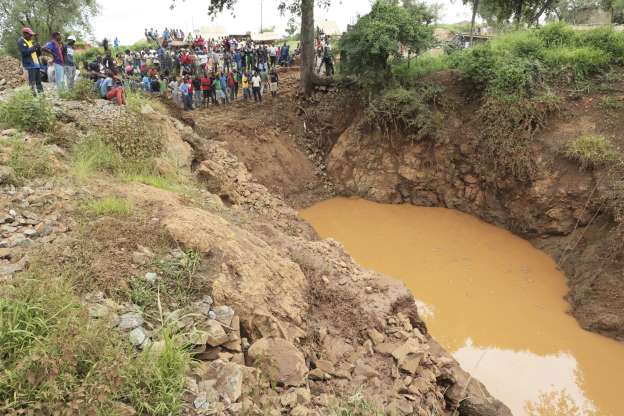
A shaft at Task Mining Syndicate 12km from Chegutu along the Chinhoyi highway collapsed trapping five miners 41 days ago. Five days ago rescuers at the mine have found a helmet, converse red shoes and gloves underground.

Although it is now highly unlikely the “Task Five” will be found alive, hopes of retrieving their remains are now high.

Constantino Dzinoreva (47), Charles Mutume (31), Shingai Gwatidzo (20) and brothers Crynos Nyamukanga (44) Munashe Christian (17) have been trapped underground since the 8th of September 2020. Shingai and Munashe are form four students who were only conducting mining part-time awaiting the re-opening of schools which were shut due to the Covid-19 pandemic.

Zimbabwe biggest mining body, the Zimbabwe Miners Federation (ZMF) leadership paid a visit last week to ascertain rescue progress. ZMF has for a long time appealed to the government for help in mechanising small-scale mining operations to reduce mining accidents.

The contribution of small-scale mining to Zimbabwean economy

0

The small-scale and artisanal mining sector has of late become one of the pillars of the economy of Zimbabwe contributing significantly to national exports.

Rudairo Mapuranga

The sector which has become of significance for the country to achieve the President’s vision for Zimbabwe becoming an upper-middle-income earner by 2030 and the mining sector achieving a USD 12 billion industry by 2023 with the gold small scale mining sector contributing up to 12 percent of total exports.

Zimbabwe’s gold deliveries in September plunged by 73% to close at 1.36 tonnes from 2.8 tonnes in the comparative period in the prior year owing to rampant smuggling by small scale miners who blamed payment delays being faced by the miners proving the importance of small-scale miners to the economy.

According to Zimbabwe Miners Federation (ZMF) Mashonaland Central Chairperson Mr. Masango Mahlahla in an interview with Mining Zimbabwe last year, the country’s chrome industry has the potential to establish a USD Billion-dollar industry with the small-scale sector able to generate over USD300 million in export sales.

“Small scale chrome miners held the potential to generate over USD 340 million in export sales revenue along with Government direct tax earnings of over USD 42 million.

“Over the last three years our continued research into chrome highlights that Zimbabwe Chrome production has the potential to become a Billion USD industry,” Mahlahla said.

World over, the small-scale and artisanal mining sector employ 10 times more people than large-scale mining, providing jobs and income for 20-30 million of the world’s poorest people and supporting the livelihoods of five times that number.

In Zimbabwe through the country’s biggest representatives of small-scale and artisanal miners Zimbabwe Miners Federation, around 50 thousand small-scale miners are registered by the body with each employing at least ten workers. And a lot more not registered by ZMF are involved in artisanal mining or illegal mining.

Researchers have estimated that the small-scale and artisanal mining sector in Zimbabwe benefits over 1,5 million people excluding equipment and service providers, this, therefore, shows that the ASM is of paramount importance to the economy of Zimbabwe.

The national Geological Survey estimates that local gold mining started in the country in the seventh century and that of more than 4000 present-day gold deposits, almost all are “located on ancient workings done through small scale mining and exploration.

The growth and continued support of the small-scale mining sector by the government through engaging with different small-scale mining stakeholders have led the miners to account to more than half of the country’s gold deliveries as well as a substantial amount in chrome deliveries and other special minerals.

The Government is putting more emphasis on small-scale mining ventures in its quest to boost mineral production across the country and revive the economy. However, the government seems to be scoring an own goal by rushing to arrest illegal miners whom a large number are unwilling participants but victims of a snail’s pace of Mining Title application processing and rampant corruption by Mines Officials.

The Minister of Mines and Mining Development Hon Winston Chitando has emphasized that his ministry was relying on small scale mining gold sector for the industry to achieve 100 tonnes of gold annually by 2023 due to the fact that Zimbabwe’s geology entails that there are some mineral deposits that are not economically viable for mining by big conglomerates.

Student dies in a gruesome accident at School of Mines

0

A 22-year-old female first-year student at the Zimbabwe School of Mines (ZSM) yesterday died after she was hit by a lorry carrying gold slimes.

By Precious Chikuruwo

The unfortunate accident reportedly happened yesterday morning when the student (name supplied) was going for her morning examination. School of Mines officials confirmed the development.

Speaking on condition of anonymity a fellow student who witnessed the accident has everyone shattered.

“This accident has shattered everyone who knew her and those who were going to work with her in the future as she was pursuing to be a female miner”.

The gruesome incident happened as she was supposed to celebrate her 22nd birthday on the same fateful day.

The lorry involved is said to have been hired by Old Nic Mine which is based near Bulawayo. The driver is said to have lost control of the lorry and sources privy to the accident say the lorry has not been serviced for a long time. The victim died on the spot and the driver survived with minor injuries.

More to follow