

Home Blog Page 551

Prospect to build a floatation pilot plant at arcadia mine

0

Prospect Resources Limited announcement on Friday of its plans to build a floatation pilot plant at Arcadia Mine near Harare to process bulk samples for its lithium markets globally, demonstrates more than just the progress the project is making.

The lithium company is listed on the Australia stock exchange and is based in Perth but with operations in Zimbabwe. Prospect’s flagship project is the Arcadia Lithium Project located on the outskirts of Harare.

Other than providing solid demonstration of how far the Greenfield lithium project has come, the Arcadia project, it reflects part of progress in the lithium sector towards the Government’s grand scheme of building a US$12 billion mining industry by 2023.

The Government launched the US$12 mining industry target by 2023 in October 2019 as part of the new administration’s broader macroeconomic roadmap towards an Upper Middle-Income Economy by 2030 with per capita income above US$4 300.

In any case, milestones achieved by key mining initiatives such as Prospect’s Arcadia project represent a huge leap forward in the country’s quest to optimise returns and benefits from mining, which generates over 60 percent of annual exports.

And Arcadia is one among several mega projects in platinum, gold, chrome, diamonds, coal and nickel, to name but a few, which are taking shape in the mineral rich southern African country and primed to ignite a palpably imminent economic boom and turnaround for Zimbabwe.

Lithium mining, including Prospect’s Arcadia project that is expected to create over 700 jobs in the first phase, will promote significant foreign capital flow into Zimbabwe, as global demand for both chemical (electric car battery) and technical grade lithium (glass and ceramics production) grows.

Prospect said it will commence construction of the flotation pilot plant to produce high purity petalite and spodumene, with long lead equipment items now secured. This plant will replicate Arcadia’s capacity at a large scale to supply global markets.

The high purity flotation pilot plant will de-risk the flotation process by operating the optimised flow sheet, supply bulk samples of high purity products to customers in the technical and chemical markets, to obtain product qualification and maximise market demand for Arcadia’s products;

Further, the pilot plant will supply samples to Uranium One Group, off-taker and prospective investor, for their own product validation purposes and continuing due diligence on Prospect and the Arcadia Lithium Mine, as well as enhance all technical elements of the project execution phase.

The plant will initially produce bulk samples of 500 tonnes of petalite and 120 tonnes of spodumene concentrates for qualification by the customer, large producers in Europe and Asia.

Processing technology will demonstrate Prospect’s ability to produce high-purity products at planned volumes and samples to be sent to current and potential off-take partners in the first half of 2021.

Prospect Resources said it had already secured long lead equipment items and was now commencing the pilot plant project at the company’s Arcadia Lithium Mine, near Harare, to produce high-purity petalite and spodumene samples.

Prospect’s managing director Sam Hosack said: “Our current key focus is to operate a pilot plant to replicate the Arcadia flow sheet to produce high purity petalite and spodumene.

“The (Arcadia) pilot plant delivers a number of key objectives for customers, project finance parties and investors in de-risking the Arcadia project. It is a major milestone that we have secured the long-lead purchases.”

The design of the pilot plant is based on flotation test work done by Anzaplan and scaled up to a pilot plant size by the Beijing General Research Institute of Mining and Metallurgy (BGRIMM) using proven flotation technology solutions.

Anzaplan is a European consultancy and engineering firm well equipped to develop flow sheet and process design following different processing routes for lithium-bearing minerals such as spodumene, petalite, lepidolite, lithium-rich clays

The implementation schedule meets the criteria of first production of on-spec product in the first half of 2021. Front End Engineering and Design (FEED) will be undertaken using information gathered from the pilot plant.

This will determine the phasing, scale of growth and nominal capacity of the Arcadia project. The strategy for the phasing of development will be clarified with the capital expenditure (estimates from the FEED.

This represents one of many progress milestones that Prospect Resources has already posted in its quest to build the largest lithium mine in Zimbabwe and Africa.

Notably, this also demonstrates significant progress in the platinum dimension of the $12 billion industry target, where Prospect’s Arcadia is expected to be a significant contributor.

The US$12 billion mining industry represents a 344 percent increase from the US$2,7 billion exported in 2017. The multi-billion-dollar industry will be driven by gold, platinum, diamond, chrome, iron ore, coal, lithium, and other minerals.

Under the US$12 billion mining roadmap, gold is expected to contribute US$4 billion, platinum US$3 billion while chrome, iron, steel diamonds and coal will contribute US$1 billion.

Lithium is expected to contribute US$500 million while other minerals will contribute US$1,5 billion. Despite currently having a single producing lithium mine, Bikita Minerals, Zimbabwe is the world’s fifth largest producer and exporter of lithium.

NO to irresponsible mining

0

The Zimbabwe Environmental Law Association (ZELA) has denounced irresponsible mining and lamented that such practices are placing human and animal lives at risk, creating irreparable damage to the environment.

By Shantel Chisango

ZELA shunned the practice of illegal mining on its Twitter page and encouraged responsible mining that complies with the law and protects the environment.

“Miners need to exercise environmental vigilance, which applies to the concerns of reckless investors. We say NO to the irreparable damage to our environment,” ZELA said.

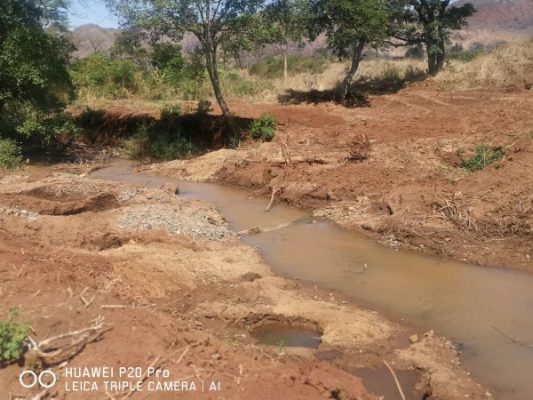
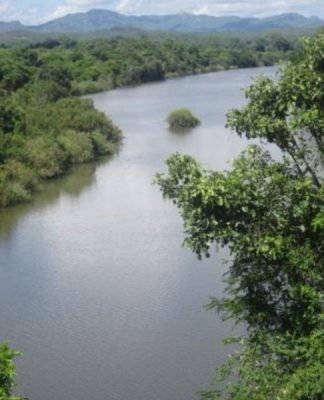
Referring to Mazowe, where illegal mining has damaged the once majestic river, ZELA expressed dissatisfaction with the current state of the river and encouraged governments to ensure that whenever contracts are entered into, it clearly outlined what the country demands of the investor.

“We’re in Mazowe, checking out what our river has become.”

Mazoe 2
Before (photo credit ZELA)
After (photo credit ZELA)


For decades, illicit mining has been ravaging the country and is not only riskier from a safety perspective, but it promotes risky conduct and leads to results that have long-term negative consequences.

With illegal mining, there is typically an absence of property rights, mining licenses, exploration or mineral transport permits, according to America’s Quarterly.

Without these licenses, there are no independent authorities to regulate mining operations and all the high-risk activities that come with them.

To minimize the possibility of damaging the environment and its people, the government needs to ensure that illegal mining is avoided by providing mining licenses to legalize all who practice illegal mining curbing the spur in illegal mining cases. Currently, formalisation is happening at a ridiculous pace with Mashonalandwest a mineral-rich province with an area of 57,441 km² being serviced by only two vehicles.

Zimbabwe seems reluctant to introduce sanitation to the artisanal small-scale mining sector, which makes a major contribution to gold production each year.

Ten miners buried alive in Mutasa

0

Ten gold miners are feared to have been buried alive at Premiere Mining area along Mutare river in Mutasa District, Manicaland.

Permanent secretary in the Ministry of Information, Publicity and Broadcasting Services Mr Nick Mangwana on his twitter account yesterday said “Ten illegal gold miners are feared to have been buried alive at Premiere Mining area along Mutare river which is owned by Zimgold fields a privately owned company in Mutasa District, over the weekend. So far two bodies have been retrieved from one of the shafts” read the tweet.

Year-in, year-out, lives are lost in Zimbabwe’s mining sector, with corruption and inadequate monitoring of mining activities by the government cited as major causes.

For instance, since 2018 several accidents have been recorded; including the flooding of Battlefields mine in Kadoma, which killed 28 people and the collapse of Eldorado mine in Chinhoyi, killing 11 men in two separate incidents.

Other accidents include the collapse of Shurugwi’s Wonderer mine, trapping over 50 artisanal and illegal gold miners underground and the Nugget gold mine collapse in May, which killed eight people, as well as the blast at Mazowe mine in which eight people died.

Again, in February this year, two miners died after a shaft collapsed at the Globe and Phoenix Mine in Kwekwe District, 200 km southwest of the capital Harare.

In May this year, another worker at Vumbachikwe Mine died after he allegedly fell during a blasting exercise when he was alone underground.

Last year, a man died in Gwanda at Berwick 3 Mine when a shaft he was working in collapsed.

Platinum giant Zimplats also recorded one fatality towards the end of the first quarter of 2019 at one of its mines, Mupfuti Mine.

On September 8, 2020, five artisanal miners got trapped underground at Task Mine in Chegutu and as of today four remain underground and only a single body was exhumed.

Zimbabwe Miners Federation (ZMF) Manicaland regional rep Judith Shadaya when contacted for comment said she had no knowledge of the unfortunate incident

Fidelity official gold buying prices Tuesday 17 November 2020

0

Fidelity Printers and Refiners (FPR) official gold buying prices Tuesday 17 November 2020

SG 90% AND ABOVE $54.25/g
SG ABOVE 85% BUT BELOW 90% $53.34/g
SG ABOVE 80% BUT BELOW 85% $52.13/g
SG ABOVE 75% BUT BELOW 80% $51.52/g
SAMPLE BELOW 10g BUT ABOVE 5g $52.74/g
FIRE ASSAY CASH $54.56/g
EXCHANGE RATE  ; 81.6741


Cash available. Fidelity Printers and Refiners prices will be changing daily in relation to world market prices.


Contact FPR

No. 1 George Drive, Msasa, Harare, Email: [email protected]Telephone: +263 242-486670, +263 242-486694, +263 242-487131, +263 242-447810-5

MMCZ pledges to work with small-scale miners

0

Minerals Marketing Corporation of Zimbabwe (MMCZ) has emphasized the vitality of small-scale-miners cooperation with mining authorities for the mining industries to be a success.

By Shantel Chisango

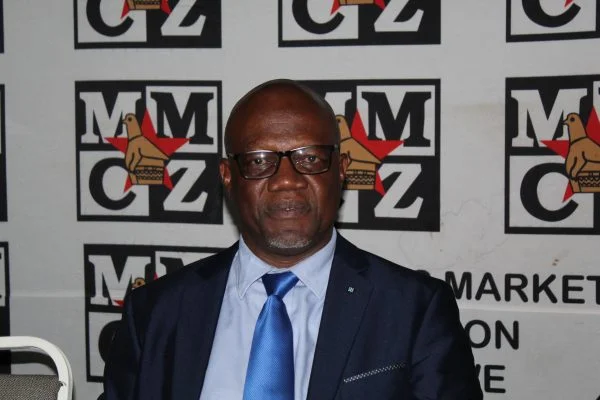
Addressing miners at a MMCZ small scale miners training held yesterday at the HICC, MMCZ boss, Mr. Tongai Muzenda said the mineral marketer’s mandate is to work with miners to attain a productive mining sector.

“As MMCZ, we do not exist to disrupt mines activities but rather to work together with miners to produce results in the mining sector,” he said.

In addition, Muzenda stated that the MMCZ is looking into making gemstones viable in the market, the mineral marketer will educate miners on the value of the minerals.

“Currently we are in a bid to make minerals such as gemstones viable on the market so we will educate miners on how valuable they are so they can start mining them on their own and benefit from it as well.”

Meanwhile, MMCZ is engaging with small scale miners from all around the country to allow easy and viable mining in the sector.

In his presentation, Muzenda pointed out that there is need to take small-scale mining seriously for it contributes 1,3 to 20 million jobs worldwide while a further 80-100 million make living from it.

3.7 million people in Africa are currently engaging in small scale mining while 30 million heavily depend on it.

Small scale miners have pleaded with the Mines Ministry and the MMCZ to capacitate them and not sabotage them in the industry taking preference of foreign investors over them.

“It is very much disappointing that our mining authorities do not consider our needs neither do they appreciate us being active in the industry, rather they take preference of foreign people over us. So as small-scale miners we are pleading the ministry to recognize us and start treating us as well,“ said one of the small-scale miners.

In response to MMCZ’s presentation on relieving miners of their grievances, another small-scale-miners asked the MMCZ if they have been taking action in implementing what they promise miners.

“What are you currently doing to make sure that as small-scale miners we get the capacitation you say you will provide because it is pointless to talk without any action being taken on the ground?” said the miner.

He further urged miners to engage with MMCZ concerning the grievances they are facing as well as come up with suggestions on how to overcome them.

Mines and Mining Development Minister, Winston Chitando who was also in attendance applauded the MMCZ for standing on behalf of the government in engaging with miners for the betterment of the mining sector.

“It is a noble intervention that MMCZ has done on behalf of the government for small-scale miners contribute heavily to the success of the economy,” he said.

He further added that the mining industry is on schedule in playing a pivotal role in the attainment of the 2030 vision.

Moreover, the government is looking at measures in which it can capacitate small-scale-miners in their industry, he said.

The Mines Ministry according to Chitando next year will establish a Minerals Commodity Exchange to assist miners in selling their minerals, and it will be established all over the country.

MMCZ has been hailed for following through on their promise this time around as they have been known to cancel events at the last hour. The training commences in Karoi a gemstone-rich area today.

Chrome Miners Push for Market Revamp

0

ZIMBABWE is pushing to transform its mining industry into a US$12 billion sector by 2023.

There is an interesting mix of minerals on which this target is being projected, including chrome.

But, for Norton Miners’ Association chairperson and small-scale miner Privelage Moyo, the vision might be hard to achieve.

There are a plethora of challenges facing the chrome mining subsector, Moyo told Standardbusiness last week.

When he joined chrome mining two years ago, he expected his new venture to be a stroll in the park.

But he soon found the going tough.

He says he found himself in a sector that was drowning in challenges like lack of government support, predatory buying and low prices.

In addition, the sector did not have a value addition and beneficiation policy.

Chrome miners have also been affected by lack of weighbridges, mining equipment and under-capitalisation.

These challenges have dampened the spirits of many miners like Moyo, and some of them have shifted to gold and gemstones mining.

“Government needs to put a task force together to only focus on the mining of chrome.

“Its focus will be on production, pricing and marketing.

“I am aware of the existence of the Minerals Marketing Corporation of Zimbabwe (MMCZ), but I am sure they need to rise to the occasion,” he said.

Moyo said pricing was a huge challenge.

Chrome miners are at the mercy of buyers and smelters, and they are calling for constant updates on pricing to help them plan.

“Knowledge of markets is crucial to miners as it gives them local or foreign options,” he said.

Moyo said if local markets and depots are created close to miners they would be happy to deliver their ore, or allow buyers to come to inspect their output.

He said, for now, buyers were hunting for chrome, which they purchase at low cost from miners.

He said the government should establish chrome markets like what has happened in diamonds.

“If the above issues are not addressed, the US$12 billion targets will remain a pipedream. We need to focus on the ease of doing business in mining because bureaucracy is affecting business,” Moyo said.

“Government needs to commit and grow an industry one at a time.

“If they want earnings in mining, then more focus must be deployed until it starts bearing results, then move to the next.

“Zimbabweans are ready for economic growth, but the government is not.

“Mining titles are not easy to get. The (Mines) ministry has manpower and mobility challenges.”

Moyo said if the government wanted to know what could derail the US$12 billion target, authorities must visit provincial mining offices to see backlogs of applications for several permits that have not been processed.

He said sometimes important documents go missing, thereby delaying production.

Zimbabwe boasts of the world’s second largest known chrome ore deposits, with 900 million tonnes of untapped ore.

The global reserve is estimated at about 7,5 billion tonnes.

South Africa has the largest proven reserves.

Zenzo Hove, the secretary of the Rhonda Miners Association, said most small-scale miners relied on manual mining methods, which affects production.

“We don’t have access to modern machinery. “Most rich claims are held by very big companies, but they are mostly lying idle.

“Some companies hold the rich claims for speculative purposes,” he said.

“That’s why you find sometimes miners end up loading trucks manually by hand.

“Artisanal small-scale chrome miners cannot afford open cast mining due to lack of those machines and financial muscle.”

The miners have also been affected by lack of electricity, which affects important works like de-watering shafts.

An alternative would be to use diesel-powered generators, but this is more expensive.

Preferential treatment given to Chinese investors in chrome mining, as well as the presence of too many middlemen, is worrying small-scale miners.

Moyo said lack of an open market was also another challenge.

“This does bring the entire mining effort to zero as buyers will be offering very low prices disregarding production costs,” he said.

“China is an ideal market but due to self-funding, the miner cannot afford to wait for a long period to be paid, hence they are forced to sell to predators.

“Government must also put weighbridges along the Great Dyke and railway sidings.

“We have been selling chrome using estimates for tonnage because in our area (Mataga or Ngungubane railway siding) there are no weighbridges.

“Big companies must be forced to either give five-year tributary agreements to small-scale miners or complete ceding of claims to locals.

“In our case as Rhonda Miners Association, we can improve production greatly if we get access to lines of credit.

“We can play our part in achieving the goal if we get enough capacitation.”

A chrome miner, Rumbidzai Vutete, said the government should come up with a chrome policy.

“It appears we still have no traction regarding our chrome policy,” Vutete.

“We need it to enable us to address all our issues.”

Martin Chitohwa, a researcher, opines that for Zimbabwe’s chrome sector to achieve sustainable growth, the government should stop heavy reliance on a single market and end the monopoly of MMCZ.

MMCZ, a government agency, is charged with supervising the sale of all minerals produced in the country except gold and silver.

Chitohwa said most problems faced by chrome miners would not be solved if Zimbabwe continued with its reliance on a single market.

Zimbabwe sells its chrome to China.

“As long as MMCZ remains restricted, predatory pricing by buyers who only sell to the single market will continue to take advantage of the situation,” he wrote.

“Buyers from other markets are available and more can be made available if there is a policy change that can allow MMCZ to be circumvented. This policy change can be temporary to allow capital built-up by local producers since proceeds will be repatriated back into Zimbabwe,” he opined.

He said a committee could be put in place to work closely with the funders and local banks.

Mines parliamentary portfolio committee chairman Edmond Mkaratigwa said in a bid to boost production in mining, last year they advocated for government to financially capacitate the Mines ministry.

“As a committee, we want to see increased production. Currently, we are working on the national budget and last year we prioritised human and material resourcing,” he said.

This year the country projects to produce 1,2 million tonnes of chrome. Standard

ZMF donate food to Task victims families

0

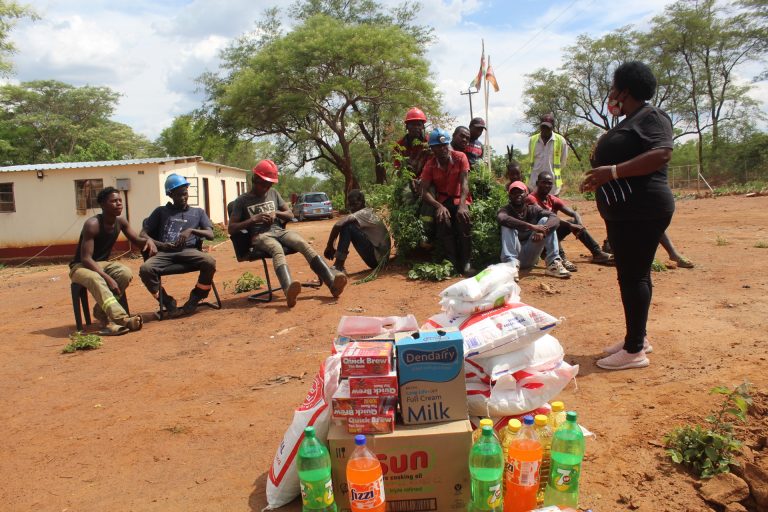
Zimbabwe Miners Federation (ZMF) yesterday visited affected families of the victims of Task Mine shaft collapse on behalf of Fidelity Printers and Refiners (FPR) to deliver food essentials to use during this pandemic. The families are currently camped at the mine waiting for the exhumation of their loved ones’ remains which are currently trapped underground.

By Shantel Chisango

ZMF regional rep Chiedza Chipangura said the funds used for buying the goods were donated by Fidelity Printers and Refiners.

“On behalf of Fidelity Printers and Refiners, as ZMF we have come to distribute goods to all the families who were affected by the Task Mine collapse,” said Chipangura.

Chipangura further added that ZMF will continue trying to help affected families despite the economic challenges crippling the country.

“We know things are hard because of the pandemic but we will try by all means possible to help where we can.”

She further added that it is their desire that the trapped bodies underground be exhumed as quickly as possible effect though it is taking longer than expected.

“If wishes were horses, we would have exhumed the bodies quickly but unfortunately it is not that simple for there are many things to consider such as the safety precautions that need to be adhered to,” she said.

Actions speak louder than words, and one of the affected families, Supreme Dzoreva said he was grateful for the action that ZMF and FPR did for them for they shown the government’s love for its people.

“I feel relieved that the government actually thought of us, this is something really important to us for it has shown that the government cares for its people and that we are not alone,” he said.

The ZMF entourage included ZMF SG Morgan Mugawu, Chegutu Miners Association Chairman Innocent Nicks, ZMF CEO Wellington Takavarasha, Norton Miners Association Chairman Privelage Moyo among others.

It has now been close to three months since the trapped bodies have been underground and only the body of Shingai Dzinoreva has been exhumed to date.

Caledonia to finish Central Shaft Project before the year ends

0

Gold producer Caledonia Mining Corporation has announced the work at Central Shaft Project to be completed before this year ends despite being three months behind schedule.

In an interview with Tim Blythe, Caledonia Chief Executive Officer (CEO) Steve Curtis said equipping of the shaft will be finished before this year shuts down for they are already behind in terms of progress.

“We are behind schedule but the equipping will be finished in Q4 before the end of this year’s Christmas shutdowns.”

The company has been performing exceptionally well amid the covid-19 pandemic and the restrictions which came with it.

Gross revenues of $25.4-million were recorded a 27% increase on the $20-million achieved in the third quarter of 2019.

The company also managed to produce 15 155 oz of gold, up from the 13 646 oz produced during the comparative period in 2019.

The CEO also said this year has been a fruitful year mentioning the great cooperation from the authorities in Zimbabwe and South Africa making it a profit cash generation.

Despite the increase in production at the mine, the company dealt with the problem of electricity in Zimbabwe causing them to use diesel generators which are costly.

“Diesel generators were used a little bit more than the usual due to electricity issues in Zimbabwe.

He said the company will take full commission of the shaft in the first quarter of 2021 following all the safety precautions.

“Full commissioning of work at Central Shaft will start and it will be a structured and very organized programme with all safety precautions being considered.”

The company has set to produce 80 000 ounces of gold by the year 2022.

Another dividend will be announced in January 2021.

Prospectors Association suspends Dzingwe

0

Zimbabwe Prospector Association suspended its outspoken President Mr. Samson Dzingwe.

In a letter dated 3 November 2020 seen by Mining Zimbabwe, the letter confirms that you are suspended from holding the office of the President for Zimbabwe Prospectors Association from today (03 November 2020) until further notice while an investigation is done into several suspected misconduct, abuse of office and violation of our constitution. The letter does not clarify the exact reasons why Dzingwe was suspended or the specific charges against him.

Dzingwe was suspended in a meeting which was attended by the Vice President –Frank Chatyoka, The Secretary General Timothy Chizuzu, the Treasurer-Simon Chinyemba, Committee members-Edward S Fundira, and
Abraham Phiri.

Below is the contents of the letter in full.

Dear Mr. Dzingwe

This letter confirms that you are suspended from holding the office of the President for Zimbabwe prospectors Association from today until further notice while an investigation is done into several suspected misconduct, abuse of office and violation of our constitution.

The executive met and agreed on your suspension on a meeting which you were invited but did not attend without an apology to the executive.

The said meeting was attended by the Vice President –Frank Chatyoka, The Secretary GeneralTimothy Chizuzu, the Treasurer-Simon Chinyemba, Committee members-Edward S Fundira, and  Abraham Phiri.

We can add to these issues as appropriate in light of our investigation.Your suspension does not mean that we have already decided that you have done or not done an action or behavior that is of misconduct. We will not keep you suspended for longer than is necessary for us to carry out the investigation and decide on action to be taken, if appropriate. We can lift the suspension at anytime.

While you are suspended you must not carry out any of Association’s duties. You must cooperate with our investigation. You may need to be called for interviews or other meetings related to the suspension or matters under investigation.

Mines Ministry determined to deal with hurdles in the Mining sector

0

The Mines Ministry has promised to deal with all hurdles in the mining sector that limits progress and growth for miners and the country’s economy.

By Shantell Chisango

Speaking at the 2021 pre-budget expectations of the mining sector in Zimbabwe held at Crown Plaza, the Chairman of the Mines Committee Portfolio, Honorable Mkaratigwa said the Mines ministry is determined to remove all backlogs in the mining industry.

“Mines Ministry is committed to clearing all backlogs that deter the industry from soaring as well as the country’s economy from developing.”

He further added that miners are required to get licenses from Environmental Impact Assessment (EIA) to help curb land degradation.

“EIA is a legal requirement in Zimbabwe in terms of the Environmental Act (EMA Chapter 20:27) as read with Statutory Instrument 7 of 2007 a tool used to define, quantify and evaluate the potential and known impacts of human activities on ecosystems at the earliest stage of project development.

“Miners, therefore, need to cooperate with the legal system so that we avoid arresting illegal miners in the long run.”

Furthermore, during the meeting, a member of the mines portfolio committee asked Mines Portfolio Committee chairperson Hon Mkaratigwa how the ministry is planning to achieve the twelve million budget considering the massive leakage of minerals in the country.

The chairman responded saying there is much being done by the ministry such as arresting miners found on the wrong side of the law as a way to reduce leakages in the country.

In addition, Zimbabwe Environmental Law Association (ZELA) member Mr. Mberikwazvo told the Mines Ministry to present measures to grow mining revenue as well as ask for resources to improve governance capacity.

Zimbabwe is rich in many minerals and there is a need to have a mining-model sector so as to avoid mining minerals which have less value on the market, said Pact Manager, Mr. Motive Mungoni.