Anglo American wants to explore for base metals in South Africa, but the country needs regulatory changes to make it more competitive with other mining jurisdictions, CEO Mark Cutifani said on Wednesday.
Policy uncertainty, insecurity of tenure and unreliable electricity supplies have stifled investment in Africa’s most industrialised economy, where the mining industry contributes around 9% to GDP.
“We will explore base metals across South Africa… We are already in Zambia and other places, we want to do more in South Africa so we are looking for adjustments in legislation there,” said Cutifani during the 2020 Joburg Mining Indaba conference.
He did not give details.
South Africa is traditionally Anglo American’s core territory, but the diversified miner has offset some of the risk of investing in the country, notably with operations in South America.
Anglo American said its interest in base metals, which include copper, nickel, lead, and zinc, was part of its global discovery strategy in greenfield and brownfield projects.
Cutifani also said he would like its South African platinum group metals (PGM) business to increase production of nickel, which can be used in battery production.
The owners of a Russian-backed project to build Zimbabwe’s biggest platinum mine have held talks to sell a stake of at least 20% to Impala Platinum Holdings Ltd., according to people familiar with the matter.
Great Dyke Investments views Impala as an attractive partner partly because the Johannesburg-based company also has the capacity to process ore from the mine, said the people, who asked not to be identified as the details aren’t public. That would give Great Dyke an offtake agreement to help it to raise financing to complete the mine, they said.
DARWENDALE PROJECT HAS THE POTENTIAL TO BECOME ONE OF THE WORLD’S BIGGEST PLATINUM MINES
Great Dyke’s Darwendale project has the potential to become one of the world’s biggest platinum mines and its development is central to the Zimbabwean government’s plans to reboot its collapsing economy.
“The size of the stake we plan to sell is subject to negotiations,” said Brown, a former chief executive officer of Impala. He declined to comment further.
Impala said it isn’t in formal negotiations with Great Dyke.
Impala already operates mines in Zimbabwe. One stumbling block to a deal is Great Dyke’s valuation of the project, the people familiar said. Great Dyke would consider selling a bigger stake, but for the moment the existing shareholders want to retain a majority holding, they said.
Zimbabwe has the world’s third-largest platinum group metal reserves after South Africa and Russia. Former president Robert Mugabe handed the Darwendale concession to Russian investors in 2006 after the government repossessed land from a local unit of Impala.
Great Dyke hopes to secure about $500 million in initial capital by the end of the year and the mine could be commissioned in 2023, CEO Aleksandr Ivanov said last month. It could produce more than 860,000 of PGMs a year at full production. Ivanov declined comment when spoken to by Bloomberg on Tuesday.
The stock market is riding high, taking Joe Biden’s widening lead in the polls as a sign to discount the odds of a contested election. But some investors say it’s too soon to count out turmoil just yet, and that gold is poised to benefit from the uncertainty.
Fears eased this week that the election would fail to produce a clear winner, with traders pointing to polls suggesting a stronger lead for Democratic hopeful Biden. The possibility of a close vote and messy aftermath had made markets nervous in recent weeks while bolstering hopes for haven assets such as gold.
“Despite some polls indicating Biden’s lead is widening, I would not assume the risk of a contested election has dropped, although I know that’s what many are concluding,” said Kristina Hooper, chief global market strategist for Invesco Advisers, which manages $1.1 trillion for clients. “A lot can happen between now and the election, and I do believe gold can benefit from it.”
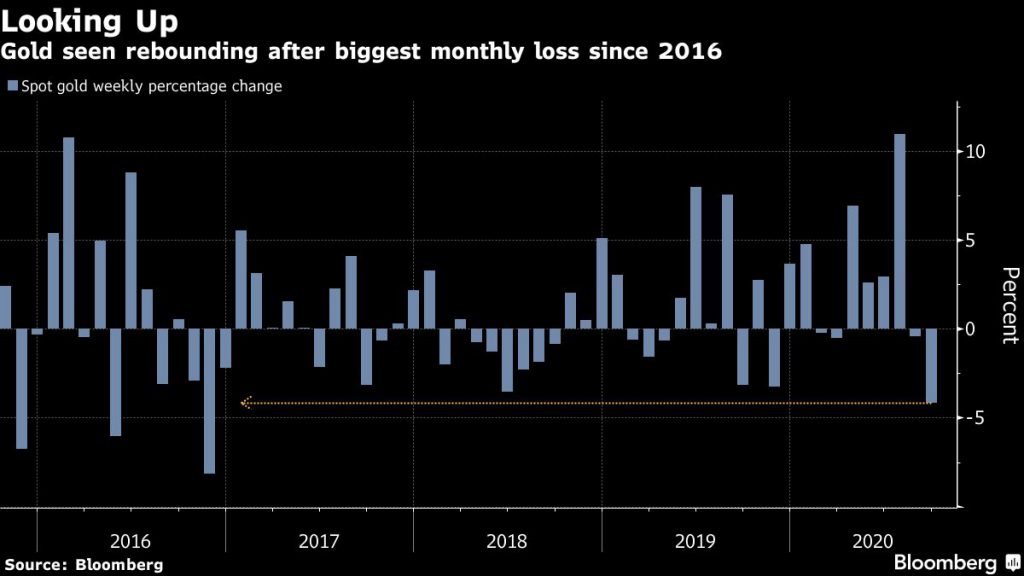
Bullion, which surged 30% through the first eight months of 2020, lost momentum in September, easing for a second month as the dollar gained. While last week saw signs demand was starting to mend — with prices posting the best gain since August on prospects for U.S. stimulus — it’s been rockier this week. Gold tumbled on Tuesday after Trump ended talks with Democratic leaders on a new support package, only to pare that loss on Wednesday.
Under-appreciated risks
Risks surrounding the election may “be under-appreciated by precious metals markets,” according to Citigroup Inc. The bank said late last month those concerns could help push bullion to a record by year-end. Spot gold hit an all-time high of $2,075.47 an ounce in August and was at $1,890.92 on Wednesday.
“Gold thrives on uncertainty: we’ve never had an election in my experience in the U.S. that is as uncertain as this, and as uncertain a political environment as this,” said George Milling-Stanley, chief gold strategist at State Street Global Advisors, the marketing agent for SPDR Gold Shares, the biggest exchange-traded fund backed by the metal.
“GOLD IS STILL AN EXCELLENT DIVERSIFIER WITHIN THE PORTFOLIO CONTEXT FOR PEOPLE WISHING TO HEDGE AGAINST THESE UNCERTAINTIES WE HAVE COMING TOWARDS US”
Growing tensions in the run-up to the contest were underscored by an unusually contentious debate last week between Trump and Biden. Markets had been girding for a possible disputed result after Trump last month wouldn’t commit to a peaceful transfer of power were he to lose the election. The Cboe Volatility Index, or VIX, has risen for six straight sessions, the longest run since 2018.
“We’ve been fooled by the polls before, so there remains a lot of uncertainty around the outcome,” Wayne Gordon, executive director for commodities and foreign exchange at UBS Global Wealth Management, said on Bloomberg TV. “Gold is still an excellent diversifier within the portfolio context for people wishing to hedge against these uncertainties we have coming towards us.”
Gordon recommended buying gold in March, when the metal was plunging as deep losses in risk assets forced some investors to sell gold to raise cash. Since that call, prices have jumped more than 30%.
Potential headwinds
There are potential headwinds for gold that could keep its rally sidelined, including a slowdown this year in demand for the metal from central banks and a dollar that proved resilient in September.
But while the U.S. election season poses the greatest political risk, it’s only one of a raft of potential drivers that are likely to underpin investor interest in gold, according to Commerzbank AG. Those include Brexit, rapidly rising national debt levels, economic stimulus and extremely low interest rates, the bank said.
Michael Cuggino, president and portfolio manager at Permanent Portfolio Family of Funds, sees gold “increasing in value regardless of the election outcome” over the longer term.
“As long as real interest rates are negative across the curve, more liquidity is provided by the Fed and Congress, and growth resumes in the U.S. and abroad post-Covid, inflation expectations will be heightened and gold should continue to rise, albeit in its traditionally lumpy fashion,” Cuggino said.
In the meantime, the focus for gold over the next several weeks will stay on the U.S. election. Trump has called universal mail-in balloting, where states automatically send a ballot to every registered voter, “rigged” and “unfair,” stirring worries about a prolonged dispute over vote tallies.
“This time around it’s a little bit different,” said Darwei Kung, head of commodities and portfolio manager at DWS Group. “It’s not just the outcome of the election, but the process of the election, that sort of uncertainty.”
Barrick Gold CEO Mark Bristow on Wednesday said the gold industry in Africa should consolidate further, as he warned of a “serious reserve crisis” looming for the sector.
A dearth of exploration has seen average mine life across the gold mining sector fall from 20 years to closer to 10 years, he added, speaking at the Joburg Indaba mining conference.
“The prospect of a serious reserve crisis is looming,” said Bristow. Gold production across the industry has only increased by 1.6% every year for the past two decades, he said.
Bristow said this week’s deal between Northern Star Resources and Saracen Mineral Holdings was a “great example” of industry consolidation that should be celebrated.
A DEARTH OF EXPLORATION HAS SEEN AVERAGE MINE LIFE ACROSS THE GOLD MINING SECTOR FALL FROM 20 YEARS TO CLOSER TO 10 YEARS
On Mali, where Barrick is among the biggest investors and operates the Loulo-Gounkoto gold mine, Bristow said the transition after an August military coup has been “very well” run.
“Everyone agrees that 18 months for transition back to full civilian rule is doable, and that’s ambitious,” Bristow said, adding that “none of the organs of state has stopped functioning.”
Bristow again signalled his appetite for acquiring Freeport-McMoran’s Grasberg mine in Indonesia, the world’s biggest gold mine and second-biggest copper mine.
“There are not a lot around, and so by deduction of course we remain interested in being able to add to our portfolio any tier 1 asset out there,” he said.
Bristow said he has no doubt the company will be able to repatriate $500 million which belongs to its Kibali joint venture in the Congo.
“That paperwork is far down the road,” he said. At the start of July, Bristow had said the money would be cleared to leave the country “very soon.”
“There’s a fundamental recognition that to continue to attract investors into the DRC, you have to give them the right to repatriate their profits,” he said.
ZIMBABWE-focused mining group, Prospect Resources, says it expects to produce top quality lithium to support its glass and ceramic business at the Acadia Lithium Project.
The project is still under development and independent laboratory test results have confirmed that the Arcadia project could produce one of the lowest iron lithium concentrates in the market.
In a latest update, Prospect said it has been focused on production process improvements at Arcadia to generate higher quality and consequently higher value products.
The company’s proprietary production processes were independently carried out by PESCO and Light Deep Earth (LDE) to produce premium ultra-low iron petalite concentrate products, achieving 4,37 percent Li2O and 0,01 percent Fe2O3.
Prospect managing director, Mr Sam Hosack, was quoted as saying: “These independent results reinforce Arcadia’s ability to consistently produce one of the lowest iron lithium concentrates in the market. These quality improvements continue to separate our products from our peers.”
He said his organisation has received numerous requests for samples from customers across Europe and Asia.
“We are now prioritising glass-ceramic customers to receive future petalite product samples,” said Mr Hosack.
Recently, Prospect announced that it has secured a long-term agreement with Sibelco N V, the world’s largest industrial minerals solutions company to supply petalite from its Arcadia Lithium project.
The mining group said the seven-year agreement will see the company supplying 700 000 dry metric tonnes (dmt) of high quality, ultra-low iron petalite concentrate during the tenure of the agreement. The seven-year agreement is for up to 100 000dmt per annum of high quality, ultra-low iron petalite concentrate while the pricing formula for the agreement is linked to the end customer sales contracts with minimum pricing provisions.
THE Bulawayo City Council (BCC) has turned down a request by a company which wanted to mine gold at the decommissioned Umzingwane Dam and surrounding areas.
Umzingwane Dam is one of the city’s three supply dams that were decommissioned.
According to the latest council report, Extra Rich Mining Private Limited proposed to partner council in mining gold at the decommission dam while at the same time de-silting it.
Director of Engineering Services Engineer Simela Dube said if the company was granted permission to extract gold at the decommissioned dam, illegal panning activities were likely to increase which could even endanger lives of Bulawayo residents.
Eng Dube said the water body was also going to be contaminated with cyanide largely used by illegal miners in their extraction activities.
He said the siltation of the city’s dams was not that bad to warrant de-siltation.
“The proposed development would increase impurities in the raw water besides making it muddy which would in turn increase the water purification costs to council. Furthermore, the proposed project would instead increase siltation and reduce the dam’s holding capacity. The dam does not have any silt hence there is no need for de-siltation and alluvial mining along Umzingwane River would lead to siltation and reduction in water inflows to the dam,” said Eng Dube.
He said such an exercise would worsen the perennial water shortages affecting Bulawayo.
“Mining activities within the dam would exacerbate the perennial water problems of the city considering that mining is also a water intensive activity. It should be noted that the idea looked attractive as gold usually did but the worry is that the proposed project will compromise the water quality and quantity within the dam,” he said.
Eng Dube said aquatic life was critical in water bodies especially for human and animal consumption and therefore there were fears that the envisaged technology would disturb the ecosystem.
“It was also noted with grave concern that Umzingwane Dam is pivotal in the pumping stability of water therefore the proposed development would bring a lot of disturbances to the dam lining and would consequently increase seepage.”
Health Services director Dr Edwin Sibanda said council has to be careful in making the decision as it could result in the local authority falling short in the service delivery mandate while exposing residents to diseases.
“Water sources are generally ‘high security’ areas. Opening them to third parties exposes the consumers to pollution and contamination,” said Dr Sibanda.
The local authority’s public relations department headed by Mrs Nesisa Mpofu noted that the water crisis had seriously affected the image of the city.
The department said gold extraction at a supply dam will therefore not be well with residents.
“The water crisis has made a huge dent on our brand and it would be better if we sought to come out of the woods with this matter. Any project at our dams that is not improving the water situation may be seen to be in the wrong spirit. Unfortunately the issue may not be well received by stakeholders,” observed the department.
After submissions by the different heads of departments, the council resolved to reject the request.
KWEKWE-based ferrochrome producer, Zimasco, says it will not be deterred from resuming operations despite having three workers testing positive for Covid-19.
The company is finalising preparations to restart production after it temporarily suspended operations at the height of lockdown measures.
General manager in charge of marketing and administration, Ms Clara Sadomba, confirmed the positive Covid-19 tests and said the company has intensified testing and protective measures ahead of reopening while affected workers are in isolation.
“We did find positive cases when we carried out tests in preparation of opening. Every worker goes through the RTD test at our local clinic prior to being allowed entry. If this is negative, we proceed and will take them through our procedures and processes to make sure,” she said. “Should the RTD be positive then there will be need for the person to undergo a PCR test to establish accuracy of the positive result and we will then be guided on a way forward from that.”
Visitors, according to Ms Sadomba, also go through the same process. She said the positive cases will, however, not hinder operations at the smelting company.
“As part of the procedures to return to work and entering the workplace, employees were tested before returning. In terms of Covid-19 protocols, those found positive would have followed the Government guidelines of isolation. These workers did not enter the workplace and their absence out of a workforce of nearly 500 would not stop operations,” she explained.
Zimasco is an integrated ferrochrome producer and operates chromite mining locations in Shurugwi, Guinea Fowl, Lalapanzi, Mutorashanga and tributary operations along the Great Dyke of Zimbabwe. Its non-core operations include coal-bed methane and ranching assets in Zimbabwe. The company employs 750 workers directly and more than 1 000 indirectly.
The company suspended its smelting and mining operations in March as the local industry suffered from the crippling effects of the deadly Covid-19 pandemic.
PLATINUM producer, Mimosa Mining Company constructed and equipped Zvishavane Vocational Training Centre girls’ hostel and the Zvishavane District Hospital Private Ward that were officially opened by the President of Zimbabwe Emmerson Dambudzo Mnangagwa in Zvishavane yesterday.
Precious Chikuruwo
Mimosa Managing Director, Mr Fungai Makoni emphasizing his company’s commitment to playing its part in improving the lives of the people.
Zvishavane Vocational Training Centre is one of 42 such centres around the country. It helps produce artisans who are key skilled workers who are able to contribute to the attainment of Vision 2030, among courses trained at the VCT is Cosmetology, Tourism and Motor Mechanics
The mining firm also donated 22 computers to the VTC as part of their Corporate Social Responsibility, built an 18-bed ward at the District Ward and a pharmacy which is equipped.
The Midlands Minister of State for Provincial Affairs Senator Larry Mavhima applauded the work by the platinum miner emphasizing that it is improving the health sector in the country.
In his opening remarks, Minister of State for Provincial Affairs and Devolution, Cde Larry Mavima said the state-of-the-art private ward which was built at a cost of US$1million will make it possible to treat even the complicated cases that may arise in the district.
“Even if I fall sick today, there will be no need to airlift me to Harare as facilities here are more than adequate” Minister Mavhima.
The Minister of Mines and Mining Development Hon Winston Chitando applauded the development by Mimosa said that the level of Corporate Social Responsibility by the miner sets a standard for the mining community to contribute to community growth.
“The two projects demonstrate the potential of mining to contribute to development in the community. This is what we envisage for all investors in the mining sector. ” ~ Minister Chitando
The president paid a tribute to Mimosa Mine for its Corporate Social Responsibility and its response to the government’s call for smart partnership between government and private sector, the President also applauded the company for contributions at Gweru and Masvingo Hospitals.
LEADING mining and exploration company, Invictus Energy Limited has announced that its Annual General Meeting (AGM) will be held on the 28th of November this year.
The company has advised the people wishing to contest for election as a director to file their nomination papers by 12 of October 2020 and that the nomination papers should be in writing.
“Invictus Energy Limited (“Invictus” or “the Company”), advises that in accordance with ASX Listing Rule 3.13.1 and clause 11.2 of its Constitution, it’s next Annual General Meeting (AGM) is to be held on 28 November 2020.
In addition, the closing date for the receipt of nominations from persons wishing to be considered for election as a director is 12 October 2020. Any nominations must be received in writing no later than 5.00 pm (WST) on 12 October 2020 at the Company’s registered office.
Shareholders will be advised of further details regarding the AGM including the date and time of the AGM in a separate Notice of Meeting, which will be provided to shareholders during October 2020.
The Notice of Meeting will also be available on the ASX Company Announcements Platform and the Company’s website at www.invictusenergy.com”
Invictus Energy Ltd is an independent oil and gas exploration company focused on high impact energy resources in sub-Saharan Africa. The asset portfolio consists of a highly prospective 250,000 acres within the Cabora Bassa Basin in Zimbabwe. Special Grant 4571 contains the world-class multiTCF Mzarabani and Msasa conventional gas-condensate prospects.
Civil Protection Unit (CPU) and body which falls under the Ministry of Mines and Mining Development has not stopped the rescue mission at Task Mining Syndicate as has earlier alluded but awaits cabinet decision on the way forward, a Ministry official has said.
Speaking to Mining Zimbabwe, Ministry of Mines Engineer Michael Munodawafa said that the Ministry has no power to stop rescue missions when an accident has been clarified as a disaster. The power lies in the hands of the CPU who are again given the go-ahead to undertake such decisions by the Cabinet.
Munodawafa said the Ministry sent an internal advisory letter addressed to the Chegutu District Administrator and not to the owners of the mine.
“If there is a disaster the Ministry has no power to shut down mining operations. The letter was addressed to the DA and not the mine owners, the case will be addressed by the cabinet soon.”
Munodawafa said that the Ministry failed to undertake rescue operations on time because Task Mine was not properly planned. Shafts were placed all over the place an event that could have also endangered the rescue team. He said measures are underway to map a way forward on how best operations can be taken.
“There are no plans in Chegutu, not even a single plan…we have to understand where you are going before we rescue, we had to focus also on the safety of the rescuers.” Engineer Munodawafa said.
Once Cabinet confirms the abandonment of the search mission, all access points into the shaft will be sealed off, making the shaft in effect a grave for (Task Five) Constantino Dzinoreva (47), Charles Mutume (31), Crynos Nyamukanga (44) Shingai Gwatidzo (20) and a minor Munashe Christian (17).
A letter which was written by the Chegutu District Development Coordinator, Tariro Tomu to Task Mining Syndicate management suggested that rescue operations were proven to be unsuccessful therefore should be stopped with immediate effect.
“A technical report from the Ministry of Mines has shown that operations are proving to be unsuccessful because of safety challenges. There is continuous fall of ground within the collapsed zone,” reads the letter in part.
The letter also stated that the Ministry indicated that there is no escape route in case of emergency and the plan exposed workers to great risk when operating.
“There is no second escape route in case of emergency and the plan of installing a bulkhead and allowing people to work below it is a risky operation as there is a high risk of it falling thereby exposing the workers to great danger if trapped,” reads the letter.
The letter by the DA to the Mine owners also indicated that rescue operations and retrieval of the bodies should be stopped with immediate effect.
To provide the best experiences, we use technologies like cookies to store and/or access device information. Consenting to these technologies will allow us to process data such as browsing behavior or unique IDs on this site. Not consenting or withdrawing consent, may adversely affect certain features and functions.
Functional
Always active
The technical storage or access is strictly necessary for the legitimate purpose of enabling the use of a specific service explicitly requested by the subscriber or user, or for the sole purpose of carrying out the transmission of a communication over an electronic communications network.
Preferences
The technical storage or access is necessary for the legitimate purpose of storing preferences that are not requested by the subscriber or user.
Statistics
The technical storage or access that is used exclusively for statistical purposes.The technical storage or access that is used exclusively for anonymous statistical purposes. Without a subpoena, voluntary compliance on the part of your Internet Service Provider, or additional records from a third party, information stored or retrieved for this purpose alone cannot usually be used to identify you.
Marketing
The technical storage or access is required to create user profiles to send advertising, or to track the user on a website or across several websites for similar marketing purposes.