Home Blog Page 623

100 percent forex retention to gold miners bad for the economy

0

The government gazetted on the 24th of June 2019 the Statutory Instrument 142 of 2019 in which banned the use of foreign currency for any transactions within Zimbabwe. However, miners were exempted from the policy citing a genesis of high-level mineral leakage.

By Rudairo Mapuranga

In 2018 Zimbabwe imported US$6.3 billion worth of goods from international suppliers, down -1.9 per cent since 2014 but up 26.1 per cent from 2017 with mining machinery such as bulldozers, excavators, road rollers munching US$76.9 million 106 per cent from 2017, mining machinery parts were at $43.4 million up 27.8 per cent from 2017. Since Zimbabwe is not producing any equipment, mining operations require foreign currency since most of the equipment they use is sourced outside Zimbabwe. The operation of mines requires from 70-90 per cent foreign currency which means that at the moment in time miners should be paid in some of their returns in foreign currency to improve the industry.

Withdrawing foreign currency from miners is not advisable and it is catastrophic to the performance and improvement of the economy of Zimbabwe. The measures would be self-destructive and regrettable, however, giving miners 100 per cent foreign currency retention is also not advisable and may lead to the flooding of black market foreign currency trading since some miners were part of the group accused of funding the operations of the illegal foreign currency dealings.

Despite the banning of foreign currency transactions within Zimbabwe, miners have been clamouring to receive 100 per cent forex retention from the country’s sole gold buyer and exporter, Fidelity Printers and Refiners.

Chinese firm vows to respect workers’ rights

0

China Aihua Jianye P/L a Chinese firm that is going to operate (Quarry extraction) in Domboshava has vowed that they were going to work differently from what other Chinese firms are allegedly doing.

By Rudairo Mapuranga

Chinese firms, especially in the Mining sector, have been lambasted over their alleged ill-treating their employees, extremely poor salaries, not providing protective clothing, not respecting environmental laws and externalising funds amongst others.

However, speaking to Mining Zimbabwe China Aihua Jianye Director Mr Liu Wei said that once the company began its operations, they will engage its employees in order to reach a mutual agreement with them.

“We will do our business respecting the laws of Zimbabwe and we are willing to negotiate with our workers in order to operate in a friendly environment,” said Mr Wei.

Mr Wei also said that his company will prioritise the safety of its workers and as such the company will provide its workers with all required technical know-how of operating mining machines, provide them with safety clothing and decent accommodation.

“We will send our workers on courses to equip them in the operation of mining machinery and of course healthy and safety is our main priority,” he said.

The China Aihua Jianye boss also said his company will is going to develop the area where it is located and has assured the community that their operations will not be noisy and dusty as the company has acquired the latest machinery from China that is noise free and penetrates in the ground smoothly.

“We are going to assist locals in building better roads, schools and social areas, above all, we are going to employ people of that community. Our equipment is modern equipment from China and will make the lowest noise and dust” he said.

The company also said that they will invest in more projects such as brick making and other building materials which will assist the Domboshava community.

Cop robs miners

0

A GWANDA-based police officer allegedly teamed up with eight accomplices to attack a group of artisanal miners and rob them of one tonne of gold ore.

Ray Moyo (30), who is based at the ZRP Matabeleland South Provincial systems administration office, Fadwell Mhlekwa (18) and seven accomplices who are still at large, armed with switches and machetes reportedly attacked 14 miners at Ettrick Mine in Gwanda on June 9 at around 2AM.

Moyo and Mhlekwa were not asked to plead when they appeared briefly before Gwanda magistrate, Miss Lerato Nyathi facing a robbery charge. They were remanded in custody to July 10.

Prosecuting, Miss Ethel Mahachi said: “Moyo, Mhlekwa and their seven accomplices who are still at large went to Ettrick Mine armed with switches and machetes. They approached 14 miners and they assaulted and threatened them.

“They held two miners Hebron Ndlovu and Bongani Ngaza hostage while they ordered the others to leave the mine. Moyo and his accomplices further ordered Mr Ndlovu and Mr Ngaza to load one tonne of gold ore which was at the mine into a vehicle which belongs to Moyo,” she said.

Miss Mahachi said Moyo, Mhlekwa and their accomplices drove away from the scene towards Gwanda- Beitbridge Road where they were intercepted by one Mr Knowledge Ndlovu. She said Moyo who was driving the vehicle and Mhlekwa were apprehended on the scene while their accomplices fled. 

Miss Mahachi said the truck loaded with gold ore was recovered. She said the vehicle’s front number plates were covered with a cloth while the rear number plates were covered with a piece of sack._The Chronicle

labour court favours 200 mine workers

0


The mine is jointly owned by the Zimbabwe Mining Development Corporation (ZMDC) and Graphite Kropfmhul Gmbh of Germany.

A LABOUR court judge recently ruled in favour of nearly 200 workers at Zimbabwe German Graphite Mine, trading as Lynx Mine, who had downed tools against non-payment of their salaries for over 13 months.

The mine is jointly owned by the Zimbabwe Mining Development Corporation (ZMDC) and Graphite Kropfmhul Gmbh of Germany.

The court, which sat on May 28 and 29, 2019 before labour judge G. Mhuri, delivered the judgment against the mine, ruling that mine workers should be paid their dues within three months.

Workers’ committee chairperson Sylvester Beremauro took the employers to the labour court so they could be paid outstanding salaries, dating back 13 months from January 2018, before the mine had shutdown, citing viability challenges.

George Ngorima, as finance manager, was cited as first responded.

In his ruling, the judge ordered the employer to pay the outstanding salaries.

Part of the ruling read: “It is hereby ruled that respondent (Lynx Mine) pays a total of sum of $294 891.89 as part of outstanding salaries.

It was also ordered that the payments be made within the three months from June.

The judge also ordered Lynx Mine to pay $69.00 to the Zimbabwe Diamonds and Allied Workers Union (ZDAWU), represented by Sam Makonde, for representing the workers.

ZDAWU intervened after the workers at the mine, situated about 50km west of Karoi town, had downed tools, demanding their dues and improved working conditions.

They claimed they had gone for 13 months without salaries, living in darkness as there was no electricity at the mine compound after it was switched off due to a debt running into thousands of dollars to Zesa.

The workers added that they were drinking untreated water from the mine dam as a result of the power cut.

“Some suppliers have come and grabbed properties as the mine is failing to pay off debts. Surprisingly, 14 containers of graphite were loaded in December, but there are no salaries for us,” one of the workers claimed.
ZDAWU) secretary-general Justice Chinhema welcomed the ruling._NewsDay

Mutodi blocks Chinese firm from operating

0

The Deputy Minister of Media, Information and Broadcasting Services and member of parliament for Goromonzi West constituency Hon Energy Mutodi has encouraged his constituency to block Chinese prospect in his areas citing the environmental degradation nature of quarry mining which might frustrate tourism in the near future.

Rudairo Mapuranga

Speaking to Mining Zimbabwe Hon Mutodi said the quarry extraction should not take place in his area because the mine site is located near one of Zimbabwe’s respected cultural heritage area and only tourism is therefore admirable in the area.

“The proposed quarry mining site happens to be in a cultural heritage area and only tourism is admissible in the area. The site happens to be within a kilometre from the famous Domboshava caves where tourists are thronging daily to view rock art. We are busy formulating strategies to promote tourism in the area. The pollution that is going to come with the quarry project will frustrate tourists. Only a stupid generation can ignore its history and cultural heritage to pave way for a Chinese quarry mining venture. ” said Hon Mutodi.

However, the Chinese firm China Aihua Jianye P/L said that the company has invested in modern equipment which is less noisy and reduces dusty pollution.

“It’s not about the equipment they have got. It’s about the impact of their project on the environment. Apart from air pollution caused by the flying dust particles, it has been observed that quarry mining projects leave the environment with large depressions that turn into lakes in the rain season; threatening both humans and livestock. Such land degradation is not ideal for an area already receiving tourist revenue due to its scenery and the rock paintings. It’s archaeological significance and cultural heritage symbolism needs to be conserved for future generations” said Mutodi.

Mutodi has been previously accused by the Domboshava community of sabotaging the project because it is being facilitated by an opposition councillor whom he thought would get credit if the project becomes a success.

The Minister was also accused of spreading false information to his people in which he told them that they were going to be relocated to Gokwe which sources say was not true and was never proposed as a solution.

Sources accuse Mutodi of sabotaging the project because he didn’t benefit from it. They claim Mutodi believed the project was worth USD500 million and would have supported it if given some shares in the project which in actual fact according to the company papers has just an initial worth of USD5 million.

Glencore’s Congo tragedy highlights security conundrum for miners

0
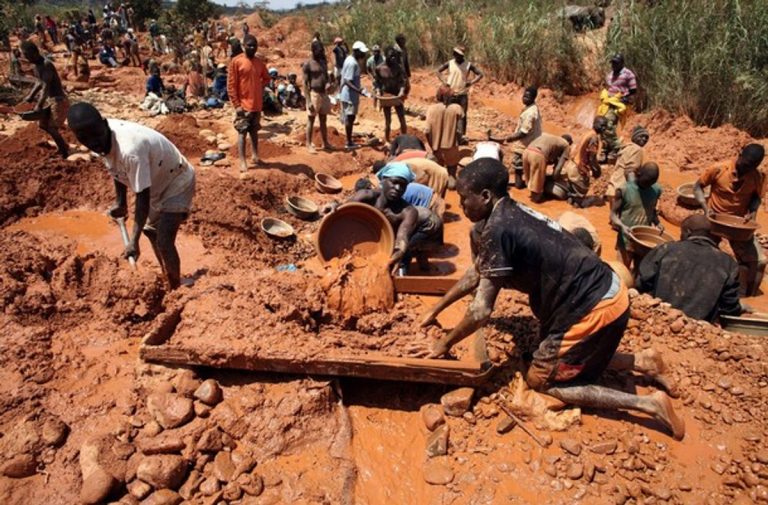
DAKAR/LIMA (Reuters) – The deaths of 43 illegal miners at a Glencore facility in Congo last week highlighted a growing challenge for mining companies struggling to secure sites from small-scale prospectors digging for cobalt, copper and other minerals.

 Artisanal gold miners sit outside a tunnel at an illegal mine-pit in Walungu territory of South-Kivu province near Bukavu in Democratic Republic of Congo, April 5, 2014. REUTERS/Kenny Katombe

Many mines span hundreds of square kilometers across rural terrains, a tantalizing prospect for illegal miners, also known as artisanal miners, who break into sites in search of metals, some of which end up in electric cars and other products.

But even as last Thursday’s tragedy ratcheted up pressure on companies to make changes to security and community outreach, industry consultants and analysts say the task will be difficult given the geographic constraints and economic challenges faced by the world’s estimated 40 million artisanal miners.

“If people do not have work or an industry, they rely on this activity,” said Patrick Hickey, a mining industry consultant who has worked at mines across Africa.

“Where you can fence off the mine site, you do. Where you can’t, you try to use security. But it is difficult.”

Thursday’s tragedy occurred in Democratic Republic of Congo’s Kamoto Copper Company (KCC) concession, which spans kilometers of flat terrain on the outskirts of Kolwezi in the southern part of the country. The mine is operated by Kamoto Copper Company (KCC), a joint venture between Glencore-controlled Katanga Mining Ltd and the state-owned Gecamines.

Only part of the perimeter, which abuts densely-populated residential areas, is protected by fencing, giving the local population easy access. Young men can often be seen just outside the mine carrying shovels and sacks brimming with freshly-mined ore to nearby trading depots dominated by Chinese buyers.

Private contractors provide most of the security, but activists say they are often ineffective and easily bought off by the miners in exchange for ignoring trespassers.

About 2,000 illegal miners regularly access the site, Glencore said.

Congo’s military plans to deploy troops to the KCC site, as it did in late June when it sent hundreds of soldiers to protect the Tenke copper and cobalt mine, which is owned by China Molybdenum Co Ltd.

“Security is not a highly-paid profession, so if you can get kickbacks from turning a blind eye, it can make you money,” said Nicholas Garrett of RCS Global, a consultancy which audits mining supply chains.

In South Africa, there are an estimated 30,000 illegal miners providing one of the biggest sources of illicit gold on the continent, with an output of around 14 billion rand ($994.4 million) per year, according to ENACT, which conducts research into transnational organized crime.

The illegal miners are known in Zulu as “zama-zamas,” which loosely translates as “those who try to get something from nothing.”

Sibanye-Stillwater, which spent millions upgrading its security infrastructure, found almost 1,400 zama-zamas in its Cooke gold mine during a 2017 security sweep.

“We have been continually arresting and trying to control access to the mines, but it’s been difficult,” said Sibanye-Stillwater spokesman James Wellsted.

CONCESSIONS

Governments and industry have been setting aside concessions for artisanal mining, but there are not nearly enough of those concessions to employ all the artisanal miners, many of whom continue to target larger deposits.

Miners operating in risky jurisdictions, as a result, employ a variety of measures – ranging from antagonistic to collaborative – to safeguard operations.

Such steps include the use of private security with military or police backgrounds; fences or other physical structures; regular border patrols; and even allowing artisanal miners access to certain areas of their operations, according to presentations from Barrick Gold Corp, Freeport-McMoRan Inc, Kinross Gold Corp and Newmont Goldcorp Corp.

Even still, artisanal miners slip through surveillance. In 2013, two were killed at Barrick’s Porgera mine in Papua New Guinea in a confrontation with police after a large crowd of illegal miners gathered at the mine, Barrick said at the time.

A spokeswoman for Barrick declined to comment on the company’s latest security measures.

‘SHORT-TERM SOLUTION’

Delphin Monga, provincial secretary of the UCDT union, which represents KCC employees, said police fired teargas a few months ago to try to chase off the diggers, but it was only a temporary deterrence.

Asked whether deploying the army would be an effective deterrent, Monga said: “Maybe as a short-term solution. But the dissuasive measures taken by the police and army do not intimidate the diggers.”

Some human rights activists say that armed responses to artisanal miners only exacerbate tensions with locals and ignore the underlying problems, which include the failure of large-scale mines to meaningfully contribute to development gains for the impoverished communities.

Artisanal miners “are the world’s hidden suppliers, and they’re working in horrible conditions,” said Karen Hayes of Pact, an NGO working across Africa to bolster supply chain transparency. “We already buy their minerals, whether we recognize it or not.”

In South America, Fura Gems Inc says securing all of its rural land in Colombia would be virtually impossible, so the emerald miner allows access in some areas, though it has promised to close a network of illegal tunnels.

“A mining company can’t do the job police do,” said Luis Rivera, an executive with Gold Fields Ltd and president of the Institute of Mining Engineers of Peru.

(This story corrects paragraph 21 to remove reference to Barrick being the world’s largest gold miner by market value)


Zesa insolvent

0

THE Zimbabwe Electricity Supply Authority (Zesa) is insolvent with its liabilities outstripping its assets by over US$92 million, a report by the Auditor General Mrs Mildred Chiri reveals.

The report was tabled in Parliament last week.

“I draw your attention to the fact that the company’s current liabilities exceed its current assets by US$92 118 178, this indicates that a material uncertainty exists that may cast significant doubt on the company’s ability to continue operating as a going concern,” Mrs Chiri said.

In 2017 the company’s liabilities exceeded its assets by US$84 167 798.

The AG also said the company’s financial were in shambles.

“Because of the significance of the matter described in the basis for the adverse opinion section of our report, the financial statements do not present fairly, in all material respects, the financial position of Zesa Holdigs Private Limited as at 31 December 2018, and its financial performance and cash flows for the year then ended in accordance with International Financial Reporting Standards,” she reported.

Zesa has attributed the challenges it faces to the sub-economic tariffs it charges resulting in production costs of electricity to remain higher than the sale costs.

The company last had a tariff increase in 2011.

It owes foreign power suppliers, Hydro Cahorra Basa of Mozambique and South Africa’s Eskom of at least US$80 million.

Government has paid US$10 million to South African power utility, Eskom, and paid off $20 million to Zesa Holdings to clear its debt.

Zesa is also expected to get an advance of $20 million from Government, in a move expected to improve power generation.

The country has been facing long periods of power outages due to depressed generation capacity because of low water levels at Kariba dam and obsolete equipment at Hwange Thermal Power Station.

The power utility has also been saddled with rampant cases of corruption has resulted in the suspension of its chief executive officer Mr Josh Chifamba.

One of its subsidiaries the Zimbabwe Electricity and Transmission and Distribution Company which paid US$4,9 million to Pito Investments for transformers it has not taken delivery of.

The same contractor was also paid in advance US$561 935 by the Zimbabwe Power Company in 2016 for the same equipment and is yet to deliver._The Chronicle

ZIM plans to conduct a full gas exploration

0

ZIMBABWE plans to conduct a full exploration of its gas deposits in a bid to establish the quantum of the key resource before engaging potential investors.

Top United States firm, General Electric and some local firms are thought to be keen on conducting the exploration and consequently exploiting the critical resource which has potential to transform lives.

Coal-bed methane or natural gas occurs in Matabeleland North province mainly in Hwange-Binga-Lupane area as well as the south east Lowveld in Chiredzi.

While fielding questions from the media during the launch of the Zimbabwe National Industrial Policy last Friday, Industry and Commerce Minister Nqobizitha Mangaliso Ndlovu confirmed the development.

“That is a Ministry of Mines issue but just to highlight the issues that happened when we were in Mozambique . . . we thought it was important that we do full exploration on our LPG (liquefied petroleum) gas so that we know the resource which we have and this will better guide Government as we negotiate for any investments that are coming through. 

“There was an indication that GE (General Electric) will take interest but we also have local players who are indicating that they could assist us with that,” said Minister Ndlovu. 

Natural gas can be used for heating and cooking, industrial uses in electricity generation and production of chemicals such as ammonia based fertilisers.

GE, whose officials met Zimbabwe’s delegation led by President Mnangagwa during the 12th US-Africa Summit in Maputo, Mozambique, is expected to send a strong team of staffers to Harare this month as the company steps up efforts to source investment opportunities.

The US firm, which is involved in energy, rail services, aviation and healthcare sectors, has been awarded the tender for the US$4,2 billion Batoka Hydropower Plant being undertaken by Zimbabwe and Zambia.

GE is working on the 2 400MW power project with China Power.

The company executive director (government affairs and policy for Southern Africa) Ms Lerato Molebatsi told our sister paper, The Sunday Mail yesterday that GE staffers destined for Harare will meet officials from the Ministries of Health and Child Care, and Energy and Power Development.


“Discussions are ongoing with various Government ministries, including the Ministries of Health and the Ministry of Energy. We are not yet at a stage where we can talk about specific projects as discussions are still taking place, but we are hopeful that the projects we are looking at can be announced soon,” she said.

“We will be in Zimbabwe in July for meetings with various ministries on several projects that have been put on the table. You may know that we have shown interest in the Batoka project and we continue to look at a number of other projects and partnerships with other developers. So, I will be in Zimbabwe mid-July with a few colleagues and it is only after then that we can discuss more about substantive issues.”

After meeting GE officials in Maputo, Finance and Economic Development Minister Professor Mthuli Ncube said the conglomerate “is very serious about investing in Zimbabwe”.

GE is a multinational firm valued at US$120 billion.

It has been operating in Africa for over 100 years._The Chronicle

Chihota retires as RioZim chairperson

0

RioZim Limited chairperson Mr Lovemore Pfupajena Chihota who recently celebrated his 80th birthday has retired from the board and has been replaced by the non-executive member of the board Saleem Rashid Beebeejaun.

According to a statement released by the mining company, Mr Chihota joined the Board of Directors on the 4th of December 2013 as a Non-Executive Director and was appointed as Chairman in November 2014. During his tenure, Mr Chihota provided the Board with strong, capable and critical leadership during a pivotal period in the Company’s history, in which period the Company grew and stabilised.

Mr Beebeejaun the newly appointed chairperson is a Fellow Member of the Mauritius Institute of Directors. He has served as a non-executive member of the RioZim Board since July 2012 he has 30 years of professional experience in both the financial and non-financial services sector, in particular in the African and Middle Eastern regions.

Beebeejaun has served as the Chief Executive Officer of several listed and non-listed companies.

In June 2013 he set up a management company, Baines Trust Corporate Services Ltd which he exited in 2017 and in 2014 Mr Saleem Beebeejaun set up Warwyck Private Bank, of which he was the first Chairman until April 2019.

Mr Saleem Beebeejaun is also the Chairman of the Task Force on Private Wealth Management in Mauritius, set up by the Financial Services Commission and is also the Honorary Consul of Malaysia

He is a recipient of the Global Leadership Excellence Award from the World Leadership Congress.

Mr Beebeejaun holds a Bachelor of Economics degree from the University of Montpellier I, France. He is a Fellow of the Chartered Institute of Insurance, UK, and was a winner of the HG Greening award in 1991, which rewards the first prize in all life subjects worldwide.

Miners emerge from underground after 9 day strike

0

AFTER spending nine days underground as part of a sit-in in protest against mine management300 miners emerged from the Lanxess Chrome Mines near Rustenburg.

Trade union National Union of Metalworkers of SA (Numsa) has called off its sit-in strike after reaching a settlement with mine management.

“The strike was very difficult for our members. They fought against an inflexible management who denied them food in an attempt to break the strike. For nine days they slept on the hard, cold stone floor of the shaft, in freezing temperatures, inhaling the fumes of the chrome dust,” Numsa spokesperson Phakamile Hlubi-Majola said in a media statement on Thursday evening.

“For the entire time, they were on strike they suffered the agony of being separated from their loved ones. But for them, the sacrifice was worth it, in order to expose a ruthless management.”

Workers at Lanxess Chrome Mine have been underground since Wednesday last week, striking largely over claims that Lanxess did not take action against a mine captain accused of sexual assault.

Numsa demanded:

  • The alleged perpetrator be suspended; and
  • The human resources (HR) manager, security manager and his wife who allegedly victimised the victim be investigated.

The mine and Numsa reached a settlement which said:

  • The alleged perpetrator will be placed on special leave pending the final investigation;
  • The mine will investigate the HR manager, security manager and his wife; and
  • Striking miners will not be fired.

“Lanxess management has created a hostile working environment for workers,” Hlubi-Majola said.

“This is a victory for Numsa and for our members. They made huge sacrifices to expose a cruel management and they emerged victorious.”