Home Blog Page 634

Corruption, child labor risk in Congo’s cobalt industry, OECD warns

0

Companies mining and buying copper and cobalt from the Democratic Republic of Congo must do more to fight corruption and child labor in the country, the Organisation for Economic Co-operation and Development said.

Congo is the world’s largest cobalt producer and fifth-largest producer of copper, according to the U.S. Geological Survey. As demand for the two minerals has soared with the growth of the electronic and electric-vehicle industries, so have worries about the conditions under which they are mined. Cobalt is a key component in lithium-ion rechargeable batteries, and Congo has almost half the world’s known reserves.

THE U.S. JUSTICE DEPARTMENT IS INVESTIGATING GLENCORE FOR ITS DEALINGS IN THE COPPER AND COBALT INDUSTRY IN CONGO

Child labor and human-rights abuses are common in small-scale mining sites in Congo, where independent, artisanal miners dig by hand, the OECD said in a report published Friday. While companies have been trying to address these concerns, they should also mind reports of corruption among the country’s biggest mining firms, the Paris-based organization said.

The U.S. Justice Department is investigating Glencore Plc for its dealings in the copper and cobalt industry in Congo. The U.K. Serious Fraud Office is also probing Eurasian Natural Resources Corp., a Kazakh mining company, for fraud and bribery in Congo. After the probe opened, ENRC’s owners formed a new company called Eurasian Resources Group, which now operates the Congolese mines.

Companies should be “proactive about addressing risks, for example by improving working conditions in artisanal mining or taking action to address corruption in their supply chains,” Ben Katz, co-author of the OECD report, said in a statement. Production from Congo’s artisanal mines often gets mixed in with industrial output, he said.

The OECD is an intergovernmental organization made up of mainly wealthy nations that supports world trade. The report is part of the group’s guidance for companies “to respect human rights and avoid contributing to conflict or bribery through their mineral or metal purchasing decisions and practices.”

Richard Muyej, governor of Lualaba province, where most of Congo’s cobalt and copper deposits are located, said the country is working to formalize artisanal mining, which employs as many as 150,000 people in the region. The province is also working with companies to improve the tracing of artisanally mined minerals from their source and to create zones where diggers can work without entering industrial mine sites, Muyej told a conference Friday in the provincial capital Kolwezi, where the OECD launched its report_Mining.com

Blue diamond found by struggling Petra sold for $14.9 million

0

South Africa’s Petra Diamonds (LON:PDL) has sold a 20.08-carat blue precious rock it found in September at its iconic Cullinan mine for $14.9 million, or about $741,000 per carat, which is the highest price analysts had predicted.

The “exceptional” blue gem quality diamond, Type IIb, was acquired by a “leading diamond company” that wishes to remain anonymous, Petra said.

“We are very pleased with this result which is in line with our expectations and confirms the resilience in the value of very high quality blue diamonds, undoubtedly one of nature’s rarest treasures,” CEO Richard Duffy said. “We look forward to following this exceptional stone’s journey to its polished form.”

THE 20.08-CARAT BLUE, GEM QUALITY STONE, WAS ACQUIRED BY A “LEADING DIAMOND COMPANY” THAT WISHES TO REMAIN ANONYMOUS, PETRA SAID

Petra has been trying to turn around its fortunes after piling up debt to expand Cullinan, where the world’s largest-ever diamond was found in 1905. That rock was cut into two stones – the First Star of Africa and the Second Star of Africa – and are now part of Britain’s Crown Jewels, held in the Tower of London.

The company’s share price collapsed to a record low amid falling diamond prices that forced it to write down the value of its mines in September by almost $250 million.

The financial struggles prompted the company to launch a restructuring that ended Friday with a number of organizational changes. Among them, Petra said it had removed the chief operating officer role, which meant Luctor Rode was no longer with the company.

Duffy said all mines would report directly to him from now on.

In the same boat

Petra is just one of the many diamond miners hit by ongoing market weakness that has hit producers of small stones hardest, due to an oversupply in that segment.

Increasing demand for synthetic diamonds has also weighed on prices. Man-made diamonds require less investment than mining natural stones and can offer more attractive margins.

Buyers, those that polish and cut diamonds for retailers, have been hit this year by lower prices and tighter credit, prompting them to delay purchases.

Tiffany’s reported in August a 3% decline in like-for-like sales, while shares in Signet, the world’s largest retailer of diamond jewellery, have lost more than 60% of their value this year.

De Beers,  the world’s No.1 diamond miner by value, has responded by axing production — with a target of 31 million carats this year compared with 35.3 million in 2018. It has also given buyers more room to maneuver, by allowing them to refuse half the stones in many of the diamond parcels.

As a result, De Beers was able to sell this month the most diamonds since June, though sales so far this year are down more than $1.2 billion from the same time in 2018.Mining.com

Mimosa explores areas to invest

0

ZVISHAVANE-based platinum miner, Mimosa Mining is exploring more areas to invest in, as part of its corporate social responsibility programmes, an official has said.

Speaking during a media tour at the mine recently, Mimosa head of corporate affairs Ms Elizabeth Nerwande, said the company has so far made a substantial investment in the education sector. 

“We are exploring areas to invest in as part of our corporate social responsibility. For now, we have made notable investments in the education sector, we have built hostels for students in vocational training centres, we have paid fees for hundreds of students and we continue to do more,” she said.

Mimosa Mining Company is one of the giant mining companies in Midlands that has made significant investments in corporate social investments such as Community Share Ownership Trusts. 

Meanwhile, the mining company recently donated two vehicles to Zvishavane Police Station, as part of its corporate social investment. Speaking during a ceremony to honour distinguished police officers in Zvishavane last week, Mimosa general manager Mr Alex Mushonhiwa said the gesture was to ensure that police can carry out their work efficiently.

“We are committed to serve communities which are free from harm where citizens can enjoy life, hence our partnership with the law enforcement agents. Today as we support the work done by the police force, we are donating two vehicles with accessories and five bicycles. We hope this gesture will help motivate police officers and enhance efficiency in the delivery of the ZRP mandate,” said Mr Mushonhiwa.

Speaking during the same event, Chief Masunda of Zvishavane said lack of resources is seriously affecting the fight against crime.

“We had been having serious challenges in the fight against crime. All along, there was only one vehicle in Zvishavane and it was affecting efficiency. We are grateful to Mimosa for this wonderful gesture,” he said.

Apart from the two cars and bicycles, the platinum miner also sponsored prizes to outstanding police officers, which saw the Cop of the Year walking away with $7 000 and a refrigerator.


The Sunday News

Diamond royalty slashed by 33pc

0

Zimbabwe’s diamond output is poised for a massive boom after Treasury cut the royalty for diamond mining to 10 percent from 15 percent of gross revenue to reduce the cost of extracting deep-seated kimberlitic gems.

Zimbabwe is targeting to ramp up diamond production from 3,2 million carats to 6 million carats by end of 2023 after the country launched a diamond mining policy recently.

Diamonds are a critical component of Zimbabwe’s plans to grow the mining sector into a US$12 billion industry by 2023 with revenue from exporting the precious mineral set to hit US$1 billion.

The diamond industry has since the turn of the century been characterised by mining, organised or informally, of alluvial gems in the Chiadzwa area of Manicaland Province.

Following the diamond rush of 2006, the Government moved in to restore order using then State-owned Zimbabwe Mining Development Corporation (ZMDC) to partner private players.

A total of seven companies, namely Marange Resources, Anjin Investments, Diamond Mining Company, Gyn Nyame Resources, Jinan Mining, Kusena Diamonds, and Mbada Diamonds were given licences.

ZMDC was then renamed Zimbabwe Consolidated Diamond Company (ZCDC) in 2016 after Government consolidated the mines amid serious concerns over transparency in the mining of diamonds in Chiadzwa with Treasury receiving paltry inflows.

This was despite the fact that the Government was an equal shareholder in each of the diamond mining entities, but after the consolidation of the mines, most surface diamonds got depleted and whoever mines gems in the area must invest in deep mining.

Presenting the 2020 National Budget, Finance and Economic Development Minister Professor Mthuli Ncube said that diamond miners are now exploiting deep-lying conglomerate deposits, hence the cost of extraction has significantly increased.

“In order to promote investment in exploration and extraction, I propose to review the royalty on diamond from 15 percent to 10 percent of gross revenue, with effective from 1 January 2020,” he said.

Following the consolidation of the seven companies in 2006, and two consecutive years of exclusively Government-dominated diamond mining, the Government completed a diamond mining policy this year and reopened the sector to private players.

The new policy streamlined the mining of diamonds to only four players, namely State-owned ZCDC, Russia and global diamond mining giant Alrosa, Chinese firm Anjin and gold miner RioZim’s Murowa.

However, two additional diamond miners are expected to be announced by December this year that will undertake gem production in partnership with ZCDC.

In terms of those that have already been licensed, Anjin is expected to start production by December this year while Alrosa will commence exploration by January 2020.

A roadmap for the growth of Zimbabwe’s US$12 billion mining industry says the country will establish a gemmology centre for cutting and polishing diamonds and a value management centre for cleaning and sorting the gems to enhance their market value.

The Sunday Mail

Illegal miners close in on Harare

0

NOTORIOUS fortune seekers, mostly gold panners, have announced themselves on Harare’s door step.

The illegal miners have set up camp at Kintyre Estates, where they are tearing into a mountain supporting the walls of Lake Chivero.

As a consequence, they are increasing the pollution of an already toxic Lake Chivero through the use of chemicals such as mercury.

Harare Mayor Councillor Herbert Gomba confirmed this: “The illegal miners are discarding heavy chemicals such as mercury into Lake Chivero and as such have put the water body and human life at risk. We have referred the issue to both Government and the police so that they can be stopped.”

The gold panners and their supporting businesses have sought accommodation in nearby Norton, where they have invaded the usually sleepy town, which until recently enjoyed a low crime rate, affordable housing and prospects of economic prosperity.

Others have been operating in Hatcliffe Extension, where they are threatening anything that stands in their way — be it roads, entire suburbs, schools, Glen Forest cemetery and any other important infrastructure.

According to Chiedza Chipangura, an official with the Zimbabwe Miners Federation and a former chairperson of the Norton Miners Association, “gold is everywhere in Zimbabwe”.

This means if left unchecked, these fortune-seekers could soon be digging up buildings in Harare and disturbing the network of fibre optic, electricity cables and water pipes.

“As I speak, there is a gold rush in Chidamoyo, Hurungwe. Even Harare is sitting on top of gold and if the illegal miners are not tamed, we might wake up to see them digging up the streets,” Chipangura said.

Harare can actually learn from what these makorokozas have done to towns such as Shurugwi, Kwekwe and Kadoma, where they turned everything upside down in search of gold.

Chegutu and Norton are the latest victims of the marauding gold panners, who will stop at nothing to get the precious mineral.

Until recently, Norton was just a small town some 40km west of Harare, a bastion of tranquillity and economic growth. Strategically located near Lake Chivero, Harare’s major source of fresh water, Norton’s rich farm lands and vast organised mining activities came under attack with the arrival of the gold panners.

Founded in 1914, the town prides itself in having factories, a pulp and paper mill and even a brewery.

Thousands of people, the majority of them coming from Harare and Chegutu, flocked to Norton. Among those that fell in love with the town included the late national hero and music superstar, Oliver Mtukudzi, who called Norton his home until he breathed his last.

However, the town’s reputation as one of the fastest growing and safest urban settlements came to a screeching halt when illegal gold panners began scouring for the precious metal in areas surrounding the town.

The influx of the machete-wielding miners has resulted in some of the residents regretting their decision to set base in this town.

As a result of all the bad things associated with the violent panners, Norton has, to a larger extent, become an undesirable destination for many.

Among the prime farming areas that have been invaded by the panners are Kent Estates, Westband and Donnington farms, thereby reducing agricultural land to dangerous pits and gullies.

The panners, among them the feared “Mashurugwi” gangs, are travelling from as far afield as Shurugwi, Silobela, Gweru, Gokwe and Mutare. Apart from stealing and forcibly taking ore from mines, the panners are also wreaking havoc at shopping centres.

Most bars are now no-go areas for locals, as the panners, who have a penchant for violence, attack locals at the slightest provocation. Rival illegal panners often take their feuds to the drinking spots, resulting in some of the locals being caught up in the crossfire.

Many locals are believed to have lost both life and limb.

As news of the miners’ violent activities become more frequent, distressed calls by Norton residents for authorities to put an end to this madness are growing louder by the day.

The burning down of a house in Norton Ward 12 by a gang of panners who were fighting over a commercial sex worker has proved to be the final straw.

Civic and political leaders, farmers, miners and the residents have since joined hands as they moot ways of ending this menace.

Laston Tachiona, the Norton Ward 12 councillor, is regretting the residents’ decision to rent out accommodation to the illegal miners.

“This is a disaster. Since the miners are our fellow brothers and countrymen, we embraced them and rented out rooms to them. It appears we are now being punished for being compassionate,” Tachiona said.

Ward 12 covers the high-density suburbs of Maridale, Kingsdale and Garikai, where the majority of the panners are living. Tachiona says as a result of the panners’ violent dispositions, the residents are now observing a curfew of some sort.

“We are telling locals not to patronise the drinking spots that are frequented by the miners. We are also encouraging them not to drink late into the night. As residents, we need to stay away from these people whose motives are always dangerous,” said Tachiona.

Letwin Nyagano, vice-chairperson of the Norton Development Association, said the presence of the violent panners is bad for both social and economic development.

“They come here, forcibly take gold ore and beat up beerhall patrons. The gold they forcibly take is channelled towards the black market and we are not in any way benefiting from associating with the illegal miners,” Nyagano said.

Her counterpart, Liziwe Musevedza, the chairperson of the Norton Residents Development Trust, echoed the same sentiments.

“All they do is drink and fight. They are not adding any value to our community,” Musevedza said.

Temba Mliswa, Norton House of Assembly member, has been very vocal on the issue, calling upon authorities to find ways of dealing with the panners.

Mliswa even suggested that locals take up martial arts as a way of defending themselves from the dangerous miners.

Mululeki “Mayor” Ncube, a Norton-based journalist, said the local authority has seemingly run out of ideas in their efforts to bring sanity to the town.

“The panners are a law unto themselves and the residents are distraught and helpless. Something must be done urgently,” Ncube said.

Chipangura, who represents the Zimbabwe Miners Federation in Mashonaland West Province, said the problems that are associated with illegal gold miners are not only confined to Norton.

“There are people holding on to mining claims and are not productive, resulting in panners invading such claims. If those that own claims can be productive, we can do away with such problems,” Chipangura said.

The illegal miners have also encroached onto farming land in nearby Zvimba East.

Ruzai Muchaurawa, the Ward 25 Councillor in the Zvimba Rural District Council, confirmed the presence of artisanal miners in Zvimba.

“The illegal miners are coming from Norton and are giving us sleepless nights. Something should be done urgently,” Muchaurawa said.

With the gold panners’ foot already in the country’s capital city Harare, will authorities finally take notice and curb this marauding force of brutality, destruction and thievery?

Only time will tell_The Sunday Mail

Blanket Mine shrugs off power crisis, Q3 gold output 7% up

0

Caledonia Mining says production at Blanket Mine rose over 7% in its latest quarter, despite power outages and rising costs.

In the three months to September, gold output dipped 2.4% year-on-year to 13,646 ounces, held back by lower mining rates. However, gold production was up 7.3% quarter-on-quarter.

Tonnes milled improved on the two quarters and the average milled grade for the quarter was 3.19g/t, an increase on the previous quarter’s grade of 3.11g/t. Low grades

In terms of costs, all-in sustaining costs – a key metric used by mines to determine all costs and efficiency – were 16% higher. However, the average realised gold price was 23% higher, offsetting the year-on-year drop in production to help Caledonia double profits to US$10.4 million.

“The third quarter of 2019 can be characterised by two distinct phases. The first six weeks of the quarter were seriously affected by power outages and by the continued effects of the unstable economic conditions in Zimbabwe on our employees; both of these factors had an adverse effect on production and financial performance,” says Chief Executive Steve Curtis.

“The last six weeks of the quarter showed a substantial improvement as the electricity supply improved, and measures taken in previous quarters to improve mining controls began to bear fruit. Notwithstanding further interruptions to the electricity supply in October, the excellent performance in the second half of the quarter has continued into October and early November,” Curtis added.

The company has increased its focus on minimising mining dilution, after lower grades forced it to cut production guidance for 2019 to between 50,000 and 53,000 ounces, down from previous forecasts of 53,000 to 56,000 ounces. Caledonia is still confident of meeting those targets, before lifting output to 80,000 ounces in 2020.

According to Curtis, while there is still work to be done on the grade front, Blanket has begun delivering improved grades, combined with higher tonnage and efficiencies.

“I am pleased to report that production in October has continued this positive trend with production of 5,596 ounces in October at a grade of 3.55g/t. I look forward to updating the market on the full year and we reiterate our full year production guidance of 50,000 to 53,000 ounces for 2019,” said Curtis.

The company has recently floated a tender for a solar plant to feed Blanket Mine, a way of solving the power crisis. According to Caledonia, the recent power tariff hike could stabilise supply.

“Although the electricity supply situation has improved, this problem has not been permanently resolved. As we have previously announced, the situation has improved following the introduction of a revised electricity tariff during the quarter which allows the funding of imported electricity which is used exclusively to supply participating mining companies.”


NewZwire

Mineral exports up 13pc in first 10 months

0

Zimbabwe’s mineral exports rose by 12,7 percent to US$1,59 billion in the first 10 months this year compared to the same period in 2018, according to Minerals and Marketing Corporation of Zimbabwe (MMCZ).

The MMCZ is the country’s sole minerals marketer except for gold and silver that fall under the ambit of Fidelity Printers and Refineries (FPR).

The figures were confirmed by MMCZ general manager Mr. Tongai Muzenda.

The increase would be seen as a tonic the mining industry is looking for as it gears towards the attainment of US$12 billion worthy of annual exports by 2023.

However, the MMCZ’s interest on the 2023 milestone is US$8 billion as the other US$4 billion is expected to be contributed by gold exports.

“Our total sales amounted to US$1,59 billion in the first 10 months of the year,” said Mr Muzenda.

“There are positive market takeaways in the third quarter in that we have seen some prices holding up compared to the first six months. The prices of PGMs, for example, have gone up and this is especially the case with rhodium,” said the MMCZ boss.

On specific mineral contributions, PGMs continue to dominate, having accounted for about US$1 billion of the total figure.

With beneficiation efforts now in full swing and private companies having bought into Government’s call to add value locally, high carbon ferrochrome continued on an upward trend and has so far raked in more than US$250 million, and expectations are high that this will continue in line with installed capacity for ferrochrome production.

“In terms of contribution to the total, almost a billion dollars is from PGM concentrates and PGM matte from the three producers — Zimplats, Unki and Mimosa in that order in terms of tonnage and value,” said Mr. Muzenda.

“On diamond sales, the total was US$142 million for the 10 months. Other metals of interest are high carbon ferrochrome, which was US$254 million, which is not bad.”

Despite the recorded increase in exports, the haul, however, fell 11 percent below set target of US$1,79 billion that the State marketer attributed to depressed PGM prices, particularly in the first half of the year.

Production has also been hit by incessant power cuts as a result of state power utility, Zesa Holdings’, rationing of electricity due to subdued production at its major plants.

Some mining houses have, however, not been affected by these power cuts as they have ring-fencing arrangements with the power utility.

However, just last week, Zesa said they were no longer able to guarantee supply even to ring-fenced customers as these too could be affected by internal challenges.

Concern overpower supply has resulted in the country’s mining confidence plunging to a two-year low with the miners’ lobby group — the Chamber of Mines of Zimbabwe — compiling a report that shows the Mining Business Confidence Index (MBCI) had declined to 2,2 percent this year.

Despite these challenges, Mr. Muzenda said MMCZ was still expecting a strong showing in the last two months of the year, with projections set at between US$200 to US$300 million in November and December.


The Sunday Mail

Terror & riches at Jumbo Mine

0

A stamp mill pounds steel against rocks, producing echoes across the pit-riddled fields.

Huge boulders, from beneath mother earth, are spread haphazardly alongside uprooted trees.

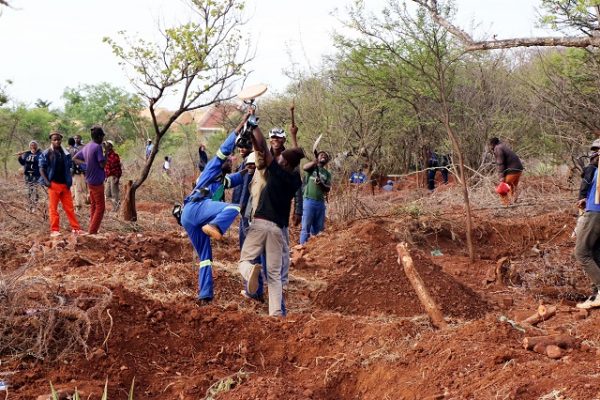
Middle-aged men covered in red soil dust crush rocks in deep pits in search of gold.

Some haul the ore to the surface, in preparation for a possible life-changing sale.

It is evident the activities of these men are not choreographed, it is each man for himself.

Both individual and gang operations have the same goal — extracting gold.

Located some 40km north-west of the capital Harare, Jumbo Mine is one of Metallon Corporation Limited’s four gold-producing mines.

However, it closed in 2015 due to mounting debts.

Over the past few months, the abandoned mine has attracted a huge number of illegal gold miners. The mine has a labyrinth of underground tunnels and gold seams, it is said.

In turn, the yellow glittering nuggets have detached the area from the rest of the country in terms of the medium of exchange.

Despite its dilapidated infrastructure and lack of development, the area is bursting with United States dollars.

Residents say when compared to the greenback, the local currency is in short supply there.

Various models of vehicles, fitted with local and foreign number plates, rumble up and down the dusty pathways day and night in search of gold and the United States dollar.

For any commodity that is sold at Jumbo Mine, prices are normally charged in United States dollars.

Vendors and ladies of the night are said to be making a killing.

“The hive of activity in this area is a testament of the economic activities here,” a resident only identified as Gilbert told The Sunday Mail Society during a recent visit to the mine. “Business is booming in this area, vendors come from far away places to sell basic commodities such as water, bread, and even ball lollipops.”

Conservative estimates by our team and small business operators in the area put the number of people that are currently living and panning gold at Jumbo Mine at around 5 000.  To confirm the level of activity taking place at the defunct mine, it takes a minimum of two hours to catch a lift from Harare to Bindura these days.

What is the reason behind such a delay?

Well, almost every public transport vehicle going that direction is now plying the Harare-Jumbo Mine route.

“Jumbo Mine yabhadhara (Jumbo Mine is giving us brisk business). People are coming from every corner of this country to do business here. Not everyone is a miner, some sell different wares while others are sex workers.

“The only danger is that some of them are not genuine customers. It’s risky dealing with them but it’s a risk worth taking because our families have to eat and the money is good,” said a pirate taxi operator, who only identified himself as Kuda.

Curse

However, there is a trail of corruption, terror and violence beneath the gold riches.

On many occasions, security personnel in the area have been called to quell clashes between the illegal gold panners.

“I came here from Gokwe in search of gold,” Given Moyo, an illegal miner, told this publication. “Ever since I became a gold miner, I thought I had become brave. Mudslides or collapsing earth do not deter me from gold mining, but now with the violence, I have every reason to fear for my life.

“The MaShurugwi or Mabhudhi gangs are terrorising and robbing us of our gold.”

Former mine authorities and security are reportedly charging US$15 per head to allow the illegal gold miners into the mineshafts during the night.

lt is said they rake up to US$1 500 per night through the practice.

According to Given, most of the violent activities often play out underground.

“The surprising thing is that before entering the mine, we are searched for weapons by the security or mine authority,” he said.

“The least number of MaShurugwi that can enter a mine shaft is 50. The number is normally huge so as to outnumber us. They take away our torches, food, and gold. If you do not have any gold, they will enslave you to work for them, you will give up all the gold you would have worked for.

“They can keep you underground for up to four days. If you are lucky they will only beat you up. However, most of our colleagues are not so lucky and do not survive the beating. Most of these cases are not reported to the police,” said Given,who has since given up forays into the main shaft.  Most fearful miners, like Given, have opted to dig up pits outside the mine. However, the pits are a stone’s throw away from the residential area.

“We are always pleading with these miners to stop their activities near our homes, but they tell us off. Some even say we should vacate or risk having the houses collapse on us,” said one resident who elected to remain anonymous for fear of victimisation.

Last month, residents in Glendale, near Mazowe, clashed with illegal gold miners, leaving a trail of destruction.

Minister of State for Mashonaland Central Provincial Affairs Cecilia Mavhunga said Government is working on re-opening the mine to eliminate the chaos.

“The situation at Jumbo Mine is really getting out control,” she said.

“Although the mine was closed, there was a gold rush and illegal miners have a way of getting into the mine. The police on the ground have been working to control the situation and I was there recently with the Minister of Mines and Mining Development to find a lasting solution on the issue.

“lncidents of violence and deaths are happening inside the shafts. We are working on re-opening the mine, some former mine employees are still based at that mine.”

Police spokesperson Assistant Commissioner Paul Nyathi confirmed the problems at Jumbo Mine and other mining communities countrywide. “We urge communities to resolve their differences amicably,” he said in a terse response.  Despite the appeal, Jumbo Mine continues to be a place of terror.

The Sunday Mail

ZIMRA calls for vehicle verification exercise, 433 affected

0

ZIMRA has called on to Vehicle owners on a list of over 400, released recently to visit the main ZIMRA Head Office in Harare for vehicle registration verification.

The comprehensive list has names of registered owners, vehicle registration details and vehicle chassis numbers. On the list are notable institution like TM Supermarkets and number of small-scale miners are also on the list.

The ZIMRA statement reads as follows, “The Commissioner-General of the Zimbabwe Revenue Authority is hereby notifying the owners of vehicles listed below to visit ZIMRA Loss Control Offices at ZB Centre corner First Street and Kwame Nkrumah in Harare for vehicle registration verification. The vehicle owners are instructed to bring the vehicle together with all customs clearance documents pertaining to their vehicles no later than 23 November 2019″.

[pdf-embedder url=”https://miningzimbabwe.com/wp-content/uploads/2019/11/zimra-vehicle-verification-exercise.pdf”]

CLICK HERE TO DOWNLOAD LIST

USD12 billion road map achievable?

0

Last month the President of Zimbabwe Emmerson Dambudzo Mnangagwa unveiled the USD12 billion road map with aims at developing the mining sector in Zimbabwe to a USD12 billion industry by 2023. The mining sector is already Zimbabwe’s biggest foreign currency earner. Experts and the government are of the view that the sector is the leading horse towards the revival of the economy.

Rudairo Dickson Mapuranga

The President’s USD12 billion road-map has put a target of USD4 billion for gold producers which is a third of the target while platinum and diamonds will weigh in with US$3 billion and US$1 billion, respectively. Chrome, Nickel and Steel are expected to generate USD1 billion, coal and hydrocarbons are also expected to produce USD 1 billion. Lithium at the moment is expected to produce USD0.5 billion while other minerals are forecast to produce USD1.5 billion up to USD 2 billion.

It is a well-known fact that Zimbabwe is hamstrung by a lack of mining exploration, moving to the USD12 billion industry by 2023 and of course becoming a middle-income earner by 2030, investing in mining exploration is the key. However, it is also a known fact that tapping of the known deposits in the country should be of primary concern.

Investment in mining prospects should be the country’s number one concern towards improving the mining sector and the economy at large. Is it possible for the sector to earn 12 billion annually by 2023?

Is the USD12 billion target achievable?

With the copiousness mineral deposit, the country is sitting on both under exploitation and unexplored but known resources, the country has the potential to earn and turn the wheels of the economy and transform the country into an upper-middle-class earner not later than 2023. It is, therefore, Mining Zimbabwe’s opinion that the country can reach the president’s vision of the country becoming a middle-income earner by 2030 with the backup of the mining industry.

The miners’ support

The Miners in Zimbabwe have thrown their weight behind the USD12 billion roadmap for the mining sector in the next three years optimistic that the target was achievable, however, miners are of the knowledge that certain initiatives, policies, and reforms need to be looked into for the sector to achieve the USD12 billion fate.

USD 4 billion for gold, is it possible?

The mining sector last year earned US$3,4 billion, driven by the high performance of the gold sector, which delivered a record 33,2 tones. Overall last year the sector failed to earn USD 4 billion how can the sector as a whole achieve that feet?

Experts are of the view that the majority of Zimbabwe’s gold is being smuggled out of the country through different channels and the nation is losing millions due to rampant smuggling.

In order to achieve the USD 4 billion mark, there are various factors that need to be addressed by the government for the gold sector to achieve the target.

(a)    Curb gold smuggling there are various reasons which have led to gold smuggling from Zimbabwe among them, the 55/45 per cent retention, late payments from Fidelity and various Statutory Instrument (SI) implemented by the government.

In order for the sector to achieve the target, it is of paramount importance for the government to consider paying gold miners what they are demanding, pay the gold producers on time to limit alternative markets and remove the current SIs gazetted by the Minister of Finance Mthuli Ncube which banned the use of foreign currency in all local transactions and pricing of equipment in foreign currency.

(b)  Invest in gold prospecting – The government of Zimbabwe needs to revive the gold mining sector by investing in gold mining through Fidelity, supplying miners with equipment, make public the gold development fund and issue miners with prospecting licenses on time in order for them to acquire loans. Geologists believe that there is a little activity happening along the Great Dyke for the country to reach full gold exploitation.

(c) Invest in Exploration – Production in Zimbabwe is limited by a lack of exploration. Identifying new mines in the mining sector is key, the government should, therefore, make it their duty to invest in exploration through granting as much EPOs as possible to various EPO holders.

USD 4 billion nearly not possible

Identifying a gold mine is a daunting task, it can take up to 10 years for geologists, chemists, and engineers to examine a potential site. And even then, the likelihood of a mine being developed into a production gold mine is less than 0.1 per cent. Only ten per cent of these sites contain enough gold to justify further development. But above ground, gold is everywhere. New deposits of gold are increasingly hard to come by and increasingly difficult to locate. Geologists have estimated that only 55 tons remain buried away in the Earth’s crust. This means, if current global mining rates continued, we could run out of newfound gold in just 20 years. So as gold Mining continues to slow and the cost associated with mining increase to meet the challenge of extraction, gold could become even more expensive.

Can the intended target for PGM be reached?

Zimbabwe hosts the second-largest platinum group metals (PGMs) resource in the world on the Great Dyke. An estimate of 2.8 billion tones PGM ore at 4g/t 4e is estimated to lounge on the Dyke. Grade and thickness of ore body persist over large areas.

It is indeed true that the sector can contribute up to USD 3 billion and push the economy of Zimbabwe to yester year’s heights thereby helping the nation reach the USD 12 billion targets however it could be difficult for the country to reach by 2023 without the necessary steps taken by the government.

It is, however, of no doubt that the PGM sector has all it takes to contribute even more than its projected target through the coming in of projects like Karo and other platinum mining firms.

The possibility of diamond contributing USD 1 billion Is it very high?

Zimbabwe in the Marange field has the largest diamond field in the world in terms of carats produced, estimated to have produced 16,9 million carats in 2013 that is about 13 per cent of the global rough diamond supply. However, diamond production at Marange is estimated at under USD 60 per carat while some diamond mines in the world produce rough diamonds valued at over USD 1000 per carat.

Zimbabwe has other diamonds reserves in Masvingo, that is Chivi, Beitbridge, Mwenezi, and Mazvihwa in Zvishavane where the diamond miner RioZim’s Murowa diamond is the miner. Murowa diamond at its Mazvihwa reserves has a record high of 740,244 carats in 2018.

Vast resources PLCThe President of Zimbabwe and the Minister of Mines and Mining Development were optimistic that the diamond sector will have an immense contribution than before through the coming in of world’s biggest miners in the diamond sector like Anjin, Alrosa, and Vast Resources.

It is, however, important to note that Zimbabwe is at loggerheads with the west, the selling of its diamonds is at risk with the US Customs and Border Protection ridiculously alleging the use of forced labour in Zimbabwe’s diamond mining sector. The sector could lose market if the government does not prove to the world that the allegations are malicious.

It is not a big target for Chrome, Nickel and Steel to generate USD1 billion?

Zimbabwe has the second-largest high-grade chromium ores in the world after South Africa with reserves of approximately 10 billion tones. The country has more untapped than tapped Nickel deposits with only Trojan mine in Bindura only mining the mineral at a very low scale.

Only steel production can reach the target in this category if plans are in place to revive the sector. However, as of now it could be just wishful thinking with no plans in place.

The government also needs to address issues of predatory chrome pricing in order for miners to invest in the sector.

Half a billion for lithium?

Zimbabwe has one of the world’s biggest hard rock lithium. The Arcadia lithium project located near Harare, Zimbabwe, is considered to be one of the world’s biggest hard rock lithium resources.

Prospect Resources fully owns the lithium project, which is estimated to produce an average of 75,000 tones per annum (TPA) of spodumene and 155,000tpa of petalite concentrates during its 20-year mine life.

In 2010, lithium was added to the United States governments’ list of critical minerals — minerals that are important to the country’s manufacturing and defence industries, highlighting its growing importance in the global economy.

Through the Arcadia Lithium project alone, the sector can generate more than half a billion per annum, however, the project could start kick to its full potential slightly after 2023 which means that the government’s target may fall by the wayside.

USD 1, 5 billion from other minerals?

The country has one of the world’s highest mineral deposits with records showing that the country has got almost all the minerals found on earth. There are various projects underway from oil and gas to gemstones.

According to one miner, the gemstone sector only has the ability to earn USD 2 billion annually if the government through Minerals Marketing Corporation of Zimbabwe (MMCZ) focuses on promoting the sector to attract buyers and value addition.

Overall conclusion, can the sector earn USD 12 billion per annum by 2023?

Mining Zimbabwe believes that it is possible for the sector to earn more than USD 12 billion per annum, however, certain points need to be addressed before the government starts on preaching about the USD 12 billion mining sector.

The government of Zimbabwe needs to take on the following 10 priorities which will get the mining sector moving towards the USD 12 billion industry.

(i) Eliminate corruption– although not muchly recorded corruption in the sector is too prevalent and the cancer of corruption needs to be dealt with once and for all.

(ii) Institutionalise the rule of law to end statutory risk– there should be no changes to rules and regulations without wide stakeholder consultations and advance notice.

(iii) Stable economic environment- A stable economy where property rights are respected and policy is consistent will help stabilize the mining sector, thereby leading to the growth of the sector through attracting the right investment.

(iv) Currency must be free-floating and tradable – A floating exchange rate is a regime where the currency price of a nation is set by the forex market based on supply and demand relative to other currencies. This is in contrast to a fixed exchange rate, in which the government entirely or predominantly determines the rate.

(v) Economic growth- Capital Flows Foreign capital tends to flow into countries that have strong governments, dynamic economies, and stable currencies, therefore, Zimbabwe needs to have a relatively stable currency to Attract investment capital from foreign investors.

(vi)Absolute minimal restrictions on lines of communication, especially the internet- The government of Zimbabwe reportedly lost millions of dollars through delayed Revenue inflows due to the slow processing of imports and exports after switching off the internet services countrywide early this year.

(vii) Improve geoscientific knowledge by revamping and recapitalising the Geological Survey Dept.

(viii) Partially privatise ZMDC- ZMDC is reportedly dead broke which led to speculations that they cannot afford to explore their numerous claims. Many assertions are constantly being thrown around which are of the view that ZMDC is sitting on dead assets and the government has no money to give so as to carry out high-risk exploration. Therefore, this has led experts into believing that, ZMDC must be listed on the stock exchange to raise money and obviously the government gets diluted to less than the controlling shareholder.

(ix) Promote exploration seriously with good tax breaks for companies who put high-risk exploration $ into the ground.

(x) Digitalise mining rights, title registration, and all payments – Amidst reports of corruption, money laundering, externalization and other unscrupulous behaviours by mining personnel, all transactions which are mining-related in Zimbabwe if done digitally this will avoid corruption and Improve transparency.

The government of Zimbabwe, therefore, needs to prioritise on these 10 points in order for the sector to achieve the 12 billion dollar status without which it will be just another project that will never yield results like the other targets previously set by the government.