Home Blog Page 640

Oil prices fall on surging U.S. crude supply, economic slowdown

0

Oil prices fell on Thursday, pressured as U.S. crude stockpiles surged to their highest levels in almost 17 months amid record production and as economic concerns cast doubt over growth in demand for fuel.

International benchmark Brent futures were at $71.44 per barrel at 0424 GMT, down 29 cents, or 0.4 percent, from their last close.

U.S. West Texas Intermediate (WTI) crude oil futures were at $64.28 per barrel, down 33 cents, or 0.5 percent, from their previous settlement.

U.S. crude inventories rose 7 million barrels to 456.6 million barrels in the last week, their highest since November 2017, the Energy Information Administration said on Wednesday.

U.S. crude oil production remained at a record 12.2 million barrels per day (bpd), making the United States the world’s biggest oil producer ahead of Russia and Saudi Arabia.

There are also concerns that an economic slowdown will soon dent fuel consumption after the International Monetary Fund this week downgraded its global growth forecast to the lowest in a decade.

Despite the surge in U.S. supply and the economic concerns, global oil markets remain tight amid supply cuts led by the Organization of the Petroleum Exporting Countries (OPEC), U.S. sanctions on oil exporters Iran and Venezuela, and escalating fighting in Libya.

“(Oil markets will remain tight) as long as Saudi Arabia continues to back the production cut deal as aggressively as it has done so far,” said Ole Hansen, head of commodity strategy at Saxo Bank.

Brent and WTI have risen by around 30 and 40 percent respectively since the start of the year.

“Pressure to global supplies continues to mount because of sanctions-linked problems in Iran and Venezuela and rising geopolitical risk in Libya,” said Stephen Innes, head of trading at SPI Asset Management.

Beyond the short-term outlook for oil markets, a lot of attention is on the future of demand amid the rise of alternative fuels for transport.

“We believe global demand has another 10 million barrels bpd of growth, with over half from China,” Bernstein Energy said in a note on Thursday.

Current oil demand stands around 100 million bpd.

Bernstein said it expected oil demand to peak around 2030, but added that “we expect a long plateau rather than a sharp decline” in consumption after that.

“While no industry lasts forever, the age of oil is far from over,” Bernstein said._Reuters

Gold holds near two-week high on dovish central banks

0

Gold edged lower, but was trading close to a two-week peak scaled in the last session as dovish U.S. and European central banks fanned concerns on economic slowdown and kept global bond yields and the dollar under pressure.

Spot gold was down 0.1 percent at $1,306.58 per ounce as of 0354 GMT, after touching its highest since March 28 at $1,310.50 in the previous session.

U.S. gold futures were down about 0.3 percent at $1,310.20 an ounce.

The dollar index was trading near a two-week low touched in the previous session after the U.S. Federal Reserve minutes from its March meeting cemented dovish policy stance citing risks of global economic slowdown.

“Policymakers are continuing to hint that they are not in a rush to hike interest rates, particularly the U.S. Fed, and the ECB also did not change their monetary policy,” IG Markets analyst Kyle Rodda said.

“That has caused a decrease in bond yields across the globe and made gold much more attractive.”

U.S. Treasury yields fell on Wednesday as tepid U.S. inflation data reinforced the Fed’s decision to hold interest rates steady.

The European bond market also fell after the European Central Bank (ECB) maintained its dovish policy stance and flagged downside risks to the eurozone economy.

ECB President Mario Draghi raised the prospect of more support for the struggling euro zone economy on Wednesday if its slowdown persisted.

Low interest rates and bond yields reduce the opportunity cost of holding non-yielding bullion, which also tends to gain in times of crisis.

“The yellow metal should see support toward $1,300 – $1,305, while a consolidated break through $1,310 should see further interest,” MKS traders said in a note.

Market participants are also closely following the ongoing Sino-U.S. trade talks with broader expectations for a quick resolution to the year-long tit-for-tat tariff war between the world’s two largest economies. Washington and Beijing have largely agreed on a mechanism to police any trade agreement they reach, including establishing new “enforcement offices,” U.S. Treasury Secretary Steven Mnuchin said on Wednesday.

Among other precious metals, spot platinum gained about 0.6 percent to $906.22 per ounce.

Palladium was up 0.1 percent at $1,388.44 per ounce, while silver was flat at $15.21._Reuters

More woes for Redwing Mine workers

0

It literary never rains, but pours for Redwing Mine workers who have not been paid for the past 15 months, but stayed put at the mine compound, demanding payment of their dues.
Five days ago, Zesa piled on their misery by disconnecting electricity supplies to the workers’ quarters over a $3 million debt.

Almost 600 workers, who are occupying the company houses in Old West village, Liverpool are living in darkness after the power utility cut supplies at the weekend. Redwing Mine is located 20 kilometres north-east of Mutare.
Management at the company yesterday refused to talk to journalists, but a member of the workers’ committee confirmed the power cut.

A member of the Redwing mine workers’ committee, Antony Chivanda said they have been living in darkness for almost five days.

“Our company is failing to pay dues of almost $3 million and almost 600 workers are affected,” he said.

Before the gold mine was switched off, contract and permanent workers had demonstrated at the company’s premises, demanding their dues for the past 15 months. At least 68 workers have already been retrenched without getting their dues. Contract workers have since been told to come to work for only two weeks per month.

The company is now rationing water to the workers amid fears of a possible water-borne disease outbreak.

“The management is saying that since 2018 they have been making losses. They are blocking us from speaking to the company directors,” the committee member said.

“Last week, we demonstrated against the non-payment of salaries. We have 68 workers who have been retrenched, but have not been given their dues.”

Mutasa South MP, Regai Tsunga (MDC Alliance), who visited the company, said the mine management was breaching workers’ contracts.

“What the company is doing is a clear breach of contracts. This requires urgent redress and the workers are bitter because they have families to take care of and what they are doing is inhumane,” he said

“The standard provision of social amenities and utilities, including water and electricity has always been a responsibility of the employer in mining compounds. I have also engaged the company management. My understanding is that they are not performing well and, therefore, they were unable to pay workers. That is what they told me, but I believe they have been insensitive for not paying workers for 15 months.”_NewsDay

Zim considering taking away mining rights

0

Zimbabwe is considering taking away mining rights from companies that are taking long to dig for minerals, Mines deputy minister, Polite Kambamura, said yesterday.

Speaking to mining executives and investors at a conference in Johannesburg, Kambamura said further details would be provided in due course.

The country is set to overhaul its mining legislative framework as the southern African nation tries to open up the sector to foreign investment and spur production to improve mineral earnings.

Mining generates more than half of Zimbabwe’s export receipts — last year it earned US$2,8 billion — but industry executives say it has the potential to earn more with increased investment.

President Emmerson Mnangagwa outlined government’s legislative agenda when he opened Parliament, indicating that the mining sector was a key component of the country’s economic recovery programme.

“The Mines and Minerals Amendment Bill will be retabled to address some inadequacies therein and will further provide for online registration of mining rights and title,” he said.

“The Gold Trade Bill and Precious Stones Trade Bill which seek to curb leakages of precious minerals will also be tabled before Parliament”.

The Mines and Minerals Amendment Bill was passed by both the lower and upper houses in the last Parliament, but was vetoed by Mnangagwa.

Among the progressive moves expected is the dropping of a clause requiring foreign mining firms to list on the Zimbabwe Stock Exchange.

The Act is also expected to take into account changes to the local ownership law which restricted foreign shareholding in mining houses to 49%.

The law has since been amended and now only applies to companies mining platinum and diamonds.

The gold industry is currently regulated through the Mines and Minerals Act, the Reserve Bank of Zimbabwe Act, the Finance Act, Criminal Law (Codification and Reform) Act, Exchange Control Act and the Environmental Management Act, the Minerals Marketing Corporation of Zimbabwe Act, the Income Tax Act and the Base Minerals Export Control Act.

There have been calls by players in the industry to harmonise the laws and recognise small-scale miners.

Small-scale miners contribute close to 50% of the country’s annual gold output.

Zimbabwe’s gold output has been on a steady increase since government decriminalised artisanal mining, but the law still has not been adjusted to recognise artisanal miners.

Amendments to the Gold Trade Act seek to define possession of gold, with the term “agent” meant to define a small-scale miner and provide for control measures in relation to the handling of gold.

Output of gold, the biggest mineral by earnings, reached 32 tonnes in 2018 and is expected to rise this year.

Platinum production is also expected to rise above 15,5 tonnes this year.

The Precious Stones Act seeks to govern the mining and marketing of minerals which include turquoise, tanzanite, amber, amethyst and aquamarine.

Zimbabwe holds the second largest deposits of platinum and chrome after South Africa and has lately seen increased interest from lithium investors, who, however, say funding still remains a hurdle.

Foreign-investor interest in the southern African nation was renewed after the fall of longtime leader Robert Mugabe, following a de facto military coup in November 2017, but projects are still constrained by lack of funding.

According to the Chamber of Mines, Zimbabwe needs up to US$11 billion in fresh capital to modernize its mines and boost production to maximum capacity over the next five years._NewsDay

Gold near 2-week peak on trade tensions, growth worries

0

Gold prices edged lower on Wednesday, but traded near the previous session’s two-week peak as equities slipped after the International Monetary Fund (IMF) cut its global growth outlook and on trade tensions between the United States and Europe.

Spot gold dipped 0.1 percent to $1,302.56 per ounce as of 0749 GMT, after touching its highest since March 28 at $1,306.09 in the previous session. U.S. gold futures were also down about 0.1 percent at $1,307.60 an ounce.

A slip in Asian equities from eight-month highs has kept bullion underpinned above the key $1,300 level.

“There is some switch from equities to gold after U.S. President Donald Trump voiced his intention to impose tariffs on imports from European Union and the market had some concerns on the economic slowdown which was also reported by the IMF,” said Argonaut Securities analyst Helen Lau.

Trump on Tuesday threatened to impose tariffs on $11 billion worth of European Union (EU) products, opening a new front in his global trade war.

Adding to investor concerns, the International Monetary Fund (IMF) on Tuesday slashed its global economic growth forecasts for 2019 and warned growth could slow further.

Gold is used as a safe investment during times of political and financial uncertainty.

“The yellow metal will continue to be bid as the Brexit drama and trade stories unfold at the same time that major central banks continue their dovish rhetoric,” Alfonso Esparza, senior market analyst at OANDA, said in a note.

Investors now await the release of the Federal Open Market Committee meeting’s minutes from its March meeting and the European Central Bank’s policy decision, both due later in the day.

Lower interest rates reduce the opportunity cost of holding non-yielding gold.

On the technical front, “gold prices will have to hold above the $1,302 mark for a continuation of the bullish trend scenario this week,” Phillip Futures analyst Benjamin Lu said in a note.

Meanwhile, holdings in the world’s largest gold-backed exchange-traded fund, SPDR Gold Trust, fell for the seventh consecutive session, dropping about 0.4 percent to 757.85 tonnes on Tuesday. The holdings are at their lowest level since November last year.

Among other precious metals, spot platinum slipped about 0.1 percent to $886.40 per ounce. The metal had touched its highest since May 2018 at $914.74 on Monday.

Palladium was about 0.5 percent lower at $1,382.70 per ounce, while silver fell about 0.4 percent to $15.16._Reuters

Oil hit a five-month high

0

Oil hit a five-month high above $71 (54.2 pounds) a barrel yesterday, supported by concern that violence in Libya could further tighten supply, although Russian comments signalling willingness to pump more dampened the rally.

Supply curbs led by the Organisation of the Petroleum Exporting Countries have underpinned a more than 30 percent rally this year for Brent crude, despite downward pressure from fears of an economic slowdown and weaker demand.

Brent, the global benchmark, rose to $71,34 a barrel, the highest since November, and by 1304 GMT was down 34 cents at $70,76. US crude also hit a November 2018 high of $64,79 and was later down 19 cents at $64,21.

“The mood is increasingly turning bullish, but several feedback loops are about to start spinning that stand in the way of a prolonged oil rally,” said Norbert Ruecker of Swiss bank Julius Baer.

“Russia already signalled its willingness to raise oil output from June. Fuel remains costly in emerging markets, with soft currencies adding to high oil prices.”

Russia, a participant in the OPEC-led supply cuts that currently expire in June, signalled on Monday it wanted to raise output when it meets with OPEC because of falling stockpiles.

Energy Minister Alexander Novak said on Tuesday there would be no need to extend the supply-curbing deal if the market was expected to be balanced in the second half of the year. US sanctions on Iran and Venezuela have deepened the OPEC supply cut and concern has grown this week about the stability of Libyan output. The OPEC member pumps around 1,1 million barrels per day (bpd), just over 1 percent of global supply.  Reuters.

Ivanhoe execs brief Congo president on progress of massive copper project

0

Ivanhoe Mines (TSX: IVN) issued a media statement this week saying that a few of the company’s top executives met with Félix Tshisekedi, the recently-elected President of the Democratic Republic of Congo, and updated him on the progress being made in the development of the Kamoa-Kakula copper project and the Kipushi zinc project.

Kamoa-Kakula, a joint venture between Ivanhoe, Zijin Mining Group and the DRC government, is located in the Lualaba province and it was a greenfield discovery made by Ivanhoe’s geological team. According to Wood Mackenzie, it is the world’s largest, undeveloped, high-grade copper discovery.

The Kipushi zinc project is a joint venture between the Ivanhoe and La Générale des Carrières et des Mines or Gécamines, the DRC state-owned mining company. The project is located in the Haut-Katanga province and, according to Ivanhoe, it is set to become an important zinc producer.

Tshisekedi was briefed on the advancement of both operations, as well as on the company’s exploration programs in the Lualaba province, during an official state visit to Washington, D.C. Robert Friedland and Yufeng “Miles” Sun, Co-Chairmen of Ivanhoe, were in charge of the presentation.

“We share President Tshisekedi’s determination to develop a strong partnership between international mining companies and the Democratic Republic of Congo,” Friedland said in the media brief. “With the continued support of the government, Kamoa-Kakula is on track to become one of the world’s greatest copper mining complexes, helping to cement the DRC as a global, top tier copper producer. The Kipushi Project will benefit from similar support and propel the DRC to become a significant zinc producer as well.”_Mining.com

Don’t bet on platinum miners boosting supply on price surge

0

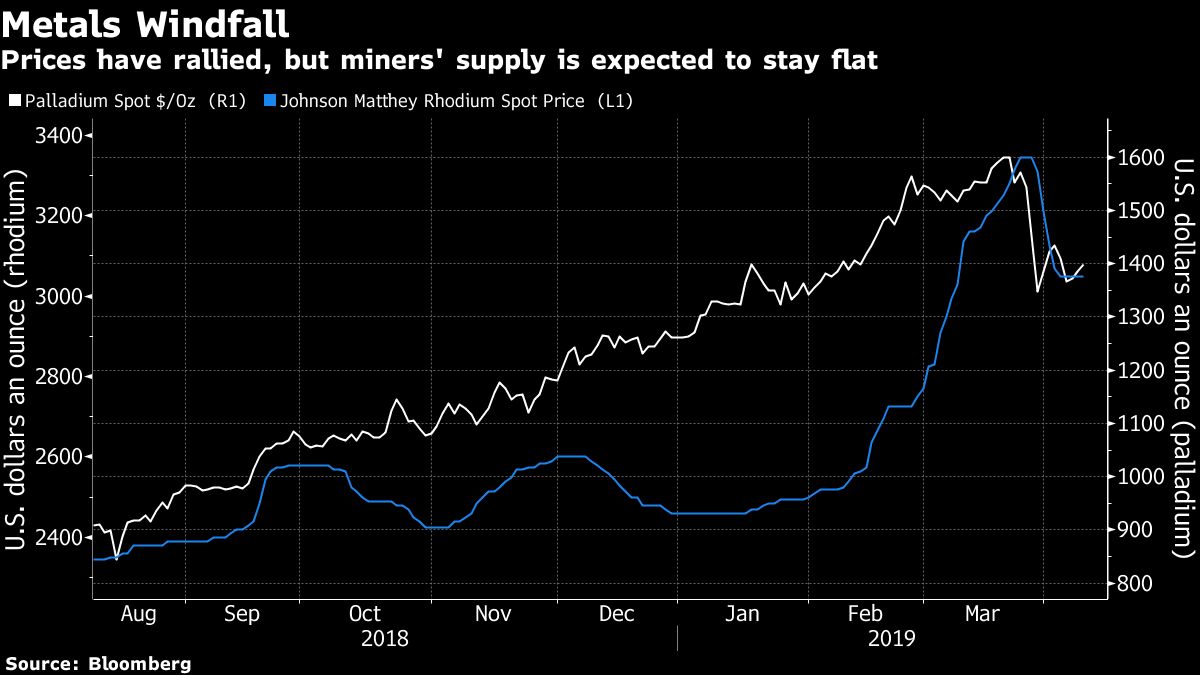
The recent jump in platinum-group metals prices is boosting miners’ profits, but that doesn’t mean they are likely to increase supply anytime soon, according to the world’s No. 1 producer.

Prices for platinum, palladium and rhodium have all gained in recent months, boosting earnings for miners in top supplier South Africa. The so-called rand basket price for the industry has increased by 20 to 25 percent this year, said Anglo American Platinum Ltd. Chief Executive Officer Chris Griffith.

Still, new supply will be limited. It takes five to seven years to open a new mine from scratch and there are other constraints to consider like processing capacity and the availability of water, the CEO said in an interview. While there are some expansion projects underway, that supply is already accounted for in market estimates, he said.

Any new production will probably replace declines elsewhere, rather than expanding total supply, which is forecast to remain flat over the next decade, Griffith said. Amplats, as the company is known, is studying plans to boost its own production by expanding its flagship Mogalakwena mine.

“We can bring metal to the market probably faster than anyone can, and that’s four to five years away,” Griffith said. “Very few companies in South Africa have the ability and real estate they can develop new mines on.”

As well as other constraints such as water, there’s very little spare processing capacity in the country, he said.

The company estimates that it will probably take 18 to 20 months before carmakers start substituting platinum in for pricier palladium in their autocatalysts, the CEO said._Bloomberg News

World’s biggest platinum miner braces for tough wage talks

0

The world’s biggest platinum producer is preparing for tough wage negotiations as higher metal prices spur labor union demands.

Talks over a new three-year industry deal are looming as the so-called rand basket price for platinum and its sister metals has surged by 20 percent to 25 percent this year. While a four-month wage dispute at Sibanye Gold Ltd.’s gold mines could spill over into the platinum pay talks, workers will probably want to avoid a prolonged strike, said Chris Griffith, chief of Anglo American Platinum Ltd., the world’s No. 1 miner.

“It will be tough negotiations but I am not expecting a long disruption,” Griffith said in an interview in Johannesburg on Tuesday. “I don’t sense that kind of appetite in the platinum-group metals industry.”

Still, the largest union in the platinum industry wants its members to share the benefits of higher prices. “Let us see that money trickle down to workers when negotiations come,” said Joseph Mathunjwa, president of the Association of Mineworkers and Construction Union. In 2014, AMCU led the longest ever platinum strike.

“I am not prophesying a strike,” Mathunjwa said. “That mandate has to come from the workers.”

Thousands of AMCU members have been on strike at Sibanye’s three gold mines since Nov. 21, and the union is appealing a labor court ruling that barred its members from widening the action across the entire mining industry.

“Its a tough environment for AMCU,” said Griffith. “They would want to try and recover some face I guess and recover some of what they have lost in the gold industry. They will see platinum as a strength, and would want to capitalize on that.”_Bloomberg News

South Africa’s carbon tax could cost Amplats $21m a year from 2021 – CEO

0

South Africa’s new carbon tax could cost Anglo American Platinum up to $21 million a year from 2021 its chief executive said on Tuesday, piling pressure on an industry already grappling with higher energy and labour costs.

South Africa’s parliament in February approved a long-delayed carbon tax bill as part of plans to reduce harmful emissions in Africa’s most industrialised and polluting country.

The bill, which was postponed at least three times since first being mooted in 2010, faces opposition from heavy energy users, including Amplats, the world’s biggest platinum producer.

On the sidelines of a industry conference in Johannesburg, Chief Executive Chris Griffith said the carbon tax would cost Amplats around 50 million rand ($3.56 million) over the next two years.

That would rise to between 200 and 300 million from 2021, from when a tax on electricity use is included.

“I’m saying to the government don’t do it,” he said._Reuters