Home Blog Page 652

How Does The Intelligent Equipment Change The Mining Industry?

0

Mining industry is a global industry and every product used is crucial. Efficiency is an important component of mining work, since most productions are converting materials into different forms. Often, small improvements in execution speed, process efficiency, and downtime reduction separate profitable operations from outright failures.

Artificial intelligence (AI) is now readily available in many of the products and services we use. In addition, cloud computing has matured, hardware prices have fallen, and machine-to-machine communications have improved, leading to unexpected advances in mining and industrial technology.

Driverless trains whizzed through ports and mines, and thousands of driverless trucks sped through red plumes of dust. That is the scenario outlined by Rio tinto, the global mining giant, in its planned $2.2 billion “smart mine” project. In the future, in the Pilbara iron ore mining area in Australia, robots, driverless cars, trucks, freight trains and unmanned drilling rigs will form a network of intelligent equipment to truly realize the intelligent mining.


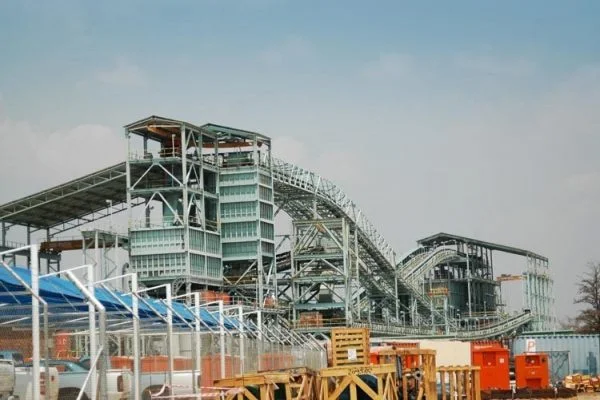
At a large port in the remote Pilbara region of Australia, a 200-meter-long motordrived conveyor belt runs non-stop, hauling 10, 000 tonnes of ore an hour from its stockyards to cargo ships bound for China and Japan. BHP began developing new technology in November 2018, which will put into use this week, to help the company monitor the productivity.

BHP and its rival, Rio Tinto, have been forced to find ways to cut costs over the past five years as commodity prices have fallen and mining profits have dwindled. Initially, mining companies focused on reducing staff, closing unprofitable mines and cutting investment in finding new deposits. At the same time, companies were investing more in research and development because new technologies can help them move into remoter areas, dig deeper and bring ore to market faster.

In Finucane Island, mechanical conveyor belt is introduced as a new technology of BHP Billiton, its technical director and former Boeing engineer Diana said that they also use drones (installing military level sensor) for drawing in mines, building real-time 3D gallery, and in the future, supercomputers will play an important role in the process of mining.

The costs are reduced by new technologies application.

In fact, many mining enterprises have already adopted the conveyor belt but the function is limited. Traditional conveyor systems use pulleys at both ends of the belt in short distances. BHP said the new design, which makes the conveyor belt cheaper to build and operate and easier to control, would break down restrictions and connect deep pits and underground tunnels to processing plants and rail stations. With the new conveyor belt, trucks can travel much shorter distances.

Mining profits have picked up in the past few years, largely because of high demand for iron ore and coal, while miners’ wages have risen. At its peak, truck drivers and drillers in the Pilbara region earned $200,000 a year. Last year, Rio Tinto attempted to transport ore from its Pilbara mines to ports using driverless trains, but the new technology failed in passing the final tests.

“Mining companies are not willing to take risks.” David Cormack, Deloitte’s head of mining consulting, said, “Any delay in introducing new processes and innovating new technologies can bring serious results.” The good news is that remote operation centres allow mining companies to monitor mines from hundreds of miles away by satellite. BHP is preparing to install automated drill bits in Australia’s iron ore mines, which could be used anywhere, after experimenting with robotic mining and finding it more productive and less costly to maintain.

Mining companies are under pressure to innovate because other ways of cutting costs are already constrained. “The question are that is it sustainable and where should it go?” At the Escondida copper mine, the world’s largest one, BHP is testing new sensors that will tell when rocks are scooped up whether they are valuable or not. The cost of expanding the plant is high, and with new technology, expansion is less urgent.

Drones fly over the Goonyella Riverside mine in eastern Australia. Mining companies have fitted the drones with infrared sensors and zoom lenses that alert monitors when large groups of people and equipment gather in the blast zone. The mine is 14 miles long and six miles wide, and without the help of drones, the only way to gather information is by car or by plane.

Industrial UAV is attracting attention now.

“We’ve been going invisible for the last few years because we don’t think it’s appropriate to talk about it if the work isn’t done,” said Krauss, founder and CEO of Airobotics, an Israeli company that recently launched a fully autonomous industrial drone. The Airobotics drone has an independent base, weighs 6kg and can perform programmed tasks automatically, such as checking equipment, guiding investigations, drawing and finding security vulnerabilities.

The drone can collect and analyze aviation data and land on the base station automatically. The base station robot can change the battery and install equipment to prepare the drone for the next flight.

Klaus claims to be the first company to offer integrated driverless systems to industrial companies. Next quarter, Airobotics will open an office in Australia, targeting mining, oil and gas, and other industrial companies. Oil and gas companies can use drones to inspect pipelines, and mining companies can order drones to fly high to check for equipment failures without risking their employees.

In 2015, the global non-military UAV market revenue reached $200 million to $400 million, and it is still growing now. Whether agribusinesses, mining companies or media companies, there is a strong demand for uav. Drones are widely used, and if they are skilled enough to operate in some unrestricted areas, they can get a head start.

Although some of the world’s largest mining companies have introduced drones, they are still in the early stages of development. For most mining companies, cutting costs and improving efficiency are much more important. Just how much lower costs and greater efficiency drones have brought to mining companies shows that they are still in their early stages of development.

Driverless trucks are designed and developed at a fast speed.

Australia produces 60% of all mining software, and its mining equipment, technology and services industries are worth 90 billion Australian Dollar($67.6 billion) a year. In Western Australia, there are more than 100 exploration and mining software companies with annual sales of less than 1 million Australian dollars (about 750,000 US dollars) or more than 100 million Australian dollars (about $75 million).

Rio Tinto is actively introducing new technologies, such as automation. Rio Tinto has deployed the world’s largest fleet of driverless trucks in its Pilbara iron ore belt, and it has used 1,700km of track to link four ports and docks together. Rio Tinto manages, monitors and adjusts the system through the Perth operations centre. At the same time, it is preparing to introduce 45 driverless trucks in stages over several years, with the aim of improving efficiency, productivity and employee safety.

The Volvo truck looks like a regular truck, with a cab that the driver can sit in and control. Autonomous trucks are being developed by Volvo in partnership with Saab, which has Combitech, a software company, to develop autonomous technology. Without human supervision, the car can go on its scheduled route. The truck is fitted with sensors and GPS to monitor stationary and moving obstacles, and the truck can communicate with the transportation system centre.

Common mining equipment is getting smarter.

Equipment for crushing, grinding, and mineral processing is essential in the mining industry, which greatly improves the work and production efficiency. With the requirements of environmental protection and market demand, these devices need to be improved constantly. Taking the hxjq machinery as an example, the primary jaw crusher has been upgraded to German jaw crusher and CJ series jaw crusher after continuous innovation. Different series of jaw crusher can meet different requirements of users in different countries and regions.

German jaw crusher is characterized by the crushing chamber and the optimal design of motion parameters, which not only greatly improve the productivity and quality, but also expand the scope of application of the crusher. It can be widely used in metal and non-metal mining, construction, sand, cement, metallurgy and other industries. Besides, it has an outstanding performance in processing hard materials.

CJ series jaw crusher adopts non-weldable dismountable structure to be easily installed and save the space. The whole machine is placed on the base of the steel frame, and the connection between the main machine and the base crosses the damping pad, which has little impact on the foundation.

Even the mobile crushing station is constantly updated. After the test and actual operation, hydraulic driving is adopted to realize the intelligent automatic driving. Without human supervision, the mobile crushing station can drive on the predetermined route. Sensors and GPS are installed to monitor fixed and moving obstacles and communicate with the operations centre.

In addition to the crushers, sand making equipment is also in continuous transformation to meet the requirements of customers on material size and strict environmental protection requirements. The new sand making machine has plastic function with less dust and lower noises in the working process. The application of sand washing machine greatly improves the utilization of resources and maximizes the revenue.

Many enterprises have gradually increased their dependence on mobile crushing station in order to improve work efficiency and reduce the impact of mining and processing on the environment. The continuous improvement of technological innovation in mining machinery industry has improved the working efficiency and resource utilization rate, thus increasing the income.

Human economic and social activities can never be separated from the material guarantee provided by mineral resources. What the mining industry needs to do is to change the inherently inefficient mining method and the concept of “mining first, then governance”, and gradually move to a higher level to realize intelligent and green development. Intelligent green mining, not only can produce mineral products of high quality and low cost but also can turn the mining industry more environmentally friendly, which is also a starting point for the mining industry to reshape the image.


Chasi confirms electricity problems to stay

0

Minister of Energy Mr Fortune Chasi has rhetorically urged Zimbabweans to forget about electricity supply as the current power deficits have ludicrously increased.

Rudairo Dickson Mapuranga

Speaking through his Twitter handle, Chasi said that the country was going to power all fuel service stations with solar energy, a move which was regarded by many as a confirmation that electricity problems will not be dealt with anytime soon as the government has resorted to power critical sectors with solar energy.

The Minister said that all service stations will use solar energy and that includes the government-owned Petroltrade and Genesis energy.

“Service stations to go solar & to include solar charging ports. We will start with the government-owned ones – Petrotrade & Genesis” reads the tweet in part.

Citizens are now of the opinion that the nation has given up on thermal and hydropower and has since moved to solar for backup.

Government’s enthusiasm on electric cars

0

The Zimbabwe government has announced that electric cars are the future of the country, despite electricity problems the country is currently experiencing.

Rudairo Dickson Mapuranga

Speaking through his Twitter handle, the Minister of Energy Fortune Chasi said that all service stations will go solar in order to support the initiative.

The Minister said that the government was going to start with Petrotrade and Genesis energy in order to set the initiative in motion.

“Service stations to go solar & to include solar charging ports. We will start with the government-owned ones – Petrotrade & Genesis” reads the tweet in part.

Earlier, the Minister of Energy had announced the government’s position on electric cars.

The Minister said that necessary incentives will be announced soon and the facilities for charging ports will be installed.

“The Government supports the introduction of electric cars. As such the necessary incentives will be announced soon and the infrastructure will be installed at service stations and along the high ways.” reads the tweet

ZESA’s blame game on power crises shifts to vandalism

0

Zimbabwe Electricity Supply Authority has shifted the blame of excessive power cuts that are so apparent in the country to vandalism of ZESA property from the Kariba water rhetoric.

Rudairo Dickson Mapuranga

Last week, the national power utility through its official Twitter handle announced that vandalism has become a major problem which has resulted in extended periods of power blackouts,  stretching up to 20 hours a day.

The power utility urged citizens to protect ZESA infrastructure by reporting all suspected theft cases to the police immediately in order to get rid of the current electricity deficits.

ZESA in this regard advised citizens to work with them vigilantly thus, by so doing they will be fulfilling a national duty.

“Many electricity consumers are going for long periods without power as a result of vandalism which can be reduced if citizens are vigilant & play their part in protecting ZESA infrastructure..” reads the tweet.

Zimbabwe has been experiencing excessive power cuts for nearly 6 months now with the power utility at first blaming Kariba water levels, thereafter shifting the blame to Eskom’s withdrawal.


Zimbabwe’s electricity challenges intensified as a result of different factors. Among them is the well-known fact that the nation has the capacity to generate 3000MW through its 5 known power stations like Kariba, Hwange, Munyati, Bulawayo and Harare, however, the country is only generating less than 300MW according to inside sources. ZESA requires a minimum of 1400MW in order to power all its customers in Zimbabwe, this will help to alleviate the power blackouts that are dominant in the country.

ZMF AGM and Exhibition cancelled

0

Zimbabwe Miners Federation (ZMF) Annual General Meeting (AGM) and Inaugural Conference and Exhibition which was scheduled to kick start today has been cancelled to a later date due to the death of former president Robert Gabriel Mugabe.

Rudairo Dickson Mapuranga

According to ZMF president Henrietta Rushwaya, the meeting was cancelled because the guest of honour will be attending the former president Robert Gabriel Mugabe’s funeral and some logistics.

The meeting has been cancelled because of the two high profile funerals that our guest of honour will be attending ” said Rushwaya.

The meeting, whose main aim is to build a relationship between small scale and artisanal miners and their stakeholders in order to liberalise the sector into the mainstream economy will be attended by high profile mining personnel including both Ministers of Mines and of Energy.

Robert Gabriel Mugabe has died

0

Robert Gabriel Mugabe has died. The former head of state who had ruled for 37 years passed away in Singapore.

Commenting on his official Twitter Platform, current President Emmerson Mnangagwa announced the death.

” It is with utmost sadness that I announce the passing of Zimbabwe’s founding father and former President Cde Robert Mugabe”.

More to follow….

Zim 38 solar power project: The move towards ending power blackouts

0

Honourable Minister of Energy and Power Development fortune Chasi told Mining Zimbabwe that the Ministry is embarking on power decentralisation through the 38 solar power project so as to reduce power cuts and power imports.

Mirirai Melissa Ngoya

In an interview held on the 30th of August 2019, the Minister of Energy and Power Development gave an insight on the journey that they have embarked on, in an attempt to make Zimbabwe a nation that is capable of generating sufficient power.

Honorable Chasi said, “As of 31 July 2019, the Ministry of Energy and Power Development through the Zimbabwe Energy Regulatory Authority (ZERA),  licensed 42 solar projects.”

He further highlighted that “Four (4) small grid-connected solar projects have been constructed and are already operational in generating about  8MW feeding into the grid.’’

Hon Chasi said that the 8MW excludes small rooftop and solar home systems owned by individual households and the remaining 38 projects are at various stages of project development.

The minister went on to say that feasibility studies have been done for some of these projects but the majority of promoters have also started civil works at project sites.

The Minister indicated that the progress of the large scale grid-connected to the solar project solar is moving at a slow pace because all solar projects require capital investment for equipment which is imported from outside the country.

“These projects also require land and other sectors of the economy, as such, we are looking forward to first set everything that is required at ground roots level, ” He said.

“As the energy sector we are affected by the economic conditions currently prevailing in the country, foreign currency is required to procure most of the equipment and the investors also need to be assured of currency convertibility and the repatriation of their earnings in hard currency. This is a challenge that my ministry, that of Finance and Economic Development are faced with and are addressing.”

Honorable  Chasi further  alluded as thus,  “in order to accelerate project development in the solar sector, the government recently passed the Renewable Energy policy which will address some of the project development bottlenecks we experienced before.”

He said that the policy proposes to streamline and reduce licensing timelines. In addition, it also proposes a number of incentives such as duty-free importation of solar panels, solar equipment and lithium batteries, granting of National Project Status to solar projects tax rebates and tax holiday granting of Prescribed Asset Status to solar projects so as to raise local funding among other measures.

“It is important to highlight that the country has a peak demand of about 1800MW against a local generation supply that varies between 1000 and 1400MW.,” said the minister.

The introduction of the solar power project is said to be a measure that will cover up power shortages.

“We are unable to generate at our installed capacity of about 2300MW because of reduced water levels at Kariba and frequent breakdowns at Hwange and other smaller thermal power stations. We import power from our neighbours at a big cost to our economy in order to plug the power supply gap” emphasising that if this project come to pass Zimbabwe will be able to generate its power.

“Government wishes to see additional power generation from local power plants including solar. Actually, the licensed solar projects have a total capacity of about 1300MW when fully developed. If these projects are quickly developed then we can reduce electricity imports, save foreign currency and create employment in the country.”

“This will also help the country to achieve security of supply in the electricity sector. So going forward, we anticipate the accelerated implementation and development of the licensed solar projects.”

The government has not earmarked any special solar project for the mining sector. However, the honourable minister highlighted the law allows the mining firms to develop their own projects as independent power projects.

“according to the law, mining firms can develop their own projects as Independent Power Producers (IPPs) with the electricity used for own consumption. Any extra power supply may also be fed to the grid”

This has been implemented after the realization that the Kariba power supply is deteriorating on a yearly basis.  Therefore, one can actually conclude that power decentralisation and the use of clean power sources is the way out for Zimbabwe to sustain its own power generation.


The gold mining game is on in Shurugwi

0

Speaking to Mining Zimbabwe, Kwekwe patron for women’s association Perseviarance Zhou highlighted that her claim in Shurugwi has been profiting quite tremendously. Having huge gold pods which are giving her a surplus profit of nine loads per day with more than thirty tonnes per load,  Zhou is optimistic that her claim will yield significantly.

Mirirai Melissa Ngoya

Shurugwi area has been envisioned as the paradise of wealth, with plenty of gold deposits being discovered in the area, Shurugwi has attracted small scale mining activities. Mrs Zhou actually admitted that she sent her team to Shurugwi because the area is known for its capacious mineral deposits.

“I sent my team to go and mine at our Shurugwi claim following reports that there is plenty of gold in the area,”  said  Zhou.

Mrs Zhou outlined the gold production that they were able to meet in a week, emphasising on the amount of profit that they managed to retain within that period.

“on our first load, we got 30.340t which was a surprise to the whole team, our second load had 33,200t followed by 33.600t.’’

According to Mrs Zhou, their fourth load had a total of 33.540t of gold, whereas the fifth load had a  total of  36. 440t of gold.

” We continued to mine and our sixth load had a total of 36.440 tonnes of gold, followed by  33.540 t”

Mrs Zhou said that Shurugwi area has been quite impressive in its gold output signifying that we have a rich mineral resource base in Zimbabwe.

“Shurugwi mining area gave us hope as a team in the  mining sector, our richest load is the eight one in which we made a total of 38.200 tonnes of gold signifying the wealth that one can acquire within the course of a day.”

“our last load had 37.040 tonnes of gold, all in one day.”

‘’With the course of a week we did 60 loads and now we are working with  Afroshine  so that they will scale and grade the gold at their plant to get the final tonnage after removing unwanted staff.”

The gold mining game is on in Shurugwi as highlighted by Mrs Zhou and indeed it is safe to say that Zimbabwe is endowed with a rich mineral resource base.

Zera raises alarm on illegal gas fillers

0

The Zimbabwe Energy Regulatory Authority (Zera) has expressed concern at the mushrooming of roadside and backyard Liquefied Petroleum Gas (LP gas) filling posts, saying they should be regularised to avoid mishaps.

This comes amid a surge in LP gas-related accidents, with Zera saying consumption of gas is set to double by the end of the year due to increased demand caused by electricity shortages being experienced in the country.

The energy regulator says it is finalising modalities for regulation of the sector which is fast gaining popularity as an alternative energy source for household and industrial use across the country. Gas’ volatile nature and improper handling has resulted in explosions, leading to loss of property and life. At least 20 million kilogrammes of gas have been used so far, with projections of consumption doubling by the end of the year. ZERA head of petroleum department Engineer Andrew Guri said demand for LP gas was increasing, but per capita use remained about three kilogrammes.

“We have a challenge of unlicensed filling of LP gas cylinders,” he said. “We are fine-tuning regulations which will lead to a blitz on such practices. We will be carrying out the blitz as ZERA, with other bodies including the Environmental Management Authority, local authorities and their fire brigades.”

The blitz, he said, would also target unlicensed wholesalers of LP gas who do not meet the set criteria which includes having their own gas cylinders.

There has been at least 14 accidents involving mishandling of gas since 2014 with five of them occurring this year alone. Eng Guri said gas cylinders should be repaired and revalidated after every 10 years to ensure safety.

He said there was higher demand for LP gas than what was being supplied owing to foreign currency constraints.

He said the rate of uptake and growth in use of gas was significantly lower than in other countries where capita use was around 10 kilogrammes. Widespread use of the fuel, he said, had presented challenges in enforcing safety compliance. There are about 90 licensed operators in the trade of LP gas.

There are plans to regulate the price of gas which has been left to operators to determine. Gas is retailing at between $15 and $20 per kg, amid concerns over the quality being sold by roadside and backyard operators, which is used up at a faster rate than that from reputable suppliers. Gas is expected to alleviate pressure on the environment as people are now resorting to use of firewood for heating.

Shurugwi villagers obstruct mining progress

0

Shurugwi locals are becoming stumbling blocks for mining activities to bourgeon, as they are constantly engaged in skirmishes and blocking roads because of boundary issues, miners have said.

Mirirai Melissa Ngoya

The matron for Kwekwe women’s association Mrs P Zhou told Mining Zimbabwe that three days ago, there were three people from the community in which she operates in who were contestably hindering her mining activities by brewing disputes between her and ZIMASCO over boundary issues.

“There are three villagers who reported to ZIMASCO that we were working on extended boundaries, we called the Ministry of Mines and Mining Development and representatives from ZIMASCO discovered that we were operating within our mining consortium.”

Mrs Zhou indicated that after it had been transparent that they were operating in the allowed proximity of their mining area, the villagers went on to demand 150 USD from her.

“I was surprised that these people went on to demand some money in USD to allow us to use the road which passes through their fields. They barricaded the way with tree branches such that our trucks couldn’t pass through ’’ she said.

Mrs Zhou further commended the good works done by the police in making sure that she was safe.

“I called the police officer in charge for shurugwi and he told me that what they were doing was not permissible. The law authorities played their part, dispatching police officers to our mine to make sure that our operations are safe” said Mrs Zhou.

It is worth noting that the police are taking strides in controlling the villagers, making sure that they behave accordingly within the community.