

Description of the ad image
Home Blog Page 726

Gold near 2-week peak on trade tensions, growth worries

0

Gold prices edged lower on Wednesday, but traded near the previous session’s two-week peak as equities slipped after the International Monetary Fund (IMF) cut its global growth outlook and on trade tensions between the United States and Europe.

Spot gold dipped 0.1 percent to $1,302.56 per ounce as of 0749 GMT, after touching its highest since March 28 at $1,306.09 in the previous session. U.S. gold futures were also down about 0.1 percent at $1,307.60 an ounce.

A slip in Asian equities from eight-month highs has kept bullion underpinned above the key $1,300 level.

“There is some switch from equities to gold after U.S. President Donald Trump voiced his intention to impose tariffs on imports from European Union and the market had some concerns on the economic slowdown which was also reported by the IMF,” said Argonaut Securities analyst Helen Lau.

Trump on Tuesday threatened to impose tariffs on $11 billion worth of European Union (EU) products, opening a new front in his global trade war.

Adding to investor concerns, the International Monetary Fund (IMF) on Tuesday slashed its global economic growth forecasts for 2019 and warned growth could slow further.

Gold is used as a safe investment during times of political and financial uncertainty.

“The yellow metal will continue to be bid as the Brexit drama and trade stories unfold at the same time that major central banks continue their dovish rhetoric,” Alfonso Esparza, senior market analyst at OANDA, said in a note.

Investors now await the release of the Federal Open Market Committee meeting’s minutes from its March meeting and the European Central Bank’s policy decision, both due later in the day.

Lower interest rates reduce the opportunity cost of holding non-yielding gold.

On the technical front, “gold prices will have to hold above the $1,302 mark for a continuation of the bullish trend scenario this week,” Phillip Futures analyst Benjamin Lu said in a note.

Meanwhile, holdings in the world’s largest gold-backed exchange-traded fund, SPDR Gold Trust, fell for the seventh consecutive session, dropping about 0.4 percent to 757.85 tonnes on Tuesday. The holdings are at their lowest level since November last year.

Among other precious metals, spot platinum slipped about 0.1 percent to $886.40 per ounce. The metal had touched its highest since May 2018 at $914.74 on Monday.

Palladium was about 0.5 percent lower at $1,382.70 per ounce, while silver fell about 0.4 percent to $15.16._Reuters

Oil hit a five-month high

0

Oil hit a five-month high above $71 (54.2 pounds) a barrel yesterday, supported by concern that violence in Libya could further tighten supply, although Russian comments signalling willingness to pump more dampened the rally.

Supply curbs led by the Organisation of the Petroleum Exporting Countries have underpinned a more than 30 percent rally this year for Brent crude, despite downward pressure from fears of an economic slowdown and weaker demand.

Brent, the global benchmark, rose to $71,34 a barrel, the highest since November, and by 1304 GMT was down 34 cents at $70,76. US crude also hit a November 2018 high of $64,79 and was later down 19 cents at $64,21.

“The mood is increasingly turning bullish, but several feedback loops are about to start spinning that stand in the way of a prolonged oil rally,” said Norbert Ruecker of Swiss bank Julius Baer.

“Russia already signalled its willingness to raise oil output from June. Fuel remains costly in emerging markets, with soft currencies adding to high oil prices.”

Russia, a participant in the OPEC-led supply cuts that currently expire in June, signalled on Monday it wanted to raise output when it meets with OPEC because of falling stockpiles.

Energy Minister Alexander Novak said on Tuesday there would be no need to extend the supply-curbing deal if the market was expected to be balanced in the second half of the year. US sanctions on Iran and Venezuela have deepened the OPEC supply cut and concern has grown this week about the stability of Libyan output. The OPEC member pumps around 1,1 million barrels per day (bpd), just over 1 percent of global supply. — Reuters.

Ivanhoe execs brief Congo president on progress of massive copper project

0

Ivanhoe Mines (TSX: IVN) issued a media statement this week saying that a few of the company’s top executives met with Félix Tshisekedi, the recently-elected President of the Democratic Republic of Congo, and updated him on the progress being made in the development of the Kamoa-Kakula copper project and the Kipushi zinc project.

Kamoa-Kakula, a joint venture between Ivanhoe, Zijin Mining Group and the DRC government, is located in the Lualaba province and it was a greenfield discovery made by Ivanhoe’s geological team. According to Wood Mackenzie, it is the world’s largest, undeveloped, high-grade copper discovery.

The Kipushi zinc project is a joint venture between the Ivanhoe and La Générale des Carrières et des Mines or Gécamines, the DRC state-owned mining company. The project is located in the Haut-Katanga province and, according to Ivanhoe, it is set to become an important zinc producer.

Tshisekedi was briefed on the advancement of both operations, as well as on the company’s exploration programs in the Lualaba province, during an official state visit to Washington, D.C. Robert Friedland and Yufeng “Miles” Sun, Co-Chairmen of Ivanhoe, were in charge of the presentation.

“We share President Tshisekedi’s determination to develop a strong partnership between international mining companies and the Democratic Republic of Congo,” Friedland said in the media brief. “With the continued support of the government, Kamoa-Kakula is on track to become one of the world’s greatest copper mining complexes, helping to cement the DRC as a global, top tier copper producer. The Kipushi Project will benefit from similar support and propel the DRC to become a significant zinc producer as well.”_Mining.com

Don’t bet on platinum miners boosting supply on price surge

0

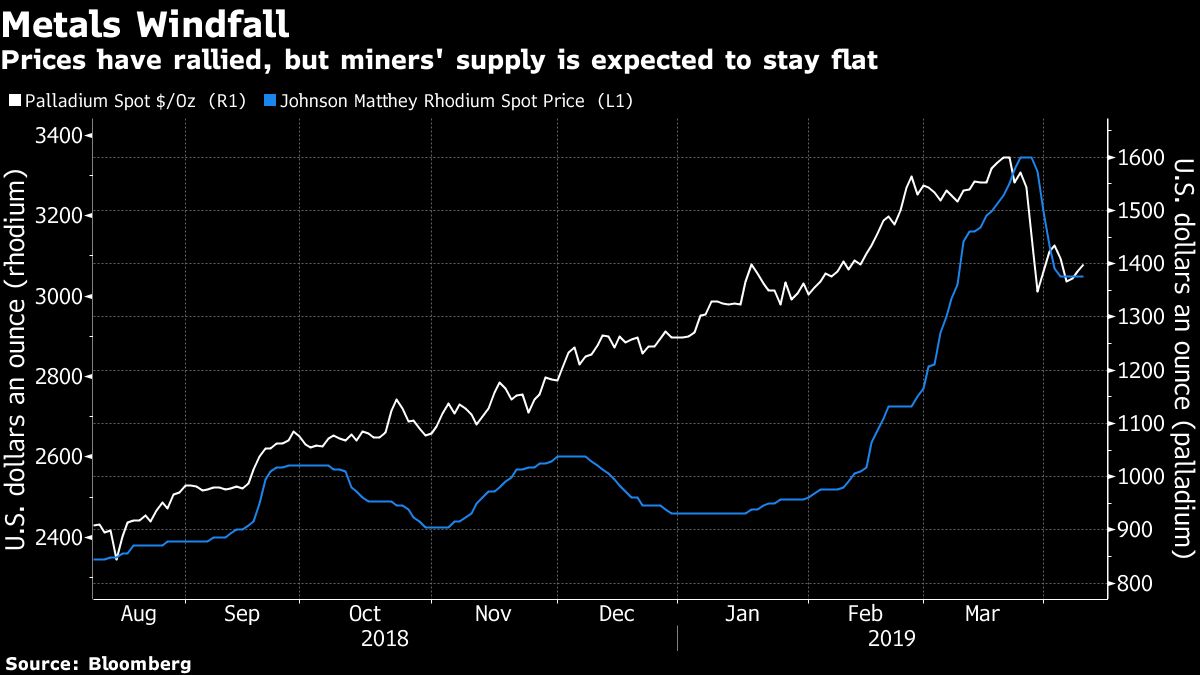
The recent jump in platinum-group metals prices is boosting miners’ profits, but that doesn’t mean they are likely to increase supply anytime soon, according to the world’s No. 1 producer.

Prices for platinum, palladium and rhodium have all gained in recent months, boosting earnings for miners in top supplier South Africa. The so-called rand basket price for the industry has increased by 20 to 25 percent this year, said Anglo American Platinum Ltd. Chief Executive Officer Chris Griffith.

Still, new supply will be limited. It takes five to seven years to open a new mine from scratch and there are other constraints to consider like processing capacity and the availability of water, the CEO said in an interview. While there are some expansion projects underway, that supply is already accounted for in market estimates, he said.

Any new production will probably replace declines elsewhere, rather than expanding total supply, which is forecast to remain flat over the next decade, Griffith said. Amplats, as the company is known, is studying plans to boost its own production by expanding its flagship Mogalakwena mine.

“We can bring metal to the market probably faster than anyone can, and that’s four to five years away,” Griffith said. “Very few companies in South Africa have the ability and real estate they can develop new mines on.”

As well as other constraints such as water, there’s very little spare processing capacity in the country, he said.

The company estimates that it will probably take 18 to 20 months before carmakers start substituting platinum in for pricier palladium in their autocatalysts, the CEO said._Bloomberg News

World’s biggest platinum miner braces for tough wage talks

0

The world’s biggest platinum producer is preparing for tough wage negotiations as higher metal prices spur labor union demands.

Talks over a new three-year industry deal are looming as the so-called rand basket price for platinum and its sister metals has surged by 20 percent to 25 percent this year. While a four-month wage dispute at Sibanye Gold Ltd.’s gold mines could spill over into the platinum pay talks, workers will probably want to avoid a prolonged strike, said Chris Griffith, chief of Anglo American Platinum Ltd., the world’s No. 1 miner.

“It will be tough negotiations but I am not expecting a long disruption,” Griffith said in an interview in Johannesburg on Tuesday. “I don’t sense that kind of appetite in the platinum-group metals industry.”

Still, the largest union in the platinum industry wants its members to share the benefits of higher prices. “Let us see that money trickle down to workers when negotiations come,” said Joseph Mathunjwa, president of the Association of Mineworkers and Construction Union. In 2014, AMCU led the longest ever platinum strike.

“I am not prophesying a strike,” Mathunjwa said. “That mandate has to come from the workers.”

Thousands of AMCU members have been on strike at Sibanye’s three gold mines since Nov. 21, and the union is appealing a labor court ruling that barred its members from widening the action across the entire mining industry.

“Its a tough environment for AMCU,” said Griffith. “They would want to try and recover some face I guess and recover some of what they have lost in the gold industry. They will see platinum as a strength, and would want to capitalize on that.”_Bloomberg News

South Africa’s carbon tax could cost Amplats $21m a year from 2021 – CEO

0

South Africa’s new carbon tax could cost Anglo American Platinum up to $21 million a year from 2021 its chief executive said on Tuesday, piling pressure on an industry already grappling with higher energy and labour costs.

South Africa’s parliament in February approved a long-delayed carbon tax bill as part of plans to reduce harmful emissions in Africa’s most industrialised and polluting country.

The bill, which was postponed at least three times since first being mooted in 2010, faces opposition from heavy energy users, including Amplats, the world’s biggest platinum producer.

On the sidelines of a industry conference in Johannesburg, Chief Executive Chris Griffith said the carbon tax would cost Amplats around 50 million rand ($3.56 million) over the next two years.

That would rise to between 200 and 300 million from 2021, from when a tax on electricity use is included.

“I’m saying to the government don’t do it,” he said._Reuters

Niger to pay $14.5m for 10% of GoviEx’s Madaouela uranium project

0

Niger’s Ministry of Mines issued a letter supporting the negotiations between Canada’s GoviEx Uranium (TSXV: GXU) and the country’s federal government regarding the Madaouela uranium project.

Although final documents on their commercial understandings are yet to be signed, the Vancouver-based miner and country authorities have agreed that the Government of Niger will acquire a 10% working interest in the project, in addition to its 10% free carried interest provided under the 2006 mining code.

To purchase the additional 10%, the Mahamadou Issoufou administration has elected to convert approximately $14.5 million in requested payments comprised of the final $7.8 million acquisition payment and settlement of previously challenged area taxes ($6.6 million) between GoviEx and the government related to the Madaouela project.

“This is the culmination of more than 12 years of relentless work and millions of man-hours by GoviEx management and our Nigerien community,” —  Govind Friedland, GoviEx’s Executive ChairmanAccording to GoviEx, following the finalization of this transaction, the company will be effectively debt-free and it will enjoy a tax abatement period up through to successful project financing for mine construction and project development.

The proposed deals also consider that the Canadian firm’s existing mining permit, the Madaouela 1 Mining Permit, will be expanded to include previous mineral resources discovered in the nearby Agaliouk permit. This expansion will add a further 5.96 million pounds (Mlb) U3O8 in the measured and indicated categories.

Madaouela’s resource has been estimated at 60.54 Mlb U3O8 in total probable mineral reserves and a predicted 21-year mine life.

The 250-square-kilometre land package sits on the southeast side of the mining town of Arlit and was first discovered by the French Commissariat à l’Energie Atomique (CEA) in the 1960s. It was later explored by a series of different companies until GoviEx Niger Holdings acquired it in 2007_Mining.com

Firestone finds another massive diamond at Lesotho mine

0

Africa-focused Firestone Diamonds (LON:FDI) has dug up a 72-carat yellow, whole makeable diamond at its Liqhobong Mine in Lesotho, the second one over 70-carat it has found this year.

The stone, recovered over the weekend together with a 22 carat makeable white stone, followed by an 11 carat fancy light-pink diamond found at the asset.

“Makeable” diamonds are those whose shape allows to cut one large diamond from it. In contrast, “sawable” stones can be cut in half in order to create two smaller diamonds.

The stone, recovered over the weekend together with a 22 carat makeable white one, followed by an 11 carat fancy light-pink diamond found at the asset.

The two diamonds, found within the northern lower grade part of the pit, will go on sale at Firestone’s next tender, which is scheduled to take place during May 2019.

Shares in the company were 7.3% higher at 2.2p following the news.

Last month, a white 70-carat diamond from also from the Liqhobong mine was auctioned for an undisclosed price, following a 46-carat precious rock, also from the same mine, which was sold for $1 million in December.

Diamond prices have been under pressure and miners are struggling across the board, especially those producing cheaper and smaller stones where there is too much supply. In December, some of Rio Tinto’s (LON, ASX: RIO) customers refused to buy cheaper diamonds, while De Beers has been forced to cut prices and offer concessions to buyers.

Firestone spent $185 million building Liqhobong, which started production in late 2016, and boasts over 11 million carats in reserve. The total open pit resource contains over 17 million carats to a depth of 393 metres._Mining.com

Gold rush along Sakubva River

0

HUNDREDS of illegal panners have besieged the banks of the raw sewerage-polluted Sakubva River digging for alluvial gold deposits, in a development that has resulted in increased human activity in the adjacent Gimboki high-density suburb.

Gold buyers are slowly trickling in to set camp near the illegal mining sites while vendors with various wares including food stuffs have since thronged the river banks.

When The Manica Post visited the area yesterday morning, illegal panners were busy digging up for gold. Several shafts as deep as 15 metres have since been dug up along the river banks, posing serious environmental hazard.

Some of the illegal panners were panning right inside the channel of Sakubva River, apparently brushing aside lumps of raw sewerage flowing down the river.

“We came here five days ago and so far we have managed to get about five grammes.

“This is hard labour and you can see for yourself that these shafts are deep. Can you imagine we dug up those metres in such a short period?” said one of the illegal panners who only identified himself as Lawrence.

At night, the illegal panners take turns to guard the mining tunnels to avoid “pirates” who want to steal the gold ore under the cover of darkness.

The panners said they were being paid an average of $120 bond notes per gramme, a figure which they said was too low.

“There are few buyers here who are paying us peanuts because we have nowhere to go. We need money for food and other implements so at the end of the day we are forced to accept what they are offering,” said Lawrence.

Fears have gripped residents of the nearby Gimboki high-density suburb who are dreading the outbreak of diseases as the raw sewerage-drenched illegal panners are constantly getting in contact with the location.

Manicaland police spokesman, Inspector Tavhiringwa Kakohwa, said the police were yet to visit the illegal panning site.

“We haven’t received reports of the illegal panning activities in that area but we are going to send our officers and see what is taking place,” he said._Manica Post

Bubi miner plans $300k investment

0

BUBI-BASED gold mining operation, Waterwitch, plans to invest $300 000 in plant and equipment upgrade to increase employment figures as well as boost output to 100 tonnes of ore per day.

The gold mine is situated in Inyathi, Bubi district, and employs 40 people directly and several others through a contract arrangement, producing between 40 and 50 tonnes of ore a day.

Mine director, Mr Ishmael Kaguru, expressed optimism that by year end they would have reached the targeted output as well as boosting employment figures to close to 100.

“Using own resources, we are investing $300 000 in plant and equipment upgrade and by the end of the year this will see our production figures increasing to 100 tonnes of ore a day from a range of between 40 and 50 tonnes a day,” he said.

“We are importing modern equipment such as ballmill, compressors, hoist and the shaving wheel from South Africa.”

Mr Kaguru said they were also replacing the existing stamp mill with a ball mill that would have the capacity to crush about 100 tonnes of ore a day.

“At the same time we will employ at least 50 more people up from the current 40 that we have. As a result of that our production will be higher in terms of tonnage,” he said.

“The existing stamp mill that we have is very small and thus we have ordered a ball mill, which will be crushing about 100 tonnes of ore a day.”

Mr Kaguru said his company has tried to secure a $400 000 loan from Fidelity Printers and Refiners to no avail due to inadequate collateral requirements.

“We are still appealing to the authorities that when it comes to the issue of collateral, they must look at the quantity of resources underground. If the resources are there, that is enough security for somebody to be given the loan,” said Mr Kaguru.

He said they were now using funds generated from the mine to buy the required equipment from neighbouring South Africa.

The operation has also applied to the Ministry of Finance and Economic Development for duty rebates to facilitate the importation of mining equipment and machinery, which was being brought in batches.

“By the end of the year, we should have turned from a medium-scale operation into a large–scale entity,” said Mr Kaguru.

Finance Minister Professor Mthuli Ncube has pledged Government’s commitment to establish a $100 million gold sector venture fund as it seeks to boost output and build reserves of the yellow metal.

The fund is designed to assist miners to re-tool so they ramp up production.

In 2018, the country produced 33,3 tonnes of gold up from 24,8 tonnes the previous year with the bulk of the mineral being produced by small-scale miners. At present, the small-scale miners are tapping from the Gold Development Initiative Fund set up by the Reserve Bank of Zimbabwe with resources under the fund being increased to $150 million last year from $74 million in 2017._The Chronicle

error: Content is protected !!