Description of the ad image
Home Blog Page 736

Sheppard appointed new CEO Konkola copper Mines

0

LUSAKA – Vedanta Resources has appointed Christopher Sheppard as the new chief executive officer for its Zambian unit Konkola Copper Mines Plc (KCM), the local firm said on Friday.

Sheppard has 35 years of mining experience and takes over from acting CEO Venkatesan Giridhar, who will now revert to his role as chief financial officer, KCM said in a statement.

Sheppard has previously held leadership roles with Anglo American, Anglo American Platinum, Lonmin and Murray & Roberts Cementation.

Prior to joining Vedanta, he was the chief operating officer at AngloGold Ashanti Limited in South Africa._Reuters

Masvingo quarry firm growing in leaps, bounds

0

Located 7km from Masvingo City along the Bulawayo Highway, is one of the fastest growing mining firms in the province that is into quarry extraction and taking advantage of the construction boom in the country’s oldest town.

Masvingo Brick and Tile PVT Ltd, a mining company which started operations in 1947 has stood the test of time, surviving the harshest economic environment in 2008 that was characterised by high inflation which rose to unimaginative levels.

Instead of falling, the company led by Cliff Mumbengegwi, grew from leaps and bounds, even in the face of adversity.

After the demise of the beef giant, Cold Storage Company (CSC), popular bus company, Tanda Taruva, most small companies followed suit and closed shop as their existence squarely depended on the two companies’ downstream spin-offs.

War experience inspired the businessman

However, Mumbengegwi soldiered on, with his experience in the war of liberation, the army and real estate business helping him to persevere and survive the vagaries of economic meltdown.

Through commitment to deliver, the company has been a leading supplier of quality quarry stones and bricks in the province and beyond since 1947, he said.

He said he took over the quarry mining company in 2005, which initially belonged to a white family sometime after retiring from Property and Real Estate business. He had retired from the army as a Colonel in 1990. Home to 100 employees including office staff, Masvingo  Brick and Tile is a US$3 million business venture with the recently installed state of the art quarry crushing plant worth US$500 000.

The company’s present capacity is 25 percent, which is enough to meet demand of quarry and bricks in the province, but plans are underway to increase it to 75 percent once demand increases.

Hopes to leverage on Harare Beitbridge dualisation

With the much awaited Beitbridge- Harare Highway dualisation already in motion Mumbengegwi said the company will soon increase its capacity given that the demand for quarry stones in the province will surge.

“Our capacity utilisation is demand driven and once the dualisation project reaches us, as a province, obviously we will pull our socks as a company. We will raise the bar in terms of our capacity,” said Mumbengegwi.

“The company supplies stones and concrete products with rated capacity of 200 tonnes per hour and the plant can produce different grades of aggregates simultaneously. The aggregates range from 5mm to 40mm ballast,” he said.

He said the company, which remains a cog in the devolution matrix that the new dispensation has enunciated, has the capacity to provide adequate quarry stones for the Beitbridge-Harare Highway dualisation programme as well as other road construction projects.

“We are ready to supply quarry stones for the Beitbridge-Harare dualisation project once it comes to our province. The company is into heavy industry as the plant we use has 500KV while others only use between 250 and 380 volts.”

The company had also recently invested in a US$150 000 worth of brick-making machine with a production capacity of 70 000 bricks per day.

Company vision

Looking back, Mumbengegwi admitted the terrain to prosperity was rugged as he met insurmountable challenges that saw others calling it quits. He said apart from not being spared by high inflationary environment that became the order of the day in Zimbabwe, the banking sector has not been very supportive for indigenous businesses and he was no exceptional.

“Our industry is heavy and that means it’s capital intensive. Local banks give loans basing on your returns but that is problematic because they do not consider our potential to grow. We would have loved to borrow more and not basing our creditworthiness on the size of production. We need money for expansion but our scope is limited because we cannot access the capital that we need, say for recapitalisation. However, CBZ is helping us and I cannot complain,” he said.

He said the company had no room for substandard job, hence hiring qualified personnel to operate the plant which is predominantly automated. He said there are journeymen who operated the machine and that comprised fitter and turners ,electrical engineers and boiler makers, all qualified with national diplomas from polytechnics.

Coming to the devolution, Mumbengegwi said as a company they were prepared to add value to development, contributing immensely to the province’s Gross Domestic Product.

He was, however, quick to denounce corruption saying, the vice should be nipped in the bud if devolution was to succeed. He said people ought to be disciplined first, shunning corruption at all levels, so that the provincial resources are put to good use with those caught in corrupt activities facing the music.

“I think our main hindrance is corruption and if we nip it in the bud, we can succeed, as a province and as a country. Those who are caught involved in shoddy deals or corrupt activities must be arrested, convicted and sent to jail. ‘We should not have scared cows on corruptions, as this will not take us anywhere as a province especially now when the economy is being devolved,” he said._Business Weekly

RBZ avails $21,7 million to women and youth miners

0

The Reserve Bank of Zimbabwe (RBZ) has availed RTGS$21,7 million to assist women and youths in small-scale mining to boost their operations.

Speaking recently in Gwanda during a workshop for small-scale miners in Matabeleland South Province, RBZ deputy director at the Bulawayo regional office Kasanda Sibanda urged small-scale miners to fully utilise the funding facility to expand their operations.

“The bank has extended financial inclusion facilities for women and the youth through local banks but utilisation has been very low. RTGS$15 million was allocated for women and RTGS$3,3 million has been disbursed so far while RTGS$10 million was allocated for youths and RTGS$0,3 million has been disbursed,” he said.

“The bank is in the process of reviewing the facilities with the view to increase their utilisation. Those that have accessed these facilities need to pay up and it’s important for organisations such as Minex to mobilise, educate and encourage miners to utilise and repay facilities extended to them.”

Sibanda said the apex bank was committed to ensuring that full potential of the small-scale miners was realised.

He said the bank was aware of challenges faced by small-scale miners, which included high cost of capital, production, fluctuating commodities and high cost of consumables used in the production of minerals.

Sibanda urged local banking institutions and suppliers of critical
raw materials and equipment to
come up with facilities to support small-scale miners as mining played a crucial role in the development of the economy.

He said there was a need to ensure that all mining claims in the country were fully utilised to increase chrome and gold production

“The mining sector is viewed as a locomotive of Zimbabwe’s development agenda. Under the new dispensation mining is taking a pivotal role in the revival of the economy.

“The current development process is underpinned by the economy’s capacity to generate sufficient foreign exchange to meet its requirements.

“In this regard mineral exports play a pivotal role in the generation of the much needed foreign exchange,” he said.

The Reserve Bank of Zimbabwe last year availed US$150 million through Fidelity Printers and Refineries to fund both working capital and capital requirements under the Gold Development Initiative Fund.

Zimbabwe Miners Federation (ZMF) senior official, Nyenje Makumba, called on Government to be lenient with miners before forfeiting the claims.

“A number of small-scale miners have a challenge of losing their claims that are being forfeited by the Ministry of Mines and Mining Development over non payment of levies. This forces some miners to end up engaging in illegal mining activities. Government will be urging them to formalise their operations while forfeiting claims on the other hand,” he said.

“Some of these miners that lose their mines are disadvantaged members of the community such as people living with disabilities and they will be hoping to be empowered through mining.”

Makumba said there was need for Government to assist suppliers of mining equipment and other consumables in sourcing these products. He said suppliers were charging in forex, which made it difficult for small scale miners to access products.

Environmental Management Agency (EMA) provincial officer, Sithembokuhle Moyo, urged miners to adhere to environmental and safety regulations in their operations. Mat South provincial mining director, Tichaona Makuza, explained steps involved in regularising claims, issuance and monitoring and the implications of the Mines and Minerals Act on artisanal miners._Business Weekly

Zisco still paying over 1 700 workers

0

THE defunct steel manufacturing firm, Zisco, is still paying over 1 700 former workers two months’ salary as per the July 2018 Labour Court ruling as the company seeks to offset employees’ outstanding salary arrears.

Public Service, Labour and Social Welfare Deputy Minister, Lovemore Matuke, said this in Parliament while responding to questions on Wednesday. 

“The court made a judgment against the employer and it specified the terms and conditions of payment for the parties. In the judgment, the court highlighted that the employees were to be paid in each single month their net salary of two months in addition to their owed current salary per individual,” he said.

“Since the judgment was issued, Zisco has been complying with the terms and conditions stipulated by the court.” 

The Deputy Minister could not clarify the source of the money to pay workers since the firm is not operational.

The matter between Zisco and its former employees was resolved by the Labour Court in July last year. Deputy Minister Matuke said since the court handed down the judgment there has been no complaint of non-payment of owed monies registered either at the National Employment Council for the engineering sector or his Ministry.

“Therefore, we presume the employer is complying with the order. If there is any breach, the employees can enforce the judgment,” he said.

The former workers, who have since been retrenched, were, however, yet to receive their retrenchment packages.

“Whether they are going to be paid (retrenchment packages) or not, it is a court decision,” said Matuke. 

Formerly the largest integrated steel producer north of the Limpopo, Zisco ceased operations at the height of economic challenges in 2008 resulting in more than 5 000 people losing                                                                                         jobs.

Hopes for the revival of operations at the steel giant were revived in 2011 when an Indian steel conglomerate, Essar Global, signed a $750 million deal with Government to resuscitate operations at Zisco.

The pact collapsed in 2015 due to a number of reasons, among them political bickering in the then inclusive Government. However, in 2017, Zimbabwe secured a $1 billion investment from R and F, a Chinese firm to resuscitate operations at the defunct Redcliff-based steel giant.

Industry and Commerce Minister Nqobizitha Ndlovu is on record as saying there has been significant progress made towards the resuscitation of Zisco so far._The Chronicle

Gold slips again

0

Gold extended losses on Friday, moving further away from a three-week peak hit in the previous session, as appetite for riskier assets improved on upbeat U.S. economic data, while the metal was still on path for a third straight weekly gain.

Spot gold was down 0.1 percent at $1,308.26 per ounce as of 0119 GMT, after touching its highest since Feb. 28 at $1,320.22 in the previous session.

The metal has risen 0.5 percent so far this week and is on track for a third consecutive gain on a weekly basis.

U.S. gold futures were flat at $1,307.50 an ounce.

Asian shares advanced on Friday after upbeat data and optimism in the tech sector lifted Wall Street stocks, helping calm some of the jitters sparked by the U.S. Federal Reserve’s cautious outlook on the world’s biggest economy.

U.S. data showed jobless benefit applications fell more than expected while mid-Atlantic factory activity rebounded.

The dollar largely held onto the previous session’s gains in early Asian trade on Friday, while sterling edged up on news that Britain could leave the European Union without a Brexit deal at a slightly later date.

Britain could leave the European Union without a Brexit deal on April 12 if lawmakers fail next week to back Prime Minister Theresa May’s agreement with Brussels, EU leaders said after a crisis summit in Brussels on Thursday.

Prime Minister Theresa May on Friday welcomed the European Union’s decision to delay Brexit, saying that lawmakers in the British parliament now had clear choices about what to do next.

The Bank of England kept interest rates steady on Thursday and said most businesses felt as ready as they could be for a no-deal Brexit that would likely hammer economic growth and jobs.

A U.S. trade delegation headed by Trade Representative Robert Lighthizer and Treasury Secretary Steven Mnuchin will visit China on March 28-29 for the next round of negotiations, China’s commerce ministry said on Thursday.

The United States imposed sanctions on Thursday on two Chinese shipping companies it says helped North Korea evade U.S. and international sanctions over its nuclear weapons program, the first such steps since U.S. President Donald Trump and North Korean leader Kim Jong Un’s summit collapsed last month.

Paulson & Co Inc, which holds 14.2 million Newmont Mining Corp shares, will not support Newmont’s planned $10 billion takeover of rival Goldcorp Inc as the premium offered is unjustified, the investor said in a letter on Thursday._Reuters

Prospects reports loss of $4,135 million

0

PROSPECT Resources (Prospect) says it reported a loss after tax of $4,135 million during the half
year ended December 31, 2018 compared to a $2,640 million recorded in previous period.

The Australia Stock Exchange-listed firm said explorations costs at its flagship Arcadia Lithium Project
weighed further on the operating performance.

The loss after adjustment for exploration and evaluation expenditure, impairments, project generation
and share-based payments has increased from the prior year period as the group progresses the
Arcadia Project and prepares for the next stage, being its development,” Prospect said.

Exploration and development stages of mining operations require heavy capital outflows before
positive cash flows are realised.
Revenue from continuing operations increased to $3,534 million during the review period compared to
$1,590 million achieved in previous comparable period. The group’s assets increased to $30,364
million during the half year ended December 31, 2018 compared to $30,250 million recorded in prior
comparable period.

Prospect said net cash outflows from operating and investing activities amounted to $8,915 million
during the review period compared to $5,078 million achieved in previous comparable period.

“As at reporting date, the group had cash and cash equivalents of $8,067 million. These conditions
indicate a material uncertainty that may cast significant doubt about the group’s and the company’s
ability to continue as going concerns,” the miner said.

Prospect also noted that assets and liabilities affected by the Monetary Policy Statement include cash
and cash equivalent, trade and other receivables and trade and other payables.
The firm said however, financial impact of this change has not been recognised in the groups
accounts at December 31, 2018.

Recently, Prospect said it has acquired new technological equipment, high pressure grinding rolls
(HPGR), which will reduce capital expenditure by $2,3 million at Arcadia.

The lithium miner has also been awarded special economic zone (Sez) status at Arcadia, which will
grant the project generous tax breaks and other concessions. The junior miner, which applied for the
status last year in November, said
the incentives and benefits to be received from the Sez status, reinforces the financial outcomes of the
project outlined in the definitive feasibility study.

Arcadia is Africa’s second-largest undeveloped lithium project. It is estimated to contain 610 500
tonnes of lithium oxide and 11,3 million pounds of tantalite pentoxide. It has an ore reserve of 26,9
million tonnes and has received its mining licence and environmental impact approval.

This comes as lithium has gained global prominence as the most valuable mineral for the future given
its use in a number of areas including medicines and ceramics, but more importantly manufacture of
electric vehicle batteries.

Government granted Prospect a mining lease for 57 claims in the country. The junior miner has
committed millions in Zimbabwe’s lithium mining sector in the past year and is currently developing the
assets.

Last year, the miner said it will start exploration of rare earth elements (REEs) at its Chishanya
carbonatite project in Dorowa, in eastern Zimbabwe.

Prospect, which has impaired costs incurred on the Prestwood and Sally Mines, also operates
Penhalonga Gold Mine, Sally Gold Mine and Prestwood Gold Mine in Gwanda._Daily News

CALEDONIA registered a 4% increase

0

CALEDONIA Mining Corporation registered a 4% increase in after tax profits to US$21,42 million in the full year to December 2018 compared to US$20,61 million in 2017, despite a fall in production.

Chief executive officer Steve Curtis said this was mainly due to “an increase in amounts due in respect of gold sales and VAT refunds from the government of Zimbabwe and a reduction in trade and other payables”.

Revenue during the period was down to US$68,4 million from US$69,76 million in the 2017 period on account of a 3% decline in production to 54 511 ounces (1,55 tonnes) from 56 133 ounces (1,59 tonnes).

In a statement accompanying the company’s results, Curtis said production was lower due to an unplanned lower recovered grade as a result of added dilution.

“During the year, we continued to implement the investment plan at Blanket Mine, with the objective of increasing production to 80 000 ounces per annum (2,26 tonnes). Certain operational and economic factors have resulted in less development being achieved than planned, which will result in a slower production ramp-up than originally expected,” he said.

“The monetary environment in Zimbabwe became more challenging following changes in policy, although the general direction of policy development appears to be positive. Policy changes disrupted the commercial banking system in October 2018 and February 2019, which adversely affected procurement.”

Production costs were up 8,7% to US$39,31 million last year compared to the 2017 comparative of US$36,18 million.

“Delays in procuring critical items meant that capital equipment suffered from a lack of maintenance which increased the frequency of breakdowns. We are optimistic that the introduction of a market exchange rate in February 2019 will, in time, allow a return to normal operating conditions.”

Caledonia is a Canadian mining firm that operates in Zimbabwe through its 49% legal ownership in the Blanket Mine. However, pursuant to the signing of an agreement announced on November 6, 2018, “Caledonia intends to purchase a further 15% of Blanket from one of Blanket’s indigenous shareholders”.

Earnings per share at 131,5 cents were lower compared to the previous year’s 135,4 cents._NewsDay

Amnesty accuses electric vehicles makers of using unethically sourced minerals

0

Human rights advocate Amnesty International has accused the electric vehicle (EV) industry of selling itself as environmentally friendly while most of the batteries they produce use polluting fossil fuels and unethically sourced minerals.

In a report published on Thursday, the rights group says manufacturing batteries can be carbon intensive, while the extraction of minerals used in them has been linked to human rights violations such as child labour.

Amnesty has outlined a vision for battery production that can result in ethical and sustainably produced batteries within five years. That process involves extraction, ethical manufacturing, reuse and recovery of batteries, and a prohibition on deep-sea mining.

The group called on companies to publicly disclose information about how human rights abuses and environmental risks are being prevented, identified and addressed throughout the lithium-ion battery’s life cycle.

Group argues that unregulated industry practices for the extraction of minerals used in lithium-ion batteries have led to human rights abuses and environmental damage.Some leading companies — including Apple, BMW, Daimler, Renault, and battery maker Samsung SDI — have already published supply chain data. Amnesty wants others to do the same.

“The massive global corporations that dominate the electric vehicle industry have the resources and expertise to create energy solutions that are truly clean and fair,” Kumi Naidoo, Amnesty International’s Secretary General, said in a statement.

“With demand for batteries soaring, now is the time for a drastic overhaul of our energy sources that prioritizes protection of human rights and the environment,” Naidoo said.

Automakers are investing billions of dollars to ramp up EVs production. German giant Volkswagen, for one, is spending $50 billion to refocus the company on the making of EVs, autonomous vehicles and new mobility services.

The Wolfsburg-based manufacturer plans to raise annual production of EVs to 3 million by 2025, from 40,000 in 2018.

Eyes on the DRC

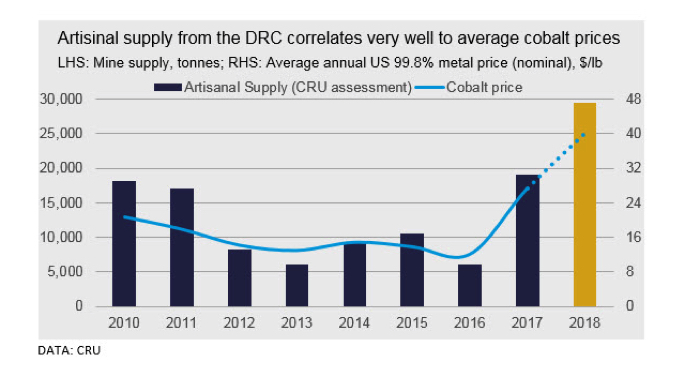
Market estimates see demand for cobalt, a key battery metal, reaching 200,0000 tonnes per year by 2020. The problem, says Amnesty, is that no country legally requires companies to publicly report on their cobalt supply chains.

Amnesty accuses electric vehicles makers of using unethically sourced minerals

Courtesy of CRU Group.

More transparency could help improve working conditions in the Democratic Republic of Congo (DRC), which generates more than 60% of the world’s cobalt.

Much of the country’s production is sent to China to be processed by multiple companies before it is used in batteries. In addition, up to 20% of the DRC’s cobalt is mined by hand, often by children with picks and shovels, as a previous Amnesty International investigation showed.

That research linked those mines to the supply chains of many of the world’s leading electronics brands and electric vehicle companies.

Amnesty said it is collaborating with Greenpeace to identify and map human rights and environmental impacts of EV battery production.Mining.com

Gunmen kills five miners in Ethiopia

0

Gunmen in Ethiopia have shot and killed five workers from a mining company in the restive west on Tuesday, residents said, with a TV station reporting two foreigners among the dead.

The unidentified attackers struck near Nedjo town, about 500 km (310 miles) from the capital Addis Ababa in the Oromiya region where several conflicts simmer, the inhabitants told Reuters.

State-affiliated Fana Broadcasting said on Twitter three Ethiopians and two foreign nationals had died in the incident early on Tuesday. It did not give their countries.

The huge region is home to Ethiopia’s largest ethnic group, the Oromo, and has at least four separate conflicts in addition to a border dispute constantly threatening violence.

Prime Minister Abiy Ahmed, himself an Oromo, has overseen a series of major political and economic changes since coming to office in April 2018 – making peace with arch-foe Eritrea, freeing political prisoners, pledging to open up the state-controlled economy and promising to overhaul security services.

But the reforms have not stopped ethnically-charged violence – including in his own native region.

Ethiopia’s Oromo, who make up about a third of the population, have long complained of being marginalized during decades of authoritarian rule by governments led by politicians from other smaller ethnic groups. In recent years the Oromo have been angered by what they see as encroachment on their land.

It was unclear which mining company was involved in Tuesday’s incident.

Among companies operating in Ethiopia are MIDROC Gold Mine Plc owned by Ethiopian-born Saudi billionaire Mohammed Hussein al-Amoudi, which has operated an open-cast mine in the Guji zone of Oromia region for more than two decades.

Its license was suspended last year after weeks of protests by locals who accused the mine of polluting their water and the atmosphere.

Others are Newmont Mining, which is prospecting for gold, while Norwegian fertilizer maker Yara International plans to build a potash mine and a fertilizer factory._Reuters

Gold near 3-week peak; palladium at record high

0

Gold rose on Thursday, trading close to a three-week peak hit in the previous session after the U.S. Federal Reserve phased out a possibility of an interest rate hike this year, while palladium scaled a record peak on supply issues.

FUNDAMENTALS

Spot gold gained 0.3 percent at $1,315.81 per ounce as of 0114 GMT, after touching its highest since Feb. 28 at $1,316.58 in the previous session.

U.S. gold futures rose 1.1 percent to $1,316.10 an ounce.

Spot palladium gained 0.4 percent to $1,609.70 an ounce, after registering a record high at $1,615.5 earlier in the session.

The dollar nursed heavy losses in Asia on Thursday after the Federal Reserve stunned markets by abandoning all plans to raise rates this year, a signal its three-year campaign to normalise policy might be at an end.

 Having downgraded their U.S. growth, unemployment and inflation forecasts, policymakers said the Fed’s benchmark overnight interest rate, or fed funds rate, was likely to remain at the current level of between 2.25 percent and 2.50 percent at least through this year.

Shares in Asia rose on Thursday after the Fed’s policy decision, but concerns over slowing global growth and U.S.-China trade talks are expected to limit gains.

U.S. President Donald Trump warned on Wednesday that the United States may leave tariffs on Chinese goods for a “substantial period” to ensure that Beijing complies with any trade agreement.

Prime Minister Theresa May made an impassioned appeal to British lawmakers to support her on Wednesday after the European Union said it could only grant her request to delay Brexit for three months if parliament next week backed her plans for leaving.

Rapid flows of investor money into physically backed platinum exchange-traded funds (ETFs) and a sharp drop in speculative bets on lower prices suggest the autocatalyst metal is on the verge of a recovery.

Citigroup Inc plans to sell several tons of gold placed as collateral by Venezuela’s central bank on a $1.6 billion loan after the deadline for repurchasing them expired this month, sources said, a setback for President Nicolas Maduro’s efforts to hold onto the country’s fast-shrinking reserves.

South Africa’s labour court ruled on Wednesday that the extension of a wage agreement to cover all gold unions and non-unionised employees of mining group Sibanye-Stillwater is valid and lawful, the miner said._Reuters

error: Content is protected !!