




At a time when the mining industry is under increasing pressure to modernise operations and improve worker safety, two final-year students from the Zimbabwe School of Mines (ZSM) are proving that innovation can start right at the classroom level. Their innovative projects, each tackling some of the most persistent safety and efficiency challenges in underground mining, demonstrate how emerging technologies can reshape the future of the sector, Mining Zimbabwe can report.
By Ryan Chigoche
Across Zimbabwe’s mining landscape, operations continue to grapple with hazards such as toxic gases, fall-of-ground incidents, and ventilation inefficiencies. These challenges not only threaten lives but also disrupt production and inflate operational costs.
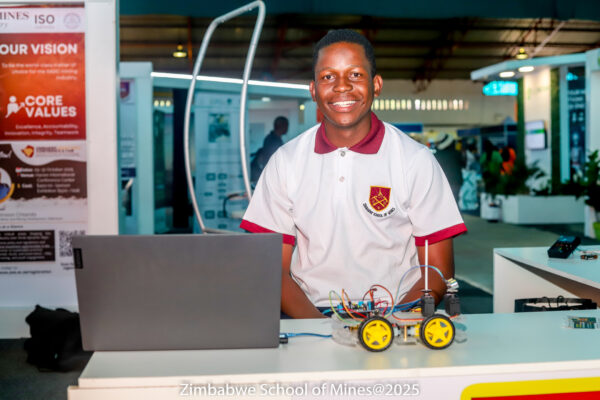
Against this backdrop, two young minds — Ronald Danha, a final-year Mine Ventilation student, and Omar Abdulla Mkwala, a Mining Engineering student also in his final year — are stepping forward with creative solutions born out of research, passion, and practical experience.

Both students had the opportunity to showcase their innovations at the just-ended Zimbabwe International Trade Fair (ZITF) Mine Entra Exhibition in Bulawayo, where ZSM provided a platform to display technologies that reflect the future of mining in Zimbabwe and beyond.
Real-Time Ambient Condition Monitoring System
For his final-year innovative project, Ronald Danha developed a system designed to transform underground mine safety through continuous digital monitoring.
“My project is on the development of a real-time ambient condition monitoring system,” Danha explained. “Eventually, in a mine, we know there are gases during re-entry and also overheating of machines.”
The system operates using two components — the sender nodes and the receiver nodes. The sender units are equipped with sensors that detect gases such as carbon monoxide and methane, as well as temperature and humidity levels. Data collected underground is transmitted wirelessly to receiver nodes on the surface, where it is decoded and displayed on a web-based dashboard using ThingSpeak for real-time visualization.
The urgency of this innovation is underscored by recent safety statistics. In 2024, Zimbabwe recorded 11 gassing accidents in underground mines, resulting in 12 fatalities, highlighting the dangers of outdated ventilation systems and insufficient technical monitoring.
“Underground mining is always at risk of toxic gases,” Danha noted. His system directly addresses this problem by providing real-time data and automated alerts, enabling mine operators to respond immediately to hazardous conditions and prevent accidents before they occur.
Unlike conventional ventilation-on-demand systems, which merely adjust fan speed, Danha’s system introduces an intelligent function that can automatically switch fans on or off depending on real-time gas concentrations. This eliminates delays associated with manual readings, ensuring rapid response during re-entry after blasting and creating safer conditions for mine workers.
Danha, who spent months designing, coding, and refining the prototype, said the idea emerged from a desire to reduce the risks of gassing incidents and move beyond manual detection methods. “After the blast, the system starts to read,” he said. “It can also view the surface and say, if this section is now safe, we can go in.”
Challenges included sourcing components locally. “The actual challenge was finding components here in Zimbabwe,” he explained. “We don’t actually have much technology available locally, so I had to research online and source alternatives.” Despite these hurdles, his innovation demonstrates how accessible technology can be leveraged for proactive, life-saving mine safety management.
Automated Roof Bolter
While Danha focused on air quality and environmental monitoring, fellow student Omar Abdulla Mkwala turned his attention to one of mining’s most dangerous operations: manual roof bolting.
His innovative project introduces an automated system capable of navigating underground, assessing ground conditions, and installing support bolts without human intervention.
“This is an automated roof bolter which I designed to counter problems such as fall-of-ground incidents that were happening at the mine where I was attached,” Mkwala said. During his industrial attachment at one of the country’s leading mines, he observed that ground collapses often occurred while operators were still manually installing bolts after blasting. These incidents posed significant danger to workers and often led to costly operational delays.
The urgency of this innovation is underscored by recent statistics: between January and May 2025, fall-of-ground incidents were responsible for 37% of all mining fatalities.
Such accidents are particularly prevalent in underground gold mining operations, driven by ground instability, rock bursts, and inadequate support systems. Mkwala’s automated roof bolter directly addresses these risks by removing the operator from harm’s way while ensuring precise and consistent installation of support bolts in unstable conditions.
“In my solution, I came up with a fully automated roof bolter in which an operator is no longer required to be in the machine,” he explained. “The bolter can navigate on its own, detect the ground condition, and carry out bolting operations automatically — from drilling and resin insertion to bolt installation and monitoring.”
The innovation integrates sensors and autonomous navigation to assess rock stability in real time while transmitting performance data to a surface control office. Mkwala’s system embodies the concept of zero harm by minimizing human exposure to unstable environments and improving productivity through consistent, precise operations.
He believes institutions like the Zimbabwe School of Mines play a vital role in nurturing such innovation. “Since the school is recognised worldwide, it can help students like us find investors who are interested in our innovations,” he said. “At the end of the day, in mining operations, we need zero harm. If someone gets injured, the company loses, and if we leave unsupported ground, that’s a loss too.”
Both students expressed deep gratitude to their mentor, Mr. Paul Matshona, the Research and Innovation Officer at ZSM, whose guidance and encouragement played a key role in shaping their work.
Speaking to Mining Zimbabwe, Mr. Matshona called for greater collaboration between academia and industry so that the full impact of these projects can be realised.
“Together, these projects demonstrate the transformative potential of young technocrats from the Zimbabwe School of Mines in driving context-specific technological solutions. However, their full impact depends on stronger partnerships between academia and industry, where mining companies provide testing grounds, technical mentorship, and financial support to further develop, pilot, and commercialize such innovations. This collaborative approach will not only accelerate technology adoption but also build a culture of research-driven industrial modernization, positioning Zimbabwe as a regional leader in safe, efficient, and sustainable mining practices,” Matshona said.
The just-concluded Mine Entra was one such platform where the students got the opportunity to showcase their innovations.
Through such initiatives, the Zimbabwe School of Mines continues to position itself not only as a leading training institution but also as an incubator of practical, industry-ready innovation. The work of Danha and Mkwala demonstrates that Zimbabwean students are capable of creating solutions that make mining safer, smarter, and more efficient — a sign of a brighter, technologically empowered future for the sector.

