


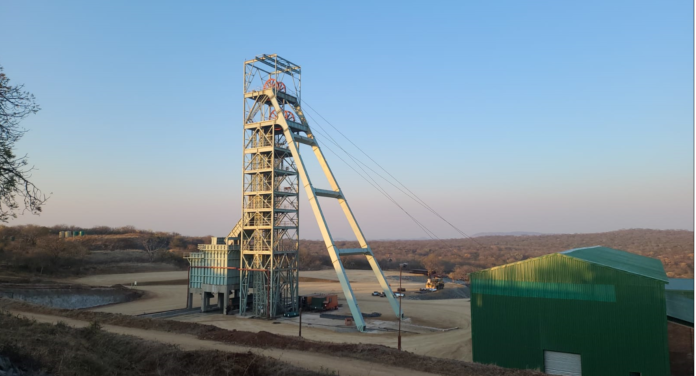

Caledonia Mining Corporation Plc has unveiled a transformative exploration discovery at its Blanket Mine in Zimbabwe, with surface drilling confirming a previously unrecognised gold zone that could fundamentally reshape the mine’s production profile and add substantial value through low-cost processing, Mining Zimbabwe can report.
By Rudairo Mapuranga
The discovery at the K-Pits target, located within the existing mining lease approximately 200 metres east of the nearest projected underground orebody, represents a potential new mineralised horizon that has never been exploited by historic underground mining operations. This is not merely a resource extension—it is an entirely separate mineralised system with significant implications for both near-term production and long-term exploration upside.
The exploration programme, comprising 2,304.1 metres of trenching from 13 trenches and 7,063 metres of shallow reverse circulation drilling across 155 holes, has successfully defined continuous near-surface mineralisation with compelling grades.
Selected drilling highlights demonstrate the consistency and quality of the mineralisation. Hole KPT0EX2553 returned an oxide intersection of 23.00 metres at 2.61 grams per tonne from surface, representing one of the more extensive near-surface zones identified. Hole KPT0EX2545 delivered 15.00 metres at 1.69 grams per tonne from surface in oxide material, with a further 4.00 metres at 2.08 grams per tonne in transitional mineralisation immediately below. Hole KPT0EX2567 produced 20.00 metres at 1.22 grams per tonne from 19 metres downhole in transitional material, while Hole KPT0EX25124 returned 12.00 metres at 1.20 grams per tonne from 23 metres in the transitional zone.
Sulphide mineralisation beneath the oxide cap delivered notably higher grades. Hole KPT0EX2510 returned 16.00 metres at 6.04 grams per tonne from 29 metres downhole, while Hole KPT0EX2542 yielded 7.00 metres at 5.96 grams per tonne from 13 metres. Hole KPT0EX2576 produced 5.00 metres at 3.96 grams per tonne from 40 metres downhole. All intersections reported are down-hole lengths, with estimated true widths calculated at approximately 60% to 70% of core length based on drill orientation.
“This is an exciting development at Blanket and further demonstrates the significant exploration potential that exists within the mining area. The K-Pits programme was originally designed to evaluate near-surface targets within the Blanket mining lease that had received little exploration attention. Results from trenching and reverse circulation drilling have confirmed the presence of significant gold mineralisation associated with shear structures and lithological contacts,”
Mark Learmonth, Chief Executive Officer of Caledonia Mining Corporation Plc, said.
Geological interpretation indicates the mineralisation is associated with strong shearing and silicification at the contacts of talc chlorite schist and surrounding metabasalts within the Archaean Gwanda Greenstone Belt. The vertical extent tested to date is approximately 40 metres, with further drilling planned from both surface and underground platforms to probe the system at depth.
What makes this discovery particularly significant for investors is the dual-track value proposition it presents.
Near-term oxide opportunity
The presence of near-surface oxide mineralisation opens the door to conventional heap leaching—a processing route with substantially lower capital and operating costs than underground mining. Metallurgical test work is already underway, with encouraging preliminary results. Management intends to commence a trial heap leach operation on an initial 10,000-tonne sample during the second half of 2026 if test work confirms acceptable recoveries.
Learmonth elaborated on the processing strategy:
“We have commenced metallurgical test work on the oxide material at Blanket to evaluate its amenability for conventional heap leaching, and the preliminary results are encouraging. If the conclusion of the test work shows an acceptable recovery, we intend to commence a trial heap leach operation on an initial sample of 10,000 tonnes of material during the second half of 2026. The potential to develop a low-cost processing route for this near-surface mineralisation could provide an attractive opportunity to complement Blanket’s existing underground operations and unlock additional value.”
Long-term sulphide potential
Below the oxide zone, the mineralisation extends into fresh sulphides with significantly higher grades, including 6.04 grams per tonne over 16 metres, suggesting a potentially larger mineralised system at depth. This could support conventional underground development and extend the mine life beyond the current production horizon. Importantly, geological interpretation suggests the mineralisation may represent a separate mineralised system that has not been exploited by historic underground mining activities, raising the possibility of a previously unrecognised orebody approximately 200 metres east of the nearest projected underground orebody.
Operational Context: Production Recovery Gaining Momentum
The K-Pits discovery comes as Blanket Mine demonstrates strong operational recovery. The company reported 17,360 ounces of gold production in Q2 2026, an 18% increase from Q1 2026, reflecting improving access to higher-grade areas. The average grade delivered to the plant improved to 2.88 grams per tonne in Q2 2026, with July grades to date tracking at 3.05 grams per tonne—a level management expects to maintain for the remainder of the year.
Learmonth addressed the operational trajectory, stating:
“Production in Q2 2026 was 17,360 ounces, an improvement on the first quarter, reflecting continued improvement in access to higher-grade mining areas. Encouragingly, we are now seeing improved grades in deliveries of ore to the plant, indicating that the measures we have taken to restore access to higher-grade ore are gaining traction. We are now tracking a grade of approximately 3 grams per tonne, and we expect to remain at that level for the rest of the year.”
Looking ahead, production is expected to strengthen further in the second half of 2026, supported by improved access to higher-grade mining areas as the mining sequence normalises, completion of the elution plant upgrade in Q3 2026, enabling processing of stockpiled fine-grain loaded carbon from September, and implementation of a seven-day working week from June 2026, adding approximately 200 tonnes per day of additional ore processing capacity.
Full-year 2026 production guidance remains firmly at 72,000 to 76,500 ounces, with output expected to be weighted towards the second half.
Learmonth reaffirmed the company’s confidence in its outlook:
“With the introduction of a seven-day working week and the completion of the elution plant upgrade due in the third quarter of 2026, we expect production to further increase in the second half of the year, in line with our guidance. We therefore remain confident in our full-year production guidance for 2026.”
Resource Update and Investment Thesis
Caledonia expects to publish an updated mineral resource statement in August 2026, incorporating the K-Pits surface exploration results alongside recent underground drilling and the Motapa exploration programme, where encouraging initial drilling results were also recently announced.
For investors, the combination of operational recovery at Blanket with improving grades, a near-term oxide processing opportunity through low-cost heap leaching, significant exploration upside from a previously unrecognised mineralised system, and an advancing development portfolio, including Bilboes targeting first gold in late 2028, positions Caledonia as a compelling opportunity in the gold sector. The company’s ability to maintain its production guidance while simultaneously identifying new mineralised horizons within its existing mining lease highlights the exploration potential that remains within Zimbabwe’s established gold belts.
Learmonth concluded:
“We are well advanced in our work to incorporate the results of this surface exploration programme into a revised resource statement expected to be published in August 2026, which will reflect the results of surface and underground exploration at Blanket alongside the exploration programme at Motapa.”

