


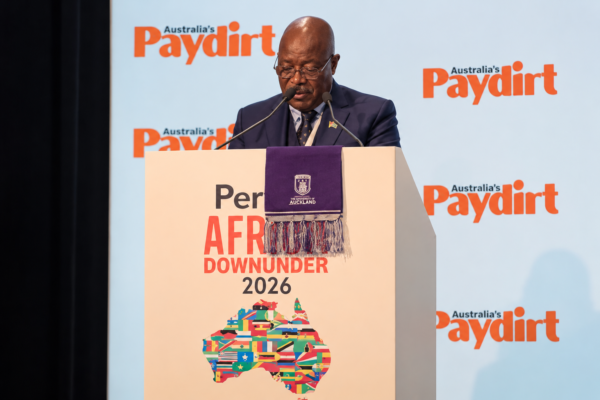

Zimbabwe went to Africa Down Under (ADU) to attract mining capital. After three days of meetings in Perth, the Government says it is returning home with a clearer sense of what companies want before they commit money to Zimbabwe, Mining Zimbabwe can report.
By Ryan Chigoche
Deputy Mines Minister Dr Caleb Makwiranzou, who led the Zimbabwean delegation, told Mining Zimbabwe that investors at the conference were not simply asking about the country’s mineral wealth.
They were approaching officials with specific commodity requirements, seeking to understand how they could enter the market and testing whether Zimbabwe could provide the conditions needed to develop projects.
“Firstly, there has been serious exploration of interest. My delegation has been asked by various investors with specific commodity requirements. Some have come and inquired from us how they can be facilitated,” Makwiranzou said.
That distinction matters for Zimbabwe as it seeks to turn its mineral endowment into a broader investment pipeline.
The conversations gave officials a more targeted picture of where investor interest lies, with the delegation recording specific interests against particular commodities so they could be pursued after the conference.
“We have been allocating names to specific commodities so that investors can be able to follow up when the conference is finished,” Makwiranzou said.
The exercise effectively turns ADU from a three-day promotional event into the beginning of a follow-up process, with the Government now able to distinguish between general interest in Zimbabwe and enquiries linked to particular minerals and potential opportunities.
But the questions coming from investors were also revealing.
Power emerged as one of the practical issues that could determine whether interest develops into investment.
Makwiranzou said investors questioned the delegation about electricity availability for mining and were told that ZESA could support projects, while companies requiring additional capacity could establish independent power plants.
The discussions underscored a reality facing Zimbabwe’s mining ambitions: attracting capital is only one part of the equation. Investors also need confidence that large, energy-intensive projects can operate reliably once they are built.
The more strategic lesson from Perth, however, was around the type of capital Zimbabwe should be targeting.
Makwiranzou pointed to discussions around Australian government-backed efforts to stockpile minerals such as vanadium and rare earths, saying they demonstrated the value of investors willing to take a longer-term view of strategic mineral supply.
“We have heard that some companies have been financed by the Australian government to stockpile certain minerals like vanadium and rare earths. So we have said that if they have patient capital, they are welcome to Zimbabwe,” he said.
For Zimbabwe, that opens a different conversation from the traditional search for capital to develop immediately profitable mines.
Some mineral opportunities require time, exploration and the development of processing capacity before their full commercial value can be realised. Attracting investors prepared to absorb that longer horizon could therefore be critical if Zimbabwe wants to expand into minerals beyond its established producers.
ADU also reinforced the importance of information.
Makwiranzou said the conference had shown that Zimbabwe’s exploration activity remains out of step with the breadth of its mineral endowment, with more than 60 minerals identified in the country.
The Government invited exploration companies to register their interest in a geoscience programme that would use modern geological surveys, including airborne surveys, to generate data capable of identifying new opportunities.
The lesson is not simply that Zimbabwe needs more exploration. It is that investors need enough geological certainty to justify the risk of exploration capital in the first place.
That creates a natural link between the Government’s geological ambitions and the investor conversations in Perth: better data can make mineral opportunities easier to assess, while more exploration can expand the pool of projects available to investors.
The discussions also showed that investors are looking beyond the mine itself.
Zimbabwe wants capital that can help develop processing capacity and create industries around its mineral resources, rather than simply expanding shipments of raw material.
Makwiranzou pointed to lithium as an example, saying the country wants to move towards products such as lithium sulphate and ultimately use mineral processing as a foundation for industries such as battery manufacturing.
“We have stressed, however, that we have moved away from exporting ore. We are exporting processed minerals,” he said.
That ambition, however, brings the conversation back to capital and to the kind of investors Zimbabwe can attract.
The Government now has specific commodity enquiries to follow up, exploration companies to engage and a better understanding of the practical concerns investors are raising around projects.
For them, that is the real value of the Perth conference.
Zimbabwe did not simply get an opportunity to tell investors what it has. It got to hear what investors need before they are prepared to put their money behind it.
The next measure of ADU’s success will therefore be outside the conference hall — in the exploration programmes, project negotiations and investment commitments that emerge from the conversations held in Perth.

