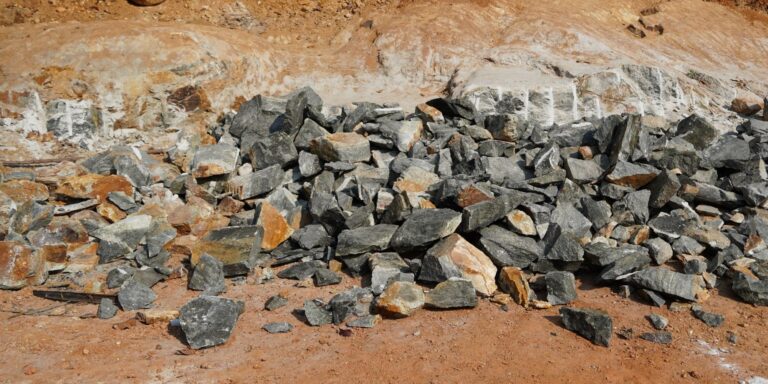
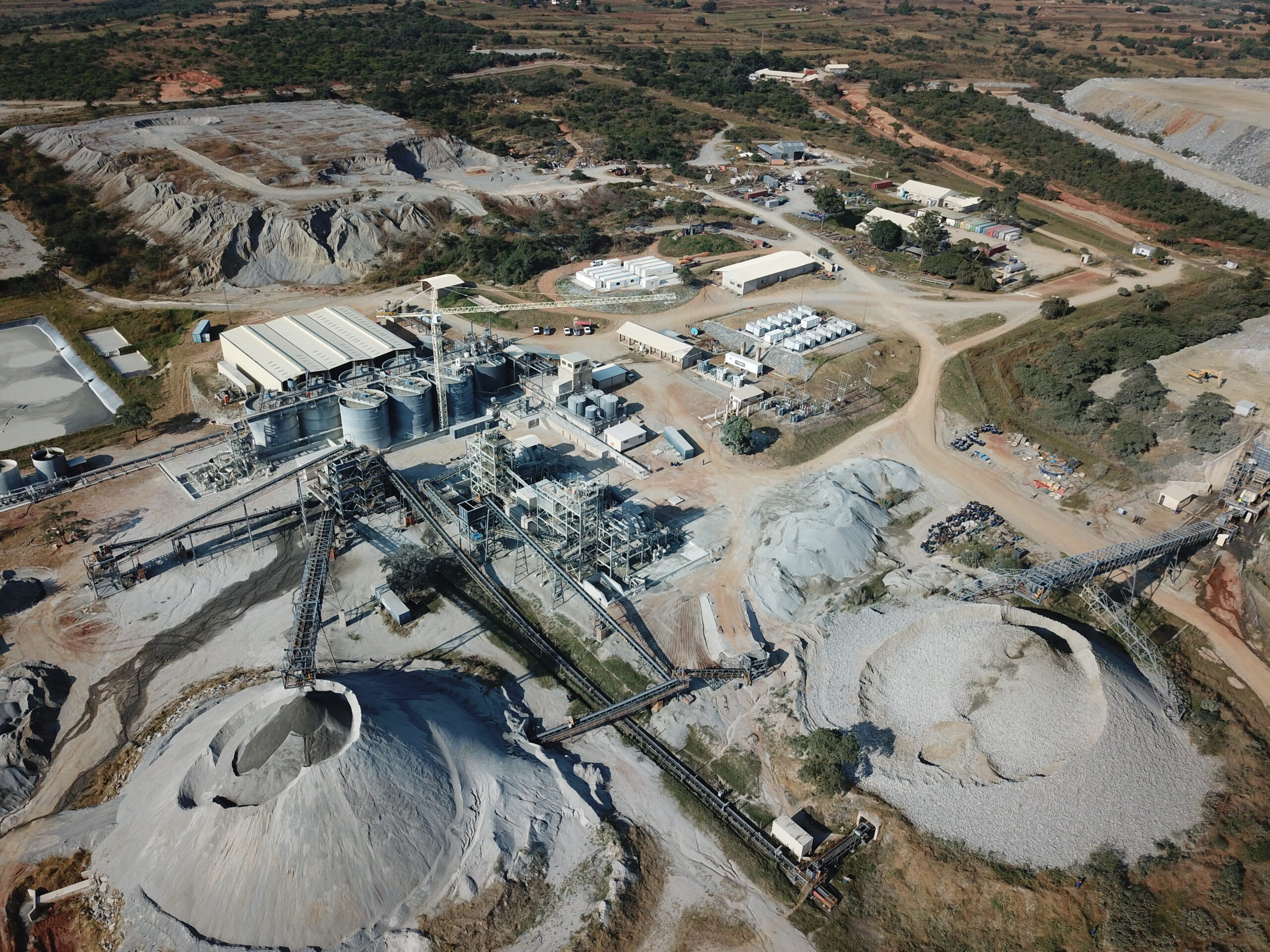
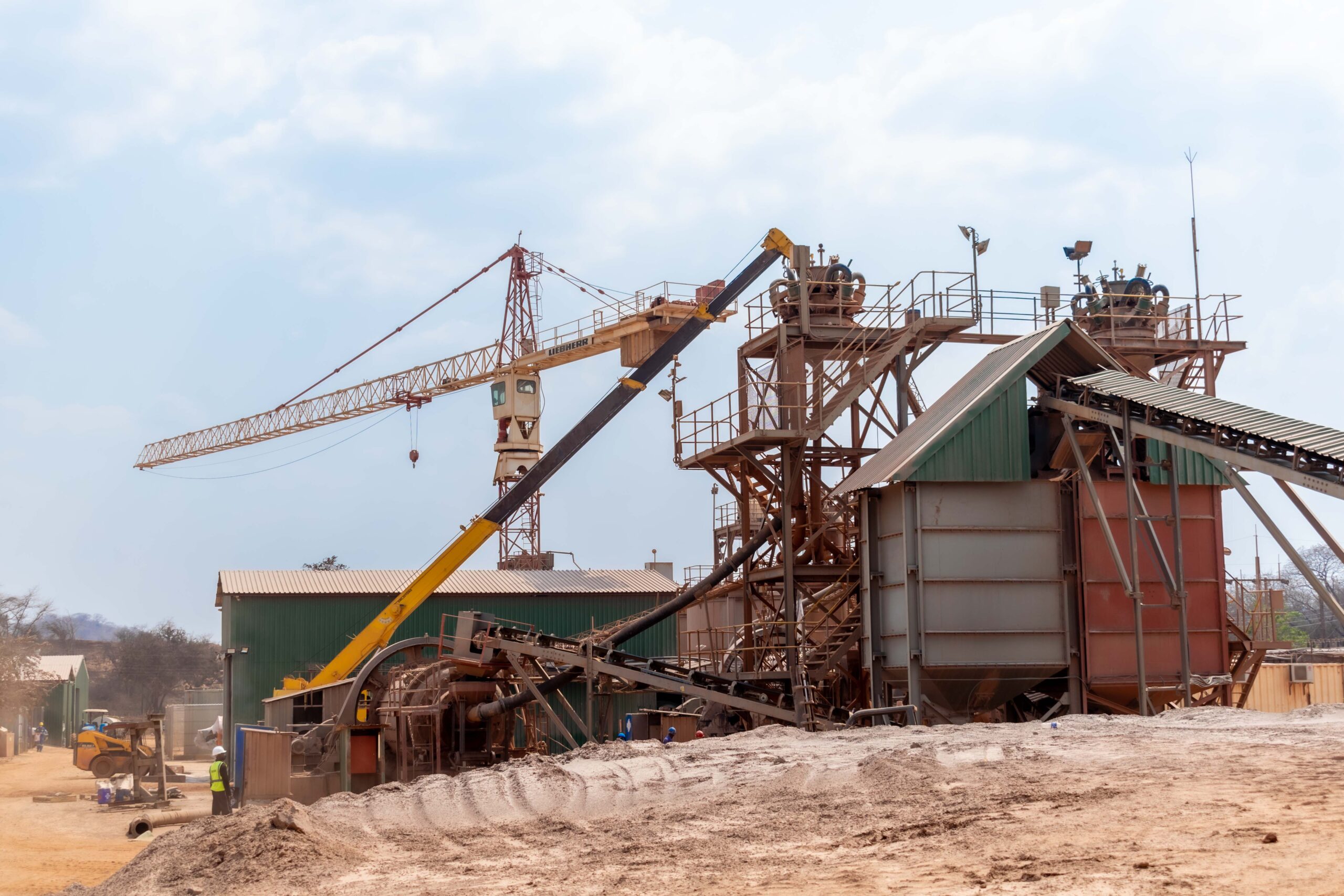
Contango Holdings has advised that the construction of a small-scale coke battery has been completed at the Lubu Coal Project in Zimbabwe.
The pilot coke plant has been constructed to provide on-site capability to manufacture coke from washed coking coal produced at Lubu for testing by future offtake partners and for the company’s internal studies and quality control.
The ultimate coke batteries to be installed at Lubu for future production and sales will be considerably larger and a different specification.
As previously reported, to date the manufacture of coke and subsequent studies from washed coking coal from Lubu has taken place remotely, with highly encouraging results. The ability to now manufacture coke on site is a significant step, providing accurate in the field results, a crucial step in securing partners in the company’s coke manufacturing strategy.
First coke manufacture
Following the completion of the pilot plant in February 2023, the company has subsequently produced approximately 4 tonnes of coke, from a sample of washed coking coal from Lubu.
A significant portion of this production will be delivered to the Multi-National Company that entered into a Memorandum of Understanding with Contango in December 2022. This is part of the ongoing due diligence process to confirm suitability for their requirements ahead of a potential transaction.
Carl Esprey, CEO of Contango, said:
“Whilst the expected margins on our coking coal production are very attractive, we have always maintained the highest margin business stems from the manufacture of coke at Lubu.
“Accordingly, we have already completed numerous small-scale tests remotely to assess the coke characteristics from Lubu, with highly encouraging results.
“The completion of the pilot coke plant will now enable us to generate larger coke production for testing, something required to enable us to conclude discussions under our MOU and, as required, provide additional samples to other parties who have expressed interest in coke produced from Lubu.
“This is a notable step in the evolution of the Lubu Project and I look forward to providing further updates with respect to the planned manufacture of coke in due course.”
The 40th World Diamond Congress, which will be held in Israel from 28-30 March 2023, will feature a full roster of illustrious speakers, from the world of diamonds and beyond, the World Federation of Diamond Bourses (WFDB) said.
The list includes (in alphabetical order): Edward Asscher, President, World Diamond Council; David Block, CEO, Sarine Technology Group; Gaetano Cavalieri, President of CIBJO, World Jewellery Confederation; Prof. Alon Chen, President, Weizmann Institute of Science; Conroy Cheng, Vice-Chairman of Chow Tai Fook; Winston Chitando, Kimberley Process Chair and Minister of Mines and Mining Development (Zimbabwe); Bruce Cleaver, Co-Chairman of De Beers Group; Yoram Dvash, President, WFDB; David Kellie, CEO, Natural Diamond Council; Aryeh Lightstone, former senior advisor to the US Ambassador to Israel; Boaz Moldawsky, President, Israel Diamond Exchange; Antoinette N’Samba Kalambayi, Minister of Mines, DRC and Moshe Salem, Vice-President, WFDB.
The World Diamond Congress, the WFDB’s most important event, convenes representatives of the 27-member bourses as well as leaders of the world diamond community every three years in a different diamond centre. Due to the Covid-19 pandemic, the last World Diamond Congress was held virtually in September 2020. This time the event is being held as part of Israel Diamond Week, being organised by the Israel Diamond Exchange.
Yoram Dvash said, “There has been an amazing level of interest in the 40th World Diamond Congress, especially as it is the first major event of the Federation, post-Covid. We have lined up a top-level roster of speakers, who will address the key issues facing the diamond industry today, as well as fascinating topics in science and diplomacy. We are certain that this will be a Congress to remember.”
China Natural Resources Inc said on Tuesday it would acquire Williams Minerals, the operator of a lithium mine in Zimbabwe, amid surging demand for the metal used in batteries for electric vehicles.
The company plans to issue restricted shares and promissory notes to fund the acquisition for a maximum of $1.75 billion, with $140 million as initial payment. It may also pay some of the amounts in cash.
Williams Minerals is owned by Top Pacific Ltd and Feishang Group Ltd, the latter also being the controlling shareholder of China Natural Resources.
Africa’s lithium production is likely to soar this decade, with the bulk of that coming from Zimbabwe.
China Natural Resources, however, said there was no guarantee that the transaction, expected to close in the second fiscal quarter of 2023, would take place under the current terms.
Fidelity Gold Refinery (FGR) has come up with strategies to ensure that gold deliveries increase significantly in 2023 compared to 2022.
Rudairo Mapuranga
FGR General Manager Mr Peter Magaramombe has projected gold deliveries to reach 40 tonnes in 2023 compared to 35 tonnes of gold in 2022, an increase of 18.9 per cent.
Speaking at the gold mobilization workshop and task force send-off on Wednesday, Magaramombe said FGR was confident that its strategies to ensure gold deliveries increase in 2023 will be of positive impact.
Magaramombe said the FGR would continue to offer United States dollar (USD) spot cash payments for gold lodgements as part of the strategies.
This will be done to ensure that small-scale gold producers are not financially constrained.
He also said that his company was ready to establish more buying centres to eliminate the hurdle of travelling long distances to sell.
“As Fidelity Gold Refinery we are going to offer international Gold buying prices. At the moment Fidelity has cash across all its branches. We are also going to open some new buying centres. Plans are in place to open new buying centres.
“FGR is now ready to open Gold centres within Gold service centres,” Magaramombe said.
He also acknowledged the importance of gold incentives in delivery increased and ensure that the government was going to continue with the program to encourage deliveries.
“The government has approved that we continue with incentives,” Magaramombe said.
He also said that, as part of its strategies, FGR was going to support artisanal and small-scale miners getting into strategic partnerships with them to ensure an increase in production.
“We are going to continue and actively support the Gold mobilization exercises.
“We are going to enter into some strategic partnerships targeting Gold mining and processing projects with potential. This will be done through the Gold development initiative fund,” Magaramombe said.
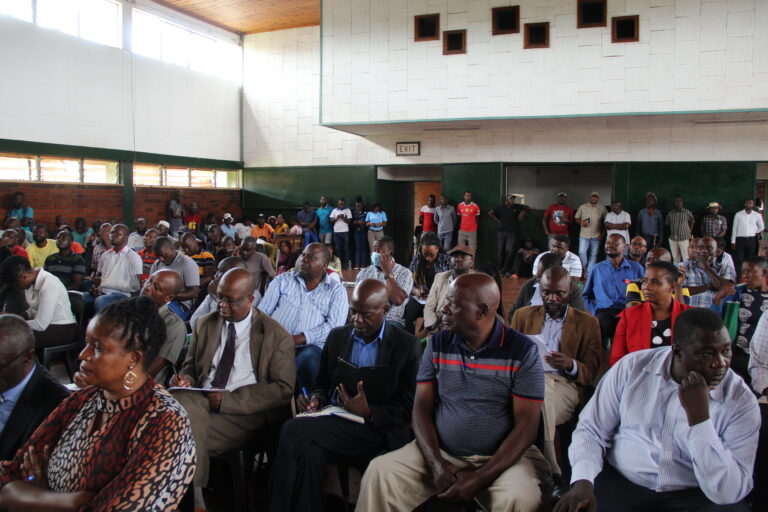
Some attendees braved fatigue and chose to attend the proceedings standing as all seats were occupied signalling the importance of inputs to get a desirable Mines Bill.
Miners raised a lot of issues and the most outstanding was displeasure with the Mines Affairs Board (MAB), the slow pace of mining title allocation amount others.
Members who will seat on the Mines Affairs Board (MAB) should go through public interviews instead of being hand-picked by the Minister of Mines and Mining Development, stakeholders voiced their concerns.
Speaking at the Mines and Minerals Amendment Bill public hearing held in Bindura on Tuesday a miner who attended said the Permanent Secretary was not supposed to be a member of the board and worse off, chairing it.
“The Board Members will be appointed by the Minister and the Permanent Secretary who is also the CEO of the Ministry will be chairing the MAB. The Permanent secretary should not be the chair of the board because it will be difficult for the board to hold him to account. I also think that the board Members will be very influential therefore should be appointed through Parliamentary interviews,” he said.
Speaking at the same event, Zimbabwe Geological Survey Director Forbes Mugumbate said stakeholders were not reading well through the lines of the Bill by suggesting that it is taking away the rights of land owners, particularly farmers.
He said that the Bill doesn’t allow miners or prospectors to peg without written consent from the farmers.
“You can’t peg without written consent from the holder of the farm,” Mugumbate said.
A miner submitting his views to the Parliamentary Portfolio Committee on Mines and Mining Development said it was of importance for the government to ensure that when a person discovered a mineral, they should be given discovery certificates so that no one can peg the land except themselves.
“There should be a temporary licence to ensure that people who discover minerals are protected,” he said.
Meanwhile, miners stressed disdain in the handling of disputes saying they preferred disputes be finalised by the Mines and Mining Development Ministry.
Addressing the gathering a Bindura miner said unscrupulous individuals are taking advantage of the court orders and will use the order to mine and even attain EIAs.
“There is an individual who went to court for a dispute and got Police officials to evict a miner with a mining title and started mining with a Court order. By law, we know that only a person with a title should conduct mining yet court orders are being used to mine right here in Bindura,” he said.
Mkaratigwa asked the miner to petition parliament in writing so that they can conduct an enquiry to get to the bottom of the issue.
Another miner stressed the importance of timely processing of titles and EPO applications saying at least 90 days should be the maximum time it takes for approval or disapproval as miners are forced to mine without requisite certificates.
On CSR a miner said it must be made a law that the community gets a share they agree on and it has to be fixed. Miners concurred that mining companies are currently taking advantage of the situation in some instances just buying school exercise books which they claim are good enough yet they make millions from the communities they are operating from. They said sometimes they are surprised to see in Media, mining companies claiming to have done non-existence projects therefore it should be made a law for communities to get at least 5% from mines operating in their areas.
A farmer also stressed the importance of separating mining from farming. He said proper planning needs to be done as they are losing cattle to haphazardly dotted pits and bridges are collapsing from miners who follow gold belts, mining without a care for the environmental impact their operations create. He also said that sometimes they are subjected to heartbreaking situations where Miners mine pits that run over each other leading to mine shaft collapses.
Another called for the ban on alluvial or river bank mining saying the practice which is mainly done by foreign-owned companies does more harm than good.
The Portfolio Committee on Mines and Mining Development is currently on a two-week tour conducting public hearings on the Mines and Mineral bill which if passed with become law replacing the existing one enacted in 1964.
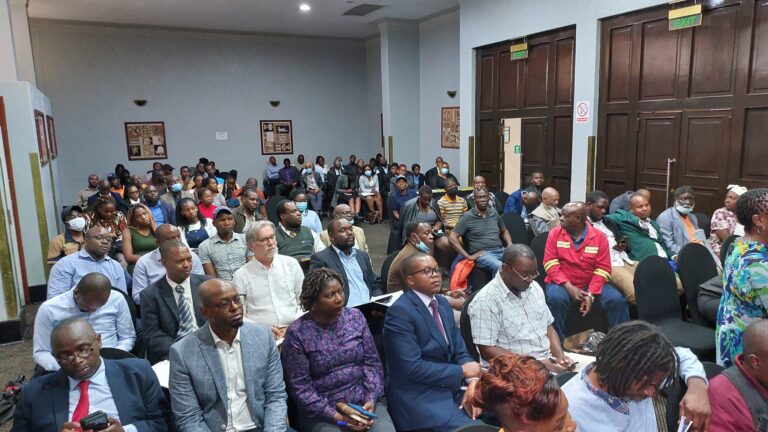
The issues to do with the Mines Affairs Board (MAB), Ownership of mining titles, Empowerment of local people and Corporate Social Responsibility (CSR) highlighted the proceedings at the inaugural Mines and Minerals Amendment Bill public hearing held at New Ambassador Hotel in the capital on Monday.
Rudairo Mapuranga
Stakeholders in the mining industry who submitted their proposals for inclusion in the mines and minerals amendment bill were in agreement that the amendment of the current mining law was long overdue, however, the amendment of the law should be in support of native Zimbabweans past, present and future to ensure holistic benefits the country’s God-given resource.
Commenting on the proceedings of the public hearings Parliamentary Portfolio Committee on Mines and Mining Development Chairperson Hon Edmond Mkaratigwa said he was encouraged by the quality of contributions of Stakeholders in the sector specifically on Ownership, Empowerment, and CSR.
“I’m encouraged by the turnout of Stakeholders Representing various groups in the mining sector, a lot of others in their individual or family trust capacity. I am also encouraged by the quality of contributions that came from the Stakeholders. To mention first are the issues to do with an empowerment model that ensures access by locals and the ownership of the mining claims by locals.
“And coupled with the empowerment, there is a strong view that while we have opened the sector for international investors to participate in our local market, we should actually, raise the bar in terms of the entry point, the threshold for any international player to come and participate in mining. They should not restrict themselves, for example to a standard mining block, maybe they should be given more than five blocks and they should be employing a minimum of 500, employees. So that they contribute significantly to our economy and they should be credible. They should pay taxes. The next, item of discussion that came out to be topical, is corporate social responsibility (CSR). What participants want to see is good infrastructure development, for example, roads, clinics and other support, infrastructure in our communities. Not only that is to be rendered by mining houses so much that the communities are going to give social license to any contribution by this foreigner.
“They also want to see the vulnerable that is, women, and the disabled participating in one way or the other in mineral exploration extraction and the value addition and beneficiation.
“There are so many issues I cannot finish them, but what I must say is, we need to see if a strong law is being enacted at the moment, a law that will defend, a law that will intensify the mining sector, a law that will regulate the mining sector, a law that will ensure that we manage and distribute equitably our resources that we are endowed with as a country and to wrap it up as an issue and we encourage conversations to allow around the participation of employees in the Ministry of Mines and Mining Development right now. The restriction they are not allowed to participate in any mining activities. They should not own any mining claims and you are saying as we, recur or as we amend this law, we also want to draw an analogy from what other Ministry officials, for example, in the agriculture sector they are allowed to what extent to own, land for agricultural purposes while they are involved in regulating that sector and those in the midst of environment, for example, who get involved in tourism and safari operations. So we’re saying our law should be fair, but we look at the views that are coming from the public not from us as a committee,” Hon Mkaratigwa concluded.
Chairperson for Artisanal and Small-Scale Miners Association (ASSA) Mr Blessing Togarepi objected that the Mines Affairs Board (MAB) be removed from the bill saying that it will slow down the processing of mining claims.
“Currently, there is slowness when it comes to the issuance of mining titles when the MAB is not involved, involving the mines affairs board will even slow down the process. As a sector we would want the MAB scrapped from the bill and give its duties to the PMDs,” Togarepi said.
Mining Consultant Nyasha Magadhi said that the MAB should be given the power it currently has in the current Mines and Minerals act and maybe take some powers to ensure that its decision to the signing of Exclusive Exploration Licence (EEL) and Special Grants (SG) be final but should not be given the power to determine who pegs, what mining claim and under what circumstances.
“We want the MAB to maintain their powers, we do not want them to be involved at whatever cost in the pegging and allocation of mining claims, it’s not and will never be their duty.
“We however want them to have the power to sign EEL and SGs on behalf of the President,” Magadhi said.
Aleck Chimhofu of Brentwood Chambers (Rusinahama-Rabvukwa Attorneys) said that the Bill should look into the Ownership of land and ensure that mining does not dispose land owners from enjoying their rights through giving mining precedents over other land uses.
“We would have expected the new bill to address for example when we pick section 241, it is introducing a provision which seeks to give an order to the owner of private land to sell their land or to dispose the land to a miner and basically what that provision would entail is that it is an erosion of the private ownership of land. It is an invasion of the rights to private property. We can’t have a law which promotes an erosion of a proper right which is enjoying the constitution because we are given this right by the constitution. Looking at section 13, subsection 4 of the constitution which says members from the local community should benefit from the natural resources which are found in their communities,” Chimhofu said.
The Chairperson of the National Gemstone Miners Association Walter Kawara said that it was of paramount importance for locals to benefit from resources found in their communities. He said that it was important that minerals like lithium and copper be removed from being classified as strategic minerals.
“We have copper and lithium everywhere in this country, and it will be a disadvantage to communities if these minerals are classified as strategic because what it means is that the communities will be relocated from the minerals they should benefit from only for a foreigner to enjoy.
“We want locals to be able to mine lithium and copper anyhow because these minerals are easy to mine, foreigners can therefore come for processing,” Kawara said.
There is nothing strategic about the mining of base minerals namely copper and lithium due to their vastness and easy extraction, National Gemstones Miners Association (NGMA) Chairperson Mr Walter Kawara said.
Rudairo Mapuranga
Speaking at the inaugural Mines and Minerals Amendment Bill public hearing held at New Ambassador Hotel in the capital on Monday, Kawara said the issue of strategic minerals should be looked into as making other Minerals strategic will lead to a situation where the country will only benefit from employment and taxes while the rest of the minerals will be siphoned away through fancy words like Foreign Direct Investment (FDI).
“The Chinese are coming and digging in people’s farms, the country is being defrauded by corruption. The law of strategic minerals should prioritize the local people. The local people should be the ones to mine minerals like lithium and copper. This law should look into communities, the government should educate locals on mining strategic minerals. There is nothing strategic with copper and lithium. People should register and mine these minerals. The (strategic) should come to the processing part of these stones. Mining copper and lithium is very easy.
“The strategic minerals are being mined by foreigners and the locals will only benefit from taxes which is ridiculous. Mining fees should differ from foreign to local people.
“Let us prescribe laws that will protect the rights and interests of Zimbabweans,” Kawara said.
Under the Mines and Minerals Amendment Bill Copper, lithium, nuclear energy source materials, rare earth minerals, diamonds, gaseous hydrocarbons and nickel have been classified as strategic.
The Government has also directed that on applications for inspection certificates, the applicants should submit a declaration of the amount of work carried out on mining claims as well as a declaration of minerals contained in the ore body being mined.
Reports reaching Mining Zimbabwe say the Zimbabwe Consolidated Diamond Company (ZCDC) Chief Executive Officer (CEO) Dr Mark Mabhudhu has been placed on suspension by the board.
It is not clear why Mabhudhu has been suspended although reliable sources claim its politics at play.
Mabhudhu managed to turn around the ZCDC from a loss-making entity since its inception in 2016 to one that has made a profit for the years 2021 and 2022.
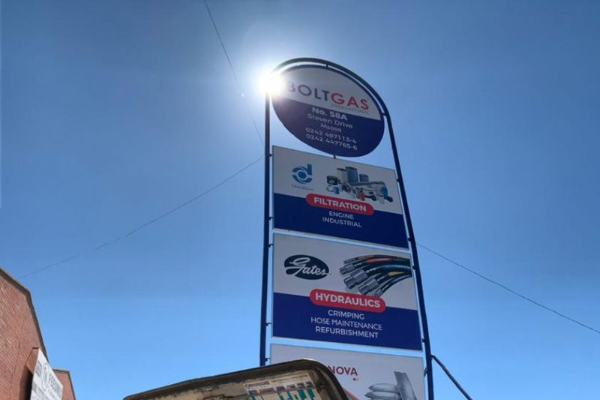
BOLTGAS, a leading supplier of engineering solutions, is evolving into a trusted brand across the central and southern African region where it continues to secure mandates – one after another – to implement high-profile projects from some of the African continent’s household names.
Having started operations nearly two decades ago, Boltgas has not only managed to dominate the Zimbabwean market but has successfully extended its reach into several markets in the sub-region as the company prepares to stretch its influence into the rest of the Eastern African region, before going all the way into North Africa.
Currently, Boltgas has two mega projects that are up and running in neighbouring South Africa, and in the Democratic Republic of Congo (DRC).
To the south of the Limpopo River, Boltgas has established a solution centre in what is undoubtedly Africa’s largest economy to make it easy for its sales force to service their clients given South Africa’s strategic location to coastline borders of the Indian Ocean to the south-east and the Atlantic Ocean to the south-west.
About the solution center Matthew Sibanda, the CEO of Boltgas had this to say: “We source from leading brands in steel products, filtration hydraulics, mineral processing, ground support, materials handling and transmission technology, etc., and distribute their quality and customised products and services to our valued customers to ensure that they enjoy an uninterrupted service all-year-round. By listening to our customers and understanding their operational challenges, we are able to provide solutions and supply chain reliability to help them enhance their productivity.”
In the DRC, Boltgas landed a contract to design and construct a sulphuric acid leach plant for one of the major mines in Katanga Province. Work on the projects is already in progress and expected to commission end of May 2023 Boltgas has been involved in the region since the late 2000s, with some of its projects having been finalised in Mozambique, Botswana and Zambia and South Africa, coal gasification project for Eskom and Leaching agitators for Crossing Uranium Mine in Namibia.
In Zimbabwe, the company has participated in a number of contracts, amongst them the establishment of a power separation plant and substation for ZimChem Refineries; the construction of a gantry and pipework for Polyoak Packaging and the design and installation of the Wattle Company’s conveying system and incinerator, Murowa Diamonds 14km pipeline, Mimosa Platinum Mine 1mw mine ventilation extraction fan
At the Pretoria Portland Cement, otherwise known as PPC, Boltgas was involved in the upgrade and maintenance of the company’s dust extraction system, while they have been responsible for the installation and maintenance of the Zimbabwe Platinum Mines’ dust bags and dust extraction industrial filtration solutions.
Boltgas started off in 2005 as a supplier of engineering services and solutions in design and detailing, structural steel works, plate works, pipe works, plant refurbishment, rehabilitation and maintenance, site works, fabrication, machining, installations, etc. The business has evolved over the years into a total provider of engineering solutions that enable their clients to keep their plants and machinery up and running to enhance their top line through reduced downtime and increased productivity.
Boltgas’ coverage extends to every inch of the country and has now taken their brand across the borders, as they push harder to being a pan-African provider of engineering solutions.
Not so long ago, they acquired National Metal Foundries in Bulawayo, opening the group to many possibilities in the engineering field. The acquisition has enabled Boltgas to diversify into National Metal Foundries’ core business of manufacturing cast-iron, aluminium, bronze and brass from scrap metal as well as general engineering, and taking the products across the length and breadth of Zimbabwe as well as into the sub-regional markets.
In addition, the engineering arm of the group went through a successful restructuring after going into a joint venture that gave birth to Boltrec Engineering whose mission is to provide customized engineering solutions that satisfy stakeholder needs. Boltrec now stands shoulder-to-should with the world’s best as a reputable engineering company designed to harness custom-made engineering solutions for its clients through formulating various synergies with industry leaders.
A proudly Zimbabwean company, Boltrec provides total engineering services and solutions in structural steel works, fabrication, precision machining, crane services, line boring, plant maintenance, installations, commissioning and training, component building, facilities maintenance, draughting and design, brick and paver moulding, project management as well as engineering skilled labour hire.
In 2021 a company brought back to life a Mine that had shut down 20 years back breathing life into the otherwise lacklustre town of Mashonaland Central Province of Zimbabwe. There was a rebirth of hope as hundreds of men and women solidified their place as breadwinners after securing employment with Dallaglio Investments’ Eureka mine. As many were preoccupied with the pleasant development little did they know Dallaglio was already a major gold player running another popular Chegutu-based asset, Pickstone Peerless Mine.
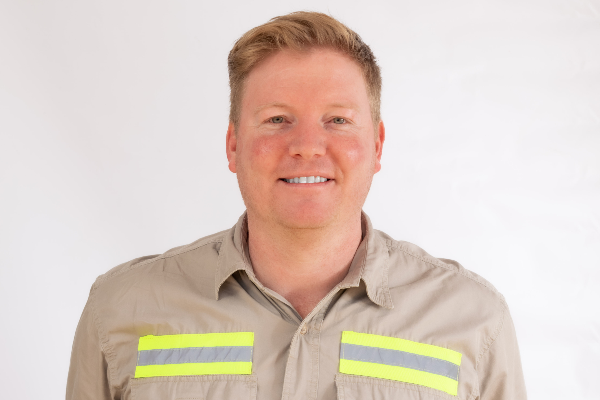
Mining Zimbabwe sat down with the man responsible for Managing the company’s overall operations Mr Marc Nicolle who is the company’s Chief Executive Officer (CEO) to learn more about the organization’s operations and its plans for the future. This is how the intriguing exchange with the 41-year-old Mining executive went.
Can we have a brief background about yourself and how you ventured into mining?
Marc Nicolle grew up in Gwanda, the home of Caledonia’s Blanket Mine. My family has been there since the late 1890s and in a gold mining town, mining was always adjacent and part of life. I really enjoyed chemistry at school and I wasn’t sure what to study, I did some assessments and then ended up studying chemical engineering. Chemical engineering then led me to a processing career in the mining industry.
What is Dallaglio’s strategy when it comes to mining growth and development in Zimbabwe, are there any plans for the company to add more Mines to its portfolio?
There is definitely hunger from our shareholders and from the management to grow the business but we want to grow the business in a very responsible way. There is evidence across the world of companies that do too much too soon. We want to be very credible and all of our results today talk of that credibility. Pickstone Peerless was a big step and was an expansion step for a group of shareholders that came together in 2012, they invested in 2014 and brought Pickstone back online in 2015. In 2018 with the success of Pickstone’s rebirth, that same group acquired Eureka which was a dormant asset and brought that back online in late 2021. The group continues to look for opportunities to grow but we want to do that from a strong balance sheet perspective, from a very credible production perspective.
Pickstone Peerless Mine is currently moving from open pit mining to underground as well as adding heap leaching, how is this development going to increase production at the Mine?
Pickstone underground will increase the grade that we can feed our mills, it is harder ore and because it’s harder ore it means we will have to increase milling capacity at Pickstone as well in 2023. That higher grade will increase our production to an average of about 80 kgs per month with underground online from the current 40 – 50 kgs per month that we have from the open pit material. The heap-leach is a project that we will detail more in 2023 and we will be looking to make an investment in 2024 if the numbers come back positive, they are however currently looking good for us. With Heapleaching we expect an average of 30 kgs to 40 kgs on top of the 80 kgs per month.
Eureka Mine is currently conducting open-cast mining, are there any plans to go underground?
There is a potential to go underground. We have over 800 thousand ounces in the underground portion of the Eureka ore body, that’s an orebody that we find 650 metres below the surface. Our plan is to mine the first 300 metres on an open pit, the balance is possibly mineable from underground. That planning is also on the radar to be defined in 2023 and early 2024 with the potential on the outcome of that coming to our business plan through 2024. It will take a significant time and investment to get underground at Eureka, our view at the moment is that it will add to the life of the Eureka asset in time.
Eureka has arguably the best CIL plant in Africa. What inspired you to develop such a plant and has it been rewarding vs current production?
All credit for that CIL plant needs to go to one of the founding shareholders, Mark Evans. Mark Evans is an incredible individual and we are lucky to have him as a team. He has pulled together through many suppliers a design for that plant and has delivered it at a wonderful level. Chemics in South Africa were the suppliers of a significant portion of the design, local company Brown Engineering manufactured the tanks on sight from Harare. The local Zimbabwean engineers that we hired did a significant job of putting that CIL plant together.
Does Dallaglio have plans to promote small-scale Mines through knowledge exchange and giving out mining tributary arrangements?
Dallaglio already has some other mining tribute arrangements. They are community-based arrangements that keep the communities around our mines aligned to our objects but also give them an opportunity to make an income.
In the next few years, what are Dallaglio’s plans in terms of investment specifically in Pickstone Peerless and Eureka Mine?
Pickstone Peerless Mine
At Pickstone we are very excited about Pickstone underground which is in the old Pickstone Trent and it’s down to 5 level. We have Pickstone underground phase 2 which is from 5 level down to 14 level. An investment into that deepening of the Pickstone mining front is very exciting for us. In addition to Pickstone 500 metres North, we have the Peerless trent. Peerless is another ore body that we mined from the open pit. Peerless as a wider ore body from our experience of mining it from the surface, we are doing some conceptual work to see how best to mine that at underground.
At Eureka, we have the beginnings of the underground as we spoke earlier, so we have that portion below the open pit down to the bottom of drilled resource that is open at depth to consider for underground mining. In addition to that we have done some test work on ore sorting, layser ore sorting has shown good potential to upgrade the grade of ore fed to the mills which will allow us to mine faster and achieve quick returns.
As the world is going green there seems to be a global lithium rush. Are there any plans for Dallaglio to diversify and potentially get into Lithium mining?
At this stage, we don’t have plans to diversify into lithium mining. We have our hands very full at Pickstone and Eureka realising the value that we can see. It’s not to say that if the right opportunity comes we will not consider it.
Zimbabwe is generally relegated as a risky investment destination. As a company operating here, what are your comments on the experience?
I’m a Zimbabwean and I’m very proud to be back in Zimbabwe applying my trade, my skills and leading fellow Zimbabweans in making this country what it can be. I understand the international community’s view of Zimbabwe simply because capital in mining is hugely scarce and it must chase a good return. My experience on being back is that there is a willingness from the government and all stakeholders to make it work but it must work in a way that is good for everyone. It must work for communities, it must work for the government and it must work for the investor and I think that the ubuntu aspect of Zimbabwean mining is something that once we can adopt, we will see a very positive change. My experience has been positive, there have been decades of under investments in the mining industry and those decades produce many opportunities.
What is the current production level and are there plans to ramp up?
In 2022 we averaged 160kgs per month, in 2023 we hope to grow that in terms of a double-digit percentage.
How have you (at Eureka) managed to be one of the top gold producers in the country while mining a low-grade gold deposit?
We achieve over 93 per cent gold recovery at Eureka. Our attention to detail in that mining operation allows us to quickly manage costs.
What is your employment policy at Eureka Mine i.e. in terms of employment of the local community?
In general, at Dallaglio, we want to be the employer of choice in the community. Our approach is to look from the local community to supply people to our mines. As I mentioned before, growing up in Gwanda the community of a town is amazing if it is contributing to the local industry. That said though, we have a very high need for top skills, mining and doing mining well require excellent professionals. We will therefore look for those skills in general and deploy them to our mining sites. But I will give you a good example, our group Processing Manager Obert Chiyangwa is from Guruve, our group treasury is also from Guruve.
There is a presence of GRANODIORITE rock which is well known for being extremely hard and tough. How are you handling this rock and managing costs at Eureka?
When you mine it is much more cost-effective when you blast correctly in the pit. So, our first port of call is to blast it in the pit. We blast it correctly in the pit we then move to crushing. Crushing is also effective for us, to date we have that particular process under control.
Are u doing in-house mining or contract mining? If it’s contract mining, how are u managing the contractor?
We are doing contract mining. Our General Managers on both sites are mining engineers and both have a wealth of experience in open-pit mining. We through the General Manager’s structure have a mining technical service team that does mining planning. We then have a Mining Manager who oversees the contractor implementation of our mine planning. So one person defines the recipe and the other cooks the cake and through that, we manage our contractors well.
What is the confidence level in the Eureka Mine Resource Model? What measures are in place to ensure that there are no surprises in the Life of Mine Plan as a result of flaws in the resource model?
The confidence level in the Eureka Mine resource model is high, it’s the highest in our group. We have taken data that was gathered by previous owners. We reassessed that in a geological structural model. From that definition of the structural model we then took the grade data within the confined structural model, the model is Jorc compliant.
What would you want to see change in Zimbabwe Mining?
We are sitting on an asset that can be world-class (Zimplats has proven this over a decade). When we are able to free up some of the funds that come into the country. If a business can deploy capital and then get a good return on it, our industry can grow significantly. Our ability as Zimbabwe to produce at an international scale will be visibly incredible. I do understand the history I do understand the need to balance what we have at the government level but I think if we will be going at any boom at the moment, the boom will be like Copperbelt DRC.
Besides the Mining business whats Marc Nicolle into?
Marc is a father of four, happily married to his wife Sophia. I live a very fulfilling life with my children. Im into cricket which I enjoy very much, I enjoy hiking so Domboshava has been a feature. I enjoy good conversations with good people, it’s always nice to talk to people.
To provide the best experiences, we use technologies like cookies to store and/or access device information. Consenting to these technologies will allow us to process data such as browsing behavior or unique IDs on this site. Not consenting or withdrawing consent, may adversely affect certain features and functions.
Functional
Always active
The technical storage or access is strictly necessary for the legitimate purpose of enabling the use of a specific service explicitly requested by the subscriber or user, or for the sole purpose of carrying out the transmission of a communication over an electronic communications network.
Preferences
The technical storage or access is necessary for the legitimate purpose of storing preferences that are not requested by the subscriber or user.
Statistics
The technical storage or access that is used exclusively for statistical purposes.The technical storage or access that is used exclusively for anonymous statistical purposes. Without a subpoena, voluntary compliance on the part of your Internet Service Provider, or additional records from a third party, information stored or retrieved for this purpose alone cannot usually be used to identify you.
Marketing
The technical storage or access is required to create user profiles to send advertising, or to track the user on a website or across several websites for similar marketing purposes.