

Home Blog Page 316

Experts Slam Bullying by Western Countries, Vow Zim Will Benefit from its Lithium Resources

0

The view by Attorney Peter Leon that by banning lithium ore exports Zimbabwe was “playing with fire” has been described by local analysts and miners as a poor attempt to solely benefit from Africa’s resources while leaving African nations with nothing to show for them.

Rudairo Mapuranga

In his argument, Leon said bans on mineral exports by Zimbabwe and Namibia could fall foul of World Trade Organisation (WTO) founding regulations.

The WTO allows export and import levies but is opposed to quantity restrictions as a basic precept of its formation, said Leon. Since raw mineral export bans are often coupled with other laws promoting in-country processing so-called ‘beneficiation’ will end up “breaking every law in the WTO’s book”, Leon said.

In 2020, Indonesia banned nickel exports saying it had domestic shortages. The WTO didn’t accept this argument. It sided with the European Union which had launched an objection. An attempt by Indonesia to appeal the WTO’s judgement was likely to fail as the WTO appellate division no longer exists, said Leon. The US declined to support the WTO during the administration of former President, Donald Trump.

Responding to the allegations by Leon, an Expert in Mining and Natural Resources Law, Dr James Tsaburi said Leon’s statement was a loud nothing threat meant to bully Africa from benefiting from its minerals resource. He said since Zimbabwe has a large lithium resource and the critical nature of lithium to the green revolution, Western countries will stop at nothing in trying to control the resource.

He said his reference to WTO is unfounded because WTO does not prescribe legal frameworks that countries must adopt to regulate their mineral value chain.

“His statement is nothing but a bully’s empty threats. There is no international treaty on mineral trading. Export restrictions are purely the purview of domestic law. As with any other country, Zimbabwe has sovereign rights to regulate mineral extraction, processing, beneficiation and mineral export.

“The reference to WTO is as mischievous as it is legally unfounded. The WTO does not prescribe legal frameworks that must be adopted by countries to regulate their mineral value chains. It is not surprising that a lithium export ban raises eyebrows – lithium is a critical mineral and the fact that Zimbabwe has massive lithium deposits throws it in the spotlight of global powers,” Dr Tsaburi said.

Speaking to Mining Zimbabwe renowned geologist Paul Chimbodza said it was always logical and beneficial to host countries if they beneficiate their minerals.

“Logically, every nation must strive to beneficiate their resources than export raw material which invariably exports jobs,” Chimbodza said.

Zimbabwe Diamond and Allied Mine Workers Union (ZDAMWU) General Secretary Justice Chinhema told Mining Zimbabwe that the idea by Western countries to dictate how Africa was supposed to sell its minerals was despotic. He said banning raw mineral exports was going to create more jobs through value addition and beneficiation.

“Our understanding as workers is that the ban on raw Lithium is benefiting the country more in many ways,

  1. Value addition and beneficiation – our minerals will be competitive on the market bringing the much-needed foreign currency.
  2. Job creation – by value addition, we are creating more jobs in the value chain up to the mining of the mineral.

“These capitalists must just shut up, they cannot tell us how we should trade our minerals. They are used to loot our resources for their benefit. They want them raw and they value add in their country and sell the same to Africa as their products. Africa needs to be independent to choose how they dispose of their minerals. Only Zimbabwe has control over its minerals,” Chinhema said.

Lithium miner Shelton Lucas said the advantages of banning lithium exports were going to benefit the country in the sense that exporting raw ores would result in the country losing other minerals which are hosted by the ores.

“The advantages of banning lithium ore exports in Zimbabwe are many because lithium is hosted by pegmatites which are embedded with 10+ other minerals like tantalite and tin which are not given a value tag and taken for free if lithium is sold as ore.

“By beneficiating lithium these minerals are liberated and can be sold separately,” Lucas said.

In December 2022, Zimbabwe imposed a ban on the export of unprocessed lithium aimed at stopping job exports.

Permanent Secretary in the Ministry of Mines and Mining Development Mr Pfungwa Kunaka at the time said the ban will help exploit the full value chain of lithium.

He pointed out that Zimbabwe had already seen marked growth in the value of mineral exports from less than US$3 billion in 2018, when it launched the 12 billion Mining Industry roadmap to grow the shipments, to US$12 billion by 2023, to well over US$6 billion in 2022.

“. . . You gain better when you are value-adding. And starting value addition is preparing to exploit the full value chain of lithium, which ends up in issues of products like solar batteries for electric cars et cetera, which is the direction the world is going.

Lithium Mining in Zimbabwe is on the rise with several projects in the exploration phase forecasted to kick-start production within 2023. The country has the largest lithium reserves in Africa and the fifth-largest deposits worldwide. It has the highest number of Lithium projects under exploration on the continent.

On the 6th of July 2023, President Mnangagwa commissioned the 3rd biggest Lithium processing plant in the world which processes 4.5 million tonnes per annum.

Bindura Nickel records 3.7 million fatality-free shifts

0

Bindura Nickel Corporation (BNC) continues with its amazing record to achieve zero harm in the mining industry by achieving a total of 3.7 million fatality-free shifts as at 31 March 2023 with the last fatality having been recorded in June 2015.

Rudairo Mapuranga

According to BNC Abridged Audited Financial Results for the year ended 31 March 2023, the company’s safety environment remains impressive with the mine recording a new record of 3.7 million fatality-free shifts, three lost time Injuries and COVID-19 cases remained under control during the year.

“As part of the Company’s pursuit of sustainable mining goals and initiatives, and given the inherently hazardous nature of mining operations, Safety, Health and Environmental (SHE) systems are continually being upgraded and improved to enhance sustainable operations. The main area of focus continues to be on instituting and deepening the desired SHE culture in order to prevent accidents, promote good health for employees and their surrounding communities, while minimising environmental harm, in line with the Company’s Zero Harm policy”

“In line with the foregoing, the Company ended the year with the COVID-19 pandemic under control and has nevertheless, continued with preventative measures and control programs to ensure the pandemic remains under control.”

“A new record of 3.7 million fatality-free shifts was achieved as at 31 March 2023, with the last fatality having been recorded n June 2015. Three Lost Time Injuries were recorded in the year, versus two in the prior year.” BNC report shows.

The Company continues to comply with applicable environmental legislation and remains SO 140012015 and SO 450012018 certified.

Miner robbed of car, us$20 000 at gun point

0
A Miner was left dejected and counting his losses after three gut-totting robbers attacked him as they threatened to gun him down before allegedly robbing him of his car and over US$20 000.
The miner who does his mining activities at Dodolo 18 Good Memory Syndicates mine in Inyathi, Matabeleland North Province was in Bulawayo on the fateful day.
“It was around 7.50 pm on Friday last week when Bhekimpilo Ncube (39) and his accomplices named as Thembani and Thandazani Dube followed the miner in their car as he drove his Toyota Lexus to his home in the Trenance suburb,” said the source.
Upon arrival at his home, the trio quickly alighted from their car and opened fire at him.
“One of the robbers shot at him, the bullet ripped through the driver’s window and went straight to the dashboard.  The miner disembarked from the car and they ordered him to lie on the ground. They kicked him and slapped him while demanding money. One of the robbers remained guarding him while the other two searched in his car and stumbled on US$20 760 and three cell phones. They took the cash and cellphones before they fled in his car,” said the source.
The miner reported the incident to the police and investigations led to the arrest of Ncube at his home in Gwabalanda suburb. However, his accomplices have not yet been arrested.
Ncube revealed to the investigators that they dumped the car at Ngozi mine before they removed the tyres.
Ncube is set to appear before a magistrate at Bulawayo Regional Court facing an armed robbery charge.
A source close to the miner said: “The incident left him traumatised and depressed.”
B Metro

Auditors doubt Premier’s going concern status

0

Premier African Minerals (Premier) auditors MAH Chartered Accountants have cast doubts on the lithium miner’s ability to continue as a going concern after it incurred heavy losses and net current liabilities.

The group reported a loss before and after tax of US$5,803 million for the year ended December 31, 2022 against a profit of US$2,29m realised in 2021. The loss before and after tax includes administration expenses amounting to US$4,622m.

The total comprehensive loss for the year was US$13,646m against a profit of US$2,150m realised in the prior period. Again, the firm’s financial position was made worse by the termination of the offtake agreement it had with Canmax Technologies Co. Under the deal, Premier secured US$35m prefunding to enable the construction and commissioning of a large-scale pilot plant which has capacity to produce nearly 50 000 tonnes of spodumene concentrate annually. The mining firm was required to supply spodumene concentrate to Canmax by May 30, 2023, but failed due to various reasons. Again, it failed to meet the June 25, 2023 deadline. This resulted in the company issuing the force majeure notice to Canmax, effectively suspending all obligations under the agreement, including those associated with Premier and any consequences associated with it.

“We draw attention to note 5 in the financial statements, which indicates that the group is loss making and has net current liabilities,” the auditors said in their audit report accompanying the firm’s financial results.

“In addition, the group is in dispute with Canmax, who have submitted a purported notice of termination of the offtake agreement and have required the group to settle the prepayment amount of US$34,7 million within 90 days of June 25, 2023. However, the group has been advised that this notice of termination has no force or effect.

“As stated in note 5, these events or conditions, along with the other matters as set forth in note 5, indicate that a material uncertainty exists that may cast significant doubt on the group’s ability to continue as a going concern. Our opinion is not modified in respect of this matter.”

Going concern refers to a company’s ability to make enough money to stay afloat or to avoid bankruptcy.

In his statement contained in the report, Premier acting chairperson and chief executive George Roach said the group would use its reasonable endeavours to work with Canmax during the period of force majeure to seek a remedy. However, he said any dispute pertaining to the offtake agreement, including the force majeure, will be resolved in Singapore through arbitration which is expected to take over 12 months for the matter to be both heard and adjudicated on based on the nature of the dispute.

“In the event that the group is unable to either resolve the status of Canmax or find an alternative offtake and marketing partner to settle the Canmax prepayment amount plus interest and Zulu fails to meet its revised production targets, then a material uncertainty exists which may cast significant doubt on the ability of the group to continue as a going concern and therefore be unable to realise its assets and settle its liabilities in the normal course of business,” he said.

Premier owns RHA Tungsten, Zulu lithium and tantalite projects in Zimbabwe. It also has assets in Namibia and Ethiopia.

Source: Zim Independent

Zimbabwe gold buying prices 13 July 2023

Fidelity Gold Refinery (FGR) official gold buying prices Thursday 13 July 2023. See the Zimbabwe gold buying prices today.

SG 90% AND ABOVE US$59.34/g
SG ABOVE 85% BUT BELOW 90% US$58.71/g
SG ABOVE 80% BUT BELOW 85% US$58.08/g
SG ABOVE 75% BUT BELOW 80% US$57.46/g
SAMPLE BELOW 10g BUT ABOVE 5g US$56.51/g
FIRE ASSAY CASH US$59.65/g

NB: Fire Assay cash price is for gold above 100gs, no sample is deducted.
For the Fire Assay Transfer price, a sample of not more than 10g is deducted
A 2% royalty is charged on all deposits (small-scale miners)
A 5% royalty is set for Primary Producers

Cash available. Fidelity Gold Refinery prices will be changing daily about world market prices.

Gaika Mine for sale

0

Duration Gold has engaged CBZ Capital as an exclusive advisor in preparation for the sale of Gaika Mine in Kwekwe.

Duration Gold, which also runs Vumbachikwe in Gwanda and other early-stage exploration projects, took the decision to streamline its operations despite already having invested over US$10 million at Gaika.

“Duration’s strategic decision to streamline its operations has come after wide consultations including its shareholders, which include five major international investors and the Ministry of Mines which is striving to meet the grand US$12 billion target set by the government,” said Duration Gold.

“The decision is timely as Duration Gold has invested heavily in the project and accomplished its primary goal of advancing the Gaika exploration project from a small historic, but abandoned, gold mine up the “Exploration Value Curve” to a critical decision point for the Company, the Nation and the local community.”

A 2022 project scoping study conducted by South African-based VBKOM project Managers revealed encouraging results with projections of 85,000 ounces per year.

The report also proposes an Open Pit Mine for Gaika at a cost of US$175 million, for a twelve-year mine life.

Having been commissioned in 1894, Gaika was one of the country’s first mines alongside neighbouring Globe and Phoenix after colonial rule commenced in 1890.

New Zimbabwe

Blanket’s Eroica ore body in encouraging drilling results

0

Drilling results at Caledonia Mining Corporation Plc-owned Blanket Gold Mine which targets depth extension to the Eroica ore body indicate that the ore body continues at depth with grades and widths being generally better than expected.

Rudairo Mapuranga

Deep-level drilling at Blanket Mine was suspended several years ago due to underground logistical constraints and the impact of Covid-19 on contractor operations. Following completion of the Central Shaft and related infrastructure, deep-level drilling resumed in January 2023 and is currently focussed on the Eroica orebody where a cross-cut has been mined to allow optimal access to drill the deeper zones of the steeply-dipping orebody.

Approximately 5,600m of drilling were completed between January 1, 2023 and May 30, 2023 approximately a further 12,900m is planned for the remainder of 2023.

According to Caledonia Chief Executive Officer Mr Mark Learmonth, approximately 5,600 meters of drilling was completed between January 2023 and the end of May 2023 with the results of the drilling campaign showing encouraging grades.

“I am delighted with the results of the drilling campaign so far. In particular, the grades are very encouraging when compared to the historically achieved mining grades from Eroica which have been approximately 4-5g/t. The Central Shaft and related infrastructure are vital not only to increase production but to give us the capacity to restart exploration with a view to extending the life at Blanket Mine. We have invested heavily in Blanket Mine in the last 7 years, including investment in 2023 (which will be continued in 2024) in a new tailings facility with an anticipated life of approximately 14 years, to create a mine infrastructure which can sustain production beyond the current production horizon.

“These results are very encouraging and we look forward to receiving results from extension drilling at the Blanket ore bodies and also from the next phase of drilling,” Learmonth said.

At the Eroica zone, drilling from an exploration drive on the 750m level of the mine has focussed mainly on converting inferred resources to indicated resources, in addition to drilling areas outside of inferred resources as the mineralization extends to a depth, between 850m and 1150m below surface.

This is above the bottom of the new Central Shaft and therefore any resources that are identified in this area will be served by the planned Central Shaft infrastructure.

Overall, the results confirm the Eroica zone persists to depth as earlier modelled, and, encouragingly, the results indicate that grades and widths are significantly higher than previously thought.

In addition, the deepest hole drilled in the programme, hole ERC750EX2214, returned strong intersections some 120m vertically beneath the current inferred resource, which returned true widths of 5.78m grading 8.18grams per tonne(“g/t”) gold and 8m grading 7.7g/t gold. The zone also remains completely open below these intersections.

These results, along with the results of further planned exploration, will be reflected in a revised mineral resource statement which will be published in due course.

Jena to Commission fresh air rescue team

0

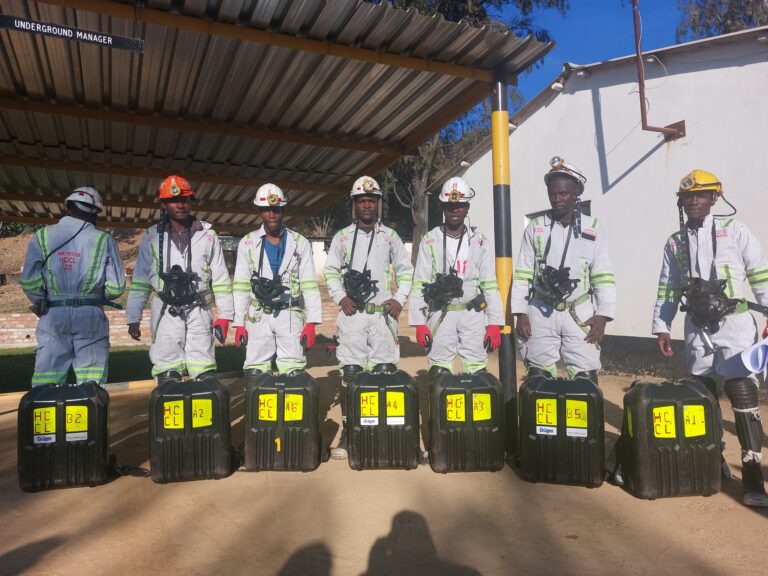
As part of its strategy to reduce fatalities, Kuvimba Mining House (KMH) owned Gold mine, Jena Mines, lost time due to injuries and casualties which has led to the mine assembling a fresh air team which will be commissioned soon, the mines Safety, Health, Environment and Quality (SHEQ) Manager Tatenda Hapanyengwi said.

Speaking to Mining Zimbabwe on the sidelines of the Mine Rescue Association of Zimbabwe (MRAZ) Westzone Quarterly training exercise held at Metallon Corporation Zimbabwe’s Bulawayo Mining Company (BMC) last week, Hapanyengwi said Jena Mines’ rescue team attended the exercise for them to have an understanding of how teams operate practically.

“We have noticed recently that statistics have been rising in terms of fatalities and lost time injuries due to hazards associated with mining. In terms of us being prepared, we decided that we should have a team that is readily available for our mine and other Mines around large or small.

“We came here to learn as a new team on how to respond in terms of call-outs for emergencies. The first thing that we learnt is that Proto is an important team in the mining industry every mine should have a team on its own to reduce casualties, save lives and safety preparedness,” Hapanyengwi said.

He also said that if commissioned, the team is going to be one of the top contenders in upcoming rescue competitions.

“Our team is young, motivated, highly intelligent and with all this training and all this effort we are putting in the idea prepare them such that when the time comes they will be ready. I guarantee you that Jena Mines is going to produce one of the best teams in Zimbabwe,” he said.

AMSZ technical visit to Enhance Tailings Safety & Environmental Protection

0

The Association of Mine Surveyors of Zimbabwe (AMSZ) is taking a proactive approach to ensure the safety and environmental protection of Tailings Storage Facilities (TSFs) in Zimbabwe.

In an effort to educate its membership on the technical requirements for building a new TSF, the AMSZ will conduct a technical visit at the Mimosa TSF facility phase 4 on Thursday the 13th of July 2023.

TSFs are reservoirs that store mine tailings, which are the fine-grained waste materials produced during the processing of ore or coal. Improper storage of these tailings can lead to serious safety, health, and environmental hazards. The AMSZ recognizes the importance of proper tailings storage and is committed to equipping stakeholders with the necessary knowledge and skills to mitigate these risks.

AMSZ President Gabriel Mwale highlighted the two presentations that will be given during the visit, focused on survey requirements for building a new tailings storage facility and constructing a penstock for the new TSF before commissioning.

“We will have two presentations. We are going to discuss the Survey requirements for building a new Tailings storage facility. What are the survey controls? Building penstock for the new TSF before commissioning. The building of new walls. New rains and the citing of important works, ” Mwale said.

Mwale emphasized the significance of the technical visit, stating that it will help stakeholders understand the requirements for establishing a proper storage facility for tailings. By providing information and discussing topics such as survey controls for building a new TSF and the construction of penstock, the AMSZ aims to reduce potential hazards and ensure the safety of workers and the environment.

The first presentation will delve into the survey requirements for building a new TSF, specifically focusing on the necessary survey controls. This session will provide valuable insights into the precise measurements and techniques required to ensure the proper construction of a safe and efficient tailings storage facility.

The second presentation will address the building of a penstock for the new TSF before commissioning. Participants will learn about the construction of new walls and the importance of accommodating rainfall and other environmental factors. Siting important works will also be discussed, highlighting the critical considerations that must be made during the planning and construction phase of the TSF.

This will be the Association of Mine Surveyors of Zimbabwe (AMSZ)’s second technical visit this year as the Association moves to demonstrate its commitment to promoting responsible mining practices.

Bikita Minerals Breaks Ground with New Gravity Separation and Flotation Plants, Launching Trial Productions

0

Bikita Minerals is pleased to announce that it has successfully completed and officially commenced trial productions on the new Gravity Separation Plant (Petalite) and Flotation plant (Spodumene).

The company initiated the new Gravity separation plant (Petalite) with an annual capacity of 2 million tons (petalite concentrate) through its own funds and raised capital, with construction work starting in 2022 based on the existing beneficiation plant at the Bikita mine.

The plant has a processing capacity of 220tph, an average product grade is 3.9% Li₂O and is expected to produce 480 000 tons of petalite annually.

The newly constructed Flotation plant (Spodumene) also comes with an annual capacity of 2 million tons (spodumene concentrate).

Once the Bikita Minerals Lithium Mine expansion project reaches its production capacity, it is expected to produce 300,000 tons of high-quality chemical-grade spodumene concentrate annually.

The flotation plant has a processing capacity of 330tph, and average product grade is 5.0-5.5% Li₂O.

Commencement of the beneficiation production lines will further enhance the company’s lithium concentrate supply capability and company’s future business performance.

Bikita Minerals under the new owners Sinomine Group has invested over USD 300 million towards plant expansion and exploration.

The new plants will create an additional 1000 jobs and the company projects to generate USD 500 million from exports in 2023.