The Zimbabwe Diamond, Allied and Mineral Workers Union Zdamwu) has described as peanuts the 108% salary increase approved by the National Employment Council, Associated Mine Workers Union of Zimbabwe (Amwuz) and the Chamber of Mines of Zimbabwe (CMZ) on May 19.
Zdamwu secretary-general, Justice Chinhema yesterday described the salary increment as another slap in the face for the industry.
“Even if they negotiate 500% — as long it is in local currency it is a non-starter because the only solution is a United States dollar salary,” Chinhema said.
“These guys take mine workers for fools. There is need for a petition to challenge this. It did not come from the workers, and it’s not for the workers. Amwuz doesn’t represent workers’ interests. They have become part of the bourgeois class. Using the current official exchange rate, the minimum wage is US$360.”
Chinhema said before last week’s salary increase, the official exchange rate was pegged at US$359.
“So the increase of the minimum wage is US$1 up to December 2022. Rates change every week and we doubt that by December we will still be alive. Cooking oil is now US$6 from US$3,50 for two litres. We need currency stability,“ he said, pointing out that mine workers in other African countries like Ghana earned US$700 minimum wage.
With the current adjustment, the highest paid employee will now be getting $215 872, while the lowest paid mine worker will get $93 074 per month.
Before the adjustment, the least paid employee was earning $44 640 a month, while the highest paid was getting $103 536.
In US dollar terms and using the official exchange rate the least paid worker is entitled to US$198, while the highest paid should get US$459.
The new salary structure is for the period April 1 to December 31, 2022.
SHANGHAI Stock Exchange-listed global battery maker, Huayou Cobalt will pour US$300 million into Arcadia Lithium Mine and construct a processing plant to produce 400 000 tonnes of lithium concentrate per annum.
Huayou deployed executives at Arcadia Mine last month, as the firm prepares the groundwork for full-scale exploitation at one of the world’s biggest lithium
endowments.
“We intend to develop the project rapidly over the next year and invest US$300 million to develop the mine and construct a process plant with a capacity to treat around 4,5 million tonnes of ore and produce 400 000 tonnes of lithium concentrate per annum,” Huayou said in a statement obtained by NewsDay Business yesterday.
The firm has paid the US$378 million to take majority control of the operation, which is taking shape at Goromonzi, about 60km east of Harare.
Funds were transferred to Prospect Lithium Zimbabwe in March, according to corporate data.
“This will be a shot in the arm for Zimbabwe’s economy, and contribute towards achieving the National Development Strategy 1 set out by the government. At least 600 locals are to be employed during the construction phase with figures rising to between 700 and 900 when production goes into full gear. The majority of these will go to local people,” read the executive statement, which was availed ahead of a tour of Arcadia Mine later yesterday.
Huayou said it was “super excited” to be in Zimbabwe where it had clinched the “biggest” lithium deal, from where it will champion the transformation of the southern African country into one of the key factors in global electric vehicle production.
Lithium is a key raw material in the production of batteries from electric vehicles.
The statement said Huayou began research into Arcadia Mine in July last year, after which a feasibility study was initiated.
In August, Prospect Resources, which controlled the resource, opened a structured bidding process for partnerships in developing the asset, and a deal was inked in December, after which a 14-member Huayou team arrived in April “to facilitate transaction of the deal”.
The team included Haijun Zhu, who is now general manager at the operation.
Prospect managing director and CEO Sam Hosack recently pointed out that Huayou’s pedigree as a leading electric vehicle battery precursor producer opens up opportunities in Zimbabwe and supports its strategy both in Zimbabwe and the broader sub-Saharan region.
“The transaction, being the culmination of years of effort of progressing and developing the Arcadia Project to this point is a testament to the skills and expertise of the Prospect team, who are now firmly focused on the path ahead, to build the next iteration of Prospect, a developer of lithium and battery and electrification metals projects,” he
said.
The National Employment Council (NEC) for the Mining industry has published the rates of pay for the period April to 31 December 2022.
The new minimum rates of pay for grades 1-13 were agreed upon in dual currency (US Dollars & ZW Dollars) by the Associated Nine Workers Union of Zimbabwe and the Chamber of Mines of Zimbabwe, on the 19th of May 2022.
Miners are living in fear, following the return of a terror gang known as Maziga, which is wreaking havoc in Norton mining town, leaving several injured and many fearing for their lives.
Prince Sunduzani
The machete-wielding gang, comprising rowdy gold panners and violence loving youths have unleashed a reign of terror, much to the worry of officials, authorities and residents.
The gang, whose modus operandi, has not changed since inception, goes around Mining towns, dispossessing miners of their gold and equipment and materials, injuring anyone who dares to stand in their way.
Maziga gang, founded and headed by a leader identified as Pelah, was in 2020 caught on camera showing off their weapons. The machete gang leader was subsequently arrested at a hiding place in Rushinga after the video of the terror gang went viral on social media. The Kadoma based group believes that gangsterism in the Zimbabwe Mining sector is led by them.
According to Norton miners, the terror group is in their area seeking revenge for grudges dating back to 2020 when some Norton Makorokoza attacked them in their home area, Kadoma.
The miners claim the gang is backed by powerful individuals who benefit from the lawlessness and the loot the terror group brings.
A miner who preferred anonymity said they have gone for three days without production as they are afraid of the gangsters.
“We are now afraid to work especially at night because of this gang. If they find you at your mine, God knows what will happen to you. We have gone for three days without working due to these MaZiga,” the miner said.
They are calling on the Police to act swiftly and nip the violence before it metastasises to unprecedented levels.
“The challenge we have is that they come here looking for other gang members and it affects us who are not gang-affiliated. We ask that the police intervene because we can even think of going back to work.
Last week Norton Legislator Temba Mliswa took to the microblogging site, Twitter to condemn the violence by gold panners after they indiscriminately unleashed violence on women and miners, in Barca rooms in Ward 1.
“Makorokoza armed with machetes attacked these people at Barca rooms in Ward 1, Norton this week. I donated vehicles& bicycles so ZRP could be mobile& swift in responding to such& but they refused. Now people suffer! Yet they accept and receive food donations,” he said.
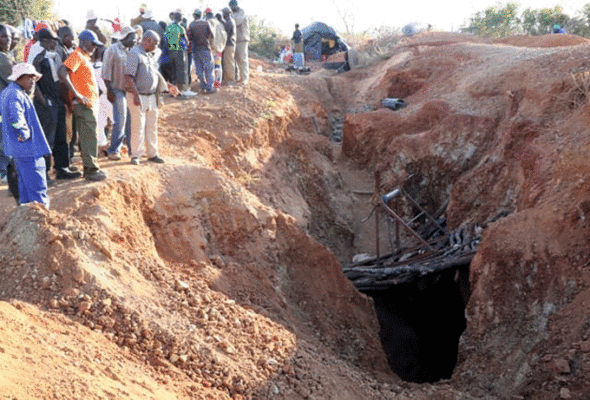
This comes after seven miners from Bucks Mine in Colleen Bawn died after hoisting ropes to a skip hoisting the 7 up the shaft from underground snapped, plunging them back on a free-fall of about 200 meters.
ZDAMWU General Secretary Justice Chinhema said his organisation was ready to sue Bucks Mine owners and he also sent condolences to the families of the deceased.
The Zimbabwe Republic Police (ZRP) has announced that Ezweni Masuku, who was the Mine Manager, Chrispen Ndlovu, a male adult aged 32 years of Nekatambe Hwange, Wisdom Munsaka, a male adult aged 28 years of Sinamagonde, Binga, Desire Ncube, a male adult aged 25 years of Hwange, Panganai Chimuka, a male adult aged 23 years, Mbangeni Chester, a male adult aged 59 years and Abie Mudimba (no further particulars known) died in the accident.
“The Zimbabwe Diamond and Allied Minerals Workers Union would like to express its heartfelt condolences to the families of seven mine workers who recently died at Bucks Mine in Gwanda owned by Mr Philisani Moyo together with his brother Fisani Moyo. We are saddened that families have now lost breadwinners in an accident which we believe was avoidable.
“We are holding the mine owners responsible and they must be brought to account. We intend to sue the mine owners for gross negligence.
“We have gathered that the accident happened when the workers were being hoisted to the surface after the end of their shift and a rope hauling their lift snapped as they were about to reach the surface. Resulting in them plunging back down into the shaft which is more than 200 meters deep leading to their death.
“The bodies were retrieved on Tuesday through assistance from Mines Ministry officials and the Vumbachikwe Mine rescue team.
“We have gathered that the mine had been abandoned for too long and we were told it was recently acquired by new owners who only resumed operations earlier this month.
“Zdamwu is going to be engaging the families of those who died for purposes of compensation. We have done this before and we intend to help the families in suing the mine owners for negligence.
“We have said time and again that safety regulations are not observed in small-scale mines and artisanal mining. This could have been avoided at all costs had proper safety standards been practised. People, employees must know that lives of Mineworkers matter first before profits and their own interests.
“We further call on the authority to invest more in education and awareness of miners on Safety and Health in the Mining Industry. Many lives have been lost and it must be addressed,” Chinhema said.
The Zimbabwe Republic Police urges mine owners to religiously follow safety, health and environmental regulations at mine sites to ensure the safety of workers.
Norton legislator Temba Mliswa cracked the whip on the Environmental Management Agency (EMA) for their relaxed approach to enforcement of environmental laws, following Afrochine and small scale miners’ environmentally unfriendly operations in his constituency.
Prince Sunduzani
Chrome miner Afrochine is up in arms with Norton miners, farmers and the community over several issues, including environmental degradation, ill-treatment of workers, shortchanging tributaries and not undertaking corporate social responsibility.
The Ministry of Mines and Mining Development, the Zimbabwe Miners Federation (ZMF), EMA, and Norton Legislator had to intervene last week, following several complaints from the community.
The agencies, together with Afrochine management toured Afrochine operations to ascertain the veracity of the community’s claims.
The company agreed to address issues raised by the community, including covering up their pits and sharing resources with the community.
We are grateful that after our interaction Afrochine has decided to help the local community as part of their corporate social responsibility. They will put water points in various areas which previously didnt have any water. pic.twitter.com/NnO6PnkZbH
— Sabhuku Temba P. Mliswa (@TembaMliswa) May 20, 2022
Speaking during the meeting, he said EMA has the power to recommend the cancellation of Afrochine’s licence for non-compliance and asked the agency to submit a report to his office for forwarding to the Minister of Mines.
He said EMA has the power through the country’s laws but was taking a lazy approach while calling on the Agency to act swiftly to address the issues.
In an interview with Mining Zimbabwe on the sidelines of the meeting, after the tour, Norton Member of Parliament Tember Mliswa said the country has good laws and the issue is in the enforcement of the laws.
He said government agencies should carryout out their mandate to protect the community and environment.
“The people who are supposed to be custodians of the laws, in terms of compliance are not acting. There is no compliance and there’s no enforcement. There is no law being enforced. Local communities must be empowered, not only through jobs but corporate social responsibility in terms of basic social amenities, schools clinics infrastructure, water and sanitation. Weare not seeing that from these companies and I think the indigenisation act was b very clear. They are profiteering more than giving back to the community which is giving them money,” said Hon Mliswa.
It emerged that the mining companies in the Norton areas were not rehabilitating the environment leaving open pits which are posing a danger to the community and livestock.
The Norton Legislator also visited Agate and Blaze brick company’s operations, after it defied an order to fill up pits from their extraction activities last year.
Instead of complying with the order, the defiant company went on to open new pits, much to the discontentment of the Norton community.
The visit resulted in the cancellation of their licence and shutting down of their operations.
“Today we visited one of them Agate & Blaze which moulds bricks. Since over a year ago when Environment Minister Mangaliso Ndhlovu visited, they have not filled up the huge holes from which they extracted soil. Instead, they have opened new ones,” said Mliswa after the visit.
“Resultantly EMA had to issue an order for them to close. They were told last year to rehabilitate the land by filling it up with rubbles and planting trees but have done none of that. The pits remain a danger to both humans and livestock.”
Norton Legislator Temba Mliswa has challenged the Ministry of Mines and Mining Development and the Ministry of Environment to cancel a special grant mining licence at Moflegosh mine in Norton whose activities are encroaching into the town’s graveyard.
Rudairo Mapuranga
Mining in graveyards is a violation of section 16 of the country’s Constitution, which states that the government and all institutions of government shall respect the cultural values and heritage of this country.
Speaking at the mine in Norton last week, Mliswa said it was shocking that the Ministry of Mines and Mining Development granted Moflegosh a permit to extract gold at graveyards going against the country’s cultural norms of respecting the dead.
Mliswa also challenged the Environment Management Agency (EMA) to recommend to the Minister of Mines and Mining Development Hon Winston Chitando to cancel the Moflegosh Special Grant.
“The encroachment of miners into the Norton Cemetery remains a grave issue. Some illegal miners have previously dug the road in Boterekwa and can dig up the graves if not dealt with here in Norton.
“As EMA you have the power to recommend the cancellation of this mining licence because they are not adhering to environmental laws.
“We have to approach the Minister of Mines and Mining Development and the Minister of Environment to come here and assess this situation,” Mliswa said.
The Centre for Natural Resource Governance Zimbabwe (CNRG Zimbabwe) has been advocating for mining companies to respect the country’s cultural laws by respecting the country’s traditions. The CNRG has been saying that for the government to allow mining companies to dig or explore for minerals in graveyards is a desecration of the cultural values of that community and Zimbabwe as a whole.
“A cemetery is the most sacred place in any community in Zimbabwe such that even the people of that community cannot just visit it as and when they want to.
“Desecration of a cemetery has a spiritual effect on the community, it brutalizes people’s souls,” said Farai Maguwu, director of the CNRG Zimbabwe.
Union Jack Mine planner, Engineer Panashe Muguza is eying to grow the junior mining operation to a large scale mine in the coming years.
Rudairo Mapuranga
According to the 26-year-old, the mine used an initial CAPEX of US$0.5 million for the project to kick start, going forward 15 per cent of the profit is also reinvested into the mine for the growth and development of a measure which has seen the mine grow significantly.
“We have been ploughing back into the project for its growth and development, initially we invested US$ 6 000 000 but we use what we call a retention, 15 per cent of profits is ploughed back into the project,” said Muguza.
Although Union Jack Mine which started its operations 8 months ago has no national grid power connected at its sight, the company has been using a diesel generator to power its operations which have been going exceptionally well. Muguza said the diesel power generator was however uneconomic for the company’s upscale operations, therefore, the company was considering a solar plant for its operations.
According to Muguza, although the life of the mine is at 22 years, for now, his team is not resting to make sure that the company invests in further exploration and mine expansion.
“We are going to sink vertical shafts once we are done with terrace mining shaft mining that’s our target for the year. Currently, the mine life is about 22 years and we need to extend it. There is huge growth potential,” Muguza said.
The mine is currently producing an average of 13,2 kgs per month with ore bodies proving that it can improve its monthly production. Muguza said the mine in March produced over 15 kgs of gold.
“We are producing an average of 13.2 per month, in March we did 15.3 Kgs,” he said.
He said the mine which is working with one contractor, Bubugao Mining Company, is at the moment doing terrace mining with a plan of sinking shafts before year-end.
In terms of processing or extraction, the Mine is using heap leaching as it is a better alternative to conventional processing. Heap leaching involves stacking ore into a heap on an impermeable pad, irrigating the ore for an extended period of time with a chemical solution to dissolve the sought-after metals, and collecting the leachate as it percolates from the base of the heap.
According to Muguza on its heap leaching, they irrigate the sodium cyanide-treated metal-bearing ore for 8 hours. In heap leaching operating costs are less sensitive to the size of the operation than capital costs.
More and more young Zimbabweans are taking up leading positions in Mines and excelling. Muguza is one of the many that the country can bank on in future and is a significant player in the country’s 12 billion mining industry vision.
Gold mining in Zimbabwe is a major mainstay for millions in the Southern African country.
There are over 4 000 recorded gold deposits in Zimbabwe of which nearly all of them are located on ancient workings. The country remains under-explored to discover deposits away from these ancient workings. More than 90% of gold deposits in Zimbabwe are associated with greenstone belts which are some of the richest in the world. Other gold deposits occur in the Limpopo Mobile Belt in the south of the country and in the Proterozoic Piriwiri rocks in the North-Western part of Zimbabwe.
It mines 3,000 tonnes of ore and removes 8,000 banks of overburden on an average every day. The mine poured its first gold in April 1988. Freda is owned by Kuvimba mining house which owns a soon to be biggest gold producer Shamva gold mine.
One of Zimbabwe’s most successful mine, owned by New York Stock Exchange-listed Caledonia Mining Corporation, run by Steve Curtis the mine is currently carrying out an ambitious expansion drive aimed at producing 80 000 ounces of gold by 2021.
RioZim
Rio Zimbabwe, a diversified miner owns two gold mines which are Renco Mine and Cam and Motor Mine in Kadoma and many more scattered across the country.
Metallon Corporation
Metallon Corporation in 2015, gold production was 97,000 ounces and the target was 120,000 ounces in 2016. Across the group, Metallon has a significant resource base with a JORC-compliant 8.3 million ounce resource.
Sabi gold Mine
The mine employs about 450 employees and is currently serviced by one rectangular double compartment shaft reaching down to 15 metres below 12 level elevation. The Principal mining method is underhand stopping. The mine has the capacity to treat 450 tonnes of ore per day.
Falcon Gold (Falgold)
The company formerly owned Dalny mine in Chakari, Venice Mine in Kadoma and Golden Quarry mine in Shurugwi. Founded in 1991, Falcon Gold Zimbabwe is a subsidiary of the New Dawn Mining Group. New Dawn Mining Corp is involved in the exploration, development, extraction, processing and reclamation of precious metal deposits in Zimbabwe.
It primarily explores for gold, base metals and precious metals. Falcon Gold Zimbabwe Limited also has an operational processing plant and Ancillary infrastructure which supports a central processing plant that treats ore from Pickstone.
Pickstone Peerless
The 584ha Pickstone-Peerless Gold Mine is located 100km southwest of Harare and has historically produced over 400,000oz gold. Pickstone-Peerless has a current JORC Resource of 62 million tonnes grading 1.8 g/t, containing 3.56 million ounces of gold. Included in this Resource is an open-pittable Ore Reserve of 16.6Mt grading at 1.9 g/t for 1.02 million ounces of gold.
Duration Gold Mine
Duration Gold Limited offers gold exploration and production services. The company owns 5 core assets with historic production of 4.6 million oz. It also sells gold at international spot prices. The company was founded in 2006 and is based in Bulawayo, Zimbabwe. Duration Gold Limited operates as a subsidiary of Clarity Enterprises Limited.
One of its flagship gold mines is Vumbachikwe, which is one of Zimbabwe’s oldest gold mines.
Bilboes Holdings
Bilboes Holdings (Private) Limited owns and operates gold mines in Zimbabwe. It engages in mining, exploring, and producing gold. The company was founded in 1989 and is based in Harare, Zimbabwe.
Bilboes own and operates four gold mines namely Isabella, Bubi, When and McCay’s ‘existing mines’ all in the Bubi Greenstone Belt of Zimbabwe. The mines were acquired from Anglo American Corporation Zimbabwe Limited (AMZIM) in 2003 together with most of AMZIM’s gold mineral rights in Zimbabwe.
Eureka Gold Mine
Eureka Gold Mine is located about 150km north of Harare.
Eureka is a modern gold mine designed to produce up to 70,000oz of gold per annum from an open pit operation. Operations were suspended in 2000 due to high costs and low gold prices. The mine is currently on care and maintenance and the Company is focused on recommencing production in 2021.
Small-scale gold mining
A Small-scale mining operation near Harare
Artisanal and Small-scale miners currently operating in Zimbabwe are estimated to range from 500 000 to 1 500 000 people.
This group is currently producing over 60% of gold submitted to the country’s sole buyer Fidelity Printers and Refiners (FPR).
The major challenges faced by the ASM sector are a lack of financial resources, equipment, expertise, and geological information. Despite these challenges, ASM operations remain crucial as production details recorded at Fidelity Printers and Refiners indicate that the sector has produced more than 60 tonnes (60%) of gold for the period 2017-2020.
Gold buying in Zimbabwe
Fidelity Printers and Refiners (FPR) Head Office in Msasa, Harare
Fidelity Printers and Refiners (Pvt) Ltd (FPR) is licensed to buy gold from large scale producers, small scale producers and holders of gold buying permits.
With FPR miners have an option to select the assay method for a particular deposit or the specific gravity method. If the customer opts for the fire assay method, payment will be made after the analysis which is carried out at the Head Office in Harare. Samples obtained after melting are accurately analysed using the internationally recognised fire assay technique. Results obtained are in the region of 1 part per thousand tolerances. However, for the specific gravity method, payment is actioned on the spot. The specific gravity method is used particularly in areas outside Harare.
FPR has decentralised its buying activities from Harare to cover the entire country, thereby significantly reducing the security risks associated with transporting gold for the small scale sector. The customer has an option to select the assay method for a particular deposit or the specific gravity method. Gold delivered to the centres is paid for on the spot after carrying out a specific gravity determination of the gold content. However, if the miner opts for the fire assay method, payment will then be made after the analysis which is carried out at the Head Office in Harare.
FPR is currently in the unbundling phase whereby new shareholders will be announced.
Fidelity Gold buying centres
FPR has decentralised its buying activities from Harare to cover all gold producing regions within the country, thereby significantly reducing the security risks associated with transporting gold over long distances. The company has also appointed Gold Buying agents to conveniently mop gold produced in outlying areas and also from artisanal miners.
The current gold buying centres are:
BULAWAYO
Address: ZB Bank Fife Street Branch Corner 10th Ave / Fife St
Phone: +263 292 880175/80, +263 292 68766
Email: [email protected]
GWANDA
Address: ZB Bank Shop No 8 NSSA Complex
Phone: +263 284 20957
Email: [email protected]
KADOMA
Address: ZB Bank No 42 Robert Mugabe Street
Phone: +263 68 212004
Email: [email protected]
MUTARE
Address: ZB Bank 88 Herbert Chitepo Street
Phone: +263 20 2061006
Email: [email protected]
BINDURA
Address: ZB Bank No 28 Robert Mugabe Way
Phone: +263 66 2106854
Email: [email protected]
GWERU
Address: ZB Bank No 69 Robert Mugabe Way
Phone: +263 54 2220328
Email: [email protected]
KWEKWE
Address: ZB Bank No 90 Robert Mugabe Way
Phone: +263 55 2526084
Email: [email protected]
ZVISHAVANE
Address: ZB Bank No 86 Robert Mugabe Way
Phone: +263 39 2353539
Email: [email protected]
CHINHOYI
Address: ZB Bank No 47 Magamba Way
Phone: +263 67 2121010
Email: [email protected]
Address: ZB Bank No 39 Robert Mugabe Way
Phone: +263 39 22265288
Email: [email protected]
Registering for gold mining claims in Zimbabwe
A small-scale Gold mine pit
Gold mining is the most popular type of mining conducted in Zimbabwe. It has a flourishing market ready to pay the greenback on demand. Popular gold mining towns include Kadoma, Bindura, Shurugwi, Gwanda, Chegutu, Kwekwe, Zvishavane, Chinhoyi, Shamva and many other towns. Gold is found in every district in Zimbabwe!
The Ministry of Mines and Mining Development (MMMD)is tasked to promote sustainable exploration, mining, processing marketing and management of mineral resources for the benefit of all Zimbabweans. Its key responsibility is to be responsible for the administration of the Mines and Minerals Act (Chapter 21:05) of Zimbabwe.
Mining investment in Zimbabwe
1.1 Foreign Investors are allowed to own 100% shareholding for mining operations in all minerals except for platinum and diamonds which the foreign investor is expected to jointly own with Government on a 51%/49% basis.
1.2 Before starting operations the newly registered company should possess a Zimbabwe Investment Authority (Z.I.A) certificate and can then apply for a prospecting license from any Ministry of Mines and Mining Development Offices.
1.3 Any person who is a permanent resident of Zimbabwe and above the age of 18 may take out a prospecting license at any Ministry of Mines and Mining Development offices.
1.4 The Provincial Mining Director acting on behalf of the Permanent Secretary may refuse to issue a prospecting license but shall forthwith be required to report each refusal to the Secretary.
1.5 Each Prospecting License is valid for two years.
1.6 A holder of a Prospecting License automatically acquires the rights of prospecting and pegging mining claims anywhere in Zimbabwe.
1.1 When a Prospecting Licence holder has identified a mineral deposit that he/she is interested in, he/she appoints an agent or an Approved Prospector to peg on his behalf.
1.2 The agent is required to physically peg the area by marking the deposit with a Discovery Peg. He/She should also post Prospecting, Discovery and Registration Notices on the ground. The notices must be posted in a conspicuous manner to alert other prospectors.
1.3 Before posting these notices the agent is required to inform/or seek consent from the landowner of his intention to prospect.
NB: Consent is only sought from the landowner if prospecting on a farm less than 100 hectares, otherwise the prospector is only required to inform the farm/landowner in writing either by registered mail or deliver by hand.
1.4 All areas classified as not open to prospecting and pegging or reserved against prospecting and pegging cannot be pegged, e.g. cultivated lands, dip tanks, Dams, etc.
1.5 Each Prospecting License can peg up to a maximum of 10 claims at 1 Ha each.
1.6 An application for registration must be submitted to the Ministry of Mines and Mining Development offices. The application must have copies of the following attachments:
(a) Prospecting license(s).
(b) Prospecting Notice.
(c ) Discovery Notice (Base Minerals).
(d) Notification of intention to prospect to the landowner.
(e) A map in triplicate to the scale of 1:25000.
1.7 If the Provincial Mining Director is satisfied that all pegging procedures have been followed he shall issue a certificate of registration upon payment of the gazette fee. This allows the holder to start mining operations subject to meeting other obligations like Environment Impact Assessment (EIA).
1.8 Within three months from the date of registration the miner is required to erect permanent beacons on the ground.
1.9 All precious mineral claims are supposed to be continuously worked on in order to obtain renewal of title. Claims have a 12-month tenure after which they shall expire or be renewed.
1.10 Gold and other precious metal claims are inspected by production and capital expenditure.
1.11 Base metal claims can be protected by payment.
1.12 If a mining claim is transferred or sold a Certificate of Registration After Transfer shall be issued by the Ministry of Mines and Mining Development.
1.13 Failure to renew title will result in the forfeiture of a mining claim. Furthermore, loss of title can be through cancellation or abandonment.
MINING companies should follow laid down safety procedures during their operations to avoid accidents that lead to loss of lives.
The accident at Bucks Mine in Colleen Bawn, Matabeleland South on Saturday where seven miners lost their lives could have been avoided if proper safety protocols were followed.
It is said that the accident happened after hoisting ropes bringing the seven miners up a shaft snapped and plunged down 240 metres.
On Sunday, an official from the Ministry of Mines and Mining Development, who preferred anonymity, hinted that the mishap could have been as a result of negligence.
“This incident can be linked to negligence because first of all seven men were not supposed to be in that cage at once because it has a low carrying capacity.
“The rope was also weak to carry the cage. The guys were riding on a one-tonne size cocopan, ingorovane, up a vertical shaft slung on a wire rope which snapped towards the surface and they were plunged with the cocopan towards the shaft bottom. Shaft has water and mud.”
Rescuers pull up the first retrieved body at Bucks Mine in Colleen Bawn Speaking at the scene of the accident on Tuesday as the rescue crew was retrieving the bodies, Mines and Mining Development Deputy Minister Polite Kambamura urged miners to adhere to safety standards in order to avoid similar accidents in future.
“It’s sad that we lost seven miners of this operation but we want to thank everyone who is here and has been making frantic efforts to rescue those who drowned underground. We’ve so far managed to retrieve five bodies; the sixth body is still underground but it will be out in the next hour.
“The seventh body is still trapped underground under a cocopan which we’re trying to move so that we can have space to get the body out. We’re confident that we’ll be able to retrieve all the seven bodies,” said Deputy Minister Kambamura.
He extended his condolences to the families and co-workers of the deceased.
“We’re so saddened as Government and want to urge the communities around to adhere to all safety standards to make sure that such accidents don’t happen in future. Currently, the department of the chief Government mining engineer is going around doing safety awareness campaigns together with the Ministry of Environment to make sure that miners adhere to safety standards and a safe working environment,” said Deputy Minister Kambamura.
Mining forms a key pillar of the economy hence it is important to always conduct operations in line with prescribed safety protocols to boost productivity while at the same time providing a safe working environment.
We commiserate with the affected families and may the souls of the seven departed miners rest in peace.
To provide the best experiences, we use technologies like cookies to store and/or access device information. Consenting to these technologies will allow us to process data such as browsing behavior or unique IDs on this site. Not consenting or withdrawing consent, may adversely affect certain features and functions.
Functional
Always active
The technical storage or access is strictly necessary for the legitimate purpose of enabling the use of a specific service explicitly requested by the subscriber or user, or for the sole purpose of carrying out the transmission of a communication over an electronic communications network.
Preferences
The technical storage or access is necessary for the legitimate purpose of storing preferences that are not requested by the subscriber or user.
Statistics
The technical storage or access that is used exclusively for statistical purposes.The technical storage or access that is used exclusively for anonymous statistical purposes. Without a subpoena, voluntary compliance on the part of your Internet Service Provider, or additional records from a third party, information stored or retrieved for this purpose alone cannot usually be used to identify you.
Marketing
The technical storage or access is required to create user profiles to send advertising, or to track the user on a website or across several websites for similar marketing purposes.