Home Blog Page 392

Bravura brings cheers to Mhondoro community

0

PLATINUM miner Bravura Zimbabwe has handed over food hampers to 30 villages as it brings festive cheers to the Mhondoro-Ngezi  community.

The handover of the food hampers done last week was part of the miner’s corporate social responsibility programme.

Bravura expressed gratitude to Chief Chivero for the hospitality given to the organisation and making sure Bravura worked peacefully in his area.

The platinum miner has also assisted vulnerable families in Mashonaland West to mitigate the effects of the COVID-19 pandemic.

It also donated ambulances and ventilators to the Ministry of Health and Child Care.

Bravura country director Lionel Mhlanga said they had completed nearly 4 0000 meters of core drilling.

“Inhouse-owned core drilling rigs were acquired at a cost of nearly US$5m,” he said.

“High tech exploration laboratory was acquired, installed and commissioned at a cost of US$$500 000.”

The platinum miner has a workforce of 200 made up of direct employees and sub-contractors.

The mine has not recorded lost time injury or fatality since inception, Mhlanga said.


Newsday

South Africa lifts curfew in new lockdown regulations

0

Zimbabwe’s giant southern neighbour’s government is easing several Covid-19 lockdown measures under an Adjusted Alert Level 1, the South African Presidency announced in a statement on Thursday evening.

The changes were based on the trajectory of the pandemic, the levels of vaccination in the country and the available capacity within the health sector.

“All indicators suggest the country may have passed the peak of the fourth wave at a national level,” the Presidency said.

Therefore, the Cabinet has approved three significant changes to lockdown measures, with immediate effect.

Firstly, the curfew has been lifted, which means there will be no restrictions on the hours of movement of people.

Secondly, indoor gatherings will be allowed for up to 1,000 people indoors and no more than 2,000 people outdoors.

Where the venue is too small to accommodate these numbers with appropriate social distancing, then no more than 50% of the capacity of the venue may be used.

Lastly, establishments that sell alcohol with licences to operate beyond 23:00 will revert to full licence conditions.

All other restrictions remain in place, including the mandatory wearing of a mask in a public place.

The changes come after meetings of the National Coronavirus Command Council and the President’s Coordinating Council, in which they were provided with updates on the management of the fourth Covid-19 wave in South Africa.

“The information gathered through the system used by the Department of Health has reported a 29.7% decrease in the number of new cases detected in the week ending 25 December 2021 (89,781), compared to the number of new cases detected in the previous week (127,753),” the Presidency explained.

“Cases declined in all provinces except the Western Cape and Eastern Cape, which recorded increases of 14% and 18%, respectively.”

“There has been a decline in hospital admissions in all provinces except the Western Cape,” it added.

“While the Omicron variant is highly transmissible, there has been lower rates of hospitalisation than in previous waves.”

“This means that the country has a spare capacity for admission of patients even for routine health services.”

The increase in deaths in all provinces has been “marginal”.

However, the Presidency warned the risk of an increase in infections was still high given the transmissibility of the Omicron variant.

“Government, therefore, calls on all organisers of these gatherings to ensure that all health protocols are observed at all times and that all attendees are encouraged to be vaccinated,” the Presidency said.

“The NCCC will continue to monitor the situation closely and will make further adjustments as necessary, particularly if pressure on health facilities increases.”

“South Africans are urged to continue observing basic health protocols to prevent the transmission of the virus,” it added.

The government also called on South Africans to get vaccinated, as it remained the “best defence against severe illness, hospitalisation and death from Covid-19”.

Furthermore, it urged parents to support their children aged 12 years and older to vaccinate before schools open.

“This will avoid learners losing school time as a result of testing positive or as a result of contact with people infected with Covid-19,” the Presidency said.

South Africa is Zimbabwe’s largest trading partner and is home to Implats the majority shareholder of Zimbabwe’s biggest mine, ZIMPLATS. In Zimbabwe curfew kicks in at 21:00hrs until 05:00 am daily.

My Broadband

BREAKING: Steve Curtis to step-down as Caledonia CEO

0

Caledonia Mining Corporation Plc has announced that Steve Curtis, aged 65, has notified the board of directors of his intention to retire from his role as CEO with effect from June 30, 2022. 

Curtis will be succeeded as CEO by Mark Learmonth, Caledonia’s current CFO. Mr Curtis will continue to serve as a director of Caledonia, transitioning from an executive to a non-executive role by the end of 2022.  He will also act as a consultant to the Company until the end of 2023. 

MARK Learmonth caledonia
Mark Learmonth

Caledonia Chairman Mr Leigh Wilson, said, “On behalf of Caledonia’s board of directors, I thank Steve for his outstanding contribution to the Company. Under his calm and steady leadership since November 2014, Caledonia’s production has almost doubled, and its market capitalisation has increased over four-fold. Steve has also laid the foundations for the next phase of Caledonia’s growth.

“The Central Shaft project at Blanket Mine has been the defining feature of Steve’s tenure as Caledonia’s CEO. This project commenced in February 2015 and the shaft was successfully commissioned in March 2021.

The new shaft is expected to result in production increasing to 80,000 ounces of gold per annum from 2022 onwards – almost double the level of production we achieved in 2014; Central Shaft is also expected to result in lower operating costs and capital expenditure, thereby enhancing earnings and cash generation respectively as well as allowing a resumption of deep-level exploration which, if successful, will extend Blanket’s mine life

“Completion of the Central Shaft and the anticipated increase in cash generation is an excellent foundation for Caledonia’s growth. Under Steve’s stewardship, the strength and depth of Caledonia’s management team has increased so that it has the capacity to take on new projects. In recent years, under Steve’s leadership, Caledonia has also improved its relevance to international capital markets, which has resulted in a substantial increase in Caledonia’s share price since 2014 and a significant increase in the liquidity of its shares which now trade on AIM, NYSE American and the VFEX in Zimbabwe.

“The process of recruiting Steve’s successor was carried out independently by Spencer Stuart, a leading global executive search and leadership consulting firm. We were pleased that Mark Learmonth accepted the position as CEO as the board believes him to be the right leader to take the Company forward to its next stage of development. Mark joined Caledonia in 2008, having spent over 17 years in corporate finance and investment banking, mostly in Africa.  Mark has been Caledonia’s CFO since November 2014 and is therefore experienced in the complexities and opportunities that arise from operating in Zimbabwe.

“I am delighted that Steve will remain with Caledonia in a non-executive role and look forward to his invaluable guidance in the future, which I am certain will continue to be a major asset to the Company.” he concluded in a statement.

Just In: Gvt pledges to support Arcadia lithium project

0
The government of Zimbabwe has pledged to support the Arcadia lithium project which is poised to become one of the country’s biggest lithium producers.
Rudairo Mapuranga
The project is in line with the National Development Strategy-1 and the US$12 billion mining industry by 2023 as the country moves towards the attainment of the upper-middle-income economy.
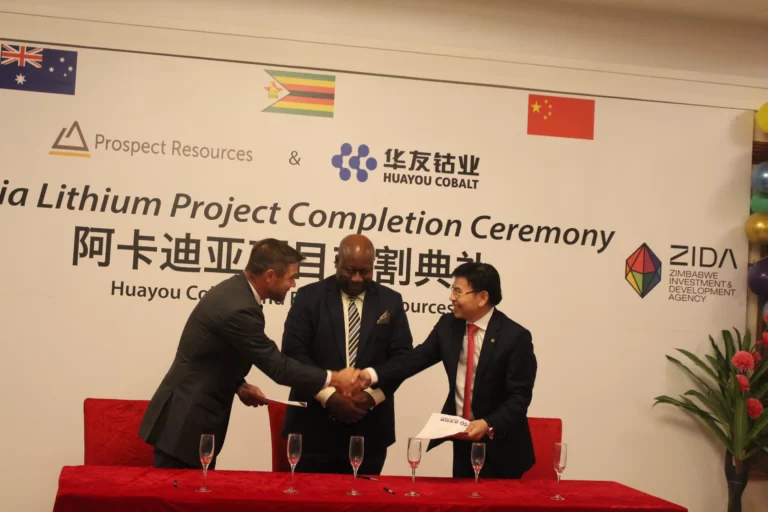
Speaking at the Prospect Resources’ Arcadia lithium binding agreement with Zheijiang Huayou Cobalt signing ceremony held at the statehouse today, Minister of State for Mashonaland East Providence Senator Appolonia Munzverengwi said the government was going to be supportive of the Arcadia lithium project ensuring that it is a success.
“As the government, we will take a keen interest to ensure the success of the project,” Senator Munzverengwi said.
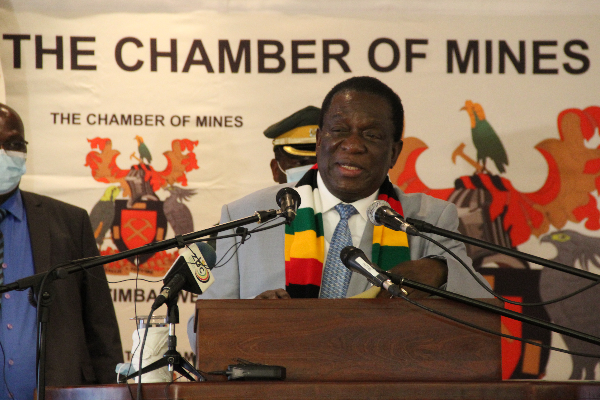
President Mnangagwa said his government and cabinet were going to support the project ensuring that the lithium sector achieves a US$0.5 billion annual revenue by 2023.
“Rest assured that you have my government’s support to facilitate the unlocking of maximum value from this strategic mineral resource, for win-win benefits. Let us move forward with speed and make this venture a great success. With unity of purpose, we will prosper together and build a Zimbabwe we all want,” said Mnangagwa.
“I wish the parties to this Agreement success in the implementation of business transaction and  declare this a positive step forward for Zimbabwe.” Dr Mnangagwa said.

China’s Zhejiang Huayou Cobalt will pay a total US$422 million to acquire the Arcadia hard-rock lithium mine in Zimbabwe.The move marks Huayou’s second foray into lithium, a key ingredient in rechargeable batteries, in the space of a week. It is the latest acquisition of overseas battery mineral resources by Chinese companies looking to shore up supply to meet demand from the burgeoning electric vehicle (EV) sector.

Huayou, the world’s biggest producer of cobalt, another battery metal, in 2020, said in a filing it would pay US$388.8 million for Australia-listed Prospect Resources Ltd’s 87per cent stake in Arcadia owner Prospect Lithium Zimbabwe.

It will pay another US$44.2 million for the 6per cent stake held by Zimbabwean professor Kingston Kajese and the 7per cent held by Tamari Trust, which previous Prospect filings show is linked to Paul Chimbodza, executive director of Prospect Lithium Zimbabwe.

Where are Zimbabweans as foreign countries take over futuristic mining deals?

0

The purchase of Arcadia Lithium mine by Chinese giant Zhejiang Huayou Cobalt invoked fiery debate on Mining Zimbabwe’s Facebook page generating over 100+ comments in the first hour of publishing.

Many were sceptical of the country’s natural resources being purchased by foreign investors which the majority warned the country will regret in the future.

The article as I write this is currently sitting at 68 883 engagements and comments at 503.

Huayou, the world’s biggest cobalt producer, another battery metal, will pay US$388.8 million for Australia-listed Prospect Resources Ltd’s 87 per cent stake in Arcadia owner Prospect Lithium Zimbabwe a deal that will be signed tomorrow.

Zhejiang Huayou will pay another US$44.2 million for the 6per cent stake held by Zimbabwean professor Kingston Kajese and the 7 per cent held by Tamari Trust, which previous Prospect filings show is linked to Paul Chimbodza, Executive director of Prospect Lithium Zimbabwe.

Zimbabweans had this to say

Manny Chavura said, “This is worrying. The state should’ve bought a stake so that Zim continues to have a bit of say in such an increasingly important resource,”.

Melusi Enock Kepekepe added his voice saying, “Country mortgaged for a song to line a few pockets. They will recoup this in less than 4 months. Zimbabwean geologists, economists should be consulted,”.

Kevin Makumbe said, “We should not sell lithium mines, instead we should get battery manufacturers to set their factories here in Zimbabwe so that we export finished goods to the international market. From this investment, the Chinese are going to make Trillions”.

Responding to a question by Tapiwa Kange, Shepherd Nyathi said, ”the issue is about who owns Arcadia mine. It’s a private entity and duly registered and operating according to our laws. You don’t just wake up and change laws because suddenly lithium is important. You follow your laws. If you so wish you can apply and open your mine as stipulated in our laws. But then you don’t have the capacity to mine. So let those who have do it. Let those who can buy mines buy,”.

Mernard Gambe contributed saying,  “What’s the agreement? Is it not between 2 private parties? Prospect Resources and the Chinese company. The former being the owner. Probably they find it worthwhile to sell at this amount. This is purely business. If I can get such an amount without expending anything then that’s a deal of the time. That’s what businesses do all over and it’s all about themselves. They are not created for charity or for a welfare of some third party,”.

One of the most interesting comments came from Michael Monson who asked, “Why can we as Zimbabweans not run our own mines, manufacture our own goods and be the breadbasket of Africa that we once were, the Jewel of Africa?.

Clean Energy

A new energy race is underway between the U.S. and China which echoes of past wars over oil. The countries are now fighting to procure new sources of lithium – the key to transitioning away from fossil fuels to clean energy, Florida-based technical analyst, market researcher, educator and trader, James Hyerczyk said.

As the world is moving toward clean energy we now live in an era defined by advancements in various forms of technology. Britain Prime Minister Boris Johnson in 2020 announced that new cars and vans powered wholly by petrol and diesel will not be sold in the UK from 2030.

Boris’ announcement placed Zimbabwe at the centre pedestal since that makes it a key global player in the revolution as it is the 5th biggest lithium producer in the world.

Countries with proposed bans or implementing 100% sales of zero-emissions vehicles include China, Japan, the UK, South Korea, Iceland, Denmark, Sweden, Norway, Slovenia, Germany, Italy, France, Belgium, the Netherlands, Portugal, Canada, the 12 U.S. states that adhered to California’s Zero-Emission Vehicle (ZEV) Program, Sri Lanka, Cabo Verde, and Costa Rica.

In 2018, Denmark proposed an EU-wide prohibition on petrol and diesel cars, but that turned out to be contrary to EU regulations. In October 2019, Denmark made a proposal for phasing out fossil fuel vehicles on the member state level by 2030 and was supported by 10 other EU member states.

In July 2021, the European Commission proposed a 100% reduction of emissions for new sales of cars and vans as of 2035.

Lithium production in Zimbabwe

Interestingly Zimbabwe globally is the 5th largest lithium producing country, yet only Bikita Minerals Mine is in production. Several lithium projects are currently being developed in the country with Prospect Resources’ Arcadia Project and Premier African Minerals’ Zulu project soon to benefit from the lithium boom. Additional miners like the Bindura based Mirroplex Lithium mine will likely see Zimbabwe potentially advancing to becoming the 3rd biggest lithium producer in the world.

Where are Zimbabweans as foreign countries take over futuristic mining deals?

In August of this year government availed land to five companies intending to establish integrated mining and ferrochrome smelters in the country, but the majority of the companies, if not all, are foreign-owned, raising the question, just like the lithium deal why are local companies or investors are not taking up such opportunities?

At the time Mining Zimbabwe spoke to the Chairman of the Portfolio Committee on Mines and Mining Development, Edmond Mkaratigwa, who said, “I am asking the same question also, where are we? Business is about capital and like all professions, it’s about your voluntary initiation,”.

“Mostly our people are able to mine on small scale which is why I always advance that there should be a national growth strategy for our small scale miners so that they also upscale their operations.”

“Generally, I also know that all those are names of companies and I have not yet managed to have the opportunity to know the share ownership structure for me to conclusively endorse the view that it’s wholly foreign-owned in the sense of shareholding.”

“In the same mind, opportunities are there but usually capital capacity is the challenge. We need to amalgamate our capabilities and capacities so that we can migrate to larger investment and not rely on selfish and individualized investment models,” Mkaratigwa said.

Popular Mining journalist Rudairo Mapuranga said Prospect has always been open about its intentions yet there was no talk of interests locally.

“It’s public knowledge that Prospect Resources has been looking for a solid takeoff agreement to kick start the project. People never talked about the prospect of coming on board to fund the lithium mine for the benefit of the country. Now that the Chinese who we know very well are after wealth have now taken over the Arcadia mine, people start to complain. Where have we been? Business is not about indigenous empowerment and all these other fancy words but Capital. We need to raise capital, take the risk and own our own minerals. We must not only be good at talking and complaining but not risk and action-oriented. Raising capital cannot be that hard if we are willing to be the owners of futuristic projects like this one.

BREAKING: Chinese company buys Arcadia mine for US$422 million

0

China’s Zhejiang Huayou Cobalt said on Wednesday it would pay a total US$422 million to acquire the Arcadia hard-rock lithium mine in Zimbabwe.

The move marks Huayou’s second foray into lithium, a key ingredient in rechargeable batteries, in the space of a week. It is the latest acquisition of overseas battery mineral resources by Chinese companies looking to shore up supply to meet demand from the burgeoning electric vehicle (EV) sector.

Huayou, the world’s biggest producer of cobalt, another battery metal, in 2020, said in a filing it would pay US$388.8 million for Australia-listed Prospect Resources Ltd’s 87per cent stake in Arcadia owner Prospect Lithium Zimbabwe.

It will pay another US$44.2 million for the 6per cent stake held by Zimbabwean professor Kingston Kajese and the 7per cent held by Tamari Trust, which previous Prospect filings show is linked to Paul Chimbodza, executive director of Prospect Lithium Zimbabwe.

The Arcadia project aims to process 2.4 million tonnes of ore per year but has not yet reached commercial production. Prospect Resources said in July the first batch of petalite from pilot production had been delivered to offtake partner Sinomine and that it was also working on spodumene samples.

Spodumene and petalite are lithium-bearing minerals.

Zimbabwe is desperate to attract investors into its mining sector, which it says will drive the recovery of its stricken economy. It has opened its doors to Chinese firms, which now operate several chrome, coal and gold mines.

Huayou’s Executive Vice-chairman George Fang told Reuters in September that the company was seeking to invest in lithium mining and processing, including in Africa.

Last Friday, Sichuan New Energy Power Co Ltd said it agreed a lithium production and battery recycling tie-up with Huayou in China.

Source: Reuters

Use it or lose it – Cabinet directs Chitando to look into Platinum Project

0

In a bid to boost the mining sector by expanding production of metals such as platinum and chrome, Zimbabwe is following up on projects that have not yet become operational and curbing exports of unprocessed minerals.

The Eurasian Resources Group-owned Todal-Bokai Platinum Project, located next to Anglo Platinum-ran Unki mine, has been targeted, with cabinet directing Mines and Mining Development Minister Hon Winston Chitando to follow up on the company to ensure it springs up into production.

A former executive with Mimosa mine – jointly owned by Implats and Sibanye Stillwater – Chitando is President Emerson Mnangagwa’s point-man in efforts to bump the mining sector to a $12 billion (R190bn) industry.

However, owing to Zimbabwe’s risk operating environment, there will be no new outside capital, according to a chamber of mines survey.

Mnangagwa’s administration is keen to see companies holding mining claims develop them into productivity. The Todal-Bokai Platinum Project is one such operation that the government wants to jump into productivity.

“Cabinet also considered the need to get the Todal-Bokai Platinum Project next to Unki Mine into production as soon as possible so that it contributes to the $12 billion mining industry milestone,” notes a post-cabinet report released on Tuesday.

It further reads: “The Minister of Mines and Mining Development was also tasked to follow up on the issue accordingly.”

Zimbabwe has a strict use it or lose it policy on platinum mining claims, which has previously seen Zimplats lose nearly half of its claims.

Eurasia Group describes the Todal-Bokai Platinum Project as a “semi brownfield project” pivoted on an “asset (that) has well-developed infrastructure and a significant resource base that could support a 40-year” life of mine.

“Advancing this project is a priority undertaking for us,” says the company on its website. It also says that it welcomes partnerships “to unlock the resource potential” of its portfolio of assets.

Tharisa is another platinum group metals-focused firm that is eyeing the development of Zimbabwe assets. It recently announced that “two phases of exploration drilling have been completed” over its project area in Zimbabwe.

On October 12, Tharisa announced that the Karo Platinum implementation studies had been completed, ensuring that the project progressed into “execution and development”.

Meanwhile, Zimbabwe has also resolved “to continue with the ban (on raw ferrochrome exports)”. It noted the ban on export of chrome ores had yielded an increase in ferrochrome production projects.

BUSINESS REPORT ONLINE

Duo Sneaks Into Eldorado Mine To Loot Gold

0

TWO daring men, who were part of a 17-member gang that breached security at gold-rich Eldorado Mine and sneaked underground to steal gold ore, have been convicted of contravening the Mines and Minerals Act.

The duo of Isaac Kufakunesu (37) of Chinhoyi and Takemore Kapungu (27) of Kwekwe, were also facing two counts of impersonation after they allegedly misrepresented that they were police and army officers investigating a robbery case at the mine, when, in fact, they intended to steal gold ore.

Chinhoyi magistrate, Rumbidzai Chuma acquitted the accused on the counts of impersonation, but found them guilty of illegally entering the lucrative mine operation.

Kufakunesu and Kapungu were fined $30 000 each, or 60 days each in jail.

The complainant was Eldorado Mine represented by Samuel Chimombe, a security officer.

The state case, led by Knight Tafadzwa Rwodzi was that on March 18, 2021, at around 6pm, Sifiso Mathuthu and Billi Marivate, employed as security guards at the mine, were deployed to guard the shaft.

The court heard that on March 19, 2021 at around 1:30am, the accused persons and 15 accomplices who are still at large, sprang from the dark and confronted the guards.

Kufakunesu, Kapungu and other gang members were putting on army and police uniforms.

They lied that they were on duty pursuing a robbery suspect, who was within the mine.

The guards demanded the “officers” to produce identity cards, but they failed to show them, thereby raising suspicion.

The gang was advised mine superiors were going to be notified of their presence at the premises.

The court further heard that as the guards were making efforts to contact their superiors, the gang took advantage of the security lax and entered the mine shaft through the headgear and went underground.

Some of the accused persons were clutching satchels and empty sacks, a clear indication they intended to steal gold ore from the mine.

On March 22 at around 7pm, Masarakufa and Kapungu were arrested by security personnel while underground as they attempted to exit the mine shaft.

NewZimbabwe

Mining companies urged to pay workers

0

ZIMBABWE Mining Workers (ZMW) president Kurebwa Javangwe Nomboka has urged mining companies to pay their workers COVID-19 allowances as the sector is regarded an essential service.

Nomboka urged the mine workers’ National Employment Council (NEC) to push for the allowances as mine workers were at high risk of contracting the coronavirus.

Last year, the government exempted the mining industry from COVID-19 lockdowns.

“Chinese mining companies don’t follow safety, environmental standards, regulations or rules. Most employees are not properly graded, they pay employees way below NEC minimum wages, and their employees work long hours.  There is no overtime, no holiday, and they treat every day as a working day,” Nomboka said.

He also alleged that most Chinese mining companies do not remit money to the National Social Security Authority (Nssa), the Mining Industry Pension Fund (MIPF), and to mine unions.

The ZMW president said most workers in the mining sector were job-insecure due to lack of fixed contracts at most mines.

“There are arbitrary dismissals and workers work excessive hours without being paid overtime allowances, while most mine workers earn below the poverty datum line, and have no rights to form unions,” he said.


Newday

Gold export receipts top US$1bn

0

Zimbabwe’s yellow metal export receipts rose 7.6% to US$1.057bn by mid-November this year from US$982.3m during the same period last year due to improved gold deliveries.

The year 2021 was a year of two halves where the deliveries were on the low side during the first half when 9.948 tonnes were delivered and the strong second half of 15.41 tonnes, with the spike in deliveries inspired by incentives and timeous payments.

Despite the fluctuations in deliveries, 2021 was characterised by firm prices due to the fact that when the US$ is vulnerable to inflation, the bullion works as a back-up currency.

According to the Reserve Bank of Zimbabwe (RBZ), gold export receipts are expected to further improve next year riding on the current high volumes.

“Latest gold shipments stand at US$1.056bn against US$982.3m shipped last year and this is mainly due to improved deliveries and firming prices. “Gold export receipts rose 10.5% up to the end of September 2021 to US$788.7m from US$713.9m recorded during the same period last year,” RBZ said.

Mineral export receipts reached US$4.4bn from US$3.65bn, mainly due to strong performance from platinum which contributed US$2.3bn.

Gold deliveries rose 45% to 25.36 tonnes during the 11 months of the year from 17.44 tonnes delivered to Fidelity Printers and Refiners (FPR) during the same period last year due to improved mining conditions and incentives.

The cumulative gold output of above 25 tonnes is the third highest national production level with a month to go, the national output is expected to surpass 28 tonnes.

Gold output rose 127% in November this year to 3.33 tonnes from 1.47 tonnes recorded during the same period last year.

The November production is the highest output so far this year followed by September output of 3.17 tonnes.

From the 25.36 tonnes delivered to FPR, small scale miners accounted for 15.21 tonnes with primary producers chipping in with 10.14 tonnes.

Gold is Zimbabwe’s third largest foreign currency earner behind platinum and diaspora remittances.

However, the sector had been stymied by delays in paying for gold delivered and prices lower than those prevailing on the international market thereby fuelling smuggling of the yellow metal.

In June, the central bank scrapped taxes on small scale miners, began timeous payments and paid the prevailing international gold prices.

Zimbabwe is targeting an output of 100 tonnes by 2023. Experts say there is a need to review retention for the large scale miners and capacitation of small scale miners to ramp up production.

The government has moved to provide equipment in gold centres to move towards helping the attainment of US$4bn gold export revenue.

The government wants to establish new gold centres following a sudden increase in output.

The gold centres are expected to provide basic equipment such as compressors and jackhammers as well as working capital to facilitate optimal production by small-scale miners who supply gold ore.

Some of the gold centres are expected to be established in Makaha, Odzi, Mount Darwin, Shamva, Mazowe and Silobela.


Business Times