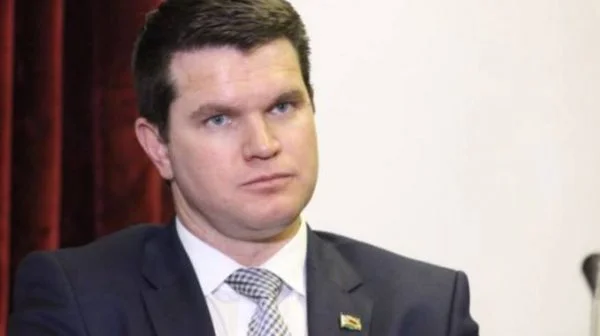
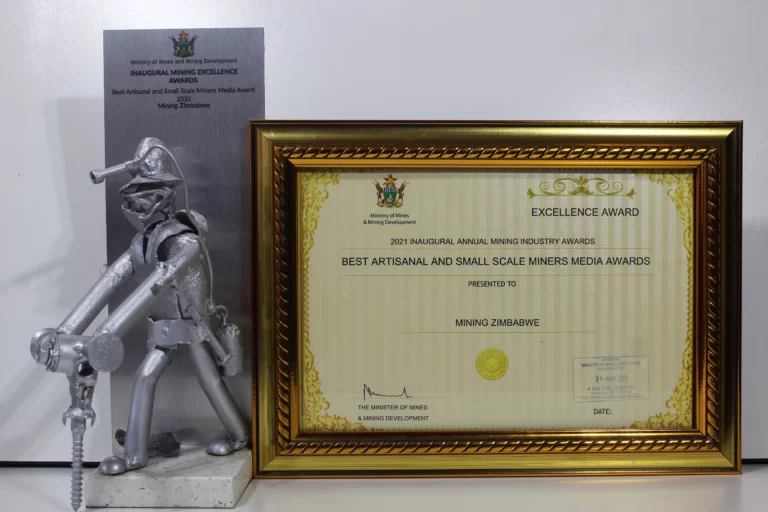
Mining Zimbabwe has been named the Best Mining Media House in recognition of its stellar coverage of Small-scale and Artisanal Miners in Zimbabwe.
Prince Sunduzani
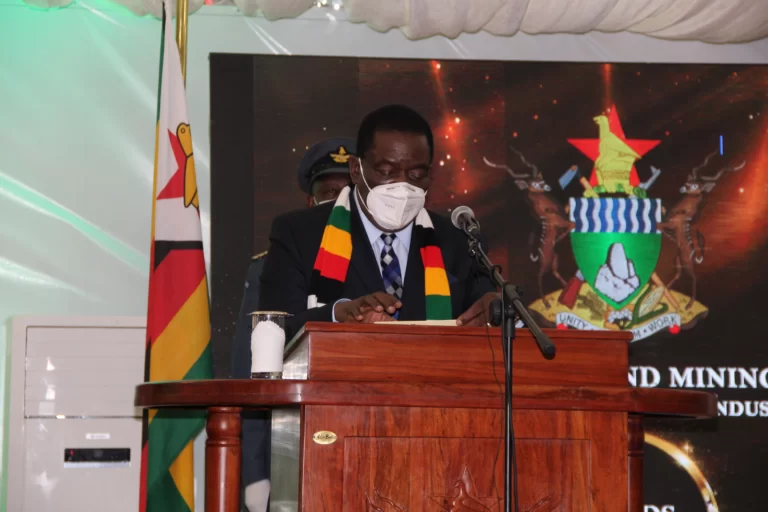
The Timelison Media-owned publication was bestowed with the accolade in the ASM media awards category at the inaugural Mining Industry Excellence Awards ceremony held at the State House yesterday, where President Emmerson Mnangagwa was the Guest of honour.
The awards, organized by the Ministry of Mines and Mining Development were aimed at honouring mining and related institutions that excelled in the previous year and made a significant contribution to the expansion of the mining sector.
Timelison Media’s founder and Managing Director said the award was a great honour and represented the highest recognition of the publication’s work by the Mining industry captains.
He pledged the magazine’s continued support of the ASM and the Mining industry at large.
He said the magazine will continue providing mining intelligence that is vital in growing the mining sector.
“Thank you to the Ministry of Mines and Mining Development for the opportunity and recognition for Best Media Coverage of the Artisanal and Small-scale Mining Industry in Zimbabwe. As Mining Zimbabwe, we are committed to empowering the fast-growing Small-scale mining industry, highlighting its challenges as well as putting forth expert solutions. Over the years we have managed to demystify the misconception that Artisanal and Small-scale Mining is only associated with dirty violent men, which has seen us grow to be the leading, factual, and most reliable mining platform in Zimbabwe,” he said.
He said to advance the Zimbabwe story, the publication will attend the continent’s biggest mining meetup, Mining Indaba, in Cape Town where the magazine will be displayed to tell a story of Zimbabwe’s growth in mining and also attract partners in growing the sector in line with the Government’s Economic Vision.
“There is a global misconception that Zimbabwe is a country with little to no Mining activity. It is in this light we decided to partner with Mining Indaba to tell the true Zimbabwean Resources story.
“This issue aims to certify that Zimbabwe is a momentous contender with a fully functioning mining economy that is fully backed by world-class equipment suppliers, service providers, highly qualified personnel and a government bent on seeing a thriving mining industry. The May Magazine will highlight the country’s ability to instil confidence for investors to just bring their personal belongings and Capex, as the rest is available locally,” said the director.
It is also without a doubt an opportunity for the country to showcase the abundant mineral resources and investment opportunities available in the Zimbabwean Mining sector. Our May 2022 Mining Zimbabwe magazine will be placed on the Media Centres at Mining Indaba in Cape Town creating an opportunity for Zimbabwe to showcase its abilities to World-Class mining Investors.”
Giving a keynote address, President Emmerson Mnangagwa commended mining industry players for making significant strides toward the achievement of an upper-middle-income economy by 2030.
The main categories and winners were as follows :
Best Artisanal And Small-Scale Miners Media Awards: Mining Zimbabwe.
Minister’s Award, Tsing Tsan group.
Gold producer of the year – Freda Rebecca Gold Mine.
Most improved gold producer – How Mine.
Ferrochrome producer of the year- Afrochime.
Coal producer of the year- Zambezi Gas Pvt Ltd.
Coke producer of the year- South Mining Pvt Ltd.
PGMS producer of the year- Zimplats Pvt Ltd.
Diamond producer of the year – Rio Zim Murowa Diamond.
Diamond exporter of the year – ZCDC.
Corporate Social Responsibility Programme of the year- Mimosa Mining Company.
Mining Media Award – Alpha Media Holdings.
Best Gold buyer of the year – Better Brands.
Best community and social responsibility programme- Masvingo people living with disabilities in Mining.
Small scale gold producer of the year- Mag Mac Mine Pvt Ltd.
Most improved small scale gold producer of the year- Power Investments Pvt Ltd.
Small Scale Gold Producer Of The Year: Mag Mac Mine (Pvt) Ltd.
Most Improved Small Scale Gold Producer Of The Year: Ultra-Power Investments (Pvt) Ltd.
The 29th of March 2022 saw the debut of the Ministry of Mines and Mining Development‘s Mining Excellence Awards.
The colourful ceremony saw the gathering of the Mining Industry’s finest players who were rewarded for excelling in different categories of the mining sector. Timelison Media‘s Mining Zimbabwe got the Best Artisanal and Small-scale Mining Media Award at the ceremony held at State House.
High-level attendees included President Mnangagwa, Vice President Chiwenga, Minister of Mines and Mining Development and his Deputy, ZMF President Ms Henrietta Rushwaya, Mines Portfolio Committee chairman Hon Edmond Mkaratigwa, MMCZ GM Mr Tongai Muzenda, Fidelity Gold Refiners General Manager Magaramombe among others.
The following were the winners of the 2021 Inaugural Mining Excellence Awards.
MINISTER’S AWARD : TSINGSHAN HOLDINGS
Tsingshan Group through its subsidiary Dinson Iron and Steel Company (DISCO) is currently establishing a Carbon Steel Plant in Chivhu-Mvuma. The Carbon Steel Plant is set to be the largest in Zimbabwe and possibly in the region, with its establishment undoubtedly going to greatly impact on the human settlement patterns in the area. The steel plant will produce 1.2 million tonnes of carbon steel per annum. It links with projects in Dinson Colliery in Hwange (Coke Project) and Afrochine Smelting in Selous (Ferrochrome Project) in line with the MoU signed with the Government of Zimbabwe after the President’s visit to China in 2018.
GOLD PRODUCER OF THE YEAR: FREDA REBECCA GOLD MINE (PVT) LTD
Freda Rebecca is a Leading Gold Producer in Zimbabwe and a key contributor to the USD 4 Billion Gold Industry by 2023. Freda Rebecca Gold Mine specializes in the extraction, purification and value addition of gold.
MOST IMPROVED GOLD PRODUCER OF THE YEAR AWARD: HOW MINE
How Mine is situated in the Bulawayo Greenstone Belt. How Mine has been in operation since 1942 and has produced over 1.1 million ounces of gold to date. How Mine is reaping the benefits of a USD5 Million Investment in a Shaft Sinking Project commissioned in 2020. How Mine is currently undertaking exploration, both on surface and underground, inorder to open up the resource base for expansion.
BEST SAFETY HEALTH AND ENVIRONMENT PROGRAM: ZIMSHEC
ZIMSHEC is an organization founded by small scale and artisanal miners in Zimbabwe to promote occupational health and safety, environmentally friendly and sustainable mining practices as well as reduce the number of people trapped in mines due to poor mining practices. The organization was launched on the 10th of September 2021 inspired by several trainings undertaken by the ZELA with support from Christian Aid.
FERROCHROME PRODUCER OF THE YEAR: AFROCHINE SMELTING
Afrochine Smelting (Pvt) Ltd was established in 2012 and is a subsidiary of Chinese firm called the Tsingshan Group. Afrochine is a leading producer of High Carbon Ferrochrome in Zimbabwe. The company is currently operating 5 state of the art Ferrochrome Smelting Plants in Selous, Mashonaland West.
MOST IMPROVED FERROCHROME PRODUCER OF THE YEAR: JINYI ENTERPRISES (PVT) LTD
Jin Yi (Pvt) Ltd is a ferrochrome producer that will establish 2 sets of smelting furnaces in 2022 and export 3 thousand tonnes per month of High Carbon Ferrochrome from February 2023.
COAL PRODUCER OF THE YEAR: ZAMBEZI GAS (PVT) LTD
Zambezi Gas Zimbabwe (Pvt) Ltd is a wholly-owned Zimbabwean private limited company operating in the coal mining and coalbed methane exploration industry since its incorporation on August 1st, 2002. Zambezi Gas explores, mine, process and market coal, coke and their associated by-products. In 2021, Zambezi Gas purchased 2 excavators and 6, 100 tonne dump trucks which will boost production after self-mining commences. A total of USD 10 million was invested in the new equipment.
MOST IMPROVED COAL PRODUCER OF THE YEAR: ZHONG JIAN
Zhong Jian is a leading coal mining company in Hwange, Matebeleland North. In 2021, Zhong Jian commenced construction of a coke battery of 300 000 tonnes per year capacity. The Coke Oven Batter is expected to contribute significantly to the value addition of coal to coke
COKE PRODUCER OF THE YEAR: SOUTH MINING (PVT) LTD
South Mining‘s expansion project was officially opened by His Excellency The President Cde Dr. E.D Mnangagwa on the 16th of July 2020. The construction of Phase 2 Coke Batteries with an additional 140 000 tonnes per annum capacity commenced in 2021 and is expected to be completed by Quarter 2 2022.
MOST IMPROVED COKE PRODUCER OF THE YEAR: SOUTH MINING (PVT) LTD
South Mining is one of the leading coke producers in Zimbabwe. Two Coke Oven Batteries are currently in operation with a capacity of 12000 tonnes per month each.
PGMS PRODUCER OF THE YEAR: ZIMPLATS (PVT) LTD
ZIMPLATS is a leading mining company in Zimbabwe specializing in Platinum Group Metals such as platinum, palladium, rhodium, iridium, ruthenium and osmium. ZIMPLATS signed a memorandum of understanding with the Government of Zimbabwe in 2021 that will see the company invest USD1.8 billion to expand its operations by the year 2025.
MOST IMPROVED PGMS PRODUCER OF THE YEAR: UNKI MINES
Development of the underground operations at Unki Mines commenced in 2008 with production from the concentrator starting in late 2010. Milling name plate capacity of 120,000 tonnes per month was achieved during 2011. Since then, production has been increasing due to optimization of underground teams’ operational performance and mineral processing capacity improvements. Unki Mines developed an employee residential scheme together with amenities and a school at the Impali housing scheme in Shurugwi which caters for its production crews. Unki Mines installed smelting facilities 2018 in response to government call for local beneficiation and value addition which saw the conversion of concentrates into matte before export. By 2019 Unki Mines underground production had increased to 180 000 tonnes per month. A concentrator expansion to 210,000 tonnes per month was commenced in 2020 and was completed in late 2021. Anglo American Platinum has invested in excess of USD 560 million in developing mine, concentrator, smelter and employee housing. Unki achieved IRMA 75 in 2021 becoming the first mine in the world to assessed by Initiative for Responsible Mining Assurance (IRMA).
DIAMOND PRODUCER OF THE YEAR: RIOZIM MUROWA DIAMONDS (PVT) LTD
RZM Murowa is one of the leading private limited diamond mines in Zimbabwe, operating a 24-hour open-pit mine situated in Ward 18 of Runde Rural District Council in the Zvishavane District of Zimbabwe. Operations are sorely based in Zimbabwe with the Headquarters located at Newlands in Harare
Since beginning production in 2004, RZM Murowa’s current name-plate capacity is approximately 1.2 million carats per annum of predominantly white, gem-quality diamonds. In 2015 RioZim took over the management of Murowa at a time the company had stopped mining sighting viability issues. RioZim led a strategic overhaul exercise for the Company which resulted in a radical change in its business by steering it to a new life of mine plan, new approach to mining and a massive brownfield expansion of the plant code-named ‘Project Sunrise’. After having more than tripled its capacity in 2016, RZM Murowa today is a global top 10 diamond mine enabling it to become one of the biggest exporters and foreign currency generators for Zimbabwe.
In 2019, the RZM Murowa Board approved a 500 tonne per hour expansion project code-named Project Crown Jewel (PCJ). The project will see the company process all ore sources on-site, namely K1, K2, K3, low-grade ore and re-crush stockpiles to maximise diamond recovery. Despite the delays caused by Covid-19, the project has presented many opportunities including the employment of 679 local people to support the various work streams. PCJ will be commissioned in the second quarter of 2022. Running concurrently with PCJ are an Underground and Exploration growth programmes that will increase the Life of Mine of the business.
RZM Murowa is “more than diamonds” as it’s making a significant impact in the country that goes way beyond producing diamonds. The Company is firmly committed to building a sustainable legacy that will improve the economy and lives in our communities, region and country. This is achieved through royalty, tax contributions, initiatives and robust sustainable development projects. Our successes to date lie in a highly skilled workforce of over 1000 in strength and shareholder support in ensuring that the company continues on its journey into the future. The business is certified to three ISO standards namely 14001: 2015 attained in 2008, 45001: 2018 attained in 2019 and 9001:2015 attained in 2021.
International Memberships
Kimberly Process Certification Scheme
Natural Diamond Council
Responsible Jewellery Council
Rapnet
Local Memberships
Business Council for Sustainable Development Zimbabwe
Employers’ Confederation of Zimbabwe
Zimbabwe Chamber of Mines
Belonging to the various industry bodies and being an affiliate to International bodies allows RZM Murowa to add its voice to the important diamond industry discussions and sustainable world-class practices.
DIAMOND EXPORTER OF THE YEAR: ZIMBABWE CONSOLIDATED DIAMOND COMPANY (PVT) LTD
The Zimbabwe Consolidated Diamond Company (Pvt) Ltd (ZCDC) is wholly owned by the Government of Zimbabwe through the Ministry of Mines and Mining Development. It holds special diamond grants in Chiadzwa and Chimanimani.
ZCDC started operations in March 2016 following the Government’s policy on the consolidation of diamond mines in the country. The consolidation policy sought to ensure transparency, accountability and global marketing of the country’s diamonds.
However, for the past 4 years to 2020, ZCDC had been making perennial financial losses, a situation which has since been reversed during the 2021 financial year. With a focused, dedicated, and formidable leadership team, the year 2021 became the first-ever financial year whereupon ZCDC declared a profit. This was all due to a cocktail of technical and business interventions related to changing processes, technology, employee mind-set to turn around the company’s fortunes.
In 2021, ZCDC exceeded its diamond production target by a whooping 30%, a feat which was achieved with a 50% reduction in the cost of doing business. Currently, Portal A in Chiadzwa which has an estimated life of mine of at least 8 years is the producing mine. The company is currently conducting extensive exploration and evaluation programs countrywide.
Regarding community development, ZCDC is carrying out focused and sustainable community development initiatives and constant engagement through implementation in line with the Initiative for Responsible Mining Assurance (IRMA) standard. The diamond company is on an upward trajectory of achieving its aspirations of becoming a World-Class Diamond Producer for the long-term benefit of the nation.
THE CORPORATE SOCIAL RESPONSIBILITY PROGRAM OF THE YEAR : MIMOSA MINING COMPANY
Mimosa Mine is carrying out various projects to increase process efficiency. A concentrate handling facility to use a bulk loading bunker was commissioned in 2021. The company is also working on process optimization project to improve recovery from the metallurgical plant. A number of Corporate Social Responsibility Projects were done in 2021 including Livestock Revitalization – artificial insemination and bull donations, building local bridges, boreholes and gardening projects. This will all target increasing revenue and helping the nation attain a USD12 Billion mining economy.
MINING MEDIA AWARD OF THE YEAR: ALPHA MEDIA HOLDINGS (PVT) LTD
Alpha Media Holdings (AMH) is a leading media company in Zimbabwe that publishes newspapers and internet publications. Alpha Media Holdings has four newspapers: The Zimbabwe Independent, a business weekly published every Friday, The Standard, a weekly published every Sunday, and Newsday, Southern Eye – daily newspapers. Each newspaper has an online edition. In addition to that Alpha Media publishes MyClassifieds, an online classifieds platform.
BEST GOLD BUYER OF THE YEAR: BETTER BRANDS (PVT) LTD
Better Brands (Pvt) Ltd, is a leading gold buying agent in Zimbabwe. The company remains honoured by the Government’s empowerment programmes and challenged by His Excellency’s mining sector targets. Better Brands is a key player in the Government’s target to increase the annual gold deliveries to 100 tonnes by 2023.
BEST COMMUNITY AND SOCIAL RESPONSIBILITY PROGRAMS: MASVINGO PEOPLE LIVING WITH DISABILITIES IN MINING
SMALL SCALE GOLD PRODUCER OF THE YEAR: MAG MAC MINE (PVT) LTD
Mag Mac Mine (Pvt) Ltd was the leading Small Scale Gold Producer in Zimbabwe in 2021. In 2021, Mag Mac Mine delivered a total of 75.7122 kg of gold.
BEST ARTISANAL AND SMALL-SCALE MINERS MEDIA AWARDS: MINING ZIMBABWE
Mining Zimbabwe is a leading publication whose core focus is Zimbabwe’s Mining Industry, Mining News, trends, new technologies being developed and used to improve the sector, as well as new opportunities and investments.
MOST IMPROVED SMALL SCALE GOLD PRODUCER OF THE YEAR: ULTRA-POWER INVESTMENTS (PVT) LTD
Ultra-Power Investments (Pvt) Ltd was the most improved small scale gold producer in 2021. A total of 18.0187kg of gold was delivered in 2021 compared to 13.1294kg in 2020 representing a 37.2% increase.
President Emmerson Dambudzo Mnangagwa has called on the Minister of Mines and Mining Development Hon Winston Chitando to speed up the amendment of the Mines and Minerals Act for the achievement of the US$12 Billion mining sector.
Rudairo Mapuranga
Speaking at the inaugural 2021 Mining Industry Sector Awards at State House last night the President said the snail’s pace at which the amendment of the Mines and Minerals Act has been moving is against the work ethics of the Second Republic.
“The amendment of the Mining and Minerals Act has rather taken too long Hon Minister (Winston Chitando). And this is against the expectation and work ethics of the second Republic. The amendment process must be speeded up to capture the interest of the various mining stakeholders and best practices in the sector,” The President said.
The President also encouraged the Parliamentary Portfolio Committee on Mines and Mining Development Chairperson to push hard for the tabling of the bill. He also reinvigorated the mining industry to remain to comply with the current Mines and Minerals act.
The President said his government will continue to create a conducive environment for investors as the mining sector has become a priority for economic growth. He said the Mining sector, which has grown from US$2,7 billion in 2017 to US$5,2 billion last year, has potential for further growth.
“This remarkable growth must cascade to other associated downstream and upstream industries; hence, my Government encourages the buy local thrust wherever possible.
“As a strategic sector, you have what it takes to accelerate the realisation of the US$12 billion milestone by 2023. This must be premised on the re-opening of closed mines, expansion of existing mines, the opening of new mines, and investment in beneficiation facilities, among others.
“On its part, my Government is committed to providing a conducive and profitable operating environment. This includes promoting sustainable extraction as well as enhancing beneficiation and value addition through the creation of value chains between mining and other sectors of the economy.
He also said that his government was rolling out a computerised mining cadastre system that will eliminate disputes and improve production towards realising the sector target of US$12 billion by 2023.
“Furthermore, Government is in the process of rolling out the computerised mining cadastre system to eliminate mining disputes and avail mining information online,” President Mnangagwa said.
Zambia, Africa’s second-largest copper producer, said it plans to limit the number of mining licences that a company can hold at a time to curb speculation and promote investment.
The ministry of mines last month suspended the issuance of mining licenses and commissioned an audit in response to public complaints about a lack of transparency and abuse in Zambia’s licensing system, which is being digitalised.
“Initial process audit findings have confirmed our fears that some companies own too many mining rights, using either a single or multiple companies with the same beneficial owners,” Mines Minister Paul Kabuswe told a news briefing.
The audit, which is ongoing, revealed that some companies owned as many as 50 licences. It also found that some were not registered with Zambia’s patents and companies registration agency and may not be paying tax.
“This has ended up promoting speculation in the mining sector instead of investment,” the minister said.
Kabuswe declined to name the firms involved, saying those holding multiple licences were mostly small and medium-sized.
The Zambian government will issue an order restricting the number of mining rights that the same beneficial owners can hold at any given time, Kabuswe said, without providing details on when this might happen or on what the upper limit will be.
The licensing department was expected to complete the audit within 14 days and would re-open on April 11, he added.
(By Chris Mfula; Editing by Wendell Roelf, Helen Reid and Alexander Smith) Reuters
The Environmental Management Agency (EMA) has said it will rein in mines and processing operations that are exacerbating air pollution.
According to research, opencast mining contributes the highest atmospheric impact with emissions.
Hundreds of tonnes of rock are unearthed, moved, and crushed in mining operations significantly increasing the amount of dust and particulates in the air.
In addition, mine tailings, which may contain finely ground and even toxic waste, can become airborne. This air pollution can directly affect human health.
Statistical studies suggest a linkage between mining pollution and human disease and mortality.
EMA Matabeleland South provincial manager Mr Decent Ndlovu said the authority is concerned with air pollution which is beyond acceptable levels.
“When we measure air pollution at various operations and find that they’re not in compliance with the recommended standards, we compel them either through issuance of orders or continuous monitoring until they reach the required level.
“If they fail to comply, we go the other extreme and let the law take its course but we first issue orders to put in place abatement measures to reduce high levels of pollution. We’re concerned with any pollution.
“It should be controlled to come down to normal levels. If companies fail to comply, the law will not be spared. We have to apply the law,” said Mr Ndlovu.
He said equipment to measure air pollution is however centralised.
“Levels of pollution are not necessarily determined by what you see. We need to conduct tests to measure pollution levels. At times what we see may not be the real reflection of the extent of the pollution.
“Of late, a lot of mines have not been doing well in terms of pollution control measures although I can’t ascertain the level right now because we need to first measure the pollution levels using the appropriate equipment.
“We always need to do tests and determine the levels at which the pollution is happening,” said Mr Ndlovu.
Air pollution control measures involve planning and implementing a series of preventive and suppressive measures in addition to dust extraction systems.
Experts recommend various ways to combat pollution such as pollution control by trees, the tolerance of trees to different air pollutants and plant species useful for controlling pollution.
They say there is a need for wider application of dust control chemicals on haul roads and sustainable management of pollution can be achieved by the proper implementation of abatement measures.
Mining can pollute air and drinking water, harm wildlife and habitat, and permanently scarnatural landscapes. Modern mines as well as abandoned mines are responsible for significant environmental damage.
ALTHOUGH Invictus Energy, the Australian firm scouring the earth for oil and gas in Zimbabwe’s Muzarabani area, says geological studies have shown the area holds significant potential to host hydro-carbons, it has remained cautiously optimistic, pointing out the chance of a commercial discovery is only 10 percent per each site drilled.
Results from further processing of geological data gathered by French oil giant, Mobil, in the early 1990’s and further primary data which Invictus collected and similarly used international experts to interpret, have shown encouraging potential for hydro-carbon deposits in the area, exploration drilling must still be undertaken to prove this.
After Mobil’s survey three decades ago, Invictus carried further studies when it conducted another seismic study (gathering sub-surface vibrations using modern equipment), which entailed much denser line spacing to pinpoint locations with the highest potential for petroleum.
With the study results showing strong potential that the area has what it takes to host petroleum deposits, excitement has been palpable at Invictus, more so within Government, given the implications of a commercial discovery on the fiscus, local area development, job creation, national energy security, export revenue and national economy.
Invictus plans to start exploration drilling in Muzarabani-Mbire around the end of June or early July this year at a cost of US$25 million. Mobilisation of British firm, Ezalo’s rig number 202, is scheduled to begin mid-May from Tanzania’s Songo Songo area where it is currently undertaking some contracted work.
Geo-Associates, Invictus Energy’s controlling shareholder, director Paul Chimbodza, told delegates in Muzarabani during a tour of the oil and gas site this week, arranged by the Australian firm’s board of directors (led by chairman Stuart Lake), senior Government officials and local traditional leaders that they were not sure yet if the area holds petroleum deposits or not.
He said Invictus, after refining the data gathered by Mobil and evaluating the data it collected through the seismic study it carried out in the area last year, the company made the decision to proceed to exploration drilling based on the encouraging study findings.
“The information that we now have has said to us we must go ahead and drill (exploration wells). In the game of exploration, I want to emphasise the word “Exploration”. You win some, you lose some, but the important thing is, we are geologists and earth scientists, our job is to find what the good Lord has hidden underground there.
“And, if you do not explore, you do not find. So, it is our game, and thanks to Dr Stuart Lake and his team for making the funds available for us to embark on such a high risk exercise.
Where we are now is we have now signed up for a (drilling) rig that has been doing some work in Tanzania where they are also looking for hydro-carbons or oil and gas.
“The plan is for that rig to start mobilising from Tanzania, a place called Songo Songo on the 15th of May (2022). The rig will go on a barge on the waters and it will be brought down to Beira (Mozambique) and then from Beira, the rig will move by road and come down to Muzarabani – Mbire.
“The plan is for us to start drilling when the rig is on site. It is going to take us two to three weeks to rig it up and start the actual drilling, which we plan to start sometime late June or early July. At this stage the plan is for us to do two wells, these wells are quite deep wells,” he said.
The first well will be four kilometres deep and the second, shallower one, will be roughly two kilometre deep. Conventional borehole water wells get to 100 metres for the deepest ones, Chimbodza said.
“These two wells are going to be critical, the question that we always get asked is ‘Is the oil/gas present in the area?’) And when we tell people we do not know, they think we are not telling the truth. Yes, we have got all these sophisticated equipment that we use, but the ultimate answer is actually in the drilling, which we hope to do in June or July.
“If we do find (oil or gas) there will be much more drilling to follow that, there could be more seismic work after drilling, where we do what we call appraisal of the basin. So, the two wells are exploration wells; anything that follows that is appraisal drilling.
“What will that do for the people that are gathered here? Most of them do not worry about the technicalities that we worry about. People want to know what this means for MbireMuzarabani.
“We always refer to this project (Muzarabani-Mbire oil and gas project) as a potential game changer, not only for Muzarabani or Mbire, but for Zimbabwe and the region.
“Once we have a commercial discovery our hope is that Zimbabwe can be energy sufficient as far as electricity is concerned. We know how our country has been battling with power cuts.
“With the Muzarabani-Mbire project being successful, it is very easy for us to be able to generate enough electricity, not only for the whole of Zimbabwe but probably pushing that into the region.
“We will be self-sufficient in terms of our fuels, but that’s the dream ahead of the work that we want to do in June and July. It is a very critical stage, a very costly stage.
“It will cost us in the region of about US$25 million to do these wells and the chances of success are about 10 percent, hence we spent a lot of time being so meticulous about where we must drill or where we are going to drill,” Chimbodza said.
Invictus chief executive, Scott MacMillan, said the company’s prospective area had potential to host 9,25 trillion cubic feet of gas and nearly 300 million barrels of condensate, essentially light oil. He said a trillion cubic feet of gas could generate 5oo megawatts for 20 years.
The company’s prospective area is considered probably the largest undrilled seismic structure onshore Africa. Invictus chairman Stuart Lake said the fact that chances of success were slim, was the reason the company had taken its time to refine geological data from Mobil and also invested in further evaluation studies to pick the right spots to drill.
Drilling results may show two kinds of success; commercial success where the quantities can be economically exploited and technical success where deposits are found to exist in quantities that are not sufficient to sustain commercial exploitation of the hydrocarbons.
Notably though, a dry hole; an exploratory or development well found to be incapable of producing either oil or gas in sufficient quantities to justify completion as an oil or gas well, does not necessarily mean the end of oil and gas search for a particular basin.
Whether the well is a “duster”, dry hole, depends on many factors of the economic equation, including proximity to transport and processing infrastructures, local market conditions, expected completion costs, tax and investment recovery conditions of the jurisdiction and projected oil and gas prices during the productive life of the well.
MacMillan said in the event of a dry hole, Invictus would undertake technical evaluation to understand the reasons for the unproductive exploration, which may entail determining if the area is completely devoid of potential to host hydrocarbons or whether the area proves to be holding petroleum deposits, but a richer target should be located and explored further.
As such, a dry hole does not necessarily result or call for a basin to be abandoned. For instance, Dr Lake said Namibia eventually made commercial discovery after initially drilling 30 dry holes while South Africa achieved success following earlier dry holes number a staggering 200.
TotalEnergies has made a significant discovery of light oil with associated gas on the Venus prospect, located in block 2913B in the Orange Basin, offshore southern Namibia. Similarly, Total has made a significant gas condensate discovery on the Brulpadda prospects, 175 kilometers off the southern coast of South Africa
The Affirmative Action Group (AAG) presidium has been dissolved with immediate effect with the country’s biggest gold buyerPedzisai Scott Sakupwanya now the new president taking over from Mr Mike Chimombe, AAG founding president Dr Phillip Chiyangwa has announced.
Addressing the media today, Dr Chiyangwa said the decision to dissolve the presidium was meant to strengthen and augment the zeal to empower the organisation.
He said all other structures in Zimbabwe and internationally remain intact with AAG remaining as an affiliate of the ruling Zanu PF party.
Invictus Energy has secured a deal that expands its exploration area seven-fold, and the company is moving into a critical phase; a production sharing agreement with government.
The company’s SG 4571 licence area will expand from 100,000 hectares to 709,300 hectares. The concession gives Invictus the right to explore across the entire Cabora Basa basin.
“The enlarged SG 4571 licence provides us with a basin master position encompassing the entire Cabora Bassa Basin in Zimbabwe. Subject to making an opening discovery with one of our first two wells, it potentially could provide us with future discoveries on a large scale within the basin,” Invictus MD Scot Macmillan says.
Government and Invictus are currently discussing a production sharing agreement, and Finance Minister Mthuli Ncube says they hope to sign it by the end of April and have the legal changes needed approved by Parliament in July.
Invictus is represented in the talks by its 80%-owned local partner Geo Associates, while Zimbabwe’s interests are held by the Sovereign Wealth Fund of Zimbabwe (SWFZ).
A production sharing agreement sets out how revenue and output are shared between the government and Invictus, should the company discover commercially viable deposits of gas or oil.
Already, the two sides have agreed that SWFZ will be granted a 10% back-in-right within six months of a final investment decision being made to go ahead with any commercial development. A back-in-right contract allows the government to take up shares in the operation once a commercial discovery has been made.
Under such agreements, investors like Invictus raise their own money and take the risk for exploration and development. Should they find commercial deposits, they are given a period to sell the output to recoup those costs, before sharing with government.
“The PSA is basically where you have agreed with the government, how much government gets, and how much the contractor gets, and that is in advanced negotiations,” according to Invictus chairman Stuart Lake.
He said in an interview with ZTN: “What we’ve shared with the government so far is all the examples that have happened in the region; what worked and what didn’t work for various companies. They (government) have gone outside to a variety of very learned individuals to get good feedback about, ‘is that correct or otherwise’. They got their own feedback, so we’re getting close to getting that progressed.” NewZwire
IMPALA Platinum Group company Zimplats has posted a 32% year-on-year decrease in net profit to $170.68-million for the six months ended December 31, 2021, compared with a net profit of $250.61-million for the six months ended December 31, 2020.
The results were impacted by net foreign currency exchange losses of $21.8-million arising mainly on Zimbabwean dollar-denominated monetary assets owing to the depreciation of the Zimbabwean dollar.
Further, revenue of $585-million was 13% lower year-on-year largely owing to negative revenue from movements in commodity prices arising on pipeline sales following the decrease in average metal prices compared with the second half of the previous financial year.
Consequently, the gross profit margin was 50%, compared with 56% in the prior comparable period.
Zimplats generated net cash inflows from operating activities of $261.3-million.
A dividend of $120-million has been declared for the interim period.
Meanwhile, tonnes of ore mined decreased by 5% year-on-year to 3.5-million tonnes, mainly as a result of production disruptions at the Mupfuti mine during a changeover of the trackless mining equipment service provider. The changeover has now been completed.
Tonnes milled was unchanged from the prior interim period’s 3.4-million tonnes.
Platinum, palladium, rhodium, gold, ruthenium and iridium (6E) mill head grade, at 2.42 g/t, was 2% lower than the prior comparable period owing to a higher contribution of ore from lower-grade mines.
6E production decreased by 2% to 282 829 oz, driven by the drop in 6E head grade.
In terms of Zimplats’ capital investment programmes, the redevelopment of Bimha mine was completed within budget at $99.8-million.
The upgrade of the Mupani mine is on schedule, with earthworks for the dome and load out station complete.
Upgrading of Bimha is progressing well, targeting 3.1-million tonnes yearly in the first quarter of full-year 2024.
Meanwhile, a bankable feasibility study for the refurbishment of the mothballed base metal refinery at SMC is ongoing, targeting completion by the end of the financial year.
Further, a bankable feasibility study for a proposed 185 MW solar project has been completed and an independent power producer’s licence issued by the regulator.
Zimplats anticipates a sustainably good operating environmental and continued enforcement of Covid-19 protocols moving forward.
Zimbabwe’s largest diamond miner, the Zimbabwe Consolidated Diamond Company (ZCDC), aims to increase its annual production to over 5 million carats from 4.1 million carats last year.
Other diamond mining companies, including Anjin, a Zimbabwe-China joint venture and Murowa, have also embarked on a drive to expand production, Mines Minister Winston Chitando said on Thursday.
“There is strong growth taking place in the diamond sector, ZCDC had record production last year, they produced 4.1 million carats from a base of about 1.8 million carats in 2017 and this year their target is to produce over 5 million carats so they are doing very well,” Chitando said.
The ZCDC, Anjin, Murowa and Russian-owned Alrosa are the four companies licensed to mine diamonds in Zimbabwe.
Zimbabwe’s diamond industry is expected to contribute at least 1 billion U.S. dollars to the government’s ambition to extract minerals worth 12 billion dollars as part of an overall plan to transform the country into an upper-middle-income economy by 2030.
Under the envisaged mining roadmap, gold is expected to contribute 4 billion dollars, platinum 3 billion dollars, while chrome, iron, steel and coal will contribute 1 billion dollars.
In 2021, Zimbabwe’s mineral exports reached 5.7 billion dollars, a huge leap from 3.2 billion dollars recorded the previous year.
The mineral-rich southern African country sees the mining sector as the main driver for economic growth.
To provide the best experiences, we use technologies like cookies to store and/or access device information. Consenting to these technologies will allow us to process data such as browsing behavior or unique IDs on this site. Not consenting or withdrawing consent, may adversely affect certain features and functions.
Functional
Always active
The technical storage or access is strictly necessary for the legitimate purpose of enabling the use of a specific service explicitly requested by the subscriber or user, or for the sole purpose of carrying out the transmission of a communication over an electronic communications network.
Preferences
The technical storage or access is necessary for the legitimate purpose of storing preferences that are not requested by the subscriber or user.
Statistics
The technical storage or access that is used exclusively for statistical purposes.The technical storage or access that is used exclusively for anonymous statistical purposes. Without a subpoena, voluntary compliance on the part of your Internet Service Provider, or additional records from a third party, information stored or retrieved for this purpose alone cannot usually be used to identify you.
Marketing
The technical storage or access is required to create user profiles to send advertising, or to track the user on a website or across several websites for similar marketing purposes.





 The ministry of mines last month suspended the issuance of mining licenses and commissioned an audit in response to public complaints about a lack of transparency and abuse in Zambia’s licensing system, which is being digitalised.