Home Blog Page 510

Dying for Gold: Rich Industry Relies on Freelance Miners

0

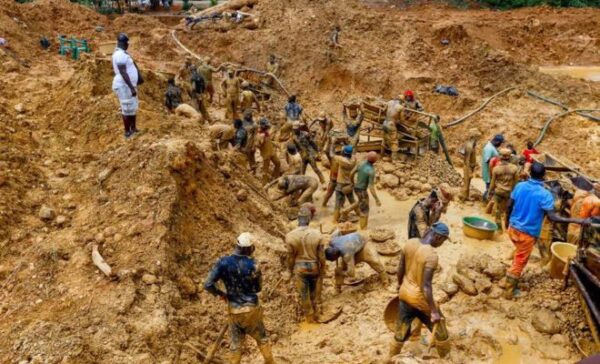
BINDURA, ZIMBABWE — Amid piles of red soil and the buzz of grinding mills, Lloyd Karambakuwa prepares to risk his life for gold.

Tall and slim, the 40-year-old is an artisanal miner in Bindura, a town 86 kilometers (53 miles) northeast of Harare, the capital. On this day, he dons a pair of worn-out shorts, attaches his headlamp and throws his equipment into a shallow tunnel. There is nothing to keep the tunnel from collapsing.

He has no protective clothing, equipment or formal knowledge of mine safety. Sometimes he has to work in water, which may be tainted with chemicals or rise frighteningly high.

Karambakuwa is among Zimbabwe’s hundreds of thousands of artisanal miners, subsistence freelancers who use their own equipment and resources. Most have no permit and no legal protections, and thus their work is largely invisible as well as illegal. And yet they are indispensable to Zimbabwe’s gold mining industry, as government buyers ignore the law and purchase their gold, no questions asked.

“It’s a dangerous game,” says the soft-spoken father of three, who has been a miner for seven years. “But it’s better to risk than sit, because I do not have many options in place to take care of my family.”

EVIDENCE CHENJERAI, GPJ ZIMBABWE

Open shafts mark the landscape at the Premier Estate mining area, where two workers died last November.

About 500,000 people work in small-scale and artisanal mining, supporting about 2 million people, according to the Zimbabwe Economic Policy Analysis and Research Unit, an independent think tank.

“[Artisanal small-scale mining] activities are associated with informal, unregulated, under-capitalised, under-equipped and labour-intensive operations where technical and management skills are lacking,” according to the study.

At least six mines have collapsed nationwide in the past year, most of them operated by artisanal miners, according to Paul Matshona, an artisanal miners’ adviser at the Zimbabwe Environmental Law Association, a nongovernmental organization. An estimated 190 miners died in those accidents.

Those figures include a mine collapse last November in Bindura. That accident alone killed an estimated 20 miners.

Sophia Mbonje’s nephew, Bright Mbonje, was among those who died.

He was 23 and had been an artisanal miner for three years. When the accident occurred, Mbonje says she and other miners’ relatives rushed to the scene. They waited two weeks for a rescue that never came.

“If he was formally employed, maybe all this would not have happened,” she says, voice bitter. “But he went into this trade to take care of his family as he had no other options.”

EVIDENCE CHENJERAI, GPJ ZIMBABWE

Artisanal miners work along the Mutare River, near farms and mountains. Some of the miners dig for gold.

Onesimo Mazai Moyo, permanent secretary of the Ministry of Mines and Mining Development, says his agency is working with other ministries and organizations to address mining accidents and other issues.

Moyo says the groups are working on a strategy to bring more artisanal miners into mainstream mining. But a nationwide coronavirus lockdown has delayed those efforts.

“It’s not always easy to engage them if [they are not registered] and you do not know where they are mining,” he says.

Gold mining is Zimbabwe’s largest earner of foreign currency. In 2019, as part of a three-year trend, the government’s main buyer saw 63% of its gold deliveries come from artisanal and small-scale miners.

Fidelity Printers and Refiners, the government-owned and -operated enterprise that oversees the buying and selling of gold, deals with unregistered artisanal miners. “We accept sellers as long [as they] have any identification document,” says Fradreck Kunaka, general manager.

Kunaka sees the gap between the law and reality, and says that’s why he has urged the government to legalize more artisanal miners. He also notes that if they aren’t legalized, they can’t get government help.

“If it’s a cat-and-mouse situation as it currently is, there is no way we will be able to assist them in terms of maybe educating them on safer ways of doing their business, because the moment they see any regulator, they disappear,” Kunaka says.

Zimbabwe Republic Police officers have arrested more than 800 artisanal miners, according to spokesman Paul Nyathi.

Police regularly raid mining sites and arrest Karambakuwa and his colleagues. But, Karambakuwa says, sometimes, “when you give the police officers money, they will let you go.”

Karambakuwa makes between $15 and $45 a day, enough for rent, school fees and other bills. But he can’t afford licenses and registration fees for miners, he says, which can cost $2,500 to $3,000. In fact, activists say, the fees box out most artisanal miners.

Moyo, the ministry secretary, disagrees: “Our fees are worth very little compared to the gold they get. But we are reviewing our fees from time to time to ensure that they don’t stifle entrance into the industry.”

Karambakuwa says he sees accidents often but has never been hurt himself. His wife worries, he says, but he stays in mining because formal jobs in Zimbabwe are scarce.

Meanwhile, Mbonje, a widow with two children, recalls how her late nephew used to help her with rent and other necessities. She laments that she can’t help support the pregnant wife he left behind.

She recalls that Bright did mining mainly for the money. Yet days before the accident, he refused to go to the mine, she says. He complained that it was too dangerous.

Zimplats revenue increases 79 percent

0

ZIMBABWE’S largest platinum group of metals (PGMs) producer, Zimplats Holdings Limited, has recorded a 79 percent increase in sales revenue for the half year ended December 31, 2020 after receipting close to US$675 million.

The resources group reported that the jump was largely a result of increases in average metal prices and volumes of metal sold which was US$2 241 compared to US$1 494 per six element (6E) ounce in the same period in 2019.

Volumes were 19 percent higher in the period under review after the group shipped 301 225 ounces compared to 252 748 in the same period in the preceding year.

“Half year revenue increased by 79 percent to US$674,9 million compared to the same period last year, largely driven by increases in average metal prices and volumes of metal sold,” said the mining concern in its Directors’ Report and Condensed Consolidated Interim Financial Statements.

“The gross revenue per 6E ounce for the half year at US$2 241 was 50 percent higher than the US$1 494 for the same period last year. 6E ounces sold increased by 19 percent to 301 225 ounces compared to 252 748 achieved in the same period last year.

“Cost of sales at US$297,4 million was 24 percent higher than the same period last year, mainly due to increase in sales volumes, and the resultant increase in royalty and commission costs,” reported the resources group.

As a result of the changes, share-based payments were higher due to improvement in the Impala Platinum Holdings Limited share price as well as an increase in gross profit margin at 56 percent which signalled a 20 percentage points increase from 36 percent achieved in the previous year.

The concern also noted an accrual from the country’s interbank foreign currency auction system as it saw a huge slash on net foreign currency exchange losses which stood at US$0,1 million compared to US$5, 6 million in the same period in the previous year.  The period under review saw the miner making progress on its capital projects which are at various stages of development.

The Bimha Mine redevelopment project is effectively complete on the back of a US$100 million capital injection which is US$1 million less than budget.

Elsewhere, the development of Mupani Mine, which is a replacement for Ngwarati and Rukodzi mines, is ahead of schedule and the project has started receiving fleets from the depleting mines and full production is earmarked for August 2025.

The mining concern reported a bullish outlook despite the threats of the Covid-19 pandemic that has slowed down business globally.

“As we continue to operate during very uncertain times with the Covid-19 pandemic still running rampant across the world, we remain optimistic about the Group’s future” said the resources group.

“The performance in the first half of the year has already demonstrated that we are on the right path, despite the new challenging operating environment. We anticipate favourable metal prices to continue for the remainder of the year.”


Business Weekly

More ferrochrome processing plants to open

0

THE country’s chrome mining sector is poised for growth as Government forges ahead with plans to partner the private sector in opening more processing plants to boost local steel manufacturing industry.

There are only six ferrochrome processing plants and Government wants to extend them to eleven by 2025.

The need to establish processing plants comes as the Ministry of Mines and Mining Development moves in to capacitate as many artisanal and small-scale miners in the chrome mining business. In the National Development Strategy (NDS1), the Government noted that setting up of ferrochrome smelters was expensive and most small-scale miners will find it hard to invest in the sector.

Mines and Mining Development Deputy Minister Polite Kanambura, in an interview, said Government was working on increasing ferrochrome processing plants capacity, buoyed by the increase in demand and prices internationally.

“The grand idea is to have more processing plants so as to maximise mineral beneficiation. The situation at hand is not pleasing because the country is losing revenue. When we have more processing plants, jobs will be created. More importantly, the local steel manufacturing industry is going to benefit.”

Chrome mining continues to be affected by global Covid-19 lockdowns but anticipation of a better year is high as experts forecast a gradual rise in chrome prices. Dep Minister Kanambura said the private sector was welcome to put forward their expressions of interests to invest in the establishment of chrome processing plants.

“The Government is committed to the public private partnership strategy to enhance mineral beneficiation,” he said.


The Sunday News

ZMF still engaging Mines Ministry on mining fees increase

0

The Zimbabwe Miners Federation (ZMF) is still engaging the Ministry of Mines and Mining Development (MMMD) over the recently gazetted Statutory instruments (SI) 44 and 46 of 2021 which saw mining fees hike averaging 2000% suspended after an outcry.

Rudairo Dickson Mapuranga

In a statement ZMF President Ms Henrietta Rushwaya advised members that they are still engaging the Ministry of Mines and Mining Development regarding the newly gazetted statutory instruments and miners will be advised of the outcome.

“Please be advised that the ZMF officials are still engaging the Ministry of Mines and Mining Development regarding the two (2) newly gazetted Statutory Instruments (SI) 44 and 46 of 2021 respectively. The Ministry of Mines and Mining Development is also treating this matter with the urgency it deserves and our Dear Miners will be notified of the outcome as soon as the issue is concluded,” Rushwaya said in a statement.

In a document, the ZMF also indicated that the hike that the government had instituted was going to affect the Federation’s formalization and regularization drive thereby becoming a large hindrance to the President’s vision for the mining sector achieve a US$12 Billion mark by 2023.

“A closer analysis of the price increases indicates that all prices were hiked by 2000 per cent. The price increases will affect the government-set target of US$12 billion by 2023 as it will push out most artisanal and small-scale miners from the mainstream economy. ZMF, therefore, requests for a revision of prices downwards by 300% as indicated on the graphs.” read the document.

“An analysis of the past 4 years from 2017 to 2020 shows that the ASM sector has been producing more than the big mining operations with a record averaging 60 per cent of the total gold production as recorded at FPR. The period 2017 to 2020 has seen the ASM sector producing 60 tonnes against 42 tonnes for the large-scale miners.”

“It is no overstatement that small scale mining contributes quite significantly to economic growth. The government, therefore, needs to incentivize their operations. Revising the prices downwards will definitely promote the ASM in the mainstream economy.” Read the statement in part.

Local mining expert Mr Hyde Elasto Watyoka said he is proposing a two-tier statutory fee charge from MMMD whereby locals pay a lower rate and foreign or any entity that includes foreign ownership pays the higher charge.

“In my opinion, our mining regime allows for cost-saving shortcuts, especially to foreign ownership. It, therefore, follows that it will not be amiss to them if we compensated ourselves by charging these foreigners 10 000% of what locals pay in statutory licencing charges”.

“Besides, these foreign companies are getting very cheap loans in their countries for mining in Africa. In most instances, they are forced by the loan conditions to source equipment from their local suppliers. In this way, African is serving as a side or surplus market to their goods. That also is reason enough to justify us to charge a higher premium for their entry into our mining market”.

In other words, I am proposing for a two-tier statutory fee charge from MMMD whereby local pay a lower rate and foreigners or any entity that includes foreign ownership pays the higher charge. This is the easiest way to indirectly incentivize locals, accommodate foreigners and balance our revenue budget,” Watyoka concluded.

The new prices affect the formalization process as more miners remain in the informal sector. Currently, 84 per cent are illegal miners against 16 per cent registered in accordance with the Mines and Minerals Reg Act.

Premier targets new funding for Zim lithium project

0

Following its recent appointment of New York-based EAS Advisors LLC (EAS) as its United States corporate adviser, diversified mining firm Premier African Mineral, says it is looking to raise new capital for its Zulu Lithium Project in Zimbabwe.

EAS was specifically engaged “primarily to assist with introductions to institutions and funding to enable the company to proceed with development of its current mining and exploration projects in Sub-Saharan Africa, in particular a Definitive Feasibility Study (DFS) at the Company’s Zulu Lithium project in Zimbabwe,” said Premier.

The Zulu Lithium and Tantalum Project is located 80km from Bulawayo, and is generally regarded as potentially the largest undeveloped lithium bearing pegmatite in Zimbabwe.

The mining group said it has agreed to issue, conditional on EAS raising at least US$5 million of new funding to support the development of a DFS for the Zulu Lithium Project on terms acceptable to Premier, a total of 360 000 000 warrants to subscribe for new ordinary shares of Premier.

The terms of this issue include: that the exercise price of 90 000 000 warrants shall be at a 40 percent premium to Premier’s closing share price the day prior to the announcement of the funding; and that the exercise price of 90 000 000 Warrants shall be at a 60 percent premium to Premier’s closing share price the day prior to the announcement of the funding.

Premier also said the exercise price of 90 000 000 warrants shall be at 80 percent premium to Premier’s closing share price the day prior to the announcement of the funding.

And that the exercise price of 90 000 000 Warrants shall be at a 100 percent premium to Premier’s closing share price the day prior to the announcement of the funding.

Said Premier chief executive George Roach: “I’m delighted that we have brought on EAS as our US corporate advisers.

We’re looking forward to working with them as we develop our US profile and take significant steps forward in the development of Zulu.”

Founded by Edward Sugar in 2008, EAS is a boutique global advisory firm focused on helping early stage mining and industrial groups access US and international financial markets and institutional capital.

Having participated in over US$6 billion in transactions since inception, EAS has been instrumental in a number of financing arrangements and has a sound record for backing early finance deals for a number of natural resource focused companies.

“With ever increasing EV demand the need for development of lithium projects becomes more essential. We’re looking forward to working with the Company regarding its ongoing finance, particularly regarding the Company’s Zulu lithium project, as well as lifting its profile in North America,” said EAS founder Edward Sugar.

Premier has a diverse portfolio of projects, which include tungsten, rare earth elements, lithium and tantalum in Zimbabwe and lithium and gold in Mozambique, encompassing brownfield projects with near-term production potential to grass-roots exploration.

Business Weekly

Madondo faces the chop as Redwing rescuer

0

Redwing Mine workers have lost confidence in the mine’s corporate rescue practitioner, Dr Cecil Madondo, who is facing criminal charges in court, and want him immediately replaced.

The workers have lost faith in Dr Madondo’s suitability to turnaround the company and protect their interests following his arrest just over two weeks ago on allegations of fraudulent conduct.

Madondo, who is the managing director of corporate rescue specialists, Tudor House Consultants (Pvt) Ltd, first signed exclusivity mining agreements with a company called Probadek Investment in respect of Redwing Mine covering 132 gold mining blocks, 8 copper mining blocks and any other mining claims belonging to Redwing Mine.

Well knowing that he had already entered into an agreement with Probadek Investments, Madondo allegedly entered into another agreement with Prime Royal Private limited giving them the same mining blocks.

It is alleged that in December, another prospective investor, Betterbrands Mining, entered into agreement with Madondo, giving them the same mining blocks.

Consequently, the complainant, Probadek Investment reportedly suffered a prejudice of US$260 000 in investment capital and fees paid in terms of the transaction due to Madondo’s conduct.

It is against this background that workers want Madondo replaced as the turnaround strategist. Metallon Corporation-owned Redwing Mine, was placed under his control in July last year after an application by the workers.

Through their lobby group, Zimbabwe Diamond and Allied Minerals Workers Union, the workers have already started the process of looking for another corporate rescue practitioner.

ZDAWU secretary general, Justice Chinhema, said in an interview with this publication that they want to replace Madondo with someone who will safeguard their interests and the company’s.

“What we have agreed is that we need to look for another corporate rescue practitioner who can safeguard the interest of the workers and the company,” said Chinhema.

“Our lawyer was at the office of The Master of High Court looking at the list of rescue practitioners so that we can do our selection. That will probably happen on Monday.”

Chinhema said at the time the company was placed under corporate rescue management, it had 800 workers who were owed about US$14 million backdated to 2012.

“We want all the money outstanding paid in full while the security of our workers is safeguarded,” said Chinhema.

Redwing Mine is located in Manicaland Province in eastern of Zimbabwe, about 20 kilometres northeast of the city of Mutare and 265 kilometres southeast of Harare. It used to be one of the largest gold producers in the country.


Business Weekly

ZIMCODD to conduct mineral resource governance meeting in Gwanda

0

The Zimbabwe Coalition on Debt and Development (ZIMCODD) is conducting a meeting in Gwanda, discussing the governance of mineral resources in the community to help in the establishment of the nation’s growth.

By Shantel T Chisango

Speaking on its social media platform Twitter, ZIMCODD made emphasis on the importance of mobilising domestic resources towards the enhancement of the economy.

ZIMCODD further stated that if natural resources are governed properly, they can be of great help to the country in terms of paying off debts.

“Natural resources are sustainable & can be used to pay off legitimate debt.”

The Gwanda community has been urged to play a crucial role in actively participating in mineral governance to help in the establishment of achieving economic development.

This came after the Gwanda community was raising questions on how to improve transparency and accountability in mining tax revenues.

Experts say that there is great potential for using mining as a motor of economic growth and that mineral resources play a very significant role in the development of the country as it has continued to bring much-needed income into the country, contributes to foreign exchange, Gross Domestic Product (GDP), government revenues, capital formation, and infrastructure development.

According to the Institute for Security Studies (ISS), Zimbabwe holds an endowment of substantial mineral resources close to 40 different minerals.

Government efforts towards the rescue all a facade – Task Mine families

0

Families of four miners whose bodies are currently trapped underground at Task mine have regarded the government’s efforts towards the exhumation of miners who got trapped last year as helpless due to the absence of rescue efforts to retrieve the bodies.

By Shantel Chisango

The families, yesterday expressed their frustration to the government Eng Mr. Munodawafa responsible, saying they have been given false hope and empty promises. This was after Chief government Munodawafa called for a meeting at the mine to assure parents that the government had not forgotten about them.

Munodawafa however ejected the Media from the meeting and bizarrely declined to comment on the matter saying he can only do so after consultations with his superiors.

Speaking to Mining Zimbabwe after the meeting, the families expressed their frustrations.

“Government must not play with our minds and making us feel helpless for trying to co-operate with them. This is all a facade,” a frustrated parent said.

Furthermore, the parents condemned Task Mine for not assisting them in any way.

The retrieving of the bodies of the miners has been futile. Only the body of a 20-year-old Shingai Gwatidzo was exhumed on the 31st of October 2020.

Disputing the notion of paying people to retrieve the bodies, Chief Ngezi of Chegutu argued that the officials who had come late last year promising to pay people who would retrieve the bodies were bogus and passing-by politicians.

Families of the affected further said if the government is planning to do a mass-grave, it must do so and leave them out of it.

Zimbabwe Miners Federation (ZMF) was applauded by the parents for being of assistance from the day of the tragedy.

The meeting was attended by police-officers from Chegutu District, ZMF representatives, and families who lost their loved ones at the mine collapse.

Constantino Dzinoreva (47), Charles Mutume (31), and brothers Crynos Nyamukanga (44) Munashe Christian (17) remains, remain underground since the 8th of September 2020.

Sibanye-Stillwater to invest in European lithium company

0

Sibanye-Stillwater Ltd said on Tuesday it has agreed to invest in European lithium company Keliber Oy, marking the South African miner’s entry into battery metals sector.

Sibanye said it will make an initial phased equity investment of 30 million euros ($36.49 million) for a 30% stake in Keliber, and will offer a further 10 million euros to the existing Keliber shareholders.
Sibanye, the world’s largest source of platinum group metals (PGMs), plans to focus on expanding into battery metals as it looks to capitalise on the global push for green technologies.

Sibanye, along with Keliber’s shareholders including Finnish Minerals Group, intend to make the project the first vertically integrated lithium producer in Europe.

THE MINER, WHICH HAS OPERATIONS IN SOUTH AFRICA AND THE UNITED STATES, SAID KELIBER’S LITHIUM PROJECT WOULD ENABLE IT TO TRANSPORT LITHIUM HYDROXIDE TO EUROPEAN CUSTOMERS

The miner, which has operations in South Africa and the United States, said Keliber’s lithium project would enable it to transport lithium hydroxide to European customers.

The Keliber project, which is in the Kaustinen region of Finland, consists of several advanced stage lithium spodumene deposits with 9.3 million tonnes of ore reserves and includes the development of a chemical plant in Kokkola.

“The investment offers the opportunity for further geographic diversification in an attractive mining destination and the opportunity to forge long term relationships with established lithium industry players,” said Sibanye-Stillwater chief executive officer Neal Froneman.

Production is expected to start in 2024 with an annual output at 15,000 tonnes of battery grade lithium hydroxide, Sibanye said.

The precious metal producer has an option to acquire a majority shareholding in Keliber after the completion of an updated feasibility study which is expected in 18 to 24 months.

The deal, which is subject to the approval by the South African Reserve Bank, is expected to be completed in March.

($1 = 0.8221 euros)

Reuters (By Shanima A and Tanisha Heiberg; Editing by Rashmi Aich and Louise Heavens)

First minerals exported from DRC with blockchain

0

Minexx has exported minerals with full financial transparency from the Democratic Republic of Congo, by processing $250k of blockchain certified payments – a first for the industry.

This is a milestone for the sector as it secures the supply chain from the moment a mineral comes out of the ground to the point at which it enters end products such as smartphones and electric cars.

The demand for cobalt, copper, tin and tungsten has increased, but these minerals are often sourced by artisanal miners with 250 million people globally depending on this informal industry, many of whom are in sub-Saharan Africa.

“It is the most unsophisticated $100 billion market in the world,”
said Marcus Scaramanga, Minexx CEO said. “But now advances in technology, such as blockchain and digital payments, give us an opportunity to reshape this sector, from the moment a mineral comes out of the ground, tracing its journey into our consumer goods.”

MINERS ARE ABLE TO CONFIRM THE EXCHANGE OF ORE FOR INCOME VIA MOBILE PAYMENT, ENSURING MINERS GET PAID FAIRLY AND ON TIME

Blockchain – the immutable digital ledger – plays a critical role in improving the traceability schemes. Coupled with digital payments, it brings the supply chain into the financial system.

The Minexx blockchain platform has global application and enables trade and compliance. Minexx is partnered with the UK’s Foreign, Commonwealth and Development Office (FCDO) and its Frontier Technologies Livestreaming Program.

The project at mine sites in South Kivu, DRC, tested how miners accept digital payments through the Minexx platform. Miners are able to confirm the exchange of ore for income via mobile payment, ensuring miners get paid fairly and on time.

From January 1, the EU brought in new regulations to ensure companies importing tin, tungsten, tantalum and gold, meet international responsible sourcing standards set by the OECD. It requires companies to carry out due diligence from this date by law.

The EU regulation also aims to ensure that global and EU smelters and refiners source these minerals responsibly.

Mining.com