Home Blog Page 521

“Need to urgently address depressed power generation”

0

THE Zimbabwe National Chamber of Commerce (ZNCC) says there is a need to urgently address depressed power generation in the country to ensure adequate supply when full-scale industrial production resumes post Covid-19.

Due to persistent technical faults, the country’s largest thermal power station in Hwange was generating about 172MW as of yesterday against installed capacity of 920MW, according to the Zimbabwe Power Company (ZPC).

The country’s combined output was at 1 027MW yesterday with Kariba Hydro Power Station producing more at 825MW while small thermals Munyati and Harare stood at 15MW each with Bulawayo at zero.

The Covid-19 lockdown measures have worsened the situation as expatriate engineers are hindered by travel restrictions while importation of spares has also become cumbersome.

Prior to the outbreak of Covid-19, poor electricity supply was one of the major drawbacks affecting productivity by the local companies. Despite improvement early this year, the power utility recently announced a return of power cuts, which has left both business and domestic consumers worried.

ZNCC vice president, Mr. Golden Muoni, said given the prevailing subdued power generation capacity, electricity challenges facing companies are expected to continue when the production returns to normal.

“Right now, given the Covid-19 pandemic there is not much of production happening and obviously there is not much of power consumption except for domestic consumption. But obviously when production is back to normal, it means we are going to have more problems,” said Mr. Muoni.

In an update for the second quarter ended June 30, 2020, ZPC indicated that it missed its power supply target by 20 percent to 1384,46-gigawatt hours against a target of 1732,56GWh. The power utility said output for the period under review was 38,64 percent below the output for the same period last year. The supply gap has kept Zimbabwe on the import path for years, which drains scarce foreign currency.

“In the reporting period, ZPC sent out a total of 1384,46GWh against a target of 1732,56GWh. The output is 20,09 percent below target, and 38,64 percent below the output for the same period in 2019,” said ZPC in a statement.

To date the power generation company has sent out 2678,32GWh, which is equivalent to 80 percent of the target for the half year.

“Hwange Power Station generated with an average of three units during the quarter and sent out 618,44GWh of energy, missing its quarterly target by 38,40 percent. This was due to the unavailability of Units 3 and 6, which have been on extended outages due to delays caused by the Covid-19 travel restrictions as well as lack of funding.

“Unit 5 was also unavailable throughout the month of June owing to ID fan problems, thus compromising the station’s output,” it said.

Kariba South Power Station generated an average of seven units during the quarter and sent out 747,69GWh of energy, surpassing the quarterly target by 19,69 percent. Kariba had to ramp up power generation in May and June to compensate for low generation at the thermal power stations.

“This was enabled by a 0,5 billion meters increase in water allocation by the Zambezi River Authority (ZRA).

“The small thermals missed their quarterly target of 103,96GWh by 82,38 percent. Generation was constrained as a result of frequent coal stock-outs at Munyati and Bulawayo power stations. Frequent failure of the plant across all the small thermals resulted in low plant availability and potential generation loss,” said ZPC.

The Zambezi River Authority allocated a total of 22 billion cubic metres (bcm) of water for power generation to Zesco of Zambia and Kariba power plant and this translated to 11bcm per utility at an average capacity of 275MW. Improved inflows in Kariba dam led to an upward review of water allocation by 0,5 bcm to each utility effective May 1, 2020, hence raising the water allocation to 11,5bcm.

The annual average capacity was thus increased from 275MW to 294MW. ZPC said it was agreed that the additional allocation be spread during the winter period when demand was high, thus, increasing the target average generation to 337MW.

On the US$1.4 billion Hwange expansion project, the power generation company said during the period under review, the project was exposed to high impact risk events, which affected its progress with Covid-19 having had serious implications on the project as personnel cannot travel to or from China for manufacturing and procurement of equipment. The project is now 47,5 percent complete against a planned progress of 57 percent.

Progress made during the quarter includes design component of the project, which is now 92 percent complete. Reviews for technical specifications and detail designs are ongoing for power plant and transmission and distribution works.

“During this reporting period, Sino-hydro progressed with both excavations and foundation construction work. Concrete construction for Units 7 and 8 structural foundations is now complete. Unit 7 steel structure installation is in progress at 96 percent complete,” said ZPC_The Chronicle

Eskom warns of more blackouts

0

South Africa’s power utility Eskom said yesterday that they are well and truly under pressure to provide the country with electricity this week, and announced that Stage 2 load shedding will continue today, September 2, as they battle to keep several power stations online.

Worse still, they said that the problems they are dealing with are so severe that there is every likelihood that they may need to escalate their load shedding programme from Stage 2 to more restrictive levels at the drop of a hat in order to ensure that the grid’s integrity is maintained.

In a statement released on yesterday, Eskom said that they are battling a plethora of technical difficulties.

“Due to the continuing severe generation supply constraints as a result of multiple-unit breakdowns, Eskom will continue to implement Stage 2 load shedding from 8:00 until 22:00 tomorrow,” they said.

They again said that their infrastructure is badly maintained and feeling the aches and pains of old age.

“Ten generation units at seven power stations suffered breakdowns in the past two days,” they said.

“With the unreliable and aged generation infrastructure, together with a number of risks on running units, there is a high probability that additional stages of load shedding may be implemented at short notice.” — The South African.

Tenants baffled by five-fold increase in Zimasco rentals

0

Ferrochrome producer Zimasco has hiked rentals for its properties in Shurugwi more than five-fold and is threatening to evict those who do not pay.

Zimasco closed its Shurugwi plant about six years ago and is renting out the houses which used to accommodate the employees.

But the latest sudden jump is causing distress.

Tenants said monthly rentals for a house in the high-density suburb had been reviewed from $500 to $2 800, while a house in the low-density area rose from $4 500 to $28 000.

“I have been paying $4 500 for a full house and recently I received a notice that the rent has been reviewed to $28 000 and I believe this is unrealistic. The figure is just exorbitant and I think the company management is just trying to tell us that they no longer want us,” said one of the affected tenants, Mr Ronald Mashoko.

Mr Mashoko said most tenants were in arrears and the new rentals were beyond the reach of many.

Another tenant, Mrs Leona Mageza, said they had since approached the local councillor to help negotiate with the Zimasco management on the new rentals.

She said most of the tenants were former workers of the company who were still owed money by the company. They suspect that the company’s decision to increase the rentals was a way of trying to clear the salary arrears.

“The company has not been benefiting much from these rentals since the rental money was being deducted from what the company owed the employees in terms of salaries,” she said.

“So it seems the company has hiked the rentals so that they quickly clear the salaries owed before they start collecting money from the tenants. It is a gimmick so we have approached the local councillor to help us negotiate with the company.”

The councillor for the area, Freddy Ncube said they would be meeting Zimasco’s management on Friday.

“We approached the management and they agreed to have a meeting with us this Friday so that we negotiate on the new rents which everyone believes were unrealistic,” he said.

Zimasco human resources manager Mr Fungai Manyau confirmed the increase in rentals, but referred further questions to the company’s spokesperson, Ms Clara Sadomba, who did not respond to questions sent to her.

IronRidge Resources becomes member of European Battery Alliance

0

Australia’s IronRidge Resources announced that it has been accepted as a member of the European Battery Alliance, an organization committed to driving a competitive and sustainable battery industry in Europe by 2025.

In a press release, IronRidge said the EBA250 network brings together over 400 interested stakeholders, industry specialists, and participants from both the public and private sectors of the EU’s battery value chain.

Members have access to the InnoEnergy Venture Capital Community and potential alternate funding sources.

“We are confident in our project fundamentals and the project’s proximity to Europe is highly advantageous and may deliver multiple pathways through the value-adding vertical integration ambitions of the EU,” Vincent Mascolo, IronRidge’s CEO, said in the media brief.

The miner’s Cape Coast Lithium Portfolio covers some 684 square kilometres in Ghana, West Africa and includes the spodumene-rich Ewoyaa lithium project, which has with a maiden mineral resource estimate of 14.5Mt at 1.31% Li2O in the inferred and indicated category including 4.5Mt @ 1.39% Li2O in the indicated category.

IronRidge also entered into earn-in arrangements with Obotan Minerals, Merlink Resources, Barari Developments and Joy Transporters Limited of Ghana, and secured first access rights to acquire the historical Egyasimanku Hill spodumene-rich lithium deposit, estimated to be in the order of 1.48Mt at 1.67% Li2O and surrounding tenements.

Mining.com

China Moly’s H1 cobalt production down 24%

0

China Molybdenum Co., one of the world’s biggest cobalt producers, saw its output of the battery metal fall 24% year-on-year in the first half, according to Reuters calculations based on company filings.

China Moly, which operates the Tenke Fungurume mine in the Democratic Republic of Congo (DRC), said in a statement on the Shanghai Stock Exchange it produced 6,543 tonnes of cobalt metal in January-June this year. It had reported output of 8,614 tonnes in the first half of 2019.

The number implies second-quarter production of 3,299 tonnes of cobalt, a key ingredient in batteries for electric vehicles.

The company’s annual cobalt production target was set at 14,000-17,000 tonnes for 2020, although a China Moly spokesman said in April a “high copper, low cobalt” production strategy was adopted for the first half for pricing reasons.

Cobalt prices on the London Metal Exchange are up 16% this quarter on concerns coronavirus-related mining and logistics restrictions may curb output in the DRC, the world’s biggest source of cobalt, and speculation China will stockpile the metal.

China Moly placed Tenke Fungurume in isolation in March due to the virus.

The mine also produced 90,972 tonnes of copper on a metal content basis in the first half, China Moly said on Sunday, up 2.8% from a year earlier and in line with its annual target of 163,000-200,000 tonnes.

Tenke Fungurume director Simon Tuma-Waku said in May he expected stable output from the mine in 2020 despite the covid-19 disruption.

Reuters

AngloGold, Barrick to sell 80% of Morila mine in conflict-ridden Mali

0

AngloGold Ashanti and partner Barrick Gold are selling their 80% stake in Mali’s Morila gold mine amid political uncertainty in the country still reeling from a recent coup, the second in less than 10 years.

Australian miner Mali Lithium will pay between $22 million and $27 million for the joint company that holds the two miners’ stakes in the mine. The remaining 20% will stay in the government of Mali’s hands.

AngloGold expects its share of the net consideration for the purchase to be roughly $10 million or less, the company said.

Barrick said the move would allow it to focus on its strategy of “discovering, developing, owning, and operating Tier One assets.”

THE ACQUISITION OF MORILA WILL TURN MALI LITHIUM INTO A CASH-GENERATING GOLD PRODUCER

The Morila gold mine poured its first gold in October 2000 and became the foundation of African gold giant Randgold Resources, now part of Barrick.

The mine halted operations last year, but ore stockpiles continue being processed. Mali Lithium said it planned to reopen the mine as soon as possible.

“Morila is one of West Africa’s great gold mines and we are excited and privileged to acquire a mine of Morila’s calibre with its past production plus Mineral Resources (gold endowment) of 8.7 million ounces of gold,” executive chairman Alistair Cowden said in a separate statement.

“This is truly a transformative transaction for the company as we become a gold producer,” Alistair added.

The acquisition of Morila, which lies adjacent to Mali Lithium’s Massigui gold project, is set to turn the Australian company into a cash-generating gold producer.

Morila, known in its heyday as “Morila the Gorilla”, is expected to produce approximately 26,350 ounces of gold from November this year to the second quarter of 2021.

The parties expect to complete the transaction by October this year.

Most miners safe

Mali President Ibrahim Boubacar Keita resigned on August 18 after seven years as a head of state and dissolved parliament hours after soldiers detained him at gunpoint and seized power in a coup.

The following day, Colonel Assimi Goita declared himself the leader of the military figures behind the coup — a group who identify themselves as the National Committee for the Salvation of People (CNSP).

The events have sparked international condemnation and are likely to further destabilize the West African nation, following months of anti-government mass protests and a rising insurgency from Islamist militants.

Experts believe that miners operating in the country’s west and south are unlikely to face any significant threats to their assets. They will, however, have to deal with disruptions, including the imposition of a nightly curfew and the closure of all Malian borders, Alexandre Raymakers, senior Africa analyst at risk analysis company Verisk Maplecroft, said in a note.

Mining companies should also expect substantial administrative delays when dealing with authorities as government structures will be paralyzed by the ongoing political crisis, Raymakers wrote_Mining.com

Friedland’s Nimba iron ore project to get World Bank backing

0

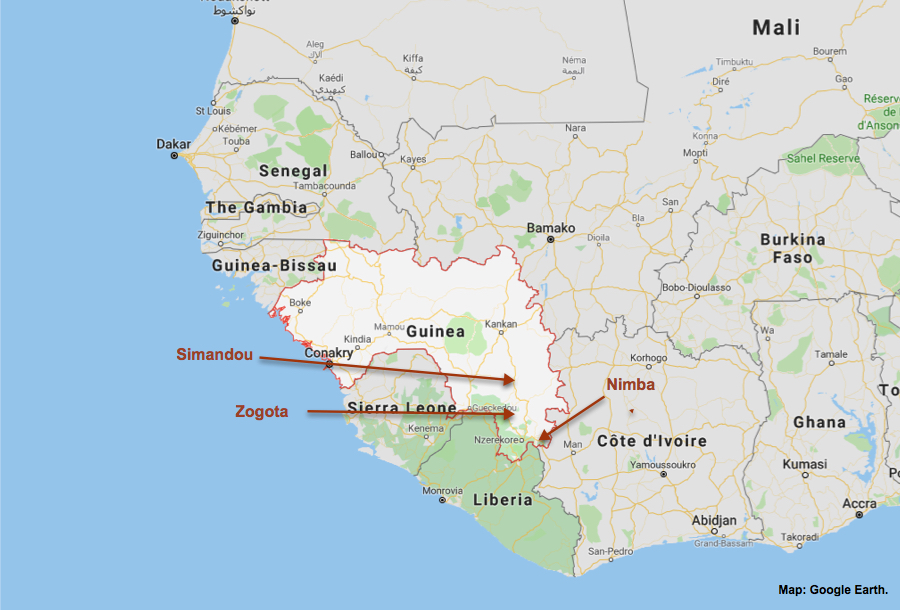
The World Bank is said to be mulling a $135 million investment in the proposed Nimba iron ore mine in southeastern Guinea, which is owned by Canada’s High Power Exploration (HPX), a privately-held company founded my mining mogul Robert Friedland.

The move by MIGA, the bank’s agency for foreign investment, would help HPX deal with potential political risks associated with the mine’s exploration phase, including the completion of key studies preceding Nimba’s construction and operations.

BASED ON A 2015 REPORT BY THE UNITED STATES GEOLOGICAL SURVEY, NIMBA HOLDS ROUGHLY ONE BILLION TONNES OF HIGH-GRADE IRON ORE

The proposed open-pit is located in the Guinean Nimba Mountains, classified as a strict nature reserve in 1944 and then as a World Heritage Site in 1981-82 for being home to globally threatened and endemic species.

The boundary of the strict nature reserve and World Heritage Site was modified in 1993 to exclude a keyhole-shaped area to allow mining in the proposed project area.

Vancouver-based HPX acquired the iron ore deposit in September 2019. Based on a 2015 report by the United States Geological Survey (USGS), Nimba holds roughly one billion tonnes of high-grade iron ore.

HPX is currently conducting studies that it hopes will enable production of up to 20 million tonnes annually.

Rail issue

Guinea is also host to the famed Simandou project, which Rio Tinto, Vale, and billionaire Beny Steinmetz’s BSG Resources fought over for years. However, the West African nation has never exported a tonne, as it lacks infrastructure to transport the ore to local ports.

In October, Guinea and Liberia inked a deal to allow several Guinean mines, including the Nimba project, to export through Liberian ports.

Guinea has struggled for decades to extract money from its iron ore, which has been left undeveloped because of protracted legal disputes and the cost of infrastructure.

Friedland’s company still needs to reach agreements with Germany’s steel giant ArcelorMittal, the sole rail concession holder in Liberia, to allow the company make use of its infrastructure.

Conservation International, a US-based environmental organization, is currently working with ArcelorMittal to make sure that local communities share the economic benefits of mining activities and are also empowered to protect the natural resources they rely on.

Friedland made his fortune from the Voisey’s Bay nickel project in Canada in the 1990s. Since then, he has been involved in some of the biggest mineral discoveries in the world, including the giant Oyu Tolgoi copper mine in Mongolia and the Kamoa-Kakula project in Democratic Republic of Congo_Mining.com

Investors who missed gold rush pile into platinum funds

0

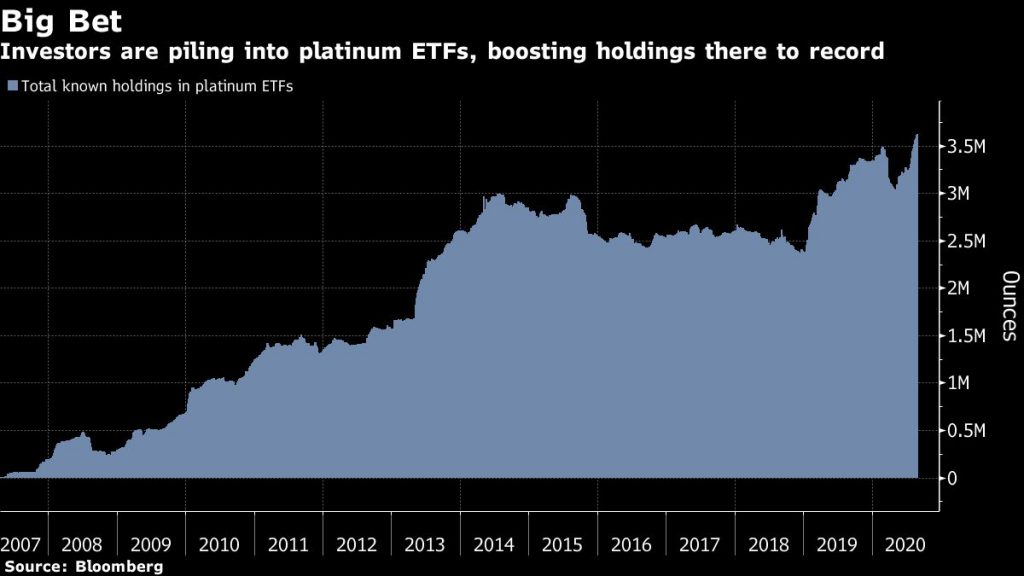
Platinum holdings in exchange-traded funds have surged to a record, raising the prospect of a catch-up rally for the precious metal after months of lagging gold and silver.

More than 600,000 ounces of platinum have been added to ETFs since mid-May, according to data compiled by Bloomberg, as investor demand partially offsets a drop in consumption from jewelry and the auto industry crippled by the coronavirus pandemic.

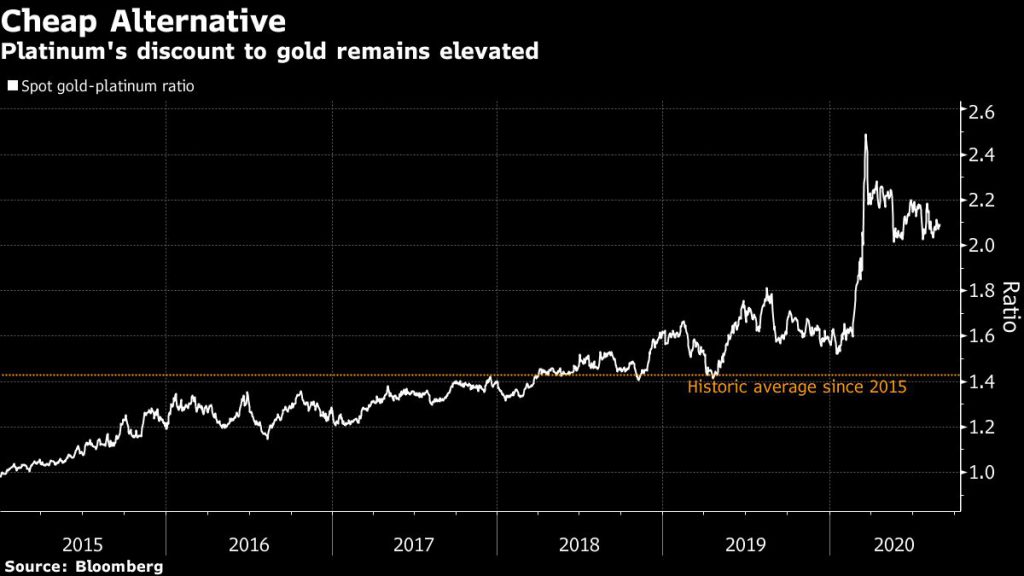
The buying spree was driven by investors who thought they were missing out on the recent rally in gold and silver, said Nitesh Shah, director of research at WisdomTree. There’s also probably been some money taken as a profit from gold and silver and added into platinum because it’s still relatively cheap compared with its peers, he said.

Most major precious metals have had a banner year in 2020 as governments and central banks including the Federal Reserve unleashed vast stimulus to aid economies hurt by the health crisis, sending investors to seek safety in hard assets amid concerns over currency debasement. Gold has rallied 29% this year, while platinum is still down about 3%.

“Platinum does seem like one of those metals that could be next if historic correlations are any guide,” Shah said.

Investment demand and worries over reduced supply from top producer South Africa after temporary closures of mines due to lockdowns have been supporting the metal. While platinum has rebounded about 66% from this year’s lows after a massive sell-off in March, its discount to gold is still not far from a record, with the silvery-white metal trading at half of bullion’s value.

“Ultimately, those questioning whether there are green shoots for platinum would do well to keep its performance in perspective,” said Steve Dunn, head of ETFs at Aberdeen Standard Investments. “While gold continues to receive the lion’s share of media attention, platinum has significantly outperformed since their lows” in March.

UBS Group AG is pinning its recent platinum forecast increase on its bullishness on gold and projected economic growth in the near term. The bank sees prices at $975 an ounce at end-September and end-2020 compared with about $935 currently. Yet, it cautioned that platinum’s fundamentals remain the bleakest among precious metals.

WisdomTree’s Shah believes platinum could flirt with the $1,000 mark in the next 12 months as the biggest consumer, the auto industry, is recovering faster than many anticipated. Platinum is widely used in catalytic converters in diesel vehicles.

“Near-limitless money printing by the Fed and global currency debasement are the prime drivers of the continuing rush to precious metals, including platinum,” said Ryan Giannotto, director of research at GraniteShares Inc. “Unlike other monetary metals, however, platinum is 16 times more scarcely produced than gold and extraordinarily concentrated in supply,” he said, adding that this should help support prices.

Bloomberg News

Petrol price to inch up by 1 cent per litre from Wednesday morning

0

South African Motorists will be paying 1 c/l more for both grades of petrol from Wednesday morning, while diesel will fall by 21 c/l.
This comes after the department of mineral resources and energy on Monday announced its monthly fuel price adjustments for September.
They are as follows:
• Petrol (both 93 ULP and LRP): 1.00 c/l increase;
• Petrol (both 95 ULP and LRP): 1.00 c/l increase;
• Diesel (0.05 percent sulphur): 21.00 c/l decrease;
• Diesel (0.005 percent sulphur): 21.00 c/l decrease;
• Illuminating Paraffin (wholesale): 26.00 c/l decrease;
• Single Maximum National Retail Price for Illuminating Paraffin: 35.00 c/l decrease;
• Maximum LPGas Retail Price: 36.00 c/kg increase; and
Among the reasons for the adjustments is an increase of 5.3 cents per litre in the retail margin of all grades of petrol to accommodate the annual wage increases of forecourt staff.
Mineral Resources and Energy Minister ,Gwede Mantashe, said additional reasons for the price increase include a weaker rand-dollar exchange rate, and a slight uptick in the average price of price of Benchmark Brent Crude.
“This was mainly due to concerns that the hurricanes may lead to closure of some of the production facilities in the South Coast of the United States of America,” the department said.
This was counterbalanced by a decrease in the average prices of refined petroleum products, resulting in a 1 c/l increase for petrol and a decrease of 21 c/l for diesel.

Q2 power supply target down 20%

0

POWER utility, Zesa Holdings, missed its electricity supply target by 20 percent to 1 384,46 Gigawatt hours in the second quarter ended 30 June 2020 against a target of 1 732,56 GWh due to continued technical faults mainly at Hwange Thermal Power Station.

In an update the Zimbabwe Power Company (ZPC), a subsidiary of Zesa, said output for the period under review was 38,64 percent below the same period last year.

“In the reporting period, ZPC sent out a total of 1 384,46GWh against a target of 1 732,56GWh.  The output is 20,09 percent below target, and 38,64 percent below the output for the same period in 2019,” said ZPC.

To date the power generation company has sent generated 2 678,32GWh, which is equivalent to 80 percent of the target for the half-year.

“Hwange Power Station generated during the quarter sent out 618,44GWh of energy generated from three units, missing its quarterly target by 38,40 percent. This was due to the unavailability of Units 3 and 6, which have been on extended outages due to delays caused by the Covid-19 travel restrictions as well as lack of funding.

“Unit 5 was also unavailable throughout the month of June owing to ID fan problems, thus compromising the station’s output,” it said.


The Chronicle