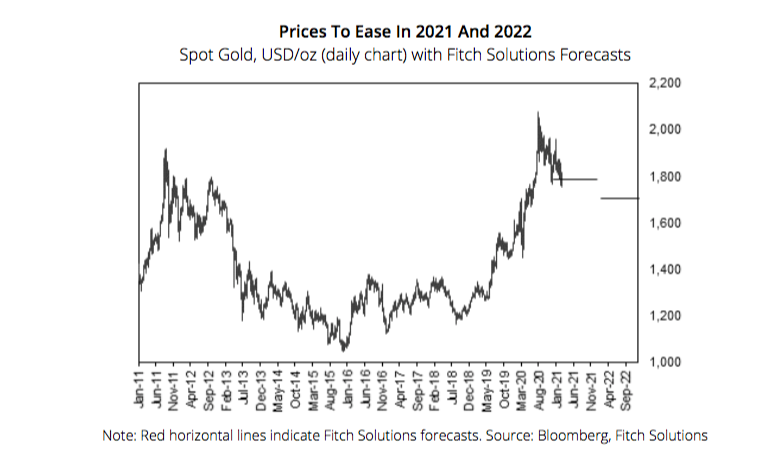
Gold prices have trended lower since the start of 2021, amidst rising US treasury yields and an increasingly positive outlook for the economic recovery.
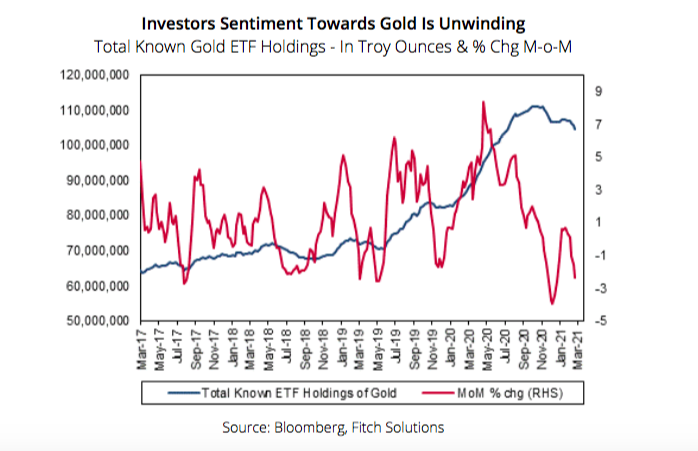
Investor sentiment towards gold has also continued to ease significantly in recent months following the rally recorded in H120 and the peak in prices reached in August last year.
Gold prices could remain supported over March-April as inflation will likely pick-up and could rise faster than bond yields sending real bond yields even in more negative territory, market analyst Fitch Solutions predicts in its latest industry report, adding that this will likely push real interest rates lower in the near term, temporarily boosting the appeal for gold.
Fitch forecasts gold prices could see some volatility in the coming weeks as financial markets assess incoming inflation readings.
However, the analyst believes gold prices will trend lower on a six-to-twelve-month horizon given its expectations for bond yields to rise this year and as macroeconomic uncertainty eases.
As such, Fitch is revising down its 2021 gold price forecast, to an average of $1,780/oz from $1,850/oz previously.
A key gold driver to monitor in the coming weeks will be rising inflationary pressures. Fitch’s Macro team expects inflation to pick up over the coming months but believes that it will only be temporary as base effects will start to wear off around Q321 and that significant slack in the economy exists.
This helps to underpin the analyst’s view for gold prices to remain supported in the near term, before they ease later in the year as inflation pressures fade and as bond yields continue to rise. However, Fitch notes that a stronger-than-anticipated rise in inflation readings or inflation expectations could provide significant a temporary tailwind to gold as it is traditionally seen as a hedge against inflation.
Prices will be driven by both upside and downside pressures in 2021, but Fitch believes the balance weighted to the downside. The analyst’s forecast implies prices will trend lower overall this year and in 2021, the average price will be similar to the $1,773/oz average in 2020.
Fitch maintains its forecasts for 2022 and beyond, expecting gold to trend lower in the coming years as monetary policy continues to normalise, and as the US Fed raises interest rates and winds down its balance sheet.
Fitch continues to hold a below-consensus view on gold prices, in 2021 and beyond.
The granting of tax exemptions to Great Dyke Investment (GDI) reflects unlimited ministerial powers which can be abused if there are no ‘clear and published guidelines’ on the granting of tax incentives, a local environmental lobby group has said.
Donald Takudzwa Nyarota
In an analysis of the tax exemption policy, the Zimbabwe Environmental Law Association (ZELA) said the lack of transparency and access to information in the mining sector fuels suspicions and makes it difficult to estimate the potential revenue loss.
ZELA said the GDI tax exemption saga is complicated by the lack of public disclosure of the beneficial registry, a situation that can lead to corruption and money laundering’ and fuel Illicit Financial Flows (IFFs).
“Given the opaqueness of the extractive sector, it is very difficult to identify the persons who control the platinum mining project. Secretive corporate structures and anonymous business entities scattered in various jurisdictions are a breeding ground for tax evasion and profit shifting to tax havens.
“There are risks of Illicit Financial Flows (IFFs) in the project as it is alleged that the biggest shareholder of the Landela Mining Venture Limited (Sotic International) is linked to Mauritius, which is a known tax haven.
“The major challenge is that negotiation and performance monitoring of contracts or agreements that the government sign with foreign investors is secretive prompting the public to suspect that the deals are targeted to benefit the investors at the expense of the country and a sense that the burden of taxation is unfair. To increase contract transparency, parliament should exercise its oversight role through contract performance monitoring and during approval of agreements with foreign entities and organisations.
“Parliament’s oversight is critical in ensuring that bad deals are avoided as both government and corporate negotiators will be aware that there is a third eye watching. The parliament must access the contract signed with the Russians and investigate it,” said ZELA.
ZELA said while the Minister of Finance may grant tax incentives to investors, he can also use discretionary powers without due diligence, as could be the case with this exemption, which raises transparency concerns.
“As it stands, the agreement in terms of which the exemption was made, was not made public by the government thus limiting the ability of citizens and CSOs to hold the government to account. So it is difficult to say that there was merit in government granting the income tax exemption because there is no public disclosure of the terms and conditions that were agreed upon.
“The sheer size, at least on paper for now, of the investment and its potential to provide huge economic benefits to the country could have significantly influenced the decision to warrant the project a Special mining lease.
“However, the discretionary powers given to the Minister and President ( in case of the Mines and Minerals Act) to grant tax exemptions can be easily abused in a political and economic context where contract disclosure is lacking and where political actors may hold economic interests or intend to benet from the tax exemptions.
“Dyke Investment a tax incentive is not clearly stated. The good intentions of this exemption can be theoretically deduced. However, the possible abuse of discretionary powers can also be deduced. The discretionary powers given to the Minister may lead to unjustifiable tax exemptions,” read part of the statement.
The Ministry of Finance and Economic Development granted a 5-year tax exemption GDI on the 27th of January 2021 through a Statutory Instrument 26/20211 cited as Income Tax (Exemption from Income Tax) (Great Dyke Investments (Private) Limited) Notice, 2021, effective from 1 January 2021.
The move will see the platinum mining company being exempted, on three fronts, from paying, income tax for a period of ve years, forego paying resident shareholders’ tax payable on dividends paid to its shareholders resident in Zimbabwe, and any additional profits tax.
ZELA called for the Ministry of Finance to ‘urgently develop Guidelines on granting incentives for investors including those for the mining sector, or if the guidelines already exist, they should publish them to promote transparency and accountability’.
China’s rare earths, a group of 17 minerals used in military equipment and consumer electronics, are being undersold due to “vicious competition” domestically and face low resource utilisation, the country’s industry minister said on Monday.
Prices for some rare earths in China, such as praseodymium-neodymium – used in rare earth magnets – have spiked to multi-year highs this year amid strong demand from the electric vehicle sector.
However, prices for other rare earths mined simultaneously, such as cerium and lanthanum, used in catalysts for oil refining, remain depressed due to abundant supply.
CHINA RAISED ITS RARE EARTH OUTPUT QUOTAS FOR THE FIRST HALF OF 2021 TO RECORD LEVELS
“Our rare earths did not sell at the ‘rare’ price but sold at the ‘earth’ price… because of competitive bidding, which wasted the precious resource,” Minister of Industry and Information Technology Xiao Yaqing said during a news briefing.
A heavy reliance on China, the world’s top producer of rare earths, has led the United States to order a review of its supply chain for the minerals.
Shipments of rare earth magnets from China to the United States hit 585 tonnes in December, the highest since at least 2016, according to Chinese customs data. China’s overall rare earth exports last year were the lowest since 2015 amid coronavirus-hit demand overseas.
China’s industry ministry proposed in January tightening regulation of the rare earth sector, including a stipulation that importers and exporters abide by foreign trade and export control laws.
“Government should play a role in maintaining market order, loosen what can be loosened and control what should be controlled,” said Xiao, who previously served as head of state-owned metals group Chinalco, the parent of one of China’s biggest rare earth producers.
The minister said some companies were producing excessive amounts of rare earths, causing environmental issues and leading to low resource utilisation rates.
China raised its rare earth output quotas for the first half of 2021 to record levels.
Meanwhile, China lacks high-level rare earth products, Xiao said, adding the country “should learn from Japanese enterprises in this regard.”
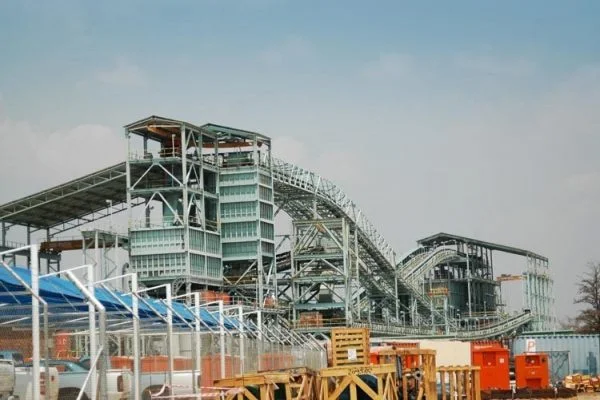
PLATINUM mining group, Implats, says it is undertaking feasibility studies to set up a fourth concentrator at Zimplats ahead of envisaged increased output from Bimha Mupani mine expansion projects.
The Johannesburg Stock Exchange-listed group owns Zimbabwe’s largest platinum miner, Zimplats, which is based in Mashonaland West province.
Implats chief operating officer, Gerhard Potgieter, said for some time now, the Zimplats smelter has been operating at 6,5 million tonnes capacity a year from four mines and three concentrator plants.
“So, the expansion of Zimplats comes with a need for further beneficiation capacity.
“Longer term, we’ve acknowledged the fact that we are constrained as far as our smelting capacity in Zimbabwe is concerned and we are busy with studies for further furnace there,” he said in an audio recording shared by the mining weekly website.
“It’s not only a furnace that goes with it and it’s quite a substantial capital investment to be made.
“We have started with a feasibility study on this, it’s early days but we have acknowledged the fact that we need more capacity in Zimbabwe.”
Meanwhile, Zimplats has recorded a 79 percent increase in sales revenue for the half year ended December 31, 2020 after receipting close to US$675 million.
The mining firm reported the jump was largely a result of increases in average metal prices and volumes of metal sold, which was US$2 241 compared to US$1 494 per six element (6E) ounce in the same period in 2019.
Volumes were 19 percent higher in the period under review after the group shipped 301 225 ounces compared to 252 748 in the same period in the preceding year.
“Half year revenue increased by 79 percent to US$674,9 million compared to the same period last year, largely driven by increases in average metal prices and volumes of metal sold,” said the mining concern in its directors’ report and condensed consolidated interim financial statements.
“The gross revenue per ounce for the half year at US$2 241 was 50 percent higher than the US$1 494 for the same period last year. 6E ounces sold increased by 19 percent to 301 225 ounces compared to 252 748 achieved in the same period last year.
“Cost of sales at US$297,4 million was 24 percent higher than the same period last year, mainly due to increase in sales volumes, and the resultant increase in royalty and commission costs,” it said.
As a result of the changes, share-based payments were higher due to improvement in the Impala Platinum Holdings Limited share price as well as an increase in gross profit margin at 56 percent, which signalled a 20 percentage points increase from 36 percent achieved in the previous year.
Mineworkers at Golden Valley Mine in Kadoma have been submitting complaints to the Zimbabwe Diamond and Allied Minerals Workers Union (ZDAMWU) raising fears of radiation from full-body scans at the mine.
By Shantel T Chisango
Speaking to Mining Zimbabwe, ZDAMWU General Secretary Justice Chinhema said workers are fearing for their health due to the body scans they are going through at the mine.
“We have cases of workers fearing a full-body scan that is being installed at Golden Valley Mine in Kadoma raising concerns of radiation,” said Chinhema.
Mr. Chinhema said that his association engaged with the Radiation Protection Association of Zimbabwe (RPAZ) over the effects of the scanning machines.
RPAZ promised ZDAMWU that they will monitor the machines and assured them that there are safe with no side effects.
“We engaged with the Radiation Authority over its effects, and they responded saying they will be monitoring and assured us that it’s not harmful,” Chinhema said.
Mr Chinhema further said that miners are lacking knowledge on radiation, hence there is a need to educate miners about everything there is to know about radiation.
“Had it not been that the country is currently hit by the Covid-19 pandemic, possibly some training would have taken place,” said Chinhema.
ZDAMWU is an organisation that helps in addressing challenges being faced by current, retired workers in the Zimbabwe mining industry.
About Golden Valley
Golden Valley mine is a gold-producing mine located in Patchway, approximately 18km from the City of Kadoma. It is currently owned by John Mack company with Head office located in Harare.
Mines and Mineral Bill is awaiting the Ministry of Mines and Mining Development Minister’s approval for it to be forwarded to Parliament, Parliamentary Portfolio Committee on Mines Chairperson has said.
By Shantel T Chisango
Speaking to Mining Zimbabwe, Parliamentary Portfolio Committee Chairperson Honourable Edmond Mkaratigwa said the Mines Bill is long overdue. He said the bill was supposed to have been out in September of 2020, and the Mines Minister can hasten the process by approving the Bill.
He further said if the Bill gets approved, it will not take the Parliament more than three months to pass the bill because Parliament Presiding officers have been awaiting the Bill for a long time.
“As Parliament and Committee Chairman we are yielding to ensure that the bill is released as early as possible.”
Mkaratigwa, in addition, applauded small-scale miners and all stake-holders including Civil Society Organisations (CSOs) for not tiring from putting pressure on the responsible officials in a bid to make the Bill be released quickly.
He went on to say that this year will yield results and will be good for miners.
“I can confidently say this year is the year for miners,” Mkaratigwa said.
The Bill has the key for the country’s short-term and long-term economic vision, said Mkaratigwa.
Impala Platinum is to expand processing capacity at Zimplats in order to support a US$290 million investment at Zimbabwe’s largest platinum mine.
Development of two Zimplats mines, Bimha and Mupani, will add another 180,000 ounces, and this extra output will need extra concentrator capacity, officials say.
“That (investment) will add another 180 000 ounces in a shallow, mechanised, low-risk operation. The cost involved with that is R4.3 billion (about US$290 million) over the next four to five years,” Implats CEO Nico Muler said in a call with press on Thursday.
Implats COO Gerhard Potgieter said the Zimplats smelter has been operating at 6.5 million-tonne capacity a year from four mines and its three concentrator plants. With the added output from the Bimha and Mupani mines, the company will need more capacity for processing.
“So, the expansion of Zimplats must come also with the need for further beneficiation capacity. As the new Mupani mine ramps up, it will be the fifth mine and, together the Bimha mine, it will be growing into a significant size of the production so much so that this current project will take it to 6.7 million tonnes,” said Potgieter.
“So, the first thing we have to do is to provide a fourth concentrator unit at the operation, so that we can concentrate those tonnes. Unfortunately, the smelter at Zimplats is at full capacity, which means that the first step from that would be those concentrates having to come to our Rustenburg operations and be treated here.”
Implats says it is also looking into investing in additional smelter capacity, which is the next stage of the processing chain.
“Longer term, we’ve acknowledged the fact that we are constrained as far as our smelting capacity in Zimbabwe is concerned, and we are busy with studies for a further furnace and the sulphur abatement that goes with it. It’s quite a substantial capital investment to be made and we’ve started with the feasibility studies on that. It’s early days, but we’ve acknowledged the fact that we need more capacity in Zimbabwe,” Potgieter said.
Previously, Zimplats said Mupani is expected to have a life-of-mine of 34 years, and increase Zimplats’ resource by three million ounces. Full production is expected in 2025, the company said last year.
Bimha, which once accounted for half of Zimplats production, collapsed in 2014, cutting some 70 000 of pgm output. The company had to re-develop the mine while it switched to open cast to recover output.
BINDURA, ZIMBABWE — Amid piles of red soil and the buzz of grinding mills, Lloyd Karambakuwa prepares to risk his life for gold.
Tall and slim, the 40-year-old is an artisanal miner in Bindura, a town 86 kilometers (53 miles) northeast of Harare, the capital. On this day, he dons a pair of worn-out shorts, attaches his headlamp and throws his equipment into a shallow tunnel. There is nothing to keep the tunnel from collapsing.
He has no protective clothing, equipment or formal knowledge of mine safety. Sometimes he has to work in water, which may be tainted with chemicals or rise frighteningly high.
Karambakuwa is among Zimbabwe’s hundreds of thousands of artisanal miners, subsistence freelancers who use their own equipment and resources. Most have no permit and no legal protections, and thus their work is largely invisible as well as illegal. And yet they are indispensable to Zimbabwe’s gold mining industry, as government buyers ignore the law and purchase their gold, no questions asked.
“It’s a dangerous game,” says the soft-spoken father of three, who has been a miner for seven years. “But it’s better to risk than sit, because I do not have many options in place to take care of my family.”
EVIDENCE CHENJERAI, GPJ ZIMBABWE
Open shafts mark the landscape at the Premier Estate mining area, where two workers died last November.
About 500,000 people work in small-scale and artisanal mining, supporting about 2 million people, according to the Zimbabwe Economic Policy Analysis and Research Unit, an independent think tank.
“[Artisanal small-scale mining] activities are associated with informal, unregulated, under-capitalised, under-equipped and labour-intensive operations where technical and management skills are lacking,” according to the study.
At least six mines have collapsed nationwide in the past year, most of them operated by artisanal miners, according to Paul Matshona, an artisanal miners’ adviser at the Zimbabwe Environmental Law Association, a nongovernmental organization. An estimated 190 miners died in those accidents.
Those figures include a mine collapse last November in Bindura. That accident alone killed an estimated 20 miners.
Sophia Mbonje’s nephew, Bright Mbonje, was among those who died.
He was 23 and had been an artisanal miner for three years. When the accident occurred, Mbonje says she and other miners’ relatives rushed to the scene. They waited two weeks for a rescue that never came.
“If he was formally employed, maybe all this would not have happened,” she says, voice bitter. “But he went into this trade to take care of his family as he had no other options.”
EVIDENCE CHENJERAI, GPJ ZIMBABWE
Artisanal miners work along the Mutare River, near farms and mountains. Some of the miners dig for gold.
Onesimo Mazai Moyo, permanent secretary of the Ministry of Mines and Mining Development, says his agency is working with other ministries and organizations to address mining accidents and other issues.
Moyo says the groups are working on a strategy to bring more artisanal miners into mainstream mining. But a nationwide coronavirus lockdown has delayed those efforts.
“It’s not always easy to engage them if [they are not registered] and you do not know where they are mining,” he says.
Fidelity Printers and Refiners, the government-owned and -operated enterprise that oversees the buying and selling of gold, deals with unregistered artisanal miners. “We accept sellers as long [as they] have any identification document,” says Fradreck Kunaka, general manager.
Kunaka sees the gap between the law and reality, and says that’s why he has urged the government to legalize more artisanal miners. He also notes that if they aren’t legalized, they can’t get government help.
“If it’s a cat-and-mouse situation as it currently is, there is no way we will be able to assist them in terms of maybe educating them on safer ways of doing their business, because the moment they see any regulator, they disappear,” Kunaka says.
Zimbabwe Republic Police officers have arrested more than 800 artisanal miners, according to spokesman Paul Nyathi.
Police regularly raid mining sites and arrest Karambakuwa and his colleagues. But, Karambakuwa says, sometimes, “when you give the police officers money, they will let you go.”
Karambakuwa makes between $15 and $45 a day, enough for rent, school fees and other bills. But he can’t afford licenses and registration fees for miners, he says, which can cost $2,500 to $3,000. In fact, activists say, the fees box out most artisanal miners.
Moyo, the ministry secretary, disagrees: “Our fees are worth very little compared to the gold they get. But we are reviewing our fees from time to time to ensure that they don’t stifle entrance into the industry.”
Karambakuwa says he sees accidents often but has never been hurt himself. His wife worries, he says, but he stays in mining because formal jobs in Zimbabwe are scarce.
Meanwhile, Mbonje, a widow with two children, recalls how her late nephew used to help her with rent and other necessities. She laments that she can’t help support the pregnant wife he left behind.
She recalls that Bright did mining mainly for the money. Yet days before the accident, he refused to go to the mine, she says. He complained that it was too dangerous.
To provide the best experiences, we use technologies like cookies to store and/or access device information. Consenting to these technologies will allow us to process data such as browsing behavior or unique IDs on this site. Not consenting or withdrawing consent, may adversely affect certain features and functions.
Functional
Always active
The technical storage or access is strictly necessary for the legitimate purpose of enabling the use of a specific service explicitly requested by the subscriber or user, or for the sole purpose of carrying out the transmission of a communication over an electronic communications network.
Preferences
The technical storage or access is necessary for the legitimate purpose of storing preferences that are not requested by the subscriber or user.
Statistics
The technical storage or access that is used exclusively for statistical purposes.The technical storage or access that is used exclusively for anonymous statistical purposes. Without a subpoena, voluntary compliance on the part of your Internet Service Provider, or additional records from a third party, information stored or retrieved for this purpose alone cannot usually be used to identify you.
Marketing
The technical storage or access is required to create user profiles to send advertising, or to track the user on a website or across several websites for similar marketing purposes.