

Home Blog Page 542

Emesent technology helps Petra Diamonds save on ore pass remediation

0

Highly accurate point cloud data sets from a Hovermap scan allowed Petra Diamonds’ mine engineers to visualize the condition of ore passes for the first time and avoid spending five months, and $350,000, on remediation.

Hover map, Emesent’s flagship product, is a smart mobile scanning unit that combines advanced collision avoidance and autonomous flight technologies to map hazardous and GPS-denied environments.

Petra Diamonds has interests in eight in South Africa and Tanzania, which produce a total of around 3,700,000 carats a year. The company’s Finsch underground mine in South Africa is often used as a testbed for new technology, prior to its deployment across other Petra sites.

HISTORICALLY SCANNING AND MAPPING INACCESSIBLE SHAFTS AND VOIDS HAS BEEN A CHALLENGE FOR PETRA

Finsch uses orepasses and underground silos to transfer ore between levels or to redirect ore for load and haul to the surface. Blockages, hang-ups, overbreak or scaling can impact the structural integrity and result in extended downtime and significant remediation costs. Accurate imagery enables mine engineers to gauge the integrity of orepasses and plan timely and cost-effective remediation programs.

The company’s management sought a way to obtain accurate visualizations of underground voids, quickly and cost effectively, without endangering the safety of personnel or contractors. Management trialed the Hovermap multiple data capture methods. Petra contracted Emesent’s partner, Dwyka Mining Services, to carry out multiple scans of an indoor stockpile, orepasses and vertical shafts, and a series of access tunnels and ramps.

For one of the orepasses, management needed to decide between scheduling remediation to repair long term scaling, or abandonment.

Dwyka spent a day onsite conducting a series of scans using Hovermap mounted to vehicles, a drone, or lowered in a protective cage.

“We lowered Hovermap down orepasses, flew the drone into drawpoints and even scanned our shaft and ramps by fixing the scanner to one of our vehicles. The visualization delivered exceeded all our expectations. The data captured in one ore pass saved us significant time and effort by confirming it was irreparable,” Alex Holder, group planning and projects lead at Petra Diamonds, said in a release.

Dwyka delivered accurate point cloud data sets for Petra’s survey team to geo-reference and analyze, within 24 hours. They also provided visualizations of the orepasses, enabling the mine engineers to ‘see’ the condition of orepasses for the first time.

Using Hovermap led to an immediate decision to abandon plans to expend resources remediating a compromised ore shaft. This decision saved Petra an estimated five months and five million rand (US$350,000).

“The ability to power and switch the Hovermap payload between the various applications meant that we were able to scan a considerable amount of the mine in one shift. Generally, this was either impossible and, if it were possible, it would take weeks to collect those datasets and months to see the final visuals.” added Heinrich Westermann, mining engineer at Petra Diamonds.

The data collected by Hovermap has become the basis of a data library for the site. It is augmented regularly and used to inform operational decision-making by Petra’s mine planning and survey teams.

Petra intends to deploy Hovermap scanning technology to map inaccessible locations at its other sites across Africa.

(This article first appeared in the Canadian Mining Journal)
Funds still in the driving seat as copper hits fresh highs

0

London Metal Exchange (LME) copper last week punched up through the $8,000-per tonne level for the first time since February 2013.

LME three-month metal touched a high of $8,238 per tonne on Friday and has retraced to a current $7,900.

The copper price has now almost doubled since its covid-19 low of $4,371 in March last year.

COPPER’S ABILITY TO WITHSTAND A BIGGER FINANCIAL SELL-OFF WILL COME DOWN TO THE RESILIENCE OF THE MARKET’S FUNDAMENTALS

The subsequent super-charged rally has been a bullish collision of positive short-term fundamentals, particularly China’s unprecedented buying spree, and funds betting on a longer-term, commodities-intensive global recovery.

However, there is a growing sense of unease that high-flying copper may be due a fall.

The immediate concern is the annual index fund rebalancing exercise, which is expected to lead to some heavy selling of the COMEX copper contract.

The broader anxiety is possible contagion from any sharp reversals of fortune in other parts of the financial system.

Funds still long and strong

Copper has been wrapped into a larger reflationary trade which leaves it exposed to broader market turbulence such as a sell-off in global equity markets.

Funds, particularly cross-sector macro funds, are an obvious transmission mechanism.

Fund positioning on both the COMEX and LME copper contracts remains heavily committed on the long side even after what appears to have been some profit-taking into the close of 2020.

Money managers were net long on COMEX to the tune of 80,768 contracts as of Jan. 5, down from 90,434 in the middle of December but still high by any historical yardstick.

Speculative positioning in the London market has followed the same pattern. Investment funds shaved their collective net long from 43,835 contracts in the middle of December to 36,669 in the first week of January.

But the pull-back comes from what was the largest bull commitment since the LME started publishing its report in the current format at the beginning of 2018.

The end-year profit-taking kicked in earlier in the “other financial” category of the LME’s Commitments of Traders Report, a segment that captures flows from parts of the insurance and pension sectors. But here too collective long positioning remained historically high at 34,763 contracts in the first week of the year.

These are backward-looking reports and the subsequent extension of copper’s rally may have triggered more buying by systematic trend-following funds.

Such high levels of fund long positioning raise the question of just how committed investors are to Doctor Copper’s recovery story.

We may not have to wait long to find out.

Index rebalance

The first source of potential turbulence is playing out right now as the annual commodity index rebalance takes place between Jan. 8 and 14.

A lot of institutional money tracks the Bloomberg Commodity Index and the S&P GSCI Index, meaning potentially significant changes in positioning to reflect each year’s new target weighting.

Citi analysts expect copper to be one of the most affected commodities this year, simply because of its out-performance in 2020. The bank thinks index re-weighting could generate up to 29,000 contracts of selling on the COMEX copper market. (“Commodity Flows,” Jan. 11, 2020)

That’s based on an assessment there is around $200 billion of assets under management, split evenly across the two indices, although Citi concedes the estimate may be at the high end of the possible spectrum.

The index-related selling may simply be absorbed by fresh buyers, if copper keeps generating positive price signals.

Then again, it might just trigger what many market participants feel would be an overdue correction to copper’s extended nine-month rally.

Resilience test

Even Goldman Sachs, which has proclaimed the dawn of a new commodities super-cycle, concedes broader concerns about financial market stability.

“With the sharp rise in equity valuations, and bond markets showing limited upside from here, investors have expressed concerns around a consolidation pullback in financial markets,” the bank notes. (“Commodity Views: A REV’ed up start to 2021”, Jan. 11, 2020).

The strength of the recent commodities rally has created “pockets of downside risk in the near term” but “commodities have historically been a safe harbour during financial market sell-offs,” according to Goldman.

The bank cites the dotcom bubble burst of March 2000, when commodities went on to rally a further 30% that year before selling off.

The analogy may not be entirely reassuring, given the amount of money currently riding the reflation and recovery trades.

Copper’s ability to withstand a bigger financial sell-off will come down to the resilience of the market’s fundamentals.

Thanks to China’s massive buying, global visible exchange stocks ended last year at 262,900 tonnes, down 39,500 tonnes on the year and the lowest end-month tally since 2014.

Such market optics are unambiguously bullish but the worry is that China’s recovery impulse will fade before that in the rest of the world picks up.

Goldman, unsurprisingly, takes the optimistic view that there will be “an unprecedented synchronised surge in global metals demand into Q2 as China’s peak activity season coincides with the recovery trends along the Western industrial supply chain.”

Others are more cautious, arguing that China’s latest economic stimulus surge may already have peaked.

The jury is very much out but the key takeaway here is that even super-bulls such as Goldman Sachs are now starting to fret about copper’s ability to withstand a broader market correction.

Funds have played a key role in copper’s extraordinary rally to date but they are also the point of maximum potential price weakness going forwards.

Reuters

Mining.com

New Cat mining shovels feature upgrades to drive efficiencies, lower cost per ton

0

The 2021 Cat 7495 and 7495 HF electric rope shovels (ERS) combine multiple standard feature upgrades that increase operating efficiency up to 10 percent to improve machine productivity. Component enhancements, increased frame durability and improved serviceability help reduce cost per ton of material moved by as much as 15 percent.

“Consistently, our customers tell us machine availability and productivity are primary contributors to their operation’s success. From the full adaptive control system for HydraCrowd to more innovative technology and data security, the advances made to the 2021 electric rope shovels reflect our commitment to meeting their needs,” commented Dan Wyatt, ERS product value stream manager. “Many of these improvements are compatible with shovels in the field, so customers can realize these gains through upgrades to their existing fleets as well as new machine purchases.”

Drive updates

A new propel gear case for the 7495 and 7495 HF models nearly doubles the life of propel gear cases in some extreme operating conditions. Precise adjustments to gearing geometry and advancements in tooth hardening enhance gear case durability and productivity. The result is lower total cost of ownership as much as $8 per hour when the drive system is replaced at one scheduled time. Additionally, an ecology drain simplifies oil draining and enables kidney-loop flushing, which reduces abrasion-causing contaminants and oil change frequency.

Updates to the 7495 AC electric drive system deliver greater reliability, improved maintenance access, enhanced safety, and expanded high-altitude and temperature capabilities. A liquid-cooled motion regulator cabinet efficiently dissipates heat generated by electrical components and enables operation at -40 degrees C/F to 50 degrees C (122 degrees F) and altitudes as high as 5 250 m (17,220 ft) without derating. A faster propel transfer switch cuts lag time by 75 percent to improve productivity, while common motors in multiple applications means fewer parts to stock, improved parts availability and simplified maintenance.

Slashing maintenance time by days while enhancing safety, reconfiguration of the crawler carriage allows drive shaft and tumbler replacement from the outboard side without removing the propel transmission. With this design, thrust loads are evenly distributed on large, tapered roller bearings rather than bronze thrust plates, increasing durability to align with 25,000-hour planned rebuilds, even in harsh environments.

Cat 7495 electric rope shovel

Structural improvements boost longevity

Stress from every load passes through the swing rack. An enhanced design includes a single-piece rail casting that eliminates vertical segment cracks to increase durability. The rail provides a uniform path for roller movement, preventing rollers from coming loose and creating irregular wear patterns. The upgraded third rail improves access for inspection and retightening plus added support to the thrust rail during operation. New swing girder bushings and girder-to-chassis shim designs offer improved access, reducing service time.

All major rope shovel structures are built with high-strength steel and rugged castings, joined and thermally stress relieved to deliver reliable operation in harsh mining conditions. Full penetration, profiled and ground welds are made at critical junctures, and MT, UT and X-ray inspections ensure weld quality. Structures are stress-relieved to prevent cracking, and white painted interiors facilitate inspection.

Both the 7495 and 7495 HF ERS models now offer a full Cat bill of materials, streamlining the parts ordering process and improving parts availability.

Technology increases efficiency

Both the 7495 and 7495 HF come standard with Product Link Elite, which transmits critical machine operating data such as utilization, location and condition via cellular or site internet connection. Added router functionality helps to protect data security. Advanced productivity tools within Product Link Elite enable a cycle segmentation algorithm, and the combined data allows for advanced analysis of productivity.

When linked with the available Cat MineStar Fleet, real-time machine tracking produces a comprehensive overview of all equipment assets to assist with fleet management and productivity. Providing real-time feedback to improve loading efficiency, available MineStar Terrain uses guidance technology and an in-cab display to deliver precise dipper position guidance. Optional MineStar Health delivers critical event-based machine condition and operating data, while its advanced diagnostic and analytic tools improve service efficiency.

The standard Operator Assist – Enhanced Motion Control simplifies machine operation to promote high production while protecting the machine. This system is designed to yield more reliable crowd rope replacement schedules, full design life for hoist ropes, reduced wear on crowd brakes and longer life for hoist gear case components.

cat 7495 electric rope shovel

HydraCrowd full adaptive control

A final piece of a multiphase enhancement initiative for HydraCrowd, a new adaptive control system (ACS) delivers up to 25 percent cost savings on the ACS valve, resulting in up to 5 percent total cost of ownership savings for the entire system. Lower initial costs, rebuildable elements and improved accessibility combine to reduce the time required for replacements. The new design increases reliability without significantly changing the HydraCrowd maintenance schedule.

The new circulation filter employs two smaller, easily accessed filters that do not require roof panel removal for replacement. More affordable than the previous single-filter design, the new configuration also reduces replacement time.

A new filter placed at the pump drive transmission improves filtration of the lubrication fluid, helping to extend the life and reliability of the system by reducing contaminants and decreasing wear. The new pump drive transmission filter assists in reducing unplanned maintenance events to decrease downtime.

Gold price rally of 2020 crushes analyst forecasts

0

Gold had a monumental 2020 as bullion soared to multiple record highs throughout the year amid the economic uncertainties brought by the covid-19 pandemic, which helped to cap off its best annual performance in a decade.

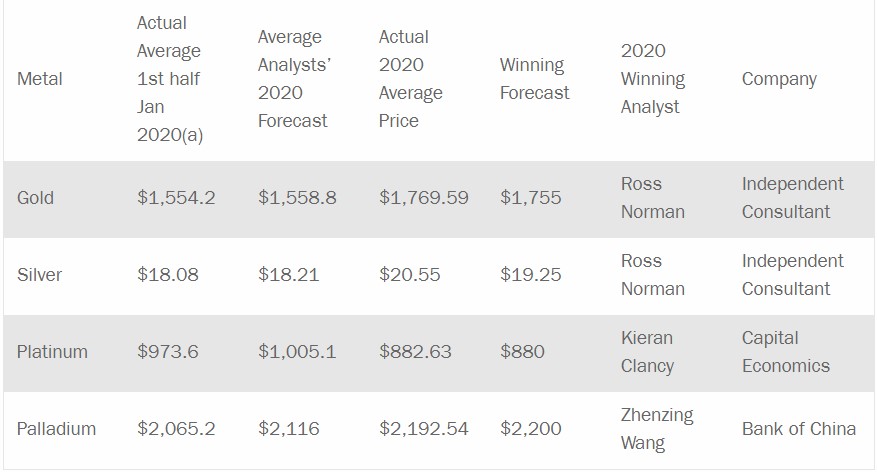
During the past calendar year, gold prices traded at an average of $1,769.59/oz, well exceeding what most analysts were forecasting in mid-January.

According to the London Bullion Market Association’s (LBMA) annual precious metals forecast competition, analysts were forecasting the gold price to be $1,558.8/oz on average, an increase of 12% from the average price in 2019, but still short of the actual average price by over $200/oz.

DURING THE PAST CALENDAR YEAR, GOLD PRICES TRADED AT AN AVERAGE OF $1,769.59/OZ, WELL EXCEEDING WHAT MOST ANALYSTS WERE FORECASTING

Therefore, only the most bullish analysts came close to the actual figures, with Sharps Pixley’s Ross Norman taking home the first place prize with his forecast of $1,755/oz, just $14 shy of the actual price.

Taking second place was Rene Hochreiter (Noah Capital Markets/Sieberana Research Pty Ltd) with his forecast of $1,670/oz, followed in third place by Frederic Panizzutti (MKS PAMP GROUP) with his forecast of $1,636/oz.

All three analysts secured first place finishes in the 2019 survey, which saw participants under-predict gold prices by about $80.

In other precious metals, Ross Norman also snatched first place in the silver category with his forecast of $19.25/oz, close to the actual price of $20.55/oz in 2020. This was Norman’s ninth first-place finish since the survey began.

Kieran Clancy of Capital Economics took first place in platinum with his forecast of $880, which was less than $3 from the actual average.

Lastly, Bank of China’s Zhenzing Wang won the first prize in palladium by virtue of his low/high ranges of $1,610-$2,500, which were closest to the actual low/high range of $1,557-$2,781.

The four winners would each receive a 1 oz gold bar donated by MKS PAMP.

Source: LBMA

Mining.com

Filter-less air filters for industrial applications

0

Air-Cleaning Blowers (ACBs) new filter-less air filters ventilate, pressurize, and clean particles from even exceedingly dusty air without using any filter elements. ACBs help reduce the costs and complications of providing ventilation in industrial, commercial and residential buildings, and are ideal for use in a wide range of industries, including at scrap yards and recycling facilities, and on construction and demolition sites.

This state-of-the-art technology makes it simpler to size and use than systems with ordinary air filters and air purifiers because they have no filter elements to clog. Without clogging, ACBs provide constant and predictable airflow, air pressure, air quality, and energy consumption.

For users, having no filter media provides numerous benefits, among them no filter media to buy or maintain, bring in dry fresh air from outside by removing mist and rain, and no deferred maintenance of filter media to cause surprise consequences.

On the company’s growing success, ACBs CEO Edward Roston said, “What we have developed here at Air Cleaning Blowers is a real innovative technology that can seriously help slow down the spread of pathogens and protect the health of many people.”

According to Air Cleaning Blowers,  while they originally developed ACBs for dusty, corrosive and other harsh industrial and military conditions, they are now used in applications as diverse and challenging as an African diamond mine, electrical controls in Nucor Steel plants, dust control in a Mitsubishi food-manufacturing plant, and US military satellite-tracking trailers in the Middle East. Currently, NIOSH (the National Institute of Occupational Safety and Health) is also using them to develop systems to produce clean air to surround and protect coal miners in underground mines.

Installation and operation of the Air-Cleaning Blower is simple. As ACBs pull the ambient air through their housings, they use the particles’ own momentums to separate them from the clean air in a multi-patented, novel way. They then eject the debris back into the atmosphere from where it came, usually outdoors. They remove large or small quantities of sand, dust and other particles, big and small—even mist and rain.

ACBs are available to fit applications with airflows from 50 to 3500 CFM (in other words, from the size of a computer to that of a good-sized store or factory). ACBs can also serve as prefilters for specialized downstream filters such as HEPA, activated carbon, and the media in swamp coolers, to increase their lives and to decrease their costs of operation, as well as to blow the air to the application.

15 rescued at Peace Mine in Silobela

0

The Ministry’s efforts to rescue 15 miners that were trapped at Peace Mine in Silobela were successful, Ministry of Mines and Mining Development Engineer, Engineer Michael Munodawafa has said.

According to Engineer Munodawafa, the Ministry has assisted in the rescuing of all 15 miners who were trapped under the gold rich mine in the southern region.

The miners according to Munodawafa were rescued safely and no injuries or death recorded.

“All 15 trapped miners have been rescued safely without any fatalities or injuries.” He said.

Accidents in the mining sector have been on the rise which led the president to recently vow to shut down  all unsafe mines.

Many miners died last year due to mine accidents.

Last month a miner died at Jena Mines also in Silobela after the tunnel he was working in collapsed.

This comes as the Zimbabwe Miners Federation together with Environmental Management Agency issued statements warning miners to be cautious when carrying out their operations.

Late last month, the Meteorological Service Department (MSD) warned illegal miners against engaging in panning activities as their shafts could collapse as the ground was unstable due to the rains.

Several gold panners have died since the start of the 2020/21 rain season following collapse of shafts due to heavy rains.

Global natural graphite output to grow 7.6% in 2021 – report

0

After increasing in 2018 and 2019, global natural graphite production has been adversely affected by covid-19 in 2020, with mines being placed either under care and maintenance or temporary suspension due to lockdowns and restrictions.

According to analytics firm GlobalData, while output has declined by 15.4% to 952.6kt in 2020, it is expected that natural graphite production will increase by 7.6% in 2021 to 1,025.5kt.

China, the world’s largest producer, is expected to produce 665kt of natural graphite over the year. This represents a decline of 5% versus 2019 due to covid-19 restrictions, mainly during the first quarter of 2020 when several mines and plants had to temporarily cease production activities.

Mozambique, the second-largest producer in 2019, is expected to see graphite output fall from 100kt to 20kt, placing the country sixth overall out of world production.

“The reduction is due to the Balama graphite project operated by Australia’s Syrah Resources being suspended due to restrictions and lower EV demand, with no production at all since April 2020,” said Vinneth Bajaj, senior mining analyst at GloblaData. “The project is well-positioned to commence operations once the market conditions improve.”

Similarly, production from Brazil is expected to decline by 4.1% due to lockdowns and restrictions, which became prevalent during the second and third quarters of 2020.

Looking ahead, natural graphite production is expected to reach 1,206.6kt by 2024 – a 5.6% CAGR. According to Bajaj, this will be supported by growing demand from the electric vehicle battery segment, where graphite is a key component.

Aside from the potential restart of Balama, projects that are most likely to commence operations during the forecast period include Madagascar’s Molo graphite project (2021), Mozambique’s Montepuez and Tanzania’s Jumbo (2022).

“These projects, together with the development of Syrah Resources’ Vidalia battery anode material project, which will make it the first vertically integrated producer of natural graphite active anode material outside China, will assist in reducing China’s dominance in the sector and providing alternative sources for battery makers across the globe,” Bajaj added.

Mining.com


Glencore in final talks over Mopani sale

0

Glencore said on Friday it was in final-stage negotiations over a potential sale of its majority stake in Mopani Copper Mines to Zambia’s mining investment arm ZCCM-IH.

Zambian state radio ZNBC earlier reported the government had concluded talks with Glencore, citing President Edgar Lungu. According to the broadcaster, a deal was likely to be signed next week.

Zambia’s state mining investment arm has been in talks to buy Glencore’s 73.1% stake in Mopani since August. ZCCM-IH currently has 10% of Mopani, with Glencore holding 73.1% and First Quantum Minerals 16.9%.

GLENCORE HAS INVESTED MORE THAN $1 BILLION IN MOPANI SINCE 2014

Glencore shelved its plans to place the operations under care and maintenance for 90 days, after Zambia threatened to revoke its mining license in April. The government strategy is driven by a need to safeguard jobs at Mopani, rather than any desire to raise its shareholding, said Barnaby Mulenga, permanent secretary in the Ministry of Mines.

On a visit to Mopani Copper Mines on Friday, Lungu said the government would ensure the mine continued to operate and no jobs would be lost.

With Zambians heading to the polls in August, President Lungu has been working to win votes in the country’s northern copper belt. The government is also in a dispute over Vedanta’s Konkola Copper Mines, which is under the control of a liquidator since May 2019. Lusaka accused Vedanta of failing to honour licence conditions, including promised investment.

Glencore has invested more than $1 billion in Mopani since 2014 – extending its life by a further 25 to 30 years.

Mopani produced 119,000 tonnes of copper in 2018.

Reuters/Mining.com

Kuvimba seeks $1 billion for 2021 acquisitions, capex

0

A mining company majority owned by the Zimbabwe government and whose profits will partly be used to compensate former white commercial farmers for land confiscated two decades ago intends to raise $1 billion for acquisitions and capital expenditure.

Kuvimba Mining House Ltd., in which the government holds a 65% stake, will invest a “significant amount” of the cash raised on the Darwendale platinum project, which belongs to its Great Dyke Investments unit, according to Chief Operating Officer David Brown. About $100 million will be set aside for acquisitions and capital expenditure over the next 12 months, he said in emailed responses to questions.

KUVIMBA HAS THREE WORKING GOLD MINES PRODUCING ABOUT 300 KG OF THE METAL EACH MONTH

“We require about $1 billion to build out mines and ensure that catch-up capital is made,” he said, referring to about three years during which little investment was made into the assets. “This will be done over time.

The group, whose portfolio includes gold, nickel and platinum, will raise part of the money internally through its operations, he said. It will also issue debt.

Kuvimba is held by government pension funds and Zimbabwe’s sovereign wealth fund, Finance Minister Mthuli Ncube said in a separate interview. He denied any ownership by Kudakwashe Tagwirei, an adviser to President Emmerson Mnangagwa, who’s under U.S. sanctions for alleged corruption.

Profits from Kuvimba will be used to compensate former white commercial farmers for land confiscated two decades ago and for pension payments that are in arrears, Ncube said.

Kuvimba has three working gold mines producing about 300 kg of the metal each month and owns a nickel mine with monthly output of 550 tonnes.

The company is finalizing negotiations to acquire Metallon Gold Zimbabwe Ltd.’s Mazwoe mine. It is looking at other assets such as lithium, nickel and copper and exploring opportunities in Africa too, Brown said.

Bloomberg News

Global cobalt production capacity expected to be cash positive in 2021 – report

0

Market analyst Roskill forecasts that cobalt’s all-in sustaining cost of production will fall by around 2% y-o-y in 2021, from $23,085/t to $22,600t.

In a recent report, Roskill explains that, as a result of this prediction, it estimates that over 98% of cobalt production capacity will be cash positive on an AISC basis, based on cobalt price circa $39,700/t.

THE DEZIWA OPERATION IN THE DRC IS EXPECTED TO REDUCE THE INDUSTRY’S OVERALL SUSTAINING COSTS

“The DRC accounts for over 70% of mined cobalt supply and any movements in cost structures there, will have a significant impact on overall cobalt cost trends,” the document reads. “Since 2018, miners have renegotiated their intermediate transportation costs from the country to South Africa. The reduction in transportation costs has resulted in falling realization (transportation) costs, which will carry through into 2021.”

Roskill points out that, after heavy investments over the past few years, major operations in the DRC have experienced a decline in sustaining capital.

As an example, it presents the case of the Deziwa operation, a joint venture between state-owned Gécamines and China Nonferrous Metal Mining Company that is targeting production of 80,000 tonnes of copper and 8,000 tonnes of cobalt per annum. The project came online in 2020 with low sustaining costs on a unit cobalt basis, and now it is expected to also reduce the industry’s overall sustaining costs.

Similarly, Roskill’s experts believe that improved operational efficiencies at significant producers such as Katanga Mining’s Kamoto mine and China Molybdenum’s Tenke Fungurume operation in Congo, and Sherritt International and General Nickel Company’s Moa mine in Cuba will lower mining costs.

Despite this positive outlook, the analyst does predict higher plant costs – which would increase processing costs – at specific operations such as Tenke Funkurume, Vale’s Voisey’s Bay mine in Canada and Goro mine in New Caledonia.

“Increases will be due to a variety of mine specific reasons,” the report states.

Mining.com