Home Blog Page 557

Fidelity gold buying prices Friday 23 October 2020

Fidelity Printers and Refiners (FPR) official gold buying prices Friday 23 October 2020

SG 90% AND ABOVE                                      $54.96/g

SG ABOVE 85% BUT BELOW 90%              $53.78/g

SG ABOVE 80% BUT BELOW 85%              $52.56/g

SG ABOVE 75% BUT BELOW 80%              $51.94/g

SAMPLE BELOW 10g BUT ABOVE 5g       $53.17/G

FIRE ASSAY CASH                                          $55.00/g

EXCHANGE RATE                                           81.3499

Cash available. Fidelity Printers and Refiners prices will be changing daily in relation to world market prices.


Contact FPR

No. 1 George Drive, Msasa, Harare, Email: [email protected], Telephone: +263 242-486670, +263 242-486694, +263 242-487131, +263 242-447810-5

Fidelity gold buying prices Thursday 22 October 2020

Fidelity Printers and Refiners (FPR) official gold buying prices Thursday 22 October 2020

SG 90% AND ABOVE $ 55,36/g

SG ABOVE 85% BUT BELOW 90%     $54,43/g

SG ABOVE 80%  BUT BELOW 85%    $ 53,20/g

SG ABOVE 75% BUT BELOW BVELOW 80% $ 52,58/g

SAMPLE BELOW 10g BUT ABOVE 5g $ 53,82/g

FIRE ASSAY CASH   $55,67/g

Exchange rate        81,3499


Cash available. Fidelity Printers and Refiners prices will be changing daily in relation to world market prices.


Contact FPR

No. 1 George Drive, Msasa, Harare, Email: [email protected], Telephone: +263 242-486670, +263 242-486694, +263 242-487131, +263 242-447810-5

NEC Mining Pay rates October to December 2020

0

NEC Mining Pay rates October to December 2020

This notice serves to bring to your attention that the following new minimum rates of pay for grades 1-13 were agreed upon in dual currency (US Dollars & ZW Dollars) by the Associated Mine Workers Union of Zimbabwe and the Chamber of Mines of Zimbabwe, on 20 October 2020 and will be subsequently sent to the Ministry of Labour and Social Services for Registration and Publication.

Download rates HERE

Gold panning couple arrested for murder

0

A gold panning couple was arrested for murder after killing their two-year-old daughter in the Hunyani River on the 30th of August 2020.

BY Precious Chikuruwo

Posting on their Twitter handle the Zimbabwe Republic Police (ZRP) said investigations have been instituted on the couple who took their daughter when they went for gold panning in Hunyani River on the 30th 0f August 2020.

The unspeakable act came to light after on 13 of October 2020 after a domestic dispute where the woman revealed the murder of the child due to a beating by the father.

In the report, the Police stated that the secretly buried two-year-old was exhumed.

“The victim who was secretly buried on the river bank has since been exhumed”.

Norton Miners donates to Task Mine

0

Norton Miners Association through their Chairperson Mr. Privelage Moyo and Mrs. Phyllis Vhitirunyu chairperson of Great Dyke Women in Mining co-operative yesterday donated food and manpower for rescue operations at Task Mine Syndicate in Chegutu to retrieve miners who were trapped underground last month.

Rudairo Dickson Mapuranga

Speaking to the media after the donation, Moyo encouraged other miners to rally behind each other during times of crisis.

Moyo said it was important for the whole industry to come together and support the rescue team at the mine who have worked tirelessly to ensure that the miners are retrieved.

“As miners, we need to look after each other more in times like these. Family members of those trapped matter too, hence the donations to look after them while as a country we hope for the retrieval of the bodies.  The rescue team on the ground are Heroes, they also need support from the entire spectrum of our industry because they are giving it all and hope to the families.” Moyo said.

It is nearly over a month and a half now since five miners “Task Five” were trapped underground at Task Mining Syndicate in Chegutu.

Constantino Dzinoreva (47), Charles Mutume (31), Crynos Nyamukanga (44) Shingai Gwatidzo (20) and a minor Munashe Christian (17) were trapped underground at the mine on the 8th of September 2020. There are fears that the mine could be their grave if the cabinet bans rescue mission at the mine.

Civil Protection Unit (CPU) and body which falls under the Ministry of Mines and Mining Development has not stopped the rescue mission at Task Mining Syndicate as has earlier alluded but awaits cabinet decision on the way forward.

Chegutu District Development Coordinator, Tariro Tomu earlier written a letter to Task Mining Syndicate management suggested that rescue operations were proven to be unsuccessful therefore should be stopped with immediate effect. The Ministry of Mines and CPU however, rubbished Tomu’s letter stating the letter was written in confidence and only Cabinet had the power to stop the operations.

Mining disasters: Is government complicit?

0

YEAR-IN, year-out, lives are lost in Zimbabwe’s mining sector, with corruption and inadequate monitoring of mining activities by the government cited as major causes.

For instance, since 2018 several accidents have been recorded; including the flooding of Battlefields mine in Kadoma, which killed 28 people and the collapse of Eldorado mine in Chinhoyi, killing 11 men in two separate incidents.

Other accidents include the collapse of Shurugwi’s Wonderer mine, trapping over 50 artisanal and illegal gold miners underground and the Nugget gold mine collapse in May, which killed eight people, as well as the blast at Mazowe mine in which eight people died.

Again, in February this year, two miners died after a shaft collapsed at the Globe and Phoenix Mine in Kwekwe District, 200 km southwest of the capital Harare.

In May this year, another worker at Vumbachikwe Mine died after he allegedly fell during a blasting exercise when he was alone underground.

Last year, a man died in Gwanda at Berwick 3 Mine when a shaft he was working in collapsed.

Platinum giant Zimplats also recorded one fatality towards the end of the first quarter of 2019 at one of its mines, Mupfuti Mine.

On September 8, 2020, five artisanal miners got trapped underground at Task Mine in Chegutu and as of September 29, they had not been rescued.

Until when shall the nation continue losing precious lives in the mining sector?

The government and mining companies must do something to end these disasters. To begin with, mining activities across the country should and must be monitored.

There should be training of people who can lead and monitor operations, especially on areas of drilling and blasting. This is where many accidents happen.

Government, through the Ministry of Mines and Mining Development, together with the Environmental Management Agency must track down and shut down all the illegal mines in the country.

The government must quickly formalise artisanal mining to enable the massive number of people who have just joined the sector to mine legally and to follow mine safety standards.

Formalisation in its various forms may enhance the adoption of safety, health and environmental standards to curb such mine disasters, says the Zimbabwe Environmental Law Association (Zela).

Dewatering and lack of proper maintenance in the shaft development are also among the major causes and the situation could be controlled if the government licenced the artisanal miners, opines the Zimbabwe Miners’ Federation.

The other issue which is of real concern is the implementation of disaster and emergency preparedness measures in the mining sector.

For instance, with the Task Mine disaster, the government rescue team has been accused of being slow and poorly coordinated.

The accident, according to Zela, exposes the lack of adequate implementation of disaster and emergency preparedness measures in the mining sector. The organisation said it appears no one in the mining sector, including the government and the mining industry, is learning anything from past mistakes, experiences and disasters.

“While the situation of the five young miners is not quite clear, the hope of rescuing them seems to be fading with each passing day,” Zela said.

Zela said it was deeply concerned and saddened by the lethargic and indolent response by the government in the Chegutu disaster.

“It is indeed worrisome to note that when such incidences happen, even other victims who might have sustained minor injuries end up losing life due to the authorities’ failure to expeditiously attend to disasters. Over the years, the significant contribution of artisanal and small-scale miners to gold production levels in the country and the national economy has been realised,” it said.

The miners were said to have been working in an old underground shaft in a claim that is alleged to historically belong to Pickstone Mine but was being controlled by influential players in the gold sector under a mining cooperative. The mine claim is also adjacent to a Zimbabwe Mining Development Corporation (ZMDC mining block), which has a shaft that might offer access to the mining area.

Zela said the mining activities at this mine site are alleged to have been illegal with mine monitoring appearing to be weak in the country. While the mine collapsed on September 8, 2020, other incidents were reported before the current one.

For example, it is reported that the mine once collapsed, when the mine shaft was 40 meters deep. Pickstone mine allegedly spearheaded the rescue operation and managed to handle the incident.

“Over the past two weeks, Zela said it has received several calls and messages from family members and members of the public calling for assistance from the government, mining companies and other actors to help rescue or at least recover the bodies of the miners.

To date, reports indicate that efforts to search, rescue or recover have been slow, it said.

“Information gathered on the ground indicates that a team of five inspectors from the Ministry of Mines once went to the site but could not do anything as it was dark with the ground not having been stable,” it said.

“Reports also indicate that there has been ground movement at the mine. In addition, no current underground plans are available at the mine site since the shafts were being worked on by artisanal miners.”

“The mine plans are said to have been last updated in 1963, and there are a lot of tunnels underground which make it difficult to search, and to open the unstable ground in the vicinity of collapse. This calls for a proper ground survey to be done to allow rescue missions. Unorganized rescue efforts might lead to other injuries or disasters,” Zela said.

Zela, therefore, encouraged the government to dedicate more resources and intensify the search, rescue or recovery efforts.

It said the government should appeal for help from mining companies, many of whom are now either buying gold from artisanal miners or organising artisanal miners to mine on old mine shafts.

The government must do more to address mining disasters in the mining sector.

All lives are precious!

Miner farmer conflicts must be solved in new Mines Bill

0

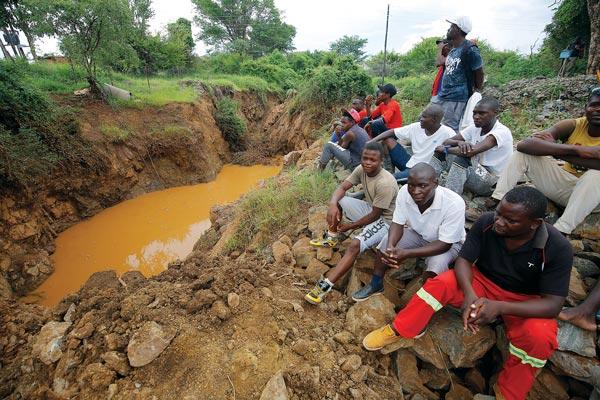
WOMEN farmers have asked Parliament to expedite the crafting of the Mines and Minerals Amendment Bill so that it solves conflicts between miners and farmers where deep pits have been left open due to illegal mining activities at their farms.

The Women in Land Zimbabwe (WLZ) made the plea recently before the Parliamentary Portfolio Committee on Mines which is led by Shurugwi South MP Edmond Mkaratigwa.

Their plea comes at a time when several stakeholders in the mining sector want the current Mines and Minerals Act revamped as it is archaic and does not deal with modern mining issues and technological advances.

WLZ national coordinator Thandiwe Chidavarume said illegal miners were encroaching into farmland owned by their members, digging in search of gold and were leaving deep pits.

“We know that there are laws like the Mines and Minerals Act which stipulates distances between mining and farming and states that if the land is less than 100 hectares there must not be mining activity taking place.  However, we have seen people with 25 hectares of land only being given mining permits,” Chidavarume said.

“Illegal gold panners are digging deep pits and causing environmental degradation and as a result livestock is falling into the pits and dying. When our women farmers report to the police nothing is being done,” she said.

Chidavarume said Shurugwi is one of the most affected areas.  Recently, the Parliamentary Portfolio Committee on Mines visited Shurugwi where they saw the land degradation left by illegal mining activities at farms.  But the committee members insisted that the laws are there but it is the implementation that is weak.

“We are pushing for the passing of the new Mines and Minerals Amendment Bill so that it includes measures that solve miner and farmer conflicts.  The old Mines and Minerals Act gives too many powers to miners and puts minerals at the expense of farming,” she said.

The Minister of Mines Winston Chitando told delegates during a recent workshop for MPs on issues of mineral transparency which was organized by the Transparency International Zimbabwe (TIZ) that the Mines and Minerals Amendment Bill is likely to be brought before Parliament after September 17.

“When we met with MPs during a workshop in Mutare, we indicated that there was the need to have further breakaway sessions by the Attorney General’s office and the Mines Ministry so that they work on the amendments to the Mines and Minerals Act.  They completed the exercise and they have been re-writing the amendments in legal language which is suitable for presentation to Parliament.

“Next week on September 17, the Ministry of Mines will have a workshop to go through all the amendments in the draft Bill and thereafter we will be in a position to present the draft amendments to the Mines Portfolio Committee,” Chitando said.

He said his Ministry was also looking at the issue of the Extractive Industry Transparency Initiative (EITI) with a view to adopting it.  The Minister of Finance Mthuli Ncube in his 2020 budget statement said Zimbabwe will adopt the EITI but to date, the country has not done so.

“As I indicated in Mutare, the starting point for EITI is for us to have a workshop or seminar with ministry officials so that they understand the implications of EITI because currently, they do not know EITI.  When we talk of EITI we need to talk of the budget needed to implement it.

“We know the EITI basic principles but we cannot implement principles.  We need an implementation strategy because right now we do not know how to implement it, how to join EITI, the databases that we need and how to share them, as well as how and what we should disclose under EITI.  We also need to know what is involved in joining EITI and why countries that did not join EITI decided not to join,” Chitando said.

TIZ said they were ready to provide technical assistance to the ministry in terms of capacitating them on EITI.

The TIZ executive director Muchaneta Mundopa said there is a need for mineral accountability and transparency because Zimbabwe is in debt distress and is donor-dependent, yet it is richly endowed with different minerals.

“It is our hope that the Mines and Minerals Amendment Bill will catalyse the growth of the economy.  TIZ also believes that small scale miners play a big role in mining and we hope the legislation will be transformed so that they graduate from being insecure and being a source of conflict to a sector which does meaningful mining,” Mundopa said.

She said Parliament plays a pivotal role in reviewing mining contracts and ensuring good revenue management and urged that the current bottlenecks in the Mines and Minerals Act must be removed through a new minerals Act.

The awaited Mines and Minerals Amendment Bill, therefore, is expected to solve several issues – from miner and farmer conflicts to strengthening accountability and transparency in mining revenue.

Heroes in worksuits

0

The reign of Napoleon Bornaparte, Benito Mussolini, Adolf Hitler or Tshaka was characterized by wars in their quest for dominion. Strong armies were built and manipulated to dissuade, repudiate and conquer enemies of the state. Strategies differed in various ways but the ultimate goals remained the same, power, supremacy, national security and to some extent, prestige. Today, the world still finds itself in consistent conflict for supremacy. However the types of wars have taken a whole different shape, this entails that even the nature of the armies has changed too. The important sector which guarantees the national security of Zimbabwe has its soldiers in work-suits.

By Sharon Tsuro

The purpose of the army is to guarantee economic, environmental, health, resource and energy security. Every nation depends on the national army to strengthen the global system of allies. However, of essence is to note that the power of the army is solely dependent on the financial state of a nation. An army needs to be fed, clothed and trained using resources that come from the coffers of the state. Zimbabwe’s economy mainly depends on agriculture and mining. Mining constitutes sixty per cent of Zimbabwe’s exports. This sector contributes sixteen per cent of the gross development product hence it is pivotal in providing the financial security of the Zimbabwean nation. Mining is synonymous with war on so many levels.

The mine shaft is nothing but a hollow corridor that reeks of death and uncertainty therefore it requires courage and bravery to work. Sometimes lives are lost and in many cases, others are injured but miners do not despair, because seeing their nation prosper is what keeps them going. They consistently remind themselves that the end justifies the means thus with all those life-threatening conditions they work with passion, perseverance and patience. Although considerable efforts are being made to enhance a safe working environment, tragedies like the Kamandama mine disaster where hundreds of men lost their lives testify to the fact that mining is dangerous yet miners still toil and sweat from dusk till dawn extracting the resources which provide economic power and subsequently limiting imperialist motives which come sometimes in the form of foreign investments. Most miners cannot afford the proper education or capital required to do mining and mineral benefaction and this poses high risks on them but they are not limited by that. Most of these heroes in work-suits use the expertise passed down to them through generations from time immemorial. How can so much passion be underrated?

Just like in war, miners leave their families to work in the mines. Sometimes they are blanketed by the moon, stars and skies, for there are no proper structures to offer the comfort they need owing to the lack of capital and adequate resources in the case of the majority of small scale miners. Just as soldiers lose their hearing senses from the noise that comes from the blazing of guns, miners endure that from the noise produced by mining equipment. Though the use of PPE limits the exposure to dust, it does not eliminate it. Miners inhale dust that poses them to various respiratory diseases. These people make a lot of sacrifices and while one may argue that they get compensation for their efforts, it is vital to note that the small-scale miner never gets value for their efforts as they are only paid for the product and not the risk.

Small scale miners contribute significantly to the economy. Sadly they are the most disrespected by society and the national security forces. They are seen as mere villains, criminals and in most cases as suspects. The term “Makorokoza” is a derogatory name used to define them. A few weeks ago, in an article published by Mining Zimbabwe, the police detained small scale miners who were travelling well within their rights with the proper documentation that exempted them from the then Covid-19 lockdown order. It is said the police refused to even look at the documentation that they had with them, kept them at the station until two am. Let us forget about police conduct in this case but rather just focus on the disrespect of the miner it showed, they could have been carrying gold or valuable materials and this compromised their security. A lot of miners are going through hell at the hands of some of the security forces who either retard their progress or disrupt their operations for trivial reasons that in many cases do not hold water.

Zimbabwean security forces need to stand united with these soldiers in work-suits, fighting to secure the financial independence of the Zimbabwean nation for, without them, this nation would not thrive.

Small or big players in the mining sector play a pivotal role in securing the financial independence of the nation. They make unimaginable sacrifices but they are still not given the respect they deserve. On top of the efforts, they make they also have to grovel for respect and support from the society and national security forces. The miners constitute an army and should be treated as one. Miners are heroes conquering wars every day on every front. The heroes in work-suits should be hailed for without them, the national army would have nothing to protect and when the economy is bad the crime rate increases making the work of the police even more complicated.

Just as we have the tomb of the unknown soldier at the heroes’ acre, all the miners that have died in mine accidents, for instance, the hundreds of miners that died at Kamandama should be remembered. Their voices still speak as they died serving the nation. Minot J Savage once said, “The brave die never, though they sleep in the dust, their courage nerves a thousand living men.”

In a nutshell, miners put their lives on the line to promote and protect the financial independence of our nation, they need to be supported and respected for their commitment. The relevant authorities give due respect to the movements and operations of miners but some of the national security forces should not deter legal mining activities for whatever reason. Miners are treated as suspects when they are in fact heroes.

United we stand, divided we fall!

Investigations by Parliament into “machete gangs”

0

Investigations by Parliament into machete gangs that had bedevilled gold mining areas in the country were stalled by the COVID 19 pandemic and lockdowns which restricted the movement of people.

Before COVID 19, the Parliamentary Portfolio Committee on Mines was about to investigate the machete gangs and their effects on Zimbabwe’s mining sector.  In this exclusive question and answer session, Mining Zimbabwe talks to Mines Parliamentary Portfolio Committee chairperson Edmond Mkaratigwa (EM) who is the Shurugwi South MP, to explain the way forward that his committee will take to investigate the machete gangs in mining areas.  Below is the interview.

QUESTION:  The Mines Committee had said they will do an investigation on machete gangs. What happened?

EM:  Indeed you will remember that we initiated the investigation around the Machete-Wielding gangs causing havoc mainly among small-scale miners and throughout the gold dominant areas in the country. I can also refresh your memory in noting that these criminals who were using the same moniker were becoming active even in urban areas in Harare and other parts of the country. The Committee invited the Zimbabwe Republic Police, the Army and other departments of Government to give insight into the menace. With the blessing of the Speaker of the National Assembly Jacob Mudenda, the Committee braved COVID-19 then and initiated the investigation. It further actually warned the security agents of the potential for a resurgence of these criminal elements as some in the Committee had indicated that these people had gone underground including into neighbouring Mozambique, hiding away from the security crackdown after a number of their deaths in encounters with the joint security operation as was witnessed in Bindura and other areas.

QUESTION:  So what exactly stood on the way of the committee to proceed with its investigations on machete gangs in mining areas?

EM:  Without much ado, COVID-19 stood in our way as we were not allowed to meet the public then hence our investigation is hung and we are reinstating it on our agenda in the coming session. On a number of aspects relating to the Committee business, we are behind and we are going to be very busy in the coming session, within the new risk challenges and new ways of operating in an environment of COVID 19 where we must follow government policy.

QUESTION:  The Second Session of the Ninth Parliament has come to an end; does it mean the issue of machete gangs will no longer be investigated?

EM:  We are going to continue with that issue because the Committee has full control of its agenda as the representative of the Whole House. The Committee is very much concerned with that issue and as you remember, there were many theories peddled around these bandits and getting to the bottom of the matter will be good for all progressive, pro-development, peace, and unity loving Zimbabweans. As Parliament and as the Committee, we may need to be more innovative, think more broadly, transformative and adapt to new methods of doing work.  I mean that, if tenable, the Committee through Parliament which is its delegator can include subcontracting trusted researchers with support from our partners, who will conduct an in-depth study within terms of references set by the Committee and within tightly set timelines. The researchers can conduct a preliminary study that will put the Committee on a smart footing for the matter to be tackled within its financial, time and other internal and external environmental constraints such as COVID-19, resources, bureaucracy and parliamentary rules and procedures. The contracted researchers can therefore present to the Committee in camera from time to time as the Committee will also act in line with forthcoming evidence and objective evidence.  That way, I am sure the Committee will easily get to the bottom of this matter and deal with it more comprehensively.

QUESTION:  Are there any proposals made by your Committee to ensure that the Mines and Minerals Amendment Bill deals with the machete gangs?  If so, what changes do you suggest will work?

EM:  Whereas the machete gangs’ negative effects have been predominantly felt in the Mining Industry and particularly by the small scale miners, the insurgence is merely a threat to the national security of Zimbabwe and the region. In that regard, the matter cannot be specifically addressed through the parent Mines and Minerals Amendment Bill but through strengthening its supporting legislation such as the Gold Trade Act in particular. The Committee is therefore almost there with regards to the Mines and Minerals Amendment Bill that is targeting enhancement of mining formalisation, expedient boundary disputes resolution and mineral footprints tracing which are key in fighting the Machete gangs criminal behaviours. Broadly though, these are criminals and insurrections hence they should be dealt with heavily as such by the relevant arms of the state to ensure concerted peace and security and avoid opportunist destabilisers in the country. Primary legislation should not target an event that is there today but should be futurist to ensure unnecessary amendments time and again hence such issues can be dealt with through more temporary legislation such as some Statutory Instruments, ministerial directives, government policy positions and programmes targeted at discouraging the behaviour of such malcontents that are bent on inhibiting achievement of the already possible national mining Vision 2023 and Vision 2030.

QUESTION:  How have these Machete gangs affected the country’s mining vision?

EM:  These criminals have instilled fear among miners and, in particular women in mining – and realistically though that should be qualified with research data.  It has led to overall formal mineral output delivery reduction. Remember the criminals would not use formal channels to a greater extent when selling their gold. They leak it through to foreign lands. In addition to the fear created among vulnerable groups in mining, the criminals disturb the mining process as the mining areas become more war zones hence production time is lost through prioritisation of personal security on the part of the miners. Despite these facts, it has also been sending a wrong signal to would-be investors hence the need for the country to be seen to be able to protect private property of miners in the manner of the gold or any other minerals which calls for a declaration of war against them. However with COVID-19, the effects were reduced as security was also deployed throughout the country inhibiting their chances for resurgence and with concerted efforts, I believe the overall fulfilment of the vision will be achieved although with some little negative effects as a result of these criminal groups.

Sinotruk Zimbabwe

0

China National Heavy Duty Truck Group Corp., Ltd. (SINOTRUK) is China’s first heavy-duty truck manufacturer, initially founded in 1956 and the cradle of China’s heavy-duty truck industry.

It became China’s first company to comprehensively introduce foreign heavy-duty truck manufacturing technology of complete vehicle in 1983. In 2009, SINOTRUK formed its strategic partnership with German MAN Group, by which MAN held a 25%+1 stake in SINOTRUK (Hong Kong) Limited.

SINOTRUK has since introduced several models of engines, axles of medium-duty and heavy-duty trucks, and relevant technologies of complete vehicles from MAN, laying a solid foundation for corporate long-term growth. Today, SINOTRUK has developed into China’s largest heavy-duty truck manufacturing base and made significant contributions to the development of China’s heavy-duty truck industry and national economic growth. It has the most patents in China’s automotive industry. SINOTRUK mainly designs, develops, produces and sells a wide range of heavy-duty trucks, buses, special trucks, engines and their sets, parts and special chassis.

Sinotruk Vehicles are distributed by Sinotruk Zimbabwe, a locally registered company which is part of the Tsapo Group of companies. In this group, there is Sinotruk Zimbabwe, Lovol Agriculture, Lovol Construction, Supreme Panel beaters, Massbreed Investments t/a FAW Zimbabwe, Grand Auto Panelbeaters and C Track Zimbabwe which offers vehicle tracking, satellite navigation, fleet management, and insurance telematics among others. Currently, we hold a 56% market share of truck sales in Africa and over 50% of market share in Zimbabwe. We are the sole distributor of the Sinotruk E7 trucks in Africa. We also offer retailing of Sinotruk parts, workshop services and administering of manufacturer warranties on all Sinotruk trucks in Zimbabwe.

Our Tipper trucks have been homologated for the punishing off-road African construction and mining terrain. You will see most of the big mining houses in tough environments using these tipper trucks. They have the biggest payload capacities in their segment. We are running a promotion on the volume-centric 8×4 tipper trucks. Check in-store for details!!!!!