Home Blog Page 641

Niger to pay $14.5m for 10% of GoviEx’s Madaouela uranium project

0

Niger’s Ministry of Mines issued a letter supporting the negotiations between Canada’s GoviEx Uranium (TSXV: GXU) and the country’s federal government regarding the Madaouela uranium project.

Although final documents on their commercial understandings are yet to be signed, the Vancouver-based miner and country authorities have agreed that the Government of Niger will acquire a 10% working interest in the project, in addition to its 10% free carried interest provided under the 2006 mining code.

To purchase the additional 10%, the Mahamadou Issoufou administration has elected to convert approximately $14.5 million in requested payments comprised of the final $7.8 million acquisition payment and settlement of previously challenged area taxes ($6.6 million) between GoviEx and the government related to the Madaouela project.

“This is the culmination of more than 12 years of relentless work and millions of man-hours by GoviEx management and our Nigerien community,” —  Govind Friedland, GoviEx’s Executive ChairmanAccording to GoviEx, following the finalization of this transaction, the company will be effectively debt-free and it will enjoy a tax abatement period up through to successful project financing for mine construction and project development.

The proposed deals also consider that the Canadian firm’s existing mining permit, the Madaouela 1 Mining Permit, will be expanded to include previous mineral resources discovered in the nearby Agaliouk permit. This expansion will add a further 5.96 million pounds (Mlb) U3O8 in the measured and indicated categories.

Madaouela’s resource has been estimated at 60.54 Mlb U3O8 in total probable mineral reserves and a predicted 21-year mine life.

The 250-square-kilometre land package sits on the southeast side of the mining town of Arlit and was first discovered by the French Commissariat à l’Energie Atomique (CEA) in the 1960s. It was later explored by a series of different companies until GoviEx Niger Holdings acquired it in 2007_Mining.com

Firestone finds another massive diamond at Lesotho mine

0

Africa-focused Firestone Diamonds (LON:FDI) has dug up a 72-carat yellow, whole makeable diamond at its Liqhobong Mine in Lesotho, the second one over 70-carat it has found this year.

The stone, recovered over the weekend together with a 22 carat makeable white stone, followed by an 11 carat fancy light-pink diamond found at the asset.

“Makeable” diamonds are those whose shape allows to cut one large diamond from it. In contrast, “sawable” stones can be cut in half in order to create two smaller diamonds.

The stone, recovered over the weekend together with a 22 carat makeable white one, followed by an 11 carat fancy light-pink diamond found at the asset.

The two diamonds, found within the northern lower grade part of the pit, will go on sale at Firestone’s next tender, which is scheduled to take place during May 2019.

Shares in the company were 7.3% higher at 2.2p following the news.

Last month, a white 70-carat diamond from also from the Liqhobong mine was auctioned for an undisclosed price, following a 46-carat precious rock, also from the same mine, which was sold for $1 million in December.

Diamond prices have been under pressure and miners are struggling across the board, especially those producing cheaper and smaller stones where there is too much supply. In December, some of Rio Tinto’s (LON, ASX: RIO) customers refused to buy cheaper diamonds, while De Beers has been forced to cut prices and offer concessions to buyers.

Firestone spent $185 million building Liqhobong, which started production in late 2016, and boasts over 11 million carats in reserve. The total open pit resource contains over 17 million carats to a depth of 393 metres._Mining.com

Gold rush along Sakubva River

0

HUNDREDS of illegal panners have besieged the banks of the raw sewerage-polluted Sakubva River digging for alluvial gold deposits, in a development that has resulted in increased human activity in the adjacent Gimboki high-density suburb.

Gold buyers are slowly trickling in to set camp near the illegal mining sites while vendors with various wares including food stuffs have since thronged the river banks.

When The Manica Post visited the area yesterday morning, illegal panners were busy digging up for gold. Several shafts as deep as 15 metres have since been dug up along the river banks, posing serious environmental hazard.

Some of the illegal panners were panning right inside the channel of Sakubva River, apparently brushing aside lumps of raw sewerage flowing down the river.

“We came here five days ago and so far we have managed to get about five grammes.

“This is hard labour and you can see for yourself that these shafts are deep. Can you imagine we dug up those metres in such a short period?” said one of the illegal panners who only identified himself as Lawrence.

At night, the illegal panners take turns to guard the mining tunnels to avoid “pirates” who want to steal the gold ore under the cover of darkness.

The panners said they were being paid an average of $120 bond notes per gramme, a figure which they said was too low.

“There are few buyers here who are paying us peanuts because we have nowhere to go. We need money for food and other implements so at the end of the day we are forced to accept what they are offering,” said Lawrence.

Fears have gripped residents of the nearby Gimboki high-density suburb who are dreading the outbreak of diseases as the raw sewerage-drenched illegal panners are constantly getting in contact with the location.

Manicaland police spokesman, Inspector Tavhiringwa Kakohwa, said the police were yet to visit the illegal panning site.

“We haven’t received reports of the illegal panning activities in that area but we are going to send our officers and see what is taking place,” he said._Manica Post

Bubi miner plans $300k investment

0

BUBI-BASED gold mining operation, Waterwitch, plans to invest $300 000 in plant and equipment upgrade to increase employment figures as well as boost output to 100 tonnes of ore per day.

The gold mine is situated in Inyathi, Bubi district, and employs 40 people directly and several others through a contract arrangement, producing between 40 and 50 tonnes of ore a day.

Mine director, Mr Ishmael Kaguru, expressed optimism that by year end they would have reached the targeted output as well as boosting employment figures to close to 100.

“Using own resources, we are investing $300 000 in plant and equipment upgrade and by the end of the year this will see our production figures increasing to 100 tonnes of ore a day from a range of between 40 and 50 tonnes a day,” he said.

“We are importing modern equipment such as ballmill, compressors, hoist and the shaving wheel from South Africa.”

Mr Kaguru said they were also replacing the existing stamp mill with a ball mill that would have the capacity to crush about 100 tonnes of ore a day.

“At the same time we will employ at least 50 more people up from the current 40 that we have. As a result of that our production will be higher in terms of tonnage,” he said.

“The existing stamp mill that we have is very small and thus we have ordered a ball mill, which will be crushing about 100 tonnes of ore a day.”

Mr Kaguru said his company has tried to secure a $400 000 loan from Fidelity Printers and Refiners to no avail due to inadequate collateral requirements.

“We are still appealing to the authorities that when it comes to the issue of collateral, they must look at the quantity of resources underground. If the resources are there, that is enough security for somebody to be given the loan,” said Mr Kaguru.

He said they were now using funds generated from the mine to buy the required equipment from neighbouring South Africa.

The operation has also applied to the Ministry of Finance and Economic Development for duty rebates to facilitate the importation of mining equipment and machinery, which was being brought in batches.

“By the end of the year, we should have turned from a medium-scale operation into a large–scale entity,” said Mr Kaguru.

Finance Minister Professor Mthuli Ncube has pledged Government’s commitment to establish a $100 million gold sector venture fund as it seeks to boost output and build reserves of the yellow metal.

The fund is designed to assist miners to re-tool so they ramp up production.

In 2018, the country produced 33,3 tonnes of gold up from 24,8 tonnes the previous year with the bulk of the mineral being produced by small-scale miners. At present, the small-scale miners are tapping from the Gold Development Initiative Fund set up by the Reserve Bank of Zimbabwe with resources under the fund being increased to $150 million last year from $74 million in 2017._The Chronicle

Mliswa cleared in Hwange mining contract bribery case

0

The parliamentary hearing into bribery allegations against four members of the National Assembly began yesterday with the complainant Mr James Ross Goddard exonerating Messrs Temba Mliswa and Anele Ndebele in his testimony but incriminating two other legislators from the committee.

The duo is being investigated together with Cde Leonard Chikomba and Mr Prince Sibanda by a Parliament’s Privileges Committee chaired by Senator Chief Fortune Charumbira on allegations of demanding a $400 000 bribe from Mr Goddard to facilitate his company, JRG Pvt Ltd secure a coal mining contract at Hwange.

They are alleged to have used their membership of the Mines and Energy Portfolio Committee to demand the bribe.

The four are alleged to have demanded the bribe at a meeting held at JRG offices on November 15 last year, a day before the Mines and Energy committee was scheduled to visit to investigate operations at Hwange Colliery.

Mr Goddard told the committee that he had been introduced to the four by businessman Mr Shepherd Tundiya who indicated that as members of the Mines and Energy Committee they could assist his company get the mining contract.

Speaking during cross-examination by Mr Mliswa’s lawyer Advocate Tawanda Zhuwarara, Mr Goddard said the Norton legislator had not made any financial requests to him during the meeting and had left soon after the meeting.

He added that Mr Ndebele had also gone and sat in his car after the meeting while Mr Sibanda and Cde Chikomba remained behind where the request for the “facilitation fee” was made through Mr Tundiya.

He said Cde Chikomba and Mr Sibanda had indicated that they could not travel to Hwange without “something” to facilitate the deal.

“It (the issue of the facilitation fee) was raised by Honourable Chikomba and Honourable Sibanda that we can’t go to Hwange without something and it was Honourable Chikomba who was the most aggressive,” Mr Goddard said.

He said Cde Chikomba later provided him with his personal banking details where he could deposit half the amount while the other $200 000 would be paid when the contract had been secured.

Cde Chikomba, who is being represented by Mr Simon Musapatika is however, denying the charges saying in his testimony Mr Goddard had not provided any evidence that his client demanded the bribe.

He said the only issues his client discussed with Mr Tundiya when they were outside when the meeting had ended concerned money he was owed by the latter. 

Mr Sibanda, who is being represented by Mr Freddy Masarirevhu, is also denying the charges and said Mr Goddard had failed to  provide any evidence of his client demanding the bribe but was relying on perceptions.   

Mr Masarirevhu also queried why Mr Goddard had not set up a trap to prove that the request for the bribe was genuine.

The hearing continues today._The Chronicle

ZPC wins licence for Byo Power Company

0

THE Zimbabwe Energy Regulatory Authority has issued a licence to the Bulawayo Power Company for the Bulawayo Power Station.

In December last year, ZERA announced in a public notice that it had received an application from ZPC for amendment of the electricity generation licence to be extended by 20 years from 2024.

The licence was also to enable it to produce 120 megawatts of power with 90 megawatts to be fed into the national grid.

Residents, through the Bulawayo Progressive Residents Association and the Bulawayo City Council, had objected to the application saying they were the owners of the power station.

However, after hearing from the three parties, ZERA has announced that it has issued the licence to ZPC.

In an interview yesterday, ZERA acting chief executive officer Mr Edington Mazambani confirmed that they had issued the licence to ZPC and the development has been communicated to BCC and residents.

“We did write to the Bulawayo City Council on the issue and we did write to the residents indicating that the licence would be issued as we had heard the issues to do with their contestation. We couldn’t refuse issuing ZPC a licence based on that.

“They applied because their licence had expired; they had applied to extend the licence and to extend the capacity. We have issued them the licence,” said Mr Mazambani.

In a letter dated 27 March written to the residents by Mr Mazambani, ZPC indicated that it had consulted residents and other stakeholders prior to their application for licence renewal and extension.

“Please be advised that following the submission of the objection from the Association, ZERA engaged Zimbabwe Power Company to get clarification on the matter. The Zimbabwe Power Company provided evidence that the public was invited to a meeting to make representations as part of the environmental assessment (ESIA) on the expansion project which is deemed to have been adequate for consultation purposes,” read part of the letter.

Zimbabwe Power Company

It continued: “Zera is therefore proceeding with the review of the amendment of the generation licence GC0023 applied for by ZPC”.

However, the residents have since written to ZERA demanding a report and minutes of the consultation said to have been conducted by ZPC.

“We have read the letter but we are however kindly requesting the evidence provided to you by the Zimbabwe Power Company on the public consultations they supposedly held. 

“We have been previously invited to several meetings being conducted by ZPC and we are surprised that such a meeting was held without the knowledge and presence of BPRA (a concerned stakeholder) as well as the Bulawayo City Council (BCC). We are therefore kindly requesting the registers, invitations notices as well as the reports and or minutes of the meetings,” read the letter.

BRRA coordinator Mr Emmanuel Ndlovu said they were prepared to take legal action against the issuance of the licence to ZPC.

“BPRA has engaged lawyers who are prepared to go to court should ZERA go ahead with issuing the licence. We have been in touch with BCC and cannot at this instance disclose what they are doing or planning to do. What we have agreed is that we will put our heads together and work tirelessly to        ensure that the licence is not granted,” said Mr Ndlovu.

India in 2017 extended a $23 million credit loan facility to the ZPC to boost power generation at the Bulawayo Power Station. 

An official from ZPC explained that it was standard procedure for the company to apply for a new licence when upgrading its power generation.

“You cannot upgrade any power station without the issuance of a new licence hence for the Bulawayo Power Station they had to apply for a new licence which would state the amount of megawatts they are producing. In simpler terms, it is illegal to upgrade any power station without a new licence from Zera,” said the official who declined to be named.

ZPC operates four coal-fired power stations, Hwange, Bulawayo, Munyati and Harare thermal stations, and the hydro powered Kariba South Power Station._The Chronicle

Vast resources to sell stake in Pickstone Peerless?

0

MORNING STAR reports Vast Resources PLC is to ask shareholders for approval to change its accounting dates and also sell off its Zimbabwean gold assets, it said Monday.

Vast resources is looking to sell its 50% stake in Ronquil Enterprises Pvt Ltd, through which it holds a 25% stake in the Pickstone Peerless gold mine and the Eureka gold mine.

Vast has signed a sale contract, is said, with an unnamed party and for an unspecified sum.

The company is also looking to push its year end to April 30 rather than March 31, for both its current year and in future.

“I am delighted with the results this transaction will achieve for the company as it will allow management to focus its efforts on the two core focus assets in the company, namely the Heritage Concession in Zimbabwe and Baita Plai in Romania,” said Chief Executive Andrew Prelea.

“The Heritage Concession will require significant investment, not only financial but in human resource to enable near term positive cash flow for the business,” Prelea continued.

“The divesting of the gold assets in Zimbabwe allows us to focus all of our Zimbabwe finance and management on this key component of the company’s growth.”

Shares were 0.1% lower on Monday afternoon at 0.16 pence each.

By George Collard; [email protected]

Gold prices gain, Platinum hovers below 10-month peak

0

Gold prices rose on Tuesday, trading close to a more than one-week high touched in the previous session, as the dollar eased after weak U.S. economic data, platinum hovers below 10-month peak hit on Monday.

Spot gold rose 0.2 percent to $1,299.59 per ounce as of 0354 GMT, after touching its highest since March 28 at $1,303.61 in the previous session.

U.S. gold futures were up 0.1 percent at $1,303.30 an ounce.

“The U.S. dollar is subdued and data shows that there is continued buying from central banks,” ANZ analyst Daniel Hynes said.

China, the world’s biggest gold consumer, raised its gold reserves by 0.6 percent to 60.62 million ounces by end-March, central bank data showed.

Turkey also raised its gold holdings in March, according to data from the International Monetary Fund.

The dollar sagged after weak U.S. economic data, making gold cheaper for investors holding other currencies. It posted its biggest daily percentage decline since March 20 in the previous session.

Orders for U.S.-made goods fell modestly in February and the manufacturing sector is slowing amid rising inventories, data showed on Monday.

U.S. nonfarm payrolls data on Friday also signalled a slowdown in wage growth and job cuts in the manufacturing sector even as employment accelerated.

“Gold’s gains in the last 24 hours were a follow-up on the jobs report from the U.S. on Friday,” said Ilya Spivak, a senior currency strategist at DailyFX.

“Decline in wage inflation takes the pressure off the Fed and lets it remain dovish and delay rate hikes and maybe switch gears, and that’s supportive for gold.”

Lower interest rates reduce the opportunity cost of holding the non-yielding bullion and also weigh on the dollar, increasing gold’s appeal.

Market participants are now awaiting minutes of the Federal Open Market Committee’s March meeting, due on Wednesday, while the European Central Bank meeting on the same day is also on investors’ radar.

“There is an expectation for a dovish-biased statement based on what came out in March. The larger issue is how concerned are our policy makers over the state of global economy,” Spivak said.

The U.S. Federal Reserve last month abandoned projections for any interest rate hikes this year amid signs of an economic slowdown.

Meanwhile, holdings in the world’s largest gold-backed exchange-traded fund, SPDR Gold Trust, fell for a sixth straight session to 760.49 tonnes on Monday.

Among other precious metals, spot platinum was down 0.1 percent at $904 per ounce, after touching its highest since end-May 2018 in the previous session.

Palladium slipped 0.5 percent to $1,376.07 an ounce, while silver gained 0.1 percent to $15.26 per ounce._Reuters

Peace Mine war: Implications on widows, orphans

0

A boom gate lowered at the entrance of a community owned mine in Silobela and a stern faced security guard armed with a knobkerrie, his dog strained against the leash in his hand, paints an intimidating picture. 

However, this fear-inspiring security arrangment could not do anything when bouncers from Bulawayo allegedly hired by a local traditional leader, Chief Sigodo, invaded the mine fighting for their paymaster to control the gold-rich Peace Mine.

The attempt by the chief and his gang to forcefully seize the gold fields triggered a fierce battle with artisanal miners which started from the mine and spilled to the nearby business centre. Elderly women, innocent bystanders and customers were assaulted during the mayhem.

“I was busy gathering stones to the crusher, suddenly I saw machetes flying all over the place as a group of bouncers hired by Chief Sigodo viciously and recklessly attacked everyone forcing a blacklash from the youth who are also part of the (Silobela Share Ownership Trust) mining syndicate,” said Gogo Monica Ncube  (66) recounting the blood curdling incident that raised alarm over the spiralling cases of violence rocking Peace Mine Community Share Ownership Trust.

“We cannot operate freely anymore. The problem is that these bouncers are runners for some local leaders and senior politicians. They seem very powerful such that at times police officers are not able to contain them.”

Gogo Ncube is a widow whose four children died in rival gold gang wars in her home village, Shurugwi, leaving her with two sons. As a result, she was left with orphaned grandchildren to take care of. 

The gloomy situation forced her to relocate to Silobela and work as a small scale miner with other community members who earn a living through panning. 

The community owned mine is mainly dominated by widows, single mothers, orphans and youth who view the mine as the only ticket to improve their impoverished lives.
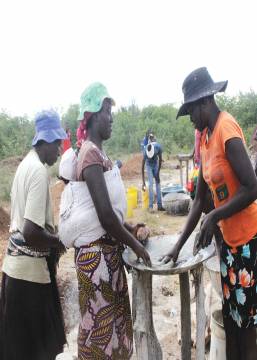
Women at Peace Mine pan crushed ore to extract gold

The trust is led by the widow of the late Arthur Nkiwane who founded it in 2015 and passed on in 2017.

Since its inception the mine has been at the centre of violent control dispute. The stand-off has been exacerbated by rivalry between the community artisanal miners and Chief Sigodo’s gang who seek to challenge the dominance of the community artisanal miners.

The vicious wars escalated after the death of Nkiwane and the community believes that the gangs deliberately attack them because they are now led by the vulnerable widow. 

“The Chief is supposed to have the community at heart, but he’s taking advantage of us women knowing fully well that we can’t go pound for pound with his men. Our hope now lies in the hands of the Government,” said Gogo MaNcube.

Operations manager of the trust Mr Malanga Nkiwane said the increasing level of violence and intimidation by the chief and his bouncers negatively affects mostly the widows and orphans who cannot defend themselves.

“Artisanal mining is dangerous work to begin with and today it is getting worse, with the emergence of the armed chief’s gang fighting local artisanal miners and forcing them to work in slave-like conditions underground,” said Mr Nkiwane.

War veterans who are members of the trust have vowed to fight tooth and nail to jealously safeguard the mine from the clutches of the chief.

“We will take the war to him and hang him by his ‘jewels’ if that’s the only language he understands. We are not intimidated. We will defend our women and children that is why we had to go to the liberation war in the first place,” said Nkathazo Mdlongwa.

Chief Sigodo said he had no intention of creating rivalry with miners highlighting that he had taken the legal route to ensure that the community fully benefits from the mine.

“I am not fighting with people as some are alleging.  In fact I haven’t set foot at the mine in a very long time because I want to do things in an orderly manner,” said Chief Sigodo.

The mine is home to more than a thousand male and female artisanal miners who directly benefit from the proceeds. Miners work in groups depending on gender and age.

The youth who are still strong are the ones who do the panning while the elderly work on the final stages of gold processing.

Some women have been pushed out of Peace Mine by the bloody clashes and now eke a living at the periphery of the mining fields as vendors of foodstuffs and an assortment of goods needed by miners for their day to day activities.

The female miners said they use the proceeds of their sweat to take care of their families and send their children to school.

“Losing our mine to the Chief is our worst nightmare. Most of us women artisanal miners are at subsistence level earning just enough for our necessities. Children will be elbowed out to the streets and this will lead to a spate of prostitution,” said Monica Chinembiri (70).

Female miners emphasised that it was safe to work as a community because they are protected and they use the community machinery. They also do not have capital and requisite skills to mine on their own.

The biggest fear is that once they are on their own they will employ primitive methods of gold extraction such as amalgamation with mercury which has been scientifically proven to cause a myriad of diseases. Their dangerous processes will often be conducted at home without protective clothing, like cracking rock walls with handmade chisels without gloves to protect their palms and use their bare hands in scooping the mud.
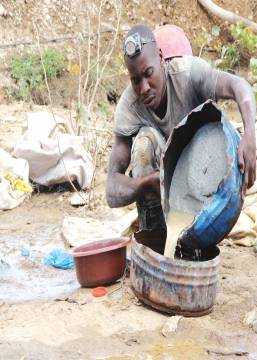
Peace Mine artisanal miner busy at work 

“Some in the sector opt to provide sexual services to male miners and they will be exposed to sexually transmitted diseases and other forms of abuse from often drunk illegal panners. It is often better than standing toe to toe with a gangster bent on killing you,” remarked one of the community miners Ms Suku Ndlovu.

“The future is uncertain. We implore the Government to rescue us by giving full control of the mine to the community and ban the Chief from interfering with production.” 

According to a teacher at one of the schools near the mine enrolment had increased significantly because parents and guardians are able to pay fees and prostitution is minimal since youth are always occupied at the mine.

“If they are to lose the mine, miners will be jobless and fail to pay fees. That will mean an abrupt end to pupils’ dreams,” said the teacher.

Apart from rampant abuse by their male colleagues, women in artisanal mining have to contend with a lot of challenges among them lack of proper equipment, pollution, low returns and poor working conditions.

Speaking at a recent mining for sustainable development workshop in Bulawayo, female participants claimed that the mining sector was hostile to them as they were being bullied by their male counterparts.

Bubi Small Scale Miners Association coordinator, Mrs Nobuhle Ncube, said women were vulnerable in the mining sector hence they wanted protection and special claims designed for them.

“We are viewed as inferior, some women artisanal miners have suffered violence and sexual harassment at the mines as they are being taken advantage of because most mining activities occur in the bushes, which are far away from homes and the police bases,” said Ncube.

Bulawayo MP, Jasmine Toffa, who also attended the meeting, said as Parliament they were going to look into the female artisanal issues. 

“We have tools to help protect the mining sector and it is our responsibility to address people’s grievances,” she said.

The gang wars and bloodletting in small scale mines affect gold production and growth in the sector. This has dampened the Government’s effort to empower women and youth artisanal miners.

Speaking at a workshop for small scale miners in Gwanda, the Reserve Bank of Zimbabwe deputy director at the Bulawayo regional office Mr Kasanda Sibanda said the bank has availed $25 million to assist women and youth small scale miners to boost production but expressed concern in low turnout for takers.

 “The bank has extended financial inclusion facilities for women and the youth. A total of $15 million was allocated for women and $10 million was allocated for youths but very little has been disbursed._The Chronicle


Oil price rises highest since November

0

Oil prices rose to their highest level since November 2018 yesterday, driven by OPEC supply cuts, US sanctions against Iran and Venezuela and fighting in Libya as well as strong US jobs data.

International benchmark Brent futures were at $70,66 per barrel at 1000 GMT yesterday, up 32 cents, or 0,5 percent from their last close. US West Texas Intermediate (WTI) crude futures were up 30 cents, or 0,5 percent, at $63,38 per barrel.

Brent and WTI both hit their highest since November at $70,83 and $63,53 a barrel, respectively, early yesterday. To prop up prices, the Organisation of the Petroleum Exporting Countries (OPEC) and non-affiliated allies like Russia, known as OPEC+, pledged to withhold around 1,2 million barrels per day (bpd) of supply from the start of this year.

“OPEC’s ongoing supply cuts and US sanctions on Iran and Venezuela have been the major driver of prices throughout this year,” said Hussein Sayed, chief market strategist at futures brokerage FXTM.

“However, the latest boost was received from an escalation of fighting in Libya which is threatening further supply disruption,” he added.

Strong US jobs data on Friday was also still supporting markets yesterday. Despite the host of price drivers, there are still factors that could bring oil prices down later this year. Russia is a reluctant participant in its agreement with OPEC to withhold output and it may increase production if the deal is not extended before it expires on July 1, Energy Minister Alexander Novak said on Friday.

Another key architect of the OPEC-Russia deal, Kirill Dmitriev, the head of Russia’s direct investment fund, said yesterday OPEC and allies should raise output from June. Dmitriev previously said it was too early to pull back from cuts. Russian oil output reached a national record high of 11,16 million bpd last year.

In the United States, crude production reached a global record of 12,2 million bpd in late March.

US crude exports have also risen, breaking through 3 million bpd for the first time earlier this year.  Reuters.


error: Content is protected !!