Home Blog Page 657

Caledonia cries foul over export incentive

0

AIM-listed mining group, Caledonia Mining Corporation, says its earnings per share will decline by approximately US$5,4 million after the Reserve Bank of Zimbabwe (RBZ) withdrew the export credit incentive scheme for gold producers.

The export incentive was introduced by the apex bank in 2016 under the bond note facility to encourage businesses to increase exports.

However, in his recent 2019 Monetary Policy Statement, RBZ Governor Dr John Mangudya announced the removal of the export incentive programme.

He said going forward the monetary authority was permitting inter-bank trading of currency held in the local banking system known as RTGS dollars and currency held in foreign currency accounts (FCA), which is capable of being used for payments outside Zimbabwe.

Responding to the issue, Caledonia said the policy shift by the central bank would negatively affect the company’s earnings per share, which if calculated on international financial reporting standards (IFRS), would decrease by $0,40 to $0,46.

“Caledonia Mining Corporation Plc (“Caledonia” or the “Company”) announces that following the announcement of a revised monetary policy by the Reserve Bank of Zimbabwe, the export credit incentive programme for Zimbabwean gold producers will be withdrawn, it is estimated this will reduce Caledonia’s earnings per share (calculated on an IFRS basis) for 2019 and thereafter by approximately US$5,4 million or 40 to 46 United States cents per share,” Caledonia said.

The RBZ had operated an export incentive programme in terms of which Zimbabwean gold producers received a premium to the international gold price.

The premium was initially at a level of 2,5 percent of gold revenues, which was subsequently increased to 10 percent and more.

“At this stage it is unclear whether this policy will address increasing inflationary pressure in Zimbabwe by creating a transparent and efficient market exchange rate between RTGS dollars and dollars held in FCAs,” Caledonia said.

“The effect on Caledonia’s earnings per share for 2019 is calculated assuming a gold price of $1 300 for the remainder of the year, that Blanket (mine) achieves the production guidance for 2019 as announced on January 14, 2019 of between 53 000 and 56 000 ounces of gold and that there are no changes in Blanket’s operating costs.”

The miner said the export incentive revenues were received into the company’s RTGS bank account and were not eligible for remittance outside Zimbabwe with a specific allocation of foreign exchange by the RBZ.

Blanket Mine is Caledonia’s local operation located in Gwanda.

Last year Blanket Mine produced 54 512 ounces of gold in line with the miner’s projected annual target, which ranged between 54 000 and 56 000 ounces._The Chronicle

Women miners seek protection and support

0

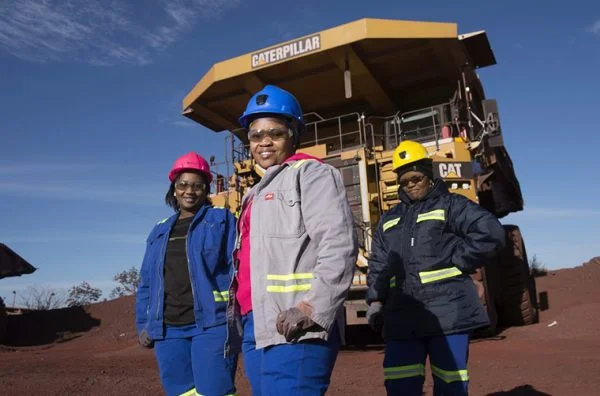
WOMEN in the mining sector have appealed for increased Government support and protection as they are facing numerous challenges in the ‘male-dominated’ industry.

Speaking at a recent mining for sustainable development workshop in Bulawayo, female participants claimed that the mining sector was hostile to them as they were being bullied by their male counterparts.

Bubi Small Scale Miners Association coordinator, Mrs Nobuhle Ncube, said women were vulnerable in the mining sector hence they wanted protection and special claims designed for them.

“We are happy to be given this opportunity to present our grievances as women in the mining industry because we are viewed as inferior. We get claims but do not have enough resources to work on those mines,” she said.

Mrs Ncube explained that lack of proper mining equipment was a major setback for women miners who find it hard to optimise production and earn concrete profits.

“We get claims but we do not have enough resources like generators, compressors, pagers and fuel for our work to be productive and there are few people who do blasting,” said Mrs Ncube.

She said their challenges have been compounded by reduced foreign currency retention at 55 percent, as recently announced by the Central Bank in the Monetary Policy Statement, from the previous 70 percent. The women said they were being subjected to numerous clashes with males over mining claims as well as victimisation, which see them giving up at times.

She said some women have suffered violence and sexual harassment at the mines as they are being taken advantage of because most mining activities occur in the bushes, which are far away from homes and the police centres.

“I am a miner at Nyathi and we discovered that some women are victims of sexual harassment because our mines are far away from homes,” said Mrs Ncube.

Bulawayo MP, Jasmine Toffa, who also attended the meeting, said as Parliament they were going to look into the issues raised as the August House has the tools to help and protect women in the mining sector.

“Parliament has three roles, which is rule making, representation and aspiration according to Section 117. We have tools to help protect the mining sector and it is our responsibility to address people’s grievances,” she said.

Women miners have in the past called for more support in improving their operations. Zimbabwe Women in Mining and Mines Development Trust chairperson, Ms Blessing Hungwe, said: “We have no structures, there is nothing. That’s where I want to try and be a voice but there is no way you can help others without proper structures. There is nothing nationally for women in mining.

“There is nothing in the Ministry of Mines and there is nothing in the Women Affairs department that is holding”.

The workshop was facilitated by the Zimbabwe Environmental Law Association (ZELA) and Transparency International Zimbabwe (TIZ).

The Chronicle

Economic development rests in the mining industry

0

The economy of Zimbabwe which was previously believed to be dominated and sustained by the Agriculture sector is slowly becoming ignited by the mining sector despite the sector’s short fall in tax paying and value addition mechanics.

Rudairo Dickson Mapuranga

The mining industry which is rumored to have produced a revenue of over 3 billion USD have the aptitude and capability to transform Zimbabwe into the most thrilling economy on earth. Almost all minerals under the sun are largely available in Zimbabwe.

Zimbabwe is on a path towards development and revitalization of the socio-economic as well as political spheres in order to create a strong, vibrant and powerful nation on earth. The mining industry has all it takes to get
Zimbabwe towards an amazing investment destination.

How mining can transform Zimbabwe?

The mining sector for a record have been able to transform nations into powerful economic house of the world, for example the United States dollar rose into becoming one of the strongest currency on earth due to the fact that it was backed by gold.

The mining sector in Zimbabwe will not be transformed by the government but will rather will be transformed by mining players through their tireless working with the ground and as well negotiating with the government for clear and fair mining laws.

The mining industry has all it takes when it comes to industrial growth, maintenance and
development. Most industries operate under the grace of the mining sector, it is the will of the mining sector to establish a strong economy and the creation of industries in Zimbabwe. Many industries closed in Zimbabwe after the exodus fall of mining giants like the African Associated mines of Gaths mine, Mashaba and Shabani.
It is high time mining players create a formidable coalition for the growth of the sector, the mining sector needs to create at least one mine or mineral polishing plant or better a large factory once every year rather than waiting for government intervention, we have tested that, it usually will not work as anticipated.

In order to transform Zimbabwe the mining industry also need to start creating or emerging with the Agriculture sector for mutual relations backup and funding. After all the two sectors will in many ways work hand in glove. The two sectors are largely responsible for thecreation of industries that processes of raw materials into finished products. The mining sector in Zimbabwe due to the fact that it can fund handsomely the
agricultural industry, it is another way miners need to look so as to transform Zimbabwe.

Challenges that can be faced and possible solutions.

One writer once said that, “Politics is bad for business”. Politics in Zimbabwe have been accused to have single handedly destroyed the economy of Zimbabwe which was essentially the bread basket of Africa to a begging bowel. It is high time miners place a further distance from politics and focus on building the industry. Politics in Zimbabwe have become a parasite that weakens the mining sector.

The industry need to be directly independent from politics in order to become relevant when it comes to
economics delectation in Zimbabwe. Rivalries are good for business growth and expansion but without mutual
understanding and engagement, that competition becomes hostility and unproductive. Mining players need to set competition upon themselves, however, they should be working together in making the mining industry an attractive and look after sector.

What the mining industry instantly need to do?

The growth of the mining sector is sorely in the indicators of mining players themselves rather than any outside force. The mining industry should focus rapidly on creating mineral polishing plants in Zimbabwe like what platinum miners have done. The industry need to move from individualism to modern communalism if the country or the industry need to be ranked among the most noticeable industry in the world.

The future of the mining industry lays in mining players working together creating an industry that is well united in growth and development.

INTERVIEW: Veteran Chrome Miner Martin Chitohwa

0

The Stotle: Inside Mining Zimbabwe interviewer Rudairo Dickson (RD) met Martin Chitohwa (MC) a veteran in Chrome mining in Zimbabwe who is also a member of Zimbabwe Miners Federation (ZMF) and Miners Marketing Corporation Zimbabwe (MMCZ) chrome committee. To discuss on his journey as a chrome miners and what need to be done to restore Chrome mining to its former exaltation.

RD: Hello Martin! Welcome to The Stotle: Inside Mining Zimbabwe. Can you please introduce yourself, who you are, where you are coming from and what you want to achieve in the Mining industry?

MC: Hi how are you Rudairo? My name is Martin Chitohwa, I am currently a member of ZMF and MMCZ Chrome Committee. I am also a chrome miner and have been in chrome mining since 2006 when I joined my brother from overseas to embark on fruitful journey of tribute mining for Zimasco, Mutorashanga division. We were one of the largest producers in the north dyke producing an average of 3,500 tons a month from upwards of 5 mechanised shafts and adit mining. I will never forget my first time in a Zimbabwean shaft, it was very different from what i had experienced overseas in ultra-deep shafts which were high tech. I fell in love with chrome mining from there and then.

My brother pushed me to learn more about chrome mining from day one and i am now a Mine Blasting License (MBL) holder hoping to achieve my Full Blasting License (FBL) in the not so distance future. I joined my brother as the Finance and Admin Director then went on to be the Operations Director after a couple of years. I then branched off to start my own tribute with ZimAlloys in Mutorashanga as well were i run both operations concurrently. My passion for chrome mining grew fonder and managed to learn a lot through the years.

I have witnessed all the ups and downs in the industry, recession, Zimasco and ZimAlloys hard times after the recession. The best year of chrome mining was before the world recession when Zimasco was fully
supportive of its Tributors. All they wanted from us was the product (chrome ore). Everything from technical work, equipment to mechanise our shafts, all the other supplies were easily accessible. Zimasco used to buy us vehicles to
further enhance our operations. All the necessities were made available on time which rendered them (Zimasco)
dependable as an organisation.

Everything changed after the recession and Zimasco was never the same again. I have been a Tributor for Zimasco all these years and have been witnessing challenges in terms of doing business adding up. I dont see the chrome sector getting back to where it was before.

Since 2016 I have sunk more than US$60,000 of my own money trying to resuscitate shafts and develop new ones on Zimasco’s claims but all to no benefit. You might say why? Well, Zimasco stopped supporting our operations after the recession and it has been our responsibility as tributors to equip your own operation, Zimasco only providing explosives, fuel and few other necessities. My passion for the chrome sector saw me contributing to the uplift of the chrome ban in 2015 when i worked closely with Engineer Peter Mutsinya and his team for cause. Before and after the ban was lifted, I, with the backing of foreign investors have tried to engage Zimalloys and Zimasco to mine concentrates but all was to no fruition, they would rather engage chinese than their local tributor who has been with them since 2006. Up to now I am still troubled by that.

I would be glad to see a great change in how smelters (Zimasco, ZimAlloys, Afrochine) would enroll a new strategy as to how they can work with contractors (Tributors) in a win, win scenario. As it is we are struggling to make ends meet and even operate as semi mechanized tributors. Price at which they buy our chrome is not viable. Now Zimasco pays US$13/ton and $50/ton.

I believe our ministry can do something to save us. If tributors for smelters get back to commendable production, more and more chrome ore will not leave Zimbabwe as raw since smelters will be fired up which in turn mean more forex for the country.

I was once employed by Meikles when they tried to venture into mining in 2013-2015 as their Operations Manager with the aim to support personal chrome claim holders along the dyke so that they would mine under our guidance and sale the product to us. As a team we had come up with a plan that would actually help a lot of locals to make a living out of their chrome claims. I can go on and on Rudairo, I am just an unhappy chrome miner who is seeing his passion and knowledge of the industry not being utilized. There is a lot of doors that can be opened in this sector and we can see it flourishing.

RD: Can you please tell us how you feel to be the first person interviewed on The Stotle: Inside Mining Zimbabwe.

MC: Ecstatic, you know the feeling when you have been holding on to something for long and you have been waiting for the right time to express it? I forsee this
platform helping us and future chrome miners getting their grievances heard. It has been long time coming. We tributors and personal claim holders really need help and I can be of much assistance to that effect in terms of strategy. Let see how it pans out from here on.

RD: Inside Mining Zimbabwe would want to call you one of the pioneers of chrome mining in Zimbabwe considering the situation back then, can you highlight the challenges you encounter as a beginner in the industry?

MC: Back then challenges were much less as i stated previously. The only
challenge was to get your foot in the door but whilst you enter, all was much easier. Thats one of the reasons why my interests were escalated in the industry. More and more challenges are coming out now and it seems our government never availed funds they said were allocated to support local chrome miners back in 2015 when the ban was uplifted. I know gold is a strategic mineral so is chrome. Why is it that there is little to no support for local chrome producers? Smelters will continue to reign and us, we continue to suffer.

RD: How did you overcame those challenges?

MC: Fun enough, back in the day Zimasco used to assist independent claim holders with technical help, equipment and explosives. So, challenges we need to overcome are today’s challenges and the question is how if access to
funding is a tall order.
RD: Can you safely say you overcame all the challenges faced by beginners in chrome mining in Zimbabwe?

MC: Like i said earlier, challenges we minimal back then, all you were required to have is the capability to mine.
Beginners of recent times are the ones who have quite a mountain to climb. We have tried to form associations to help the cause but all was in vain. From time to time we try to seek assistance from ZMF to liaise with the smelters but it never works.

RD: Are the challenges you faced back then still affecting Chrome miners?
MC: I think a lot of people who are trying to get into this sector they have no clue of what the industry was like back then so they have nothing to compare with. It will never work for most for them unless there is some awareness campaign of some sort. What we need is to address current challenges and we work a way forward. We seasoned miners we then help with our experiences to bring about a workable solution.

RD: How can these challenges be curbed for our future mining generation?

MC: Next generation has to embrace and prepare themselves for the challenges they will now and in the future. Without capitalization of the sector I do not see light at the end of the tunnel. This product needs to mined and beneficiated locally. That way, local smelters will be forced to buy ores and competitive prices.

RD: For today we can end it here, thank you Martin for this wonderful insight.

MC: Thank you for the platform Rudairo.

Gold steady but held close to its lowest in 2wks

0

Gold steadied today, but held close to its lowest in two weeks, as the U.S. dollar recouped losses thanks to stronger-than-expected U.S. economic data.

Spot gold was up 0.1 percent at $1,314.35 per ounce as of 0129 GMT, after touching its lowest since Feb. 15 at 1,312.15 in the previous session.

U.S. gold futures were flat at $1,315.80 an ounce.

The dollar, which pulled back from over three-week lows, was up 0.1 percent against major currencies.

U.S. gross domestic product increased at a 2.6 percent annualised rate in the fourth quarter, above economists’ forecasts for a 2.3 percent gain.

Asian shares inched higher on Friday with broader gains capped by investor caution as concerns about China’s economy and global trade weighed on sentiment.

Factory activity in China contracted to a three-year low in February as export orders fell at the fastest pace since the global financial crisis, highlighting deepening cracks in an economy facing weak demand at home and abroad.

U.S. President Donald Trump warned he could walk away from a trade deal with China if it were not good enough, even as his economic advisers touted “fantastic” progress towards an agreement to end a dispute with the Asian country.

A second summit between Trump and North Korean leader Kim Jong Un collapsed over sanctions, and the two sides gave conflicting accounts of what happened, raising questions about the future of their denuclearisation negotiations.

China’s leaders will pledge in parliament next week to keep the country on safe footing as the economy faces its biggest test in years, amid pressure to roll out more measures to bolster growth and revive weak business and consumer confidence.

Indian military officials said they welcomed Pakistan’s planned return of a captured pilot, but refused to confirm they would de-escalate a conflict between the two nuclear powers.

South Africa’s labour court has ordered a mineworkers’ union to suspend its plans for an industry-wide strike from Feb. 28 to March 7 until it issues a ruling on whether to block the action.

Two of Ecuador’s five mines in development are on track to start producing copper and gold in the fourth quarter of 2019 in line with plans, a senior government official said in an interview.

The U.S. Mint sold 12,500 ounces of American Eagle gold coins in February, down 81.1 percent from the previous month, according to the latest data.

SPDR Gold Trust, the world’s largest gold-backed exchange-traded fund, said its holdings fell 0.52 percent to 784.22 tonnes on Thursday._Reuters

Palladium gaining ground

0

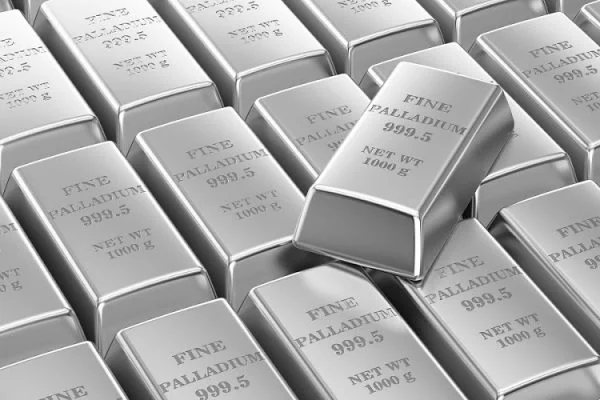
For the first time in more than a decade, palladium is rivalling gold in value.

At its current spot price of just over US$1 300/oz, reaching as high as $1 400/oz in January 2018, it has truly become the most precious of the precious metals.

Demand has been primarily driven by the automotive industry through the “demonisation” of diesel engines in Europe.

The resultant growth in small petrol engines and hybrid engines, which are fitted with emission-reducing catalytic converters that require it as a catalyst to control pollution, along with the shift away from diesel engines, has benefitted the material.

Moreover, the Volkswagen emissions scandal has negatively impacted the European diesel market and platinum prices.

According to Michael Jones, the President and CEO of TSX-listed Platinum Group Metals, the developer of the Waterberg palladium-dominant project in South Africa, it has become apparent that the electric vehicle revolution has been a major factor driving demand.

While adoption rates of electric vehicles are expected to increase anywhere between 8 percent and 10 percent by 2023, Jones stresses the importance that at least half of these new electric vehicles will be hybrid electric vehicles as opposed to full electric vehicles and will therefore still require the use of palladium in the catalytic converter.

Moreover, China’s tougher new vehicle emissions standard, the China VI emission standard, released in June 2018, means that cars will require more robust catalytic converters that are able to meet the new emissions legislation – another factor that may require increased palladium during manufacture in order to minimise emissions.

According to data from German chemicals giant BASF, the China VI emission standards is expected to create an additional 1 Moz of palladium demand annually by 2020, which Jones believes the market is already experiencing.

From the 2.2 Moz of palladium estimated to be required in the manufacture of Chinese cars in 2018, palladium demand is estimated to grow to 3.1 Moz by 2020, says BASF.

These figures are not based on the amount of new vehicles, but rather the impact of the change in the standard for emissions which will require increased amounts of palladium in its manufacture to ensure the longevity of the catalyst.

While Jones notes that this may cause car manufacturers to substitute out of palladium back into platinum as a cheaper alternative, it may take several years for this change to come into effect and have a physical impact on the price of palladium.

This being said, palladium is also a much more attractive metal for autocatalysis, particularly in hybrid (petrol) electric vehicles, he adds.

Moreover, with palladium being relatively rare, mined mainly as a by-product of nickel and platinum mining, it may take a while for demand fundamentals to slow should catalytic converter demand slow, says Jones.

This increasing demand, combined with constrained long-term supply, has caused a deficit in palladium supply which has been the key driver in palladium’s high prices – a price trend which experts expect to continue.

Despite weakening automotive sales in key markets, stringent emissions controls are expected to sustain demand as governments seek to improve their emissions targets.

Jones expects this demand to continue well into the foreseeable future due to tight supply. — Mining Review Africa

RBZ bends on 30-day retention period

0

The Reserve Bank of Zimbabwe will allow exporters to keep part of their export proceeds before compulsory conversion to local currency for periods longer than the prescribed 30 days in exceptional circumstances where such need arises to avoid choking companies’ operations, Business Weekly can reveal.

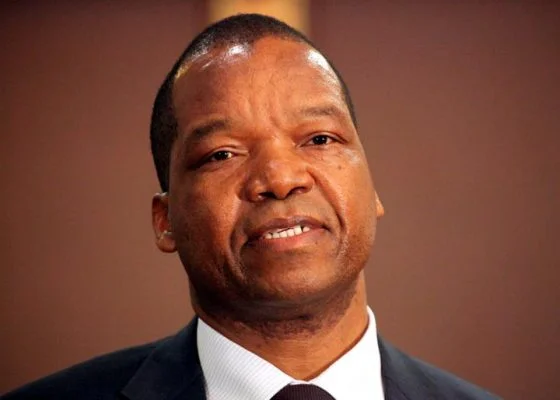
This comes after central bank governor John Mangudya, indicated in the 2019 Monetary Policy Statement last week that exporters would be allowed to retain a prescribed percentage of their export proceeds in hard currency for only 30 days, after which the unused funds will be released onto the market at a prevailing exchange rate.

Mangudya floated the US dollar exchange rate against the RTGS dollar and other currencies within the multi-currency basket through the introduction of interbank market.

The interbank opened at 1:2,5, lower than average 1:3,5 on the parallel market thanks to the combination of official and parallel dollars..

Manufactures now retain 80 percent of their export proceeds; gold producers (55 percent); other minerals (50 percent); tobacco and cotton merchants, for input schemes (80 percent); tobacco growers; 50 percent, cotton growers; 30 percent while horticulture, transport, and tourism will retain (80 percent).

Non retained earnings converted

The balance, which cannot be retained at all, is immediately converted to RTGS dollars at the prevailing exchange rate upon receipt to improve liquidity.

The new retention thresholds have already taken effect and an exchange control directive has been issued.

“Companies will not be constrained (by the compulsory conversion to RTGS dollars) because there is an exchange control authority that is given to those people who are genuine,” Mangudya told Business Weekly in an interview yesterday.

“Where there are exceptions, they (exporters) are given that exchange control authority/ approval.

“Just like CD1 forms, we say people (exporters) must acquit in 90 days, but others don’t submit within that period because of certain challenges. The exporters know that there is a law (providing for that).”

Confederation of Zimbabwe Industries (CZI) president Sifelani Jabangwe said while the retention thresholds are commendable, the 30-day period was too short.

“We understand the need for the 30-day window but we believe the ideal thing is to have a window of 90 days to 180 days,” said Jabangwe.

“It will give comfort to the depositor (exporter) that I will not be forced into expenditure.

“When people are forced to spend, they will spend irrationally, sometimes on raw materials and yet the liquidity for the company is not good.”

Hospitality Association of Zimbabwe (HAZ) president Innocent Manyera concurred with Jabangwe.

“Indeed, the wheel should be given time to turn. With the time period given, we might be faced with panic buying and unplanned expenditure might also end up affecting other cost line items.

“Cash flows are not that liquid. We need to spare for different expenditures without panic and captive expenditure,” Manyera said.

New measures a departure from the past

Mangudya said the latest policy position was in fact an improvement, given that before October 2018, companies could only retain their export proceeds for 14 days.

Economist Persistence Gwanyanya echoed Mangudya’s sentiments, saying the 30-day retention window is “just for regulation purposes, otherwise for genuine requests…extensions have always been granted.”

“What is important now is for banks to work closely with their clients to understand their cash flows as well as foreign currency requirements so that the seemingly shorter retention window doesn’t work against generators of foreign currency.

“We should understand that the bulk (85 percent) of the country’s foreign currency is generated by five commodities, which makes it imperative for RBZ to come up with more efficient and effective measures for this foreign currency to be accessible to other players in the market, and one such measure is the shorter retention window.

“But of course we need to get feedback from the market pertaining to this measure and if need be, it can be revised in a manner that balances the need to encourage increased foreign currency generation and its accessibility by the market,” Gwanyanya said.

He added that the move was necessary for the success of the interbank foreign exchange market.

Recently, the RBZ has come under fire from exporters who claim that the apex bank raided private accounts of exporters and used their funds.

Mangudya has fiercely denied the allegations.

Some exporters, including RioZim Limited, have gone to the point of filing litigation against the central bank over alleged denied access to export proceeds.

RioZim claimed it had not received significant amounts of its export earnings particularly over the period between 2016 and September 2018, amounting to nearly US$100 million.

Early this month, RioZim, a diversified miner listed on the Zimbabwe Stock Exchange which extracts gold at three mines in Kadoma, Chegutu and Masvingo, shut down operations for the second time in four months over delays in payments of the forex it was entitled to retain.

It has since resumed operations.

Business Weekly

Rio Tinto partying like its Christmas

0

Rio Tinto’s (ASX, LON:RIO) investors will be celebrating Christmas in February, as the miner is giving them a $4 billion special dividend, or $2.43 cent a share, after posting its highest annual underlying earnings since 2014.

The world’s second largest miner reported Wednesday a 2% increase in underlying profit, up to $8.8 billion, beating market forecasts of $8.5 billion on the back of rising revenue of $40.5 billion. The special dividend also came after a string of asset divestments, including Rio’s entire interest in Indonesia’s Grasberg mine for $3.9 billion.

Shareholders will receive a special dividend worth $4 billion, or $2.43 cent a share, as Rio Tinto recorded its highest annual underlying earnings in the last five years.

Since Jean-Sébastien Jacques took the helm in July 2016, Rio has focused on cutting costs, generating cash and returning as much of it as possible to investors through dividends and share buybacks.

Last year, the company waved all its coal assets goodbye and is now the only major miner with a fossil-fuel-free portfolio. In total, Rio has sold $12 billion worth of unwanted assets since 2015.

But not all was rosy in the company’s 2018 results. The firm flagged a further delay from the $5.3 billion underground expansion of its Oyu Tolgoi copper-gold-silver mine in Mongolia. The expansion has now been scheduled for the third quarter of 2021.

Jacques also acknowledged the clouds currently casting shadows over the global economy, including the threat of a trade war between the U.S. and China, the main market for Rio’s iron ore.

“I believe common sense will prevail at some stage,”  Jacques said. “There is uncertainty around, but we are very well positioned. The only thing I can do is to make sure I have a business that is even stronger.”

Separately, Rio Tinto released a major report into its plans to transition into a low carbon future, and Jacques made a point of underlining its Environmental, Social and Governance (ESG) credentials.

The company also finally confirmed a promising copper find at its Winu project in Western Australia.

Mining.com

Barrick, Newmont step up game to sway top investors

0

Canada’s Barrick Gold (TSX:ABX)(NYSE:GOLD) and U.S. rival Newmont Mining (NYSE:NEM) are working hard on persuading their respective top investors that are merger of the companies is the best, or the worst, option for them.

The Toronto-based miner, which launched its hostile bid for Newmont on Monday, updated its presentation on Thursday, adding more information on the expected synergies and benefits of the deal.

Barrick chief executive Mark Bristow reiterated that acquiring the Colorado-based company would create up to $7 billion in synergies, with $4.7 billion coming from Nevada, where both companies have massive mines and exploration projects.

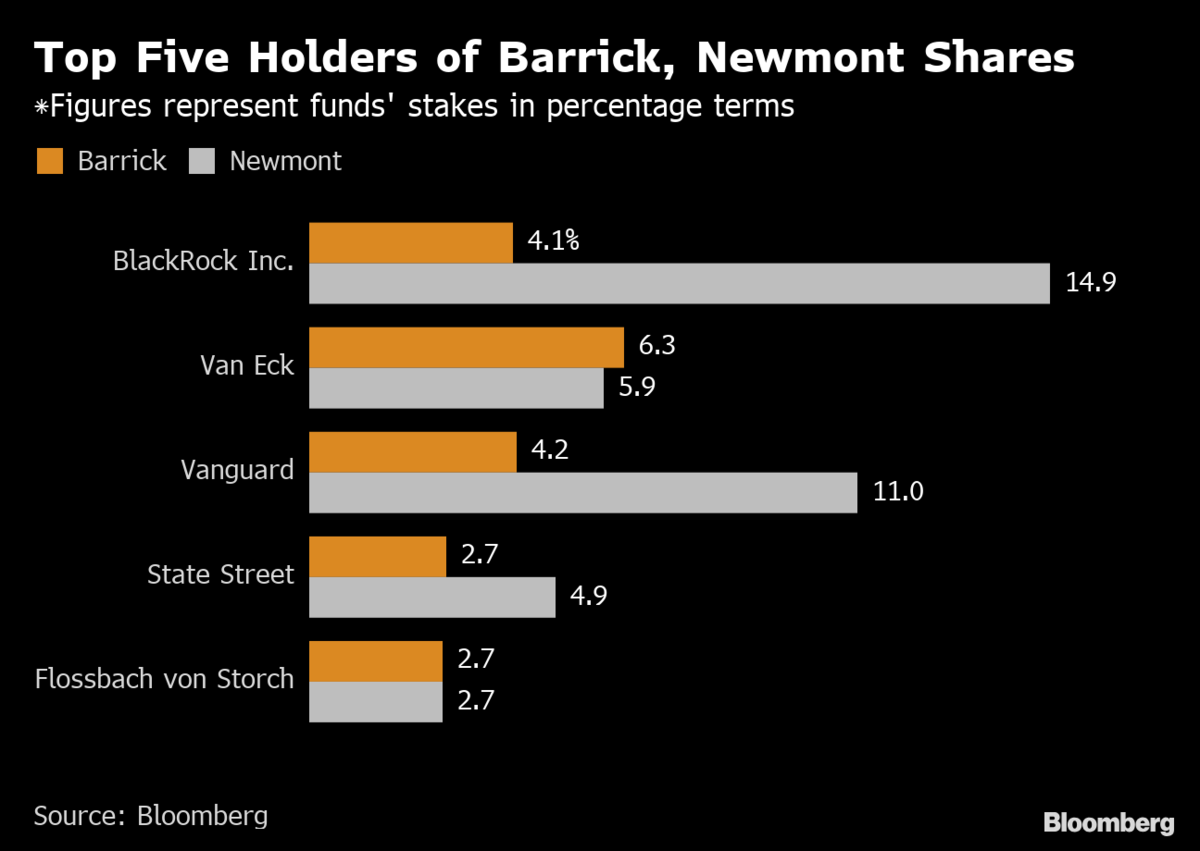
Bristow wants Newmont shareholders including BlackRock Inc., VanEck, and Flossbach von Storch AG to back its no-premium hostile bid for the miner.

According to Andrew Cosgrove, an analyst with Bloomberg Intelligence, the top 20 holders in Barrick, who own 55% of total shares outstanding, also own 91% of Newmont’s shares. So if Bristow’s power of persuasion works on them, Newmont will be forced to scratch its $10 billion agreement to buy Goldcorp (TSX:G) (NYSE:GG).

There’s no consensus about analysts about what the best outcome would be. For Michael Dudas from Vertical Research Partners, Barrick’s all share-no premium deal, currently priced at an 8% discount, may require a reset.

“Our view supports Newmont completing its Goldcorp proposed transaction, while looking to accelerate joint Nevada asset utilization discussions, structure and detailed plans while Barrick focuses on optimizing its newly combined global mining company,” Dudas wrote.

While the experts acknowledged that the synergy potential in Nevada for the companies could be “quite healthy”,  he said that the proposed arrangement “would heighten overall execution risks presented to a new management team in the early stages of integrating Barrick and Randgold’s portfolio.”

Rejection in the cards?

Vertical Research anticipates Newmont investors rejecting the hostile approach. “Hostile acquisitions have rarely been successful in the gold mining industry – especially in a smaller, more collegial sector,” Dundas said.

Analysts at Canaccord agree, adding that the potential benefit outlined by Barrick appeared to be too high, particularly in Nevada.

In its updated slide presentation titled “Capturing the Missing Billions,” however, Barrick argues that synergies “are the premium.”

“Newmont’s CEO admitted he hasn’t reviewed the opportunity since 2014, and only then a high level review for a couple of days,” the presentation says.

“Nevada JV is not the right path forward. [It] would not enable full realization of benefits due to duplicate administration, conflicting priorities and cumbersome governance,” Barrick notes.

“It might be hard for Newmont to swallow, but there’s huge synergies,” Robert McEwen, now the chairman and chief owner of McEwen Mining said in an interview this week. “But they’d also become such a mega producer – the distance between them and everybody else in the industry becomes a big question of, what happens next?”

A deal between the two world’s largest gold miners would create a billion-global mammoth, leaving Australia’s Newcrest Mining (ASX:NCM) as the world’s No.2 producer of the precious metal, with a current value of about billion.

It would also bring into question Barrick’s ability to integrate another miner, as the company has just completed the acquisition of Randgold.  The Canadian miner, however, highlighted it had outperformed Newmont by 20% since the move was announced in September.

Should Newmont’s shareholders choose to go ahead with the planned acquisition of Goldcorp instead, the Colorado-based firm would become the world’s biggest, with Barrick grabbing the second place and Newcrest the third.

Mining.com

RBZ calls on miners to increase production

0

The Reserve Bank of Zimbabwe (RBZ) Governor John Mangudya, has called on miners to ramp up production to compensate for potential declines in mineral prices.

Precious metal prices were generally subdued last year, occasioned by weak safe haven demand and a generally stronger dollar owing to interest rate hikes by the Federal Reserve during the year.

Mangudya said the developments “significantly” raised opportunity costs of holding precious metals such as gold and platinum.

Further, a general waning in global tensions diminished safe haven demand for precious metals.

Base metal prices, which firmed in the first half of last year, fell sharply in the second half following the imposition of broad-based tariffs by the United States on China’s imports.

Intensified trade tensions involving the two countries have raised market concerns about global trade and investment prospects, clouding the outlook for demand for most commodities.

Said Mangudya in the 2019 Monetary Policy Statement on Wednesday: “The moderation in commodity prices calls for increased production in commodity dependent economies such as Zimbabwe, so as to compensate for the potential revenue losses.”

Mineral revenue jumps to $3,4bn last year

Last year, the mining sector earned more than $3,4 billion, driven by high international metal prices and record breaking output particularly for gold, diamonds, chrome and nickel.

Minerals Marketing Corporation of Zimbabwe (MMCZ)’s corporate communications executive Pretty Musonza said the actual figures were not yet ready, but provisional figures point to “an increase from the 2017 figures”.

“The figures for last year have not been finalised. They should be ready in the near future,” said Musonza in a recent interview.

“However, I can confirm that indicative figures point to an increase from what the sector achieved in 2017.”

MMCZ, which was established through an Act of Parliament (MMCZ Act Chapter 21:04), is an exclusive agent for marketing and selling of all minerals produced in Zimbabwe except silver and gold.

The approximately $3,4 billion revenue generated last year represented a significant jump from the $2,3 billion raked in 2017.

Platinum Group of Metals (PGMS) matte rose 33 percent to 15 115 metric tonnes, and generated about $625,9 million.

Chrome concentrates output increased by 26 percent to 658 306mt and generated US$102,6 million with nickel output also rising by 9 percent to 61 073mt and raked $59 million.

With diamond output surpassing the 2,4 million carats target to end the year on 2,8 million carats, more money is expected from that sector and experts see mineral export receipts topping US$3,4 billion.

The Zimbabwe Revenue Authority (Zimra) recently reported that the mining sector contributed $95,67 million in royalties, against a target of $90 million.

The impressive performance of the revenue head represented 30,86 percent jump from the US$73,11 million achieved in 2017.

Chamber of Mines of Zimbabwe chief executive officer Isaac Kwesu said the jump in mining royalties was indicative of the growth of the mining sector.

This year, Kwesu predicts a jump in mineral output, but only if Government addresses the cost of doing business in the country.

“The challenge remains the high cost structure in the industry but as long as we manage to produce cheaply, as long as we secure inputs cheaply, as long as we get capital cheaply, I think the sector is poised to expand output.

“We know that the authorities are doing something about the challenges we face as a sector and the industry continues to engage,” said Kwesu.

He said the mining sector must take advantage of the rising global prices, “otherwise we miss the opportunity”, if the country does not increase output.

Government wants the mining sector to generate $12 billion revenue by 2025.

Gold blings with 33,2t

Gold deliveries to Fidelity Printers and Refineries, a gold buying arm of the RBZ, reached 33,2 tonnes, a record high for the country.

The annual target was 30 tonnes.

It represents a 33,9 percent increase from the 24,8 tonnes delivered in 2017.

The output was the greatest since 1980. Small-scale producers, who confront a plethora of challenges, continued to dominate the country’s gold deliveries, accounting for 65,3 percent of the total deliveries.

Primary producers, who have all the sophisticated equipment, contributed 34,7 percent to last year’s gold deliveries.

Mangudya said the “marked increase” in gold deliveries was realised against the background of “strong Government and RBZ support and incentives to further boost production and exports”_Business Weekly