Home Blog Page 747

Hwange Colliery sets community development example

0

In an effort to promote the education sector in Zimbabwe which has been affected by recent economic woes, Hwange Colliery Company stepped up the ladder by donating 100 beds to Neshaya Secondary School in Matebeland North situated in Makwa area under Chief Whange’s jurisdiction.

Dickson Rudairo Mapuranga

Pupils at the boarding school were reported to be sleeping on the floor due to lack of beds, after hearing the plight of children at Neshaya School  the colliery hospital set aside beds for the children.

The head of the school Sibongile Sibanda with smiles all over her face appreciated the move by the colliery company saying that the pupils’ school performances will as a result increase due to the fact that the pupils will have a comfortable rest, a psychological image.

“We really appreciate this goodwill gesture by Hwange Colliery Company Limited to our students.  As a result of good sleep they will certainly get desirable and decent examination results.  Good rest results in a fresh mind in the morning which can subsequently produce the much needed positive results” said Sibanda.

Sibanda also thanked the colliery company for giving students from the school apprenticeship and school of nursing programmes, she added appreciating the relationship between the company and the school hoping it will last longer.

“We also thank the company for absorbing students from this school in their programmes like the Apprenticeship Intakes and School of Nursing programmes and it is my fervent hope that the good relationship between ourselves will continue going forward” said Sibanda.

The Colliery’s Corporate Affairs Manager Mrs Rugare Dhobbie highlighted in her remarks that the donation was an onset of more to come from the organisation.

“This is the beginning of mutually beneficial partnerships with schools in the district; the Company will take advantage of periodic visits to all the five traditional Chiefs in Hwange district to assess pressing educational challenges of the communities” said Dhobbie.

Dhobbie said that the company was moved by the reports that pupils at the school were sleeping on the floor, as stakeholder of the community they could not just watch such things happening in their society.

“Upon engagement with Hwange Colliery Company Limited, we were informed by the school administration that some school kids at this quasi boarding facility were sleeping on the floor. Our Management could not let the situation go on bearing in mind that this school carries the hopes of tomorrow and our future leaders in the district as well as the nation of Zimbabwe” said Dhobbie.

Dhobbie encouraged the school to develop the cooperation and very good relationship it has with the office of the chief.

“We would also like to take this opportunity to encourage you to increase your already existing cooperation with the office of Chief Whange in coming up with solutions for other challenges here in Makwa village.” she said.

Deputy Minister visits GMSC in Mt Darwin

0

In a bid to boost gold production in Zimbabwe, the government initiated the development of Gold Milling Service Centres (GMSC), last week the deputy minister of Mines and Mining Development Hon Polite Kambamura visited the proposed centre in Mt Darwin which will be co-owned and operated by Zimbabwe Mining Development Corporation (ZMDC) led by Richard Taure and Mt Darwin Miners Association, chaired by Christine Munyoro.

This kicks off part of a national familiarization tour in which the Deputy Minister Hon Polite Kambamura is visiting some of the proposed sites on which a total of 10 Gold Milling Service Centers will be established.

The Gold Milling Service Centers are a Government’s initiative to boost Gold Production throughout gold producing areas within Zimbabwe.

The Ministry of Mines and Mining Development is planning to have a $12 billion dollar mining industry by 2023 to fulfill the Country vision of becoming an upper middle income economy.

The figure was deduced from plans to capacitate extraction of various minerals found in the country.

As part of the road map to fulfill the vision the Gold Sector is being capacitated as part of the strategy to increase productivity output to 100 tonnes, the Ministry has rolled out the Gold Service Centre Project which will be managed by a Joint Venture Company between ZMDC and Mt Darwin Mining Association.

The project is aimed to empower local miners through equipment hiring and hire purchase facilities from the centre, capacitation of mines, milling services, technical services such as  Geologists, Mining Engineers, Transport, and provision of gold buying services under one roof.

The goal is to ensure small scale miners are well equipped while ensuring safe and sustainable mining practices takes place within the region. The success of the project is hinged on the local miners supporting the service centres.

Stakeholders Reserve Bank of Zimbabwe via Fidelity Printers and Refiners, Ministry of Mines Mashonaland Central Provincial Office led by Mr Malcom Mazemo, Ministry of Mines: Research and Value Addition led by Dr. Mercy Manyuchi, and the Zimbabwe Miners Federation Mashonaland Central Province led by Masango Mahlahla & National Leadership led by Henrietta B. Rushwaya will provide support to ensure the project is a success.


Liberia mourns dozens

0

Liberian President George Weah declared Monday a day of national mourning after more than 40 people were killed in a mudslide at an alleged illegal mine in the north of the country.

The national disaster management agency has been searching for survivors since the incident in Nimba County last weekend, but the region is inaccessible and getting the necessary equipment there is posing a challenge, a spokesperson said.

The president also declared the region a national disaster zone and ordered authorities to isolate the area, provide security and prevent illicit mining.

“It is totally depressing for our country at a time my government is endeavoring to create an enabling environment for our people to improve their lives,” said Weah. He assured victims’ families that the government would provide support and assistance.

Bloomberg News

Petra Diamonds appoints new CEO, share prices rises

0

African miner Petra Diamonds named a new chief executive on Monday as it works to cut debt and generate free cash flow after first-half core earnings were hit by lower diamond prices.

The news helped lift its shares more than 8 percent by 1010 GMT. The broader mining market was little changed.

Analysts said appointing Richard Duffy, who has held finance posts in his 27 years in the mining industry, would benefit the company as it sought to cut debt. He has previously worked at Anglo American and AngloGold Ashanti.

Petra’s stock had fallen about 30% this year as the company sought to cut borrowing after heavy capital investment in infrastructure and opening up a new section of ore at its flagship Cullinan mine

Petra’s stock had fallen about 30 percent this year as the company sought to cut borrowing after heavy capital investment in infrastructure and opening up a new section of ore at its flagship Cullinan mine in South Africa. Diamond prices meanwhile have dropped below historical annual averages.

The company said on Monday adjusted earnings before interest, tax, depreciation and amortisation (EBITDA) fell 6.4 percent to $75.6 million in the six months to Dec. 31, from $80.8 million in the same period a year earlier.

The company stuck to its production forecast of 3.8 million to 4.0 million carats for fiscal 2019.

“The focus to generate free cash flow remains paramount for the company,” said outgoing CEO Johan Dippenaar, whose departure was announced in September.

Duffy takes over on April 1.

Dippenaar said the company had delivered “solid production” but recognised the impact lower value diamonds had in the six months to the end of December and said the company was working to boost production from a new section of ore.

The aim was to lower the net debt to EBITDA ratio to 2 by the middle of 2020 from 3.3, he said.

A low ratio is seen as an indicator of financial health in the capital-intensive mining industry.

Petra Diamond’s chief financial officer and chief operating officer are expected to stay in place. But Dippenaar said the company was “committed to further changes in the board during this calendar year”.

RBC Capital Markets, which rates the stock “sector perform,” welcomed the appointment of Duffy and noted “positive pricing improvements” as provisional results from a February diamond sale showed a 1 percent rise on the previous six months.

Analyst Tyler Broda said Duffy was “a very solid hire” with experience including in finance roles. Broda said Duffy’s experience “should be an asset as PDL (Petra) delivers on its investments and begins to de-lever the balance sheet”.

Reuters

How South African mines cope with power cuts

0

South African utility Eskom imposed the worst power cuts in several years on homes and businesses last week, conjuring up memories of the 2008 crisis when the grid nearly collapsed and cost the mining industry billions in lost output.

Although Eskom – which supplies around 90 percent of power in Africa’s most industrialised economy – paused the blackouts on Friday for the first time in five days, it warned that its creaking infrastructure could buckle at any time.

A decade ago, the state utility ordered mining houses to evacuate all underground staff and cease mining operations for five days as it cut electricity supply to minimum levels.

It is not clear how much the industry, which consumes about 15 percent of Eskom’s annual output, lost in production but the crisis sent prices of both gold and platinum to record levels and pummelled the rand.

But mining companies now appear to be better prepared to cope with the scheduled blackouts thanks largely to an agreement struck in 2010 between Eskom and the industry that allows it to continue operating on reduced power.

“The South African mines are probably a little bit better prepared for electricity cuts than they were 10 years ago,” said Peter Major, an analyst and director of mining at Mergence Corporate Solutions.

Anglo American Platinum Ltd (Amplats), the world’s top producer of the metal, said it lost 14,000 ounces or less than 1 percent of annual output – based on 2018 production – last week.

Diversified miners Exxaro and Anglo American said their operations were affected to varying degrees while AngloGold Ashanti said safety and production were untouched.

An industry group, the Mineral Council, did not give specific details about the impact of last week’s power cuts on production but said the effect on output for the sector had been minimal.

Miners including Impala Platinum, Harmony and Sibanye-Stillwater have also been working on reducing their reliance on Eskom by setting up their own power generators. However, it has been difficult to get that off the ground because of red tape and prohibitive costs, they say.

What is at stake?

South Africa is home to the world’s biggest platinum group metals deposits, accounting for just over 90 percent of global production. Any disruption in output could directly affect prices of the white metal.

The mining industry directly contributes more than 7 percent to the economy which has been struggling with anaemic growth over the last 10 years.

Miners, among the biggest consumers of electricity in the country, are already grappling with weak profits that could be exacerbated by the potential loss of output if Eskom imposes deeper power cuts.

The potential impact on jobs is also a concern in a country with a jobless rate of more than 27 percent and has prompted fierce opposition from the country’s powerful trade unions to President Cyril Ramaphohsa’s plan to split the utility.

“With all these power cuts through Eskom there will be consequences … People will lose their work for less time put in for work and we are very, very concerned about this,” said Stanford Mazhindu, spokesperson of trade union UASA.

What are miners doing to cope?

The 2010 agreement between Eskom and the mining industry has partly shielded miners from the massive disruption caused by the 2008 power cuts, when the sector was forced to shut for five days to allow the grid to recover.

Under the scheme, Eskom gives the industry notice to reduce their power consumption by between 15 and 20 percent when the national grid is at its tightest and unable to meet demand.

“If it’s a 15 or 20 percent reduction in demand and it goes on for an extended period, it can have quite a big impact,” said Sibanye spokesman James Wellsted.

For instance, concentrators are switched off and water pumps that would prevent underground dams from flooding are only turned on during low usage hours at night, he said.

Impala Platinum reduces its usage of power-intensive equipment, including furnaces, during national peak usage times when residential consumers are just waking up or have just returned from work, spokesman Johan Theron said.

Are these measures enough?

Despite these measures, business leaders and the Mineral Council are still concerned about the risks Eskom poses to the industry.

Impala’s Theron said shifting energy-intensive work to an off-peak demand period in the middle of the night to catch up on lost production “is not ideal or sustainable, as it will impact the business over time in that wear on furnaces are accelerated under these operating conditions”.

While the industry was coping, extended rolling blackouts would have affected the commercial viability of mines, particularly deep-level mining and platinum mines, Mineral Council spokeswoman Charmane Russell said.

Why can’t miners generate their own power?

Attempts by miners to produce their own power are expensive, as Eskom requires them to connect to the grid for a fee.

The variety of legal codes found at the energy regulator and energy ministry are additional hurdles to independent power generation, they say.

The volume of electricity consumed by the industry is also too much to rely solely on self-generation.

“We need to fix Eskom, to think that underground gold mining can survive without Eskom is going to be difficult,” said Peter Steenkamp, the chief executive of gold miner Harmony.

However, a few companies have succeeded in cutting dependency on the grid. Petrochemicals firm Sasol produces 70 percent of its electricity needs to power its sprawling plants.

Power generation, from steam turbines commissioned in 2010 and contracted with Eskom via a medium-term power purchase programme, helped to alleviate Eskom’s shortages at the time, Sasol said.

But companies such as Sibanye are struggling to do the same.

The precious metals producer has pushed back plans, unveiled in 2014, to build a solar plant because of difficulty in getting finance for the project and bureaucracy related to connecting to the national power grid.

Harmony Gold has also been trying to build a 30 megawatt solar plant.

Amplats said it was also considering building a 100 megawatt solar power plant at the group’s Mogalakwena mine.

Reuters

RioZim resumes operations

0

LISTED resources group RioZim has resumed operations at its three gold mines after receiving arrear
payments from the central bank.

Last week, the miner shut down operations at its Renco, Cam and Motor and Dalny mines for the
second time in four months after the Reserve Bank of Zimbabwe had failed to pay for part of its gold
deliveries in United States dollars.

“…the company’s gold operations have resumed full production as normal,” it said in statement.
“This development follows the fruitful discussions held with the Reserve Bank of Zimbabwe which
facilitated the clearance of all arrear payments thus allowing the company to resume its normal
operations,” read the statement.

All gold producers in Zimbabwe are obliged to sell their output to RBZ subsidiary Fidelity Printers and
Refiners and are supposed to be paid 55 percent of their earnings in United States dollars.
The remainder is paid via electronic dollars into their bank accounts.

RioZim, which recently dragged the central bank to court over its failure to pay foreign exchange
earnings due to the gold producer in the past ? last year estimated losses caused by payment delays
to be $40 million in increased expenses and delayed capacity, a figure anticipated to have shot up,
precipitating the recent temporary suspension of operations.

Last year, the three mines were only re-opened after the RBZ, which is the country’s sole gold buyer
through Fidelity, said it would allow mines to keep 55 percent of their earnings, up from the previous
30 percent.

This was despite the fact that RioZim had requested to retain 60 percent of its foreign exchange
earnings in hard currency.
Additionally, the RBZ then increased the local currency gold export incentive from five percent to 20
percent.

According to RioZim chairperson Lovemore Chihota, in the 30 months leading to October 2018, the
company had only received 14 percent of its money in foreign exchange against an RBZ directive of
50 percent directly to its nostro account and 50 percent through application to the central bank.

Gold is Zimbabwe’s single largest export earner and production reached an all-time high of 33 tonnes
in 2018 from 27 tonnes the year before, official data shows, driven by record output from small-scale
producers.

Big mining companies say the acute shortage of dollars, which has also sapped supplies of fuel and
medicines, hampers their ability to expand production and start new projects.

Daily News

Should EPOs be scrapped?

0

Last month Zimbabwe Miners Federation (ZMF) sent a letter to the Mines Minister, Winston Chitando. ZMF stated that they were against the application of Exclusive Prospecting Orders (EPOs) due to the fact that EPOs are against national interest.

Rudairo Dickson Mapuranga

ZMF argued that, while it is true that there is a need to explore and quantify minerals in Zimbabwe using modern technologies, EPOs will eventually affect the uplifting of women and economic empowerment, gains achieved since independence due to the fact that some people will grab large pieces of land for themselves living others with nothing specifically women who are mainly amateurs in the industry.

Commenting on ZMF stance, one expert in the mining industry and economics said that EPOs were necessary for the country to discover new metals and also to protect other metals from being extracted without the knowledge of the government which might lead individuals or organizations benefiting instead of the government.

“Surely the government must have guidelines to curb speculation. The rest of the world grants EPOs and new large deposits are found that way. The government can simply copy regulations that stop speculative purposes. Rather than ban exploration that generates new large scale deposits which Zimbabwe is so desperate to increase forex generation for the country” he said.

However, some miners believe that EPOs should be strapped because they are becoming a platform of corruption and prestige, where one would just acquire large pieces of land without even mining.

“The challenge is people hold on to these EPOs for years without any work on the ground. The rules are there but with little enforcement as has been the case, the industry is going to suffer” said one miner.

Those who support the idea that EPOS are a danger to gains of economic freedom believe that EPOs should target mainly heavy metals like lithium and gases, coal.  As gold and chrome have been prospected and discovered long back. They believe that the Government must prioritize small scale mining for quick gains in gold and chrome production.

However, experts believe that, under any circumstances, EPOs have to be enforced. Corrupt elements that might be disturbing the correct purpose of EPOs should be looked in to. They believe that for the mining industry to grow the current position on EPOs is the right thing to do.

“Any country that requires new deposits must give companies ground for large scale exploration. The reason people think gold was discovered long back only is that there hasn’t been exploration ground available for new discoveries to be made. This is exactly why Zimbabwe came from being the third-largest gold producer in Africa to I don’t even know number what now. That’s why we get happy producing 30 tonnes of gold when we should be close to 100 tonnes of gold per year” said one expert.

This article first appeared in Mining Zimbabwe Feb 2019 issue

ZMF pushing the government to solve fuel crisis

0


Last month the president Emmerson Mnangagwa announced fuel price hike which was deemed by some economic experts “painful but necessary”. The price hike were aimed at reducing the high demand of fuel which had smashed Zimbabwe to the hardcore, was also implemented to reduce the allegedly hoarding of fuel from Zimbabwe by foreign companies due to the fact that in reality fuel in Zimbabwe was too cheap, costing less than USD O,7O.

Rudairo Dickson Mapuranga

However, according to some experts, the fuel situation in Zimbabwe is affecting miners all the more than creating a favorable environment for them. The fuel price hike which caused diesel and petrol to cost more than $3, fueled the escalation of some mining equipment and even basic commodities without prices of precious metals and stones increasing, as a result the miner is affected all the more.

Miners are crying over fuel prices in Zimbabwe, some who met Mining Zimbabwe said that their work relations have been decreased due to price hikes which were speared mainly by the increase in fuel prices.

“Currently the fuel remains the hardest hitting coupled with the fact that the retention is not workable,    Chamber of Mines is engaging government to increase forex payment to 80%, and submissions were made to Reserve Bank for immediate review. The portion of 50% and 50% bond is a huge loss for chrome Miners especially with the increased fuel price and the fact that service providers are charging USD for parts” said one miner.

Zimbabwe Miners Federation (ZMF) said that they are engaging the government on the issue of fuel which have affected mining activities to a greater degree. They said that the government need to look into the matter, pay their dues in USD or provide them with a certain funding that will enable them to grow. The fact remains that the mining industry have proven be a major catalyst in the turnaround of the economy of Zimbabwe.

“We continue with the call for formalization by government amending the mining act and ZMF requires an act to be included in government budgets to access funding for its miner programmes” they said.

An inside source in ZMF said that the organization is in the process of pushing to acquire fuel import license so that cost of fuel will be reduced specifically to the miner in order to increase production. Miners activities especially small scale miners require the use of diesel and petrol because most of these miners use diesel or petrol electricity generators for extraction and power.

“We want a license so we can import it in specifically for miners, but the president will announce it let me put you in touch with her directly, so she gives you the scoop first. We are still in talks right now so it can only be divulged after there’s a concrete plan” she said.

This article first appeared in Mining Zimbabwe Feb 2019 issue

Africa should stop expecting supercharged profits from mining: Akufo-Addo

0

Standing before hundreds of mining investors and executives last week, Ghanaian President Nana Akufo-Addo issued a firm warning: stop expecting supercharged profits from Africa’s mineral riches.

It’s a theme that has simmered for years, as governments across the continent seek a bigger share of benefits from their natural resources. The debate ratcheted up in 2018, with countries including the Democratic Republic of Congo and Zambia—the continent’s No. 1 and 2 copper producers—becoming increasingly insistent that producers must pay up.

There’s also been a backlash against the terms under which foreign companies agreed to invest in the first place—many mining codes, investment pacts and joint ventures were drawn up based on lower commodity prices and by previous regimes. In his Cape Town speech, Akufo-Addo said African nations shouldn’t be expected to give special financial incentives to secure investment that producers wouldn’t get in other parts of the world.

For Congo and Zambia at least, geology is on the government’s side

For Congo and Zambia at least, geology is on the government’s side. The countries are home to some of the richest copper deposits at a time when the biggest miners are universally bullish on the metal and almost all are looking to expand their exposure. Congo’s resources of cobalt—a key ingredient in rechargeable batteries that’s found in the country alongside copper—are even rarer.

In Congo, arguably the most important of Africa’s mineral-rich countries, the government introduced a new mining code last year that raised royalties, added taxes and canceled a clause that would have protected producers against fiscal changes for 10 years.

“Never forget that money is a coward.”

There has been strong opposition from the mining industry, but no concessions. While producers may have hoped for a reprieve when the country elected a new president in December, there have been initial indications that the code won’t be revisited. Still, President Felix Tshisekedi has yet to appoint a team or clearly outline policy, so the situation may change.

Zambia, which is situated on the same giant copper belt as Congo, has also increased its mining royalties. While companies threatened to cut jobs and close mines, the government says it’s standing firm.

“The mismatch that exists between the huge resources that the country sits on and the poverty levels in the rest of the country cannot continue,” said Zambia Mines Minister Richard Musukwa. “There is no one who goes to pay taxes while smiling. It’s only natural for them to defend their positions.”

So far, the mining industry has been vocal in its opposition to the changes, but its options are limited. Having poured billions of dollars into building mines that take years to start making money, many have little choice but to grumble and get on with it.

Still, producers warn that the increased uncertainty will put future investment at risk.

“Never forget that money is a coward,” said Robert Friedland, founder of Ivanhoe Mines Ltd., which is developing huge copper and zinc mines in Congo. “When a politician says something dumb, when a government does something dumb, money runs away at the speed of light.”

Bloomberg News

Celebrations as trapped Miners resurface from underground

0

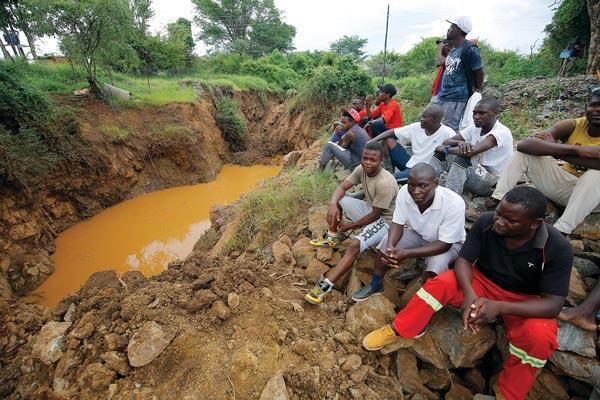
WATCH: As crowds celebrate when the first miners appeared from below the ground in Battlefields.