



WATCH: Artisanal miner narrating his ordeal
AUDIO: What really happened at the Battlefields mine disaster

“Survivors were neck deep in water for days”
The member of Parliament for Chegutu West Dexter Nduna explains in detail what happened at the Battlefields Mine and updates the current situation of the survivors.
The accident has highlighted the safety issues confronting illegal gold miners, who last year contributed significantly to Zimbabwe’s record 33 tonne bullion output.
Battlefields and surrounding areas are rich in gold deposits and popular with artisanal miners who use picks and shovels and generator-powered water pumps. The makeshift shafts and tunnels can easily collapse in the rainy season when the ground is soft.
The pits are dotted around a clearing some 8 km from the main dirt road. On the edges are shacks made of plastic which serve as accommodation for those digging for gold.
At abandoned mines, the miners, known locally as “Makorokoza” or hustlers, usually sneak in at night and can disappear into shafts and tunnels for more than two days.
Listen to the audio below detailing what really happened
IMAGES: Dexter Nduna with rescued miners

SURVIVORS of the Battlefield mine accident are starting to surface after a spirited effort to rescue them from the pits they were illegally mining.
President Emmerson Mnangagwa declared the accident a state of disaster. The accident occurred at the Silver Moon and Cricket Mines in battlefields near Kadoma.
More survivors are expected to be pulled to the surface as rescue teams are working nonstop since the news broke.
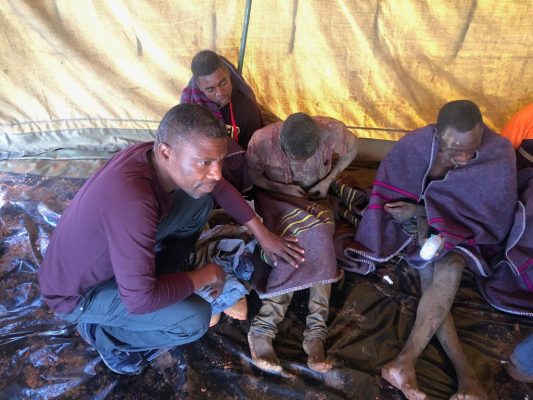
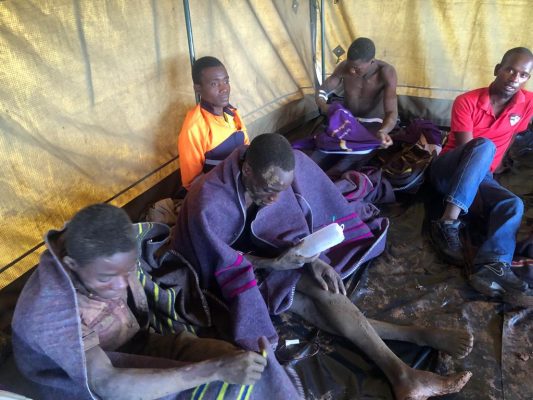
WATCH: Miners get rescued at the Kadoma accident site
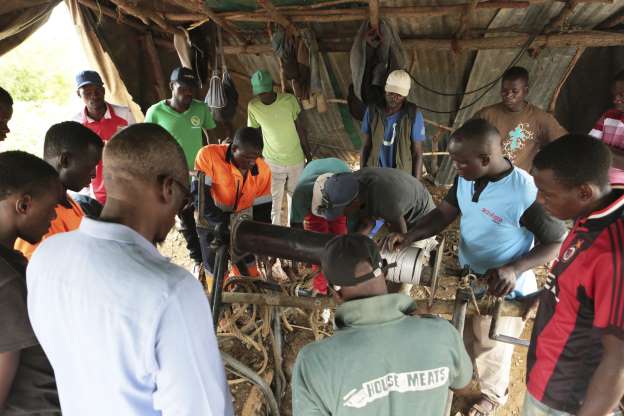
WATCH: Miners get rescued at the Kadoma accident site
8 miners are rescued from Battlefields mines
REPORTS coming in say at least 8 miners have been rescued at the battlefields mine.
More to follow…
Gold fields slumped 73%

South Africa’s Gold Fields Ltd said on Friday its full-year profit slumped 73 percent, dented by a decline in bullion production led by its South Deep operations.
Headline earnings per share (HEPS) fell to $0.07 per share, for the full year ended Dec. 31, 2018, from $0.26 in the previous year.
HEPS is the main profit measure used in South Africa that strips out certain one-off items.
Revenue dropped 7 percent to $2.58 billion in 2018 from $2.76 billion in 2017 due to the lower ounces sold, the firm said.
Bullion production slipped 6 percent to 2.036 million ounces in 2018 from 2.160 million ounces in 2017 due to a decline in production at South Deep, Gold Fields said.
While South Deep had a difficult year, the large-scale restructuring completed at the end of 2018, places the mine on an improved footing from which to gradually build up production
South Deep, the company’s last South African asset, has lost money over the past five years and Goldfields has been working to mechanise operations in the face of challenging geology 3 kms (2 miles) below the surface.
Production at the South Deep in 2018 was affected by a slow build-up after the seasonal holidays in the first quarter, labour restructuring, safety stoppages and a six-week strike, the gold miner said.
“While South Deep had a difficult year, the large-scale restructuring completed at the end of 2018, places the mine on an improved footing from which to gradually build up production,” said Chief Executive Officer Nick Holland in a statement.
Gold Fields, which employs about 3,600 people in South Africa, said last year it would restructure its South Deep operations and cut about 1,100 jobs, nearly a third of the workforce, to save money. In response, the National Union of Mineworkers (NUM) went on strike at the mine on Nov. 2.
The firm has declared a dividend of 20 cents per share, making the total dividend for the year at 40 cents ($0.0283) per share, compared with 90 cents a year ago.
Reuters
Battlefields Mine accident declared a national disaster

The Battlefields Mine accident has been declared a national disaster.
President Emmason Mnangagwa declared the accident a state of disaster. The accident occurred at the Silver Moon and Cricket Mines in battlefields near Kadoma.
The Director of the Civil Protection Department, Nathan Nkomo told ZBC News that the relatives of each victim will receive $1000 which will go towards meeting burial costs plus one blanket to each victim among other forms of assistance.
So far close to 50 people have been declared dead with some eyewitnesses believing the number could certainly be higher.
Solutions to prevent mining accidents and dangers of illegal mining

DUE of the unique dangers in mining operations, workers need extensive safety training. Mandatory and optional training is widely available to mining professionals,rapidly raising the safety standards of this industry.
Compulsory Training Programs for Miners
Most mining countries mandate that each mine have an approved worker training program in health and safety issues. Each plan must include a certain quantity of hours of basic safety training for new miners with no experience. In addition to new miner training, each miner must receive regular refresher safety training every year, and miners assigned to new jobs must receive safety training related to their new task.
Prevention Through Simulation
Increasingly, mines use more high-tech tools for miner training, such as machinery simulators and virtual reality simulators. By simulating actual mine conditions and emergencies, mine workers are better prepared, and companies can instantly assess a mine worker’s progress and skills.
Blasting License
People in charge of blasting operation attend specific training and are required to be licensed for the use of explosives and initiation systems. Most mining countries set up a specific refresher safety training for experienced blasters to integrate fast-paced changing legislation and the new technological trends.
- Administration Classes on Health, Safety, and Mining Methods
- Mining Machinery Manufacturers offer courses in machine operation and maintenance with emphasis on safe practices due to potential liabilities in case of an accident
Safety Legislation
Common efforts of governments, mine operators, labor, professional organizations, and academia are likely to be the rule in most mining countries to promote up-to-date, efficient safety legislation and harmonization of practices.
Nevertheless, international mining groups have developed exploitation and production health and safety standards that are implemented in their mines regardless of the countries where they are operating. As they are corporate standards adopted by listed groups, those standards and prescriptions are likely to be much more protective than many local regulations.
Technology Standard
The introduction of new technologies has been continuously contributing to reducing the injury and fatality rates in the mining industry. The larger occurrence of mining accidents in developing countries and in illegal mining operations is directly related to a lack of up-to-date technology, especially regarding:
Personal Protective Equipment: Standards personal protective equipment, including adequate radio communication devices or safety lamps that won’t potentially trigger explosives atmospheres.
Exploitation Infrastructure: Exploitation infrastructure for fire alarm, gas management, miners rescue, ventilation, etc.
Explosive Products: Now there is available a wide range of water-based emulsion explosives and precise programmable detonators to initiate it. These make a major difference in safety versus unstable TNT-based explosives or erratic traditional detonators (fuse caps). Between 1978 and 2000, 106 miners were killed and 1,050 were injured by explosives and breaking agents. Electronic detonators are a good example of technological progress towards a safer mining environment. The real safety advantage to the system is that the miner in charge can have total system verifications before he goes into a charge-and-fire sequence, which means that almost all potential problems will be known up front before firing. So corrective measures can be taken, and save lives. This level of safety and operational transparency was previously impossible.
Machinery to Replace Operators For the Most Dangerous Operations: Some mines have now set up fully robotized drilling and explosives charging processes.
ILLEGAL MINING
Illegal mining has been ravaging our planet for decades. Not only is illegal mining riskier from a safety perspective for those who choose to participate, but it encourages reckless behavior and leads to outcomes that have negative long-term consequences.
Illicit mining activities don’t follow the same provisions that legal mining does. While some may argue that all mining has dangerous consequences, the implications of illegal mining are much worse.
Negative Effects Of Illegal Mining On The Environment And Human Health
Most mining activities are extremely high-risk for not only the environment, but also those who do the actual physical labor.
The environmental risks of mining include:
- the formation of sinkholes
- the contamination of soil and groundwater
- loss of biodiversity
- chemical leakages
In addition to environmental risks, mining activities in general are also very dangerous to operate. Not only do miners have to sometimes travel to or live in remote regions, they often also work in extenuating conditions.
They face health risks due to breathing toxic chemicals or absorbing them into the skin. Miners also have to operate heavy machinery or may be exposed to flooding, gas explosions, or cave ins.
While all of these risks exist for legal mining operations, they only increase in likelihood for illegal projects. Not only is the environmental degradation much worse, but the human risks are also far greater.
Destructive cases of illegal mining across the world
In South America, the $2.4 billion illegal gold mining industry has been destroying the Amazon and costing dozens of lives.
In Peru, Bolivia, and Colombia, illegal gold mining operations by private companies have devastated local communities.
The operations have left behind pools of cyanide and mercury, twice the size of Olympic swimming pools. In just three months, the illegal mining activities damaged the ecosystem by killing the entire fish population of the Aguita River after water-pumping machines leaked toxins into the water.
According to Colombia’s National Planning Department, Colombia now ranks second in the world for mercury pollution.
Local populations have reported health issues related to mercury poisoning such as tremors and memory loss. According to some sources, illegal mining companies often extorted the local populations by forcing them to search for gold by sending in armed groups to intimidate them. Other times, they tried to barter deals by promising to repair crippling infrastructure in the region, but instead, pillaged the region and left without keeping their word.
South America isn’t the only region that has suffered from illegal mining.
In Africa, the conflict diamond industry cost thousands of lives in the 1990’s and 2000’s. During that time, the illegal industry produced billions of dollars which were used to fund civil wars that decimated countries including Sierra Leone, Angola, Liberia, Ivory Coast and the Democratic Republic of Congo (DRC).
Government up effort to rescue drowned miners
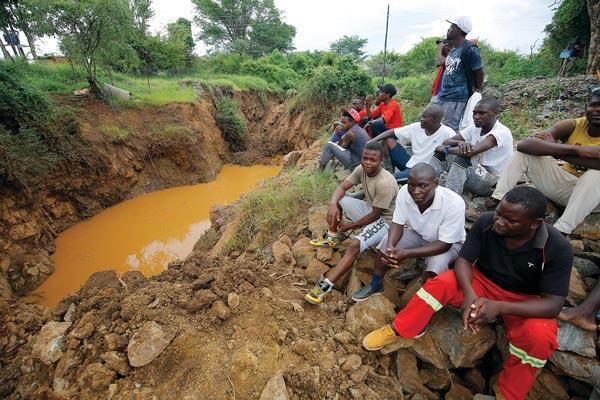
THE Zimbabwe government yesterday said it was mobilising resources to help retrieve the bodies of at least 23 miners who reportedly drowned at Battlefields on Tuesday night when Silver Moon and Cricket mines in Muzvezve were flooded.
Several mining experts visited the scene of the incident as the Civil Protection Unit (CPU) started the process of pumping out water from the two mines with the help of mining companies.
Mashonaland West provincial administrator Cecilia Chitiyo, who chairs the provincial CPU, appealed to miners with big pumps to help assist in the rescue efforts.
Retrieval of the bodies is expected to start from today or tomorrow when significant water is expected to have been pumped out.
According to reports, the miners died when interlinked shafts and tunnels at Cricket Mine and one owned by a Mr Baxter, were flooded after a dam wall collapsed due to heavy rains received in the area. Newsday
More casualities expected in Battlefields accident
The Mining community in Zimbabwe is in mourning with the sad news of the illegal miners accident in the Battlefields area. The Authorities have reported that the number of casualties could be about 50 as none are expected to have survived flooding in the shafts.
The miners were trapped on Tuesday night when the shafts they were working in were flooded after a nearby dam burst.
Some of the shafts were 100 metres deep and rescue teams from nearby mines like Zimplats and the Civil Protection Unit were pumping water from shafts and tunnels before recovering the estimated 50 bodies.