Home Blog Page 188

ZZCC Thermal Power Expansion on Hold Amid Market Pressures

0

Zimbabwe Zhongxin Coking Company (ZZCC) has announced that its plans to expand its 50MW thermal power plant have been put on hold due to financial challenges linked to a significant drop in the price of coke. This development comes as the company continues to construct two new automated recovery coke oven batteries at its Madumabisa site, a project employing 80 locals and 60 Chinese personnel, Mining Zimbabwe can report.

By Rudairo Mapuranga

According to the Ministry of Mines and Mining Development’s 2024 report following their visit to Matabeleland North, one of these new batteries is 90% complete and scheduled to commence operations by the end of the second quarter in 2025. Once completed, the facility is expected to produce 600,000 tonnes of coke annually. However, the drop in coke prices has negatively affected ZZCC’s profit margins, stalling capital projects, including the much-anticipated expansion of the thermal power plant.

The report noted that “the thermal power plant expansion project is on hold”, a significant setback for the company’s energy ambitions. ZZCC, through its sister company ZZEC, operates in the Chaba area within the Hwange Colliery Company Limited (HCCL) concession, mining coal to supply both coking coal for ZZCC’s coke production and thermal coal for the power plant. Despite the production of 432,000 tons of coke projected for 2024, the market’s downward pressure on prices has impacted the company’s ability to invest in its thermal power capacity.

In light of these challenges, the Ministry’s Mining Development Directorate recommended cost-saving measures to mitigate financial strain. The report suggests that the company could make use of excess coke oven gas for flame stabilization at the existing thermal power plant. By utilizing this resource, ZZCC could reduce operational costs, helping to ease the burden of low-profit margins.

As the company continues construction on its new coke oven batteries, there is hope that these cost-saving strategies will enable it to move forward with its planned thermal power expansion, thereby contributing to Zimbabwe’s energy security. Until then, the completion of the new Coke batteries and their scheduled start-up in mid-2025 remains the primary focus for ZZCC as it navigates the challenges posed by the global Coke market.

Premier’s Over US$4 Million Fundraising Falls Short, Board Considers Alternative Options

0

AIM-listed mining and exploration junior Premier African Minerals has announced that it’s proposed £3.5 million ($4.35 million) fundraising, intended to be achieved through a combination of a placing and retail offer, will no longer proceed as originally structured, Mining Zimbabwe can report.

By Rudairo Mapuranga

The company aimed to raise capital by issuing new ordinary shares but failed to meet the target amount.

On January 16, 2025, Premier outlined plans for the fundraising, which was conditional upon gross proceeds of £3.5 million ($4.35 million) and creditors agreeing to settle liabilities by accepting new shares (“Settlement Shares”). The company successfully raised £1.2 million ($1.46 million) through the placement of 4.34 billion new ordinary shares at an issue price of 0.0275 pence per share. However, the retail offer, expected to generate additional funds from shareholders, did not attract sufficient interest at the set issue price.

As a result, Premier’s Board, in consultation with its brokers, has decided not to proceed with the placing and retail offer in its current structure.

The Board is now exploring alternative fundraising strategies and considering restructuring the original issue size. Additional funding options are being reviewed to ensure the company secures the capital necessary to sustain operations and support growth plans. A further announcement will follow once the company determines its next steps.

Despite this setback, Premier has not issued any shares as part of the cancelled fundraising, and its financial position remains as previously disclosed.

Renowned for its Zulu Lithium and Tantalum Project in Zimbabwe, Premier African Minerals remains committed to its operational objectives and actively pursues the most viable financial path to meet its capital requirements.

Gold buying prices per gram in Zimbabwe 21 January 2025

These are the official gold buying prices per gram in Zimbabwe today 21 January 2025, from the official gold buyer and exporter Fidelity Gold Refinery (FGR).

SG 90% and ABOVE US$82.26/g
SG ABOVE 85% BUT BELOW 90% US$81.39g
SG ABOVE 80% BUT BELOW 85% US$80.52/g
SG ABOVE 75% BUT BELOW 80% US$79.65/g
SAMPLE BELOW 10g BUT ABOVE 5g US$78.34/g

Fire Assay CASH $82.70/g

NB: Fire Assay cash price is for gold above 100gs, no sample is deducted.
For the Fire Assay Transfer price, a sample of not more than 10g is deducted
A 2% royalty is charged on all deposits (Small-scale miners)
A 5% royalty is set for Primary Producers

Cash available. Fidelity Gold Refinery prices will be changing daily to match the world market.

Canmax Reaffirms Commitment to Zulu Lithium Project as Premier Pushes for Final Commissioning

0

AIM-listed mining and exploration junior Premier African Minerals has received a renewed commitment from its key partner, Canmax Technologies Co., Ltd, following the company’s recent Placing and Retail Offer, Mining Zimbabwe can report.

By Rudairo Mapuranga

In a joint effort to secure the future of the Zulu Lithium and Tantalum Project, Canmax has confirmed its intent to align with Premier for the completion of both the primary and secondary flotation plants. This move solidifies the partnership’s goal of achieving the required spodumene grade and recovery to bring the Zulu Project into full production.

Under the terms of the restated Offtake and Prepayment Agreement, first announced in August 2023 and later amended in December 2024, Canmax reaffirmed that their prepayment agreement remains unchanged. Canmax’s financial commitment was made to secure SC6 delivery (a lithium spodumene concentrate), and not to pursue ownership or control of Zulu’s operations. This clarification quashes any speculation that Canmax was aiming for managerial influence over the project, instead focusing on Premier’s delivery of the agreed product.

According to George Roach, CEO of Premier African Minerals, the company is confident in completing the optimisation and final commissioning of its flotation plant at Zulu.

“I remain confident that Premier will complete the optimisation and final commissioning of the spodumene float circuit at Zulu. The extensive additional test work completed in the latter part of 2024 and the purchase of additional float cells to be installed at Zulu will support this,” he said.

Roach’s comments come after Premier’s aggressive push to finalise plant operations at Zulu. According to Roach, Premier and Canmax share the same objective: to meet product delivery commitments and liquidate the prepayment that made the construction of Zulu possible. Without Canmax’s financial input, Zulu’s development would not have progressed to this point.

The Zulu Lithium Project, located in Zimbabwe, is one of the largest undeveloped lithium-bearing pegmatite resources in the country, with significant potential to become a key player in the global lithium market. The demand for lithium, a key component in electric vehicle (EV) batteries, continues to surge, making the success of Zulu critical for Premier African Minerals and its stakeholders.

The announcement further boosts market confidence in Premier’s ability to overcome the technical and financial challenges that have delayed Zulu’s production. The focus now shifts to the optimisation and commissioning of the project’s spodumene float circuit, which, once operational, will mark a significant milestone in bringing Zulu into full production.

The reaffirmed partnership between Premier and Canmax signals a robust and united front to push the project across the finish line. With continued collaboration and aligned goals, the completion of the commissioning at Zulu is seen as the final hurdle before Premier can meet the rising demand for lithium products globally.

As the world races toward clean energy solutions, the importance of lithium cannot be overstated. Projects like Zulu will be essential in ensuring a sustainable supply of this critical mineral.

BREAKING: Police Release Names of Miners Killed in Bindura Shaft Collapse

0

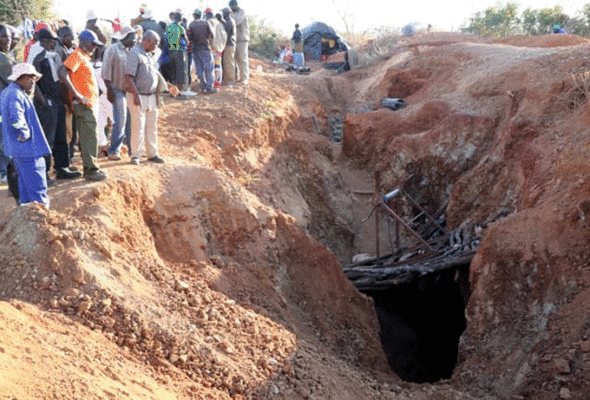
The Zimbabwe Republic Police (ZRP) has released the names of five of the seven Artisanal Miners who were killed after a mine shaft they were working on collapsed.

In a statement the ZRP announced the deceased as follows:-

Leo Chapondama of Maganyani village Masembura village, Bindura, Zolani Nyani (21) of Church Road, Chipadze Bindura, Samson Madyira (20) of Waerera Village, Jacob Madyira (20) of Waerera village and Mathew Madyira (23) of Waerera village, Masembura, Bindura.

Two other victims are yet to be identified by their next of kin.

Mining during the rainy season poses significant risks to artisanal and small-scale miners. Heavy rains claim lives at poorly maintained or secured mine shafts which collapse due to water infiltration, weakening soil stability in the rainy season.

Flash floods are a constant threat, often trapping miners underground or washing away equipment and ore. Increased water levels can lead to drowning incidents in poorly drained or abandoned mine pits. Additionally, wet conditions make it harder to transport materials and increase the risk of equipment failures and accidents.

Miners must prioritize safety measures, including proper drainage systems, reinforced supports, and regular weather monitoring to minimize these dangers. However, this is a challenge as some embark on illegal mining at disused mine shafts


Gold buying prices per gram in Zimbabwe 20 January 2025

These are the official gold buying prices per gram in Zimbabwe today 20 January 2025, from the official gold buyer and exporter Fidelity Gold Refinery (FGR).

SG 90% and ABOVE US$82.49/g
SG ABOVE 85% BUT BELOW 90% US$81.62g
SG ABOVE 80% BUT BELOW 85% US$80.74/g
SG ABOVE 75% BUT BELOW 80% US$79.87/g
SAMPLE BELOW 10g BUT ABOVE 5g US$78.56/g

Fire Assay CASH $82.93/g

NB: Fire Assay cash price is for gold above 100gs, no sample is deducted.
For the Fire Assay Transfer price, a sample of not more than 10g is deducted
A 2% royalty is charged on all deposits (Small-scale miners)
A 5% royalty is set for Primary Producers

Cash available. Fidelity Gold Refinery prices will be changing daily to match the world market.

Premier Secures $4.35 Million to Restart Zulu Lithium Lithium Operations

0

AIM Stock Exchange-listed mining and exploration junior, Premier African Minerals Limited, has secured approximately $4.35 million from a fundraising initiative, marking a crucial step toward restarting operations at its Zulu Lithium and Tantalum Project in Fort Rixon, Mining Zimbabwe can report.

By Rudairo Mapuranga

The fundraising effort includes a retail offer of $2.87 million through the issuance of 8.263 billion new ordinary shares at a price of 0.0275 pence per share, alongside a $1.5 million share placing. This ensures the company has the necessary capital to complete the final commissioning of the Primary Flotation Plant and purchase a Secondary Flotation Plant at the Zulu project.

The retail offer, part of Premier’s larger strategy to resume full-scale production at Zulu, comes at a 30% discount from the 15 January 2025 mid-market closing price. The success of the offer remains conditional on the new shares being admitted to trading on the AIM market of the London Stock Exchange by 23 January 2025.

Most of the funds raised will be directed toward critical operational needs, beginning with a 3-to-5-day test run of the plant. This phase is expected to cost $800,000 and includes the commissioning of the Secondary Flotation Plant. Additionally, $250,000 will go toward settling deferred VAT and other statutory obligations owed to the Government of Zimbabwe. Premier will also allocate $400,000 to cover overdue employee salaries and wages, and $180,000 will be used to pay suppliers of plant spares and maintenance costs.

The remaining balance from the fundraising will be used for partial payments to contractors and other creditors, facilitating the continuation of commercial operations at Zulu.

Alongside this, Premier has been negotiating with various creditors, suggesting they accept new shares as partial or full settlement of debts owed by the company and the Zulu project. The company expects these discussions to conclude shortly, with shareholders receiving updates on the issuance of settlement shares once agreements are finalized.

Gold buying prices per gram in Zimbabwe 17 January 2025

These are the official gold buying prices per gram in Zimbabwe today 17 January 2025, from the official gold buyer and exporter Fidelity Gold Refinery (FGR).

SG 90% and ABOVE US$82.53/g
SG ABOVE 85% BUT BELOW 90% US$81.66g
SG ABOVE 80% BUT BELOW 85% US$80.78/g
SG ABOVE 75% BUT BELOW 80% US$79.91/g
SAMPLE BELOW 10g BUT ABOVE 5g US$78.60/g

Fire Assay CASH $82.97/g

NB: Fire Assay cash price is for gold above 100gs, no sample is deducted.
For the Fire Assay Transfer price, a sample of not more than 10g is deducted
A 2% royalty is charged on all deposits (Small-scale miners)
A 5% royalty is set for Primary Producers

Cash available. Fidelity Gold Refinery prices will be changing daily to match the world market.

CNlite vs. Cyanide: A Comparative Analysis of Environmental Impact

0

In the world of gold mining, the choice of extraction methods can significantly impact the environment. Traditionally, cyanide has been the go-to chemical for gold leaching due to its effectiveness and relatively low cost. However, in recent years, alternatives like CNlite have emerged, touted for being safer and more environmentally friendly, Mining Zimbabwe can report.

By Rudairo Mapuranga

This article compares CNlite with cyanide, focusing on their environmental effects and the growing demand for greener mining practices.

Cyanide: An Effective but Controversial Method

Cyanide has been used in the gold mining industry for over a century, offering an efficient way to extract gold from ore. However, its environmental implications are significant. Cyanide is a toxic substance that poses severe risks to water sources, soil, and ecosystems if mishandled or if accidental spills occur. Cyanide spills have been responsible for the contamination of rivers and ecosystems, often leading to fish kills and long-term damage to local wildlife.

Moreover, cyanide poses a significant threat to human health. Communities near gold mining operations risk exposure to cyanide-contaminated water and air, which can result in respiratory issues, skin irritation, and even death in extreme cases. Despite advances in technology and strict regulations designed to mitigate these risks, accidents and mismanagement still occur, leaving cyanide as a controversial chemical in the mining industry.

CNlite: A Greener Alternative

In response to the environmental and health concerns posed by cyanide, CNlite was developed as an eco-friendly alternative for gold leaching. CNlite is non-toxic and biodegradable, making it a safer option for both miners and the environment. Unlike cyanide, CNlite does not pose the same level of risk to water sources and ecosystems, significantly reducing the potential for contamination.

From an environmental perspective, CNlite has several advantages over cyanide:

  1. Reduced Toxicity: CNlite is non-toxic and does not produce harmful by-products. This eliminates the risk of toxic spills that can devastate ecosystems, unlike cyanide, which can cause long-term environmental damage.
  2. Biodegradability: CNlite naturally breaks down in the environment, reducing the chances of residual contamination. Cyanide, on the other hand, requires additional processing to detoxify before disposal, often at a significant cost and risk.
  3. Lower Environmental Risk: The use of CNlite reduces the environmental footprint of mining operations. This is particularly important in sensitive ecosystems or areas where local communities rely on clean water sources for agriculture and daily living.

Cost vs. Environmental Responsibility

While CNlite presents a more environmentally responsible choice, the transition from cyanide to CNlite is not without challenges. Cyanide remains cheaper and widely available, which continues to make it attractive for many gold mining operations, especially in developing nations where cost is a key consideration. However, the long-term environmental costs associated with cyanide spills and contamination can far outweigh the initial savings.

Investing in CNlite and other non-toxic alternatives signals a shift towards more sustainable and responsible mining practices. As global awareness of environmental issues grows, and as governments and international organizations tighten regulations on mining operations, there is likely to be increasing pressure on companies to adopt greener technologies.

A Choice for the Future

The comparison between CNlite and cyanide reveals a clear winner in terms of environmental sustainability. While cyanide remains a powerful tool in gold extraction, its risks to the environment and human health cannot be ignored. CNlite, with its non-toxic, biodegradable properties, offers a compelling alternative that aligns with modern demands for eco-friendly mining practices.

As the gold mining industry evolves, the adoption of safer, greener alternatives like CNlite is not just a responsible choice; it is an essential step toward minimizing environmental impact and protecting the communities that live near mining operations. Ultimately, the future of mining lies in sustainable solutions, and CNlite is leading the charge in that direction.

Pambili’s Golden Valley Drilling Results Confirm Significant Gold Mineralization

0

Toronto Stock Exchange-listed mining and exploration junior Pambili Natural Resources Corporation has discovered a promising new development at its Golden Valley Mine (GVM) in Bulawayo, confirming the down-dip extension of gold mineralization at significant widths and grades, Mining Zimbabwe can report.

By Rudairo Mapuranga

The results from the company’s ongoing drilling program have excited the company, potentially reshaping the future of this historic mine.

The latest assays, conducted by Antech Laboratories in Kwekwe, Zimbabwe, revealed that Hole EADD001 intercepted a broad zone of sulphide mineralization, returning an intersection of 1.2 grams per tonne (g/t) gold over an impressive width of 17.2 meters. This critical find points to economic potential in the deeper unmined sulphides, offering a promising outlook for the future of the Golden Valley Mine.

Jon Harris, Pambili’s CEO, expressed his enthusiasm for the results, stating that his company is excited about the mine’s future.

“The Pambili team is highly encouraged by the grades and widths of gold mineralization encountered in the unmined sulphides beneath the historic workings at our Golden Valley Mine,” he said.

According to Harris, what makes this discovery particularly noteworthy is the structure of the mineralization. The upper mineralized zone returned 2.19 meters at 1.57 g/t gold, while the lower zone was even more promising, delivering 7 meters at 2 g/t gold. A standout highlight within this lower zone is a 2-meter section yielding 3.86 g/t gold, a high-grade intersection that adds considerable weight to the economic viability of the deposit. The zones are separated by a 6-meter wide stretch of internal waste with a lower grade of 0.29 g/t gold.

Historically, Golden Valley has produced around 2,500 ounces of gold at an average grade of 9 g/t, focusing mainly on shallow oxide mineralization. However, this recent discovery shifts attention to the deeper sulphides, where the company believes substantial untapped potential lies.

Harris emphasized the importance of these findings, stating that the company’s focus is now on establishing whether the potential scale of gold mineralization at Golden Valley is far more significant than previously recognized.

“With regional sulphide mineralization continuing to depths of more than 1 km, our focus is now on establishing whether the potential scale of gold mineralization at GVM is far more significant than previously recognized,” he said.

The Pambili CEO said that to explore this potential further, Pambili plans to develop a cross-cut from the existing sub-vertical shaft, aiming to expose both the upper mineralized zone and the up-dip extension of the lower zone. This step is crucial for obtaining metallurgical samples to assess the recoverability of the sulphide mineralization.

If recoverable grades are confirmed, according to Harris, the company intends to launch an on-strike development program, opening up new areas of the mine for further exploration and extraction.

“Our next phase is to extend the development of the planned cross-cuts and learn more about the extent of this anomalous zone of mineralization,” Harris said, outlining the company’s forward-looking strategy.

The discovery of down-dip extensions at Golden Valley marks a pivotal moment for Pambili Natural Resources. As the company moves to assess the true scale of these sulphide deposits, the potential for high-grade, deep gold resources could propel Golden Valley into a new era of production. These recent assay results, with their broad intersections and consistent grades, provide a solid technical foundation for future growth.

With ongoing exploration and strategic development, Pambili is poised to redefine the economic landscape of its Golden Valley Mine, positioning it as a critical player in Zimbabwe’s gold mining industry. As Harris concluded, “We look forward to learning more about the extent of the anomalous zone as we extend the development.”