

Home Blog Page 390

Mining, agric maintain grip as Zim exports top earners

0

ZIMBABWE’S agro-industrial and mineral commodities continue to maintain the grip as the country’s top export drivers further confirming agriculture and mining as the economic mainstays in meeting the national development agenda.

Under Vision 2030, the Second Republic aims to achieve an upper middle-income economy with a Gross Domestic Product per capita of US$3 500.

To set the tone towards an upper middle-income status, the Government has proclaimed the National Development Strategy 1, a five-year economic blue print, which is already being implemented and running from 2021-2025.

Driving the envisaged economic growth projections under NDS1, is the mining industry which is expected to attain a US$12 billion milestone by 2023 while the contribution from the agriculture sector would be US$1,9 billion by 2025.

Latest data on external trade availed by the Zimbabwe National Statistics Agency (Zimstat) show that in November 2021, the country’s main exports were tobacco (32,2 percent) and semi-manufactured gold (21,5 percent).

Constituting Zimbabwe’s major exports also are nickel ores and concentrates at 14 percent of Zimbabwe’s total exports during the month under review while nickel mattes including platinum group of minerals (PGMs) contributed 12,7 percent, ferro-chromium (4,8 percent), platinum unwrought or in powder form (three percent) and cotton (2,5 percent).

“It was noted that major minerals produced in the country such as nickel concentrates and nickel mattes were exported in a semi-processed form, while nickel ores (including PGMs) are exported in a raw form.


The Chronicle

Invictus in US$1,4m capital raising scheme

0

AUSTRALIAN energy firm Invictus Energy Limited (IEL) has issued a prospectus announcing another capital raising initiative for AUD2 000 000 (US$1 437 383,85) through a security purchase plan (SPP) offer.

This came hardly two weeks after IEL announced that it would issue 35 000 000 placement shares to professional and sophisticated investors at a price of AUD0,10 (US$0,071854654) per share to raise AUD3 500 000 (US$2 514 697,65).

The company later issued the 35 000 000 shares to complete the placement on January 6, pursuant to its existing placement capacity under the Australian Stock Exchange (ASX) rules.

However, as an additional capital raising initiative to bolster those efforts, IEL is now undertaking an SPP offer to eligible shareholders to raise an additional
AUD2 000 000 to enable eligible shareholders to participate in the capital raising initiative.

“The placement includes the issue of 17 500 000 free options, being one free option for every two shares subscribed for and issued pursuant to the placement. The issue of the options is the subject of the placement options offer under this prospectus,” IEL said.

“In addition to the placement, the company is undertaking the SPP offer to eligible shareholders, to raise AUD2 000 000 to enable eligible shareholders to participate in the capital raising.”

IEL said the free options would be exercisable at $0,14 (US$0,10056547) each on or before 5pm (WST) on January 31, 2025.

The firm added that all of the shares issued upon exercise of the options would rank equally with the shares on issue at the date of the prospectus.

“The SPP offer is an offer to each eligible shareholder to subscribe for a maximum of
AUD30 000 (US$21 566,126) worth of new shares at an issue price of AUD0,10 per share, together with one SPP option for every two SPP shares subscribed for and issued. Fractional entitlements will be rounded down to the nearest whole number,” IEL said.

Under the SPP offer, the total number of shares issued will not equate to more than 30% of shares on issue at the issue date of the shares.

Further, the issue price of the SPP shares is equal to or greater than 80% of the volume-weighted average price (VWAP) of shares for the five days in which trading in the shares occurred before the date of the announcement of the SPP offer.

IEL is extending the SPP offer to shareholders who were registered at 5pm (WST) on December 24, 2021 (the record date) and whose registered address is in Australia or New Zealand whom the company calls “eligible shareholders”.

“Oversubscriptions up to a further AUD1 000 000 (US$719 121,14) may be accepted, at the discretion of the directors, under the SPP,” IEL said.

“All of the shares offered under the SPP offer will rank equally with the shares on issue at the date of this prospectus … The options offered under the SPP offer pursuant to this prospectus will be exercisable at AUD0,14 (US$0,10063125) each on or before 5pm (WST) January 31, 2025.

“All of the shares issued upon exercise of the options will rank equally with the shares on issue at the date of this Prospectus. The SPP offer is non-renounceable, which means that eligible shareholders may not transfer their rights to any securities offered under the SPP offer.”

According to the IEL, the price of the shares under the SPP offer represents a 13% discount to the closing price of Invictus shares prior to the placement and SPP announcement last December. It also represents a 14,1% discount to the 5-day VWAP prior to that date.

IEL has participated in several capital raising initiatives as it continues to lack enough funds to realise the potential of its Muzarabani Project, located in the Mashonaland Central province in Zimbabwe.

The project is believed to hold significant oil and gas reserves.


NewsDay

Govt avails US$13m for Dorowa Minerals refurb

0

GOVERNMENT says US$13 million from the $2,3 billion allocated to Industrial Development Corporation of Zimbabwe (IDCZ) will be released in the first quarter of this year towards the refurbishment of Dorowa Minerals.

Industry and Commerce minister Sekai Nzenza says the project, which is expected to be commissioned in April this year, targets to achieve 70% output by mid quarter.

“The funds are expected to be released starting quarter 1 of 2022 for the refurbishment of the Dorowa plant to restore production to the name-plate capacity of 150 000 tpa which translates to over 430 000 tpa of NPK basal fertilizer. This output is enough for current and future NPK fertilizer,” she said

According to the ministry, a feasibility study is under way for a medium to long-term expansion project to increase capacity to 1 000 000t and production of all NPK basal fertilizers including high analysis for local and export in the sub-region.

Nzenza said government together with Confederation of Zimbabwe Industries, Zimbabwe National Chamber of Commerce and CEO Africa Roundtable were tracking capacity utilisation of local companies to ensure they contributed to the attainment of vision 2030.

“We are tracking the capacity utilisation of local companies. The target of 61% capacity utilisation will be monitored in 2022 so that we surpass that target as we contribute to the attainment of Vision 2030,”  Nzenza said.

Funds will be availed to the IDCZ  in 2022 to offer concessionary funding towards the promotion of import substitution and manufactured exports.

However, the government intends to increase Dorowa Minerals production and export for both phosphate and magnetite to take advantage of the trade agreements signed  with Sadc, Comesa, the Africa Continental Free Trade Area and the European Union.

Chemplex, a unit of the IDCZ, will install new equipment and machinery at its two units — the Buhera-based Dorowa Mines and Harare-based Zimphos, which is the country’s sole producer of phosphate fertilizers, aluminium sulphate for water treatment and sulphuric acid.

Zimbabwe’s fertilizer products are currently the most expensive in the region, partly due to high costs which lead to massive production inefficiencies.

The country’s demand for fertilizer in a normal farming season is about 600 000 tonnes, both basal and top dressing, of which 70% goes towards government farming programmes.


NewsDay

China frets over negative publicity

0

THE Chinese embassy in Zimbabwe has claimed that some unnamed Western media outlets were on a smear campaign to discredit its investments.

This follows media coverage of various incidents involving relocation of locals in areas where Chinese mining companies have claims.

“Some Western media outlets keep smearing Chinese investment in Zimbabwe by making and spreading fake news,” the embassy said in a statement yesterday.

“They are not guardians of the interests of the Zimbabwean people, but guardians of illegal sanctions imposed on Zimbabwe. Spooking Chinese investors in Zimbabwe is what they really want.”

Chinese mining companies have been accused of violating labour laws and human rights in areas they were operating.

In Marange, Manicaland province, Chiadzwa villagers are resisting eviction to pave the way for diamond mining by Chinese company Anjin Investments.

In Hwange, Matabeleland North province, 600 Dinde villagers are fighting government over a proposed coal mining project by Chinese mining company, Beifa Investments, as they fear displacement.

In Mutoko, 50 families are reportedly facing eviction to pave way for a granite mining venture by Chinese company, Jinding Mining Zimbabwe.

But in a statement, the company refuted the allegations.

It stated that only three families would be displaced, adding that two of the three families had been compensated.

“There is a malicious and false accusation currently being circulated to the effect that Jinding has not properly compensated two Mutoko families for relocating those families from the Jinding mining claims there.  As for the so-called relocation of 50 households, it is even more rumours and slander. The fact is that the mining project only involves relocation of three families. These accusations are completely groundless. Jinding has all relocation contracts and payment proof of proper compensation for the two families relocated by Jinding arising out of its mining operations,” the company .


NewsDay

Muzarabani project must not be another resource curse

0

THAT Zimbabwe has been blessed with abundant natural resources which could transform its economic fortunes overnight is not debatable. These resources range from diamonds, gold, platinum group of metals, coal, chrome, human, wildlife and land, to name but a few.

Given that rich natural resource base, why are citizens in perpetual poverty? Over a decade ago, the southern African nation catapulted itself to the global map of leading diamond producers, but the resource could not transform the country into even a regional economic powerhouse. Instead, the diamonds turned out to be a national curse as the elite fattened their pockets from proceeds of the earth while villagers living in the vicinity of the gem fields and the nation at large sank into abject poverty.

For many years, mining companies have robbed mother earth of on-demand minerals, with the bulk spirited out of the country for personal enrichment by those connected to the centre of power. Currently, all attention is on the Muzarabani oil and gas project in Mashonaland Central province. The project is being spearheaded by Australian firm, Invictus Energy Limited. If well managed, the project could easily turn out to be the panacea to Zimbabwe’s energy crisis given that these two energy sources drive economic activity globally. Barring everything, Zimbabwe could soon be out of the economic woods. But given our leaders’ propensity for self-enrichment from resources meant to benefit the nation, Muzarabani oil and gas reserves could easily become another national curse.

The rate at which the investor keeps rushing to the international market for capital makes the Muzarabani project appear iffy.

Since the signing of the deal in 2018, Invictus appears to be struggling to get the project off the ground. But, this shouldn’t be shocking as when the government signed the deal, the company only had an asset base of less than US$10 million, whereas high-profile projects of this nature require huge capital investments.

Invictus’s lack of preparedness for the deal first manifested in May 2020 when the firm announced a 25% cut to its board and management annual fees and remuneration in light of global market and oil uncertainty over the coronavirus. What this proved is that Invictus was inadequately capitalised, yet, President Emmerson Mnangagwa’s administration turned a blind eye to those tell-tell signs. Invictus is struggling so badly that it has announced participation in two capital raising exercises. The first was in 2019 when the firm raised US$1,5 million from new and existing investors. The second was held early last year where Invictus successfully raised US$6,2 million via a share placement to new and existing institutional and sophisticated investors.

The most obvious sign of Invictus’s struggles, however, was the recent announcement that in exchange for funding 33,33% of the costs for the Muzarabani project, the firm would give a 25% stake to British-based African oil and gas exploration firm, Cluff Energy Africa.

Given these financial inadequacies, why did the government rush to seal the deal?  Is this not a murky deal? Time will tell. We hope this is not going to be another feeding trough for the elite.

The nation still has vivid memories of the US$5,2 billion deal that government signed with South African company — Nkosikhona Holdings — that would have seen Zimbabwe produce over eight million litres of liquid fuels per day from coal in Lisulu, Hwange.

It later turned out that Nkosikhona Holdings was nothing but a shelf company, and like Invictus, had very few assets to prove that it could handle such a multi-million-dollar project.  Without sounding alarmist, we call on authorities to conduct due diligence on foreign investors so that the nation does not feel hard done when deals collapse before benefiting the economy. Food for thought.


NewsDay

Mine workers up against harassment of female miners

0

MINE workers have launched a countrywide campaign against the harassment of their female counterparts, after a female human resources officer at Duration Gold Investment (DGI) Private Limited, Queens Mine in Inyathi, Matabeleland North province, took her boss to court for sexual harassment.

The campaign was confirmed yesterday by the Zimbabwe Diamond and Allied Mineral Workers Union secretary-general Justice Chinhema.

“We are campaigning against the harassment of women in the world of work after we got a report from one of our members who were harassed at the DGI. This lady is being attacked by her immediate boss at work. She has not known peace since she rejected his proposals,” Chinhema said.

“As a union, we want this to stop and we are going to do everything within our powers, including taking this to international level. This is just one case, but we know that several women are suffering in silence and fear for their jobs.”

Chinhema said the manager in question was charged with indecent assault, while the union is of the view that the charge is too light.

He said they would be taking the matter to the Zimbabwe Anti-Corruption Commission, the National Prosecution Authority and Parliament to ensure justice is done for their members.

Court documents in possession of Southern Eye show that DGI administration manager Langton Mharira has a pending court case where he is accused of indecently assaulting a female employee at the mine.

It is alleged that on December 20, 2020, when Mharira arrived for orientation at the company, he proposed love to the lady and she spurned his advances.

In her statement to police, the lady claimed that she told him that she was married.

At the time when she was sexually harassed, the victim used to cook for the company’s chief executive officer, Francesco Marconati.

When Mharira visited the company for orientation, the woman also served him food as a visitor in the boardroom, where he asked Marconati about her marital status.

It is further alleged that when Mharira joined DGI in March as administration and logistics manager, the victim reported directly to him, and that was when the alleged abuses happened.

She alleged that some of the abuses included a salary cut after she refused his sexual advances.

“She took advantage of my gender and sexually harassed me, as well as indecently assaulted me in front of the general manager in his office,” the woman said in the court papers.

Mharira is denying the charges.


NewsDay

BREAKING: Eng Cleopas Furusa dies

0

Former Masvingo and Matabeleland South Province Provincial Mining Director (PMD) Eng Cleopas Furusa has passed away.

Eng Furusa passed on in Masvingo yesterday. His brother Mr Conwell Furusa confirmed the sad news.

Trained in the UK Furusa joined the Ministry of Mines and Mining Development in 1995 after an attachment stint at Dalny mine in Chakari. He worked in Kadoma as a Mining Engineer for the Kadoma mining district reporting to the regional mining Engineer stationed in Gweru. He was promoted to regional mining Engineer for Masvingo province. He also held the position of acting Chief Government Mining Engineer (CGME) several times at the Ministry.

Well known as a hard-working man who loved the catchphrases “Mamamia, Changamire, Shish” Furusa was promoted to Provincial Mining Director (PMD) for Masvingo around 2014/5. He was moved to Gwanda as PMD where he was involved in a road traffic accident which led him to resign on medical grounds.

Eng Furusa will be buried in Nhema tomorrow his brother advised.

“His body will depart Masvingo for Shurugwi in Nhema today where we expect he will be buried tomorrow,” his brother Conwell Furusa said.

Some of his former colleagues include the current acting Mines and Mining Development Permanent secretary Tahwa, Dep CGME Paskwavaviri, Dr Mandal (former CGME), Eng Wonder Farikai (now Unki Mine Manager), Kudakwashe Kajaidzire, amongst many others.

These are our heroes. May his dearly departed soul rest in eternal peace.

‘They Want To Remove Us And Take The Rock’: Mutoko Villagers

0

AS COMPANIES extract wealth, villagers say they see little benefit and are instead exploited in quarries, live in homes damaged by blasts and are unable to farm polluted land

A convoy of trucks laden with huge black granite rocks trundles along the dusty pathway as a group of villagers look on grimly.

Every day more than 60 trucks take granite for export, along this rugged road through Nyamakope village in the district of Mutoko, 90 miles east of Zimbabwe’s capital, Harare.

The air reverberates with blasts and heavy machinery noises as the mountain above the village is slowly reduced, slab by slab. Quarrying has been happening here since the 1980s.

Mutoko stone is sought after for its lustre. It is a popular material for tombstones. An extension to the Danish royal library in Copenhagen, known as the Black Diamond, is clad in Mutoko granite.

The Buja people who live here say that as mining companies extract wealth from the mountain, they leave behind a trail of damaged roads and bridges, hazardous pollutants and dirty air. Cracks can be seen on houses and blast debris is everywhere.

Now 50 families in the village have been told by a Chinese mining company that they will have to leave their homes and land. People in four other villages in the district fear they will also lose their ancestral lands.

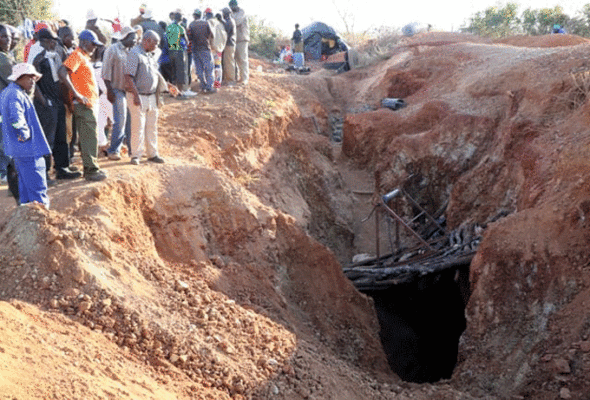
Two families, including an 82-year-old villager and his wife, have already been relocated by Jinding mining company, which wants to build a polishing plant.

“The 82-year-old man collapsed when he heard the news because he never anticipated it. He was later resuscitated at the hospital. This is how bad things are here,” says Claudine Mupereri*, 38.

She says the man was told his house was within the area licensed to the mining company by the government. Zimbabwe’s Communal Areas Act gives the president power to decide the use of an area that makes up 40% of the country’s land, home to about 70% of the population.

“These companies do not respect communities. If the government does not protect us, then where will we get the protection we need?” says Mupereri.

Two other families were given $2,500 (£1,840) to rebuild their homes, but community leaders say this is insufficient.

“There is uncertainty around this village. Right now, we do not have anyone willing to help us because our councillor does not want to help us. Anyone who dares to speak out is threatened. Whether they remove us or not, we are already scared to speak out,” says Anesu Nyamuzuwe*.

The 40-year-old father of four fears losing five hectares (12 acres) of land, his only source of income.

“I have a good farm with fertile soil. My farming always meets my household requirements. I had built a good home and I am close to Mutoko centre, so I am not sure if I will ever get such a piece of land again,” he says.

“What is more important, investors or the villagers? We should have the right to reject these people from entering our community.”

Jinding mining company in China could not be reached for comment.

A manager and interpreter at the company’s plant in Mutoko says families who live within the 500 hectares the company is licensed to mine will be relocated, but adds: “the people who are giving out the claims [to mining companies] have a problem. Why are they giving them [companies] so much land? This land is almost 500 hectares, I am sure they already know that people live in this place.”

Zimbabwe has enjoyed a close relationship with China for decades. But the bond between the two countries solidified when western states imposed economic sanctions on Robert Mugabe’s government.

As credit and investments dried up, China stepped in.

In 2018, Zimbabwe-Chinese relations were elevated from “all-weather friends” to strategic partners, paving the way for Chinese investors to pour money into the country, particularly in the extractive industries, where they have been accused of paying little attention to environmental damage by environmental and human rights activists.

Those living near granite mines say companies are failing to restore the land after extraction. Open pits are left uncovered, endangering children and wildlife.

Zimbabwe’s government has been accused of turning a blind eye to complaints because, critics say, it doesn’t want to anger its biggest investor.

Mineworkers speak of poor working conditions. At another mine in Mutoko, workers give accounts of beatings and poor pay.

“Imagine going to work every day for over 12 hours and getting $50 at the end of it all. When I get home I am tired. My home knows no peace,” one worker tells the Guardian.

“My friend was beaten with a steel rod and another 17-year-old boy had his arm broken after coming to work late. He was given $250 as compensation after villagers complained.”

In 2020, two workers were shot and wounded in Gweru, central Zimbabwe, allegedly by a Chinese miner after a quarrel over salaries.

Evelyn Kutyauripo, a paralegal with the Zimbabwe Environmental Law Association (Zela), who has been rallying villagers in Mutoko to resist evictions, says local officials need to protect people.

“I blame the headmen and the councillors because they are working with the Chinese. They should stand with the community,” she says, adding that companies were taking from communities and not helping them develop.

“They are not developing anything in the community. They should have a strong corporate social responsibility because they are killing our environment. We are suffering, our houses are cracking and there is pollution. The government should come to see what is happening.”

Another Chinese mining company, Shanghau Haoying Mining Investments, is also causing unease among Nyamaropa villagers.

Last year, the company was reportedly given a government licence to mine granite on tracts of land belonging to local people.

“I hear they want to remove us so that they take the rock, which is underneath, but the people do not want to. They will have to use guns to remove us here,” says Gladman Murape*, 34.

Shanghau could not be reached for comment.

Richard Ncube, a legal officer at Zela, says people in Mutoko were “extremely worried” about evictions. “The major challenge is they are living in the dark, and they are not sure what is going to happen.”

He said people were too scared to challenge the company. “We have gathered that most of the communities [in Mutoko] are afraid to come forward and take these matters to court due to intimidation and fear of being victimised,” says Ncube.

Attempts to challenge the mining companies elsewhere in Zimbabwe have had mixed results.

In November, Heijin mining company lost its mining licence in Murehwa, a district about 55 miles from Harare, after local leaders complained to the government that the company planned to evict locals.

In 2020, Zela was involved in the successful fight to overturn licences to mine coal in Hwange national park, the country’s largest national park, home to 40,000 elephants. Following protests, the government banned mining in all its national parks.

However, in September, hundreds of people in Chikomba district, 80 miles south of the capital, were evicted from their ancestral homes to make way for a $1bn iron and steel mining project.

The Zimbabwe government says it has not received any reports of abuse of workers in Chinese-owned mines, but it did encourage workers to report any incidents.

Deputy mines minister, Polite Kambamura, urged villagers to approach the ministry if they had problems.

“We haven’t heard of any Chinese company which has relocated people in Mutoko. If villagers are not happy, they may approach our provincial mining office in Marondera or come directly to the ministry,” he says.

“We understand that if ever there is a company that wants to relocate the people, they should engage the community, to buy that social licence from the community.”

Kambamura adds that an environmental impact assessment – to ensure the environmental, social, economic and cultural issues related to any mining project are considered before it begins – must also be conducted by the company and should address any concerns.

The Chinese embassy in Zimbabwe did not respond to numerous requests for comment. Mutoko leaders were also approached for comment.

Names have been changed


The Gardian

Chrome ore export ban excites local players

0

THE steel manufacturing sector has welcomed Government’s decision to ban exportation of chrome ore saying this will assist local players to secure ferrochrome at competitive rates.

The banning of chrome ore and chrome concentrate follows a Cabinet resolution that was made in August last year. The former is already effective while the later will be effective in July 2022.

In announcing the policy shift Minister of Information, Publicity and Broadcasting Services, Monica Musvangwa, on Tuesday said the ban of the chrome ore exportation will capacitate current smelters and maximise the value chain to be realised from the country’s abundant resources as spelt out in the National Development Strategy 1.

Institute of Zimbabwe Foundries (ZIF) president, Itai Zaba, said the Government’s bold stance was crucial for the metal foundry industry, which was facing challenges in securing inputs at affordable rates.

“Zimbabwe foundries will be able to get all grades of ferrochrome at better rates opposed to current high import cost,” he said.

“This means we will lower our cost of production and make our products cheaper on the market.”

This is also of the need to safeguard the ferrochrome industry including metallurgical processes such as steel manufacturing.

As such, Zaba said the ban will promote beneficiation of chrome ore, which will promote industrial growth, employment creation and technology transfer to the country.

He said the ban will not benefit the foundry family alone but downstream suppliers.

“Beneficiation will promote industrial growth via setting up of new plants and this will bring about the much-needed employment and also brings about technology transfer to Zimbabwe,” said Zaba.

“Also, the value chain cannot be closed in at the foundry alone, it goes far to various suppliers in services, chemical, gas, fuel, power, construction, banking and Zimra who will find opportunity to do business in the foundry and chrome beneficiation sectors.

“So, one should never be blinkered like a horse to only see the foundry industry in this equation, it’s a big net of benefits to the nation.”

Also commenting on the issue, chairperson of the Mines and Mining Development Parliamentary Portfolio Committee, Edmond Mkaratigwa, he said directive given by the Government was in the national interest.

“The Government has banned the export of chrome ore. This will bring long term benefits to the country, which will be seen soon as the decision was done at the interest of the people of Zimbabwe,” said Mkaratigwa.

“Market monitoring is important as returns are the main considerations in all business endeavourers. And this ban was done after determining the cost and benefits analysis of available options to the country and its citizens.

“There were challenges around returns from the sales of these primary resources relative to its benefits to its implicated citizens. These are the matters we need to consider,” he said.

Under vision 2030, President Mnangagwa’s administration has identified the mining sector as a key player towards realising an upper-middle-income economy.


Business Weekly

Invictus Energy on track for Zim oil, gas drilling

0

AUSTRALIA Stock Exchange-listed resources junior, Invictus Energy, says it is on track to commence its planned two-well oil and gas exploration drilling programme in Muzarabani in May.

The muzarabani prospect is believed to host 8,2 trillion cubic feet plus 247 million conventional gas condensate while  the total assessed reserves of Invictus’ special grant 4571 stand at 9,25TCf and 294 million barrels of condensate.

Discovery of oil/gas would mean significant benefits for Zimbabwe’s economy, including energy self-reliance, production of petro-chemicals, Liquified Natural Gas (LNG), fertliser, increased exports and fiscal revenue among others.

“We are planning for a successful drilling campaign, which if transpires will be a transformational event for both Invictus and Zimbabwe,” Invictus Energy managing director Scott MacMillan said.

Already, the company has posted major milestones on the project, including signing petroleum exploration development and production agreement with Government, completion of a seismic survey, signing agreements for a drilling rig and contract.

The company said this week it had secured the necessary casing, wellheads and long lead
items for exploration well drilling programme scheduled.

A well casing is a lining that is installed in an oil well once it is drilled and surrounds the well entirely. Typically, the casing is hollow steel pipe that lines the inside of the wellbore.

The casings are used to support the oil or gas wells, as the raw sides of the well would collapse in without the support rendered by these key equipment.

A wellhead is the component at the surface of an oil or gas well that provides the structural and pressure-containing interface for the drilling and production equipment.

Long lead items are those components of a system or piece of equipment for which the times to design and fabricate are the longest, and therefore, to which an early commitment of funds may be desirable in order to meet the earliest possible date of system completion.

The announcement came days after the Australian firm announced plans to raise A$5,5 million (A$) to finance further development of the Muzarabani project through issuance of at least 55 000 new shares.

The company also said it had completed an extensive tendering exercise for the integrated well services contract including cementing, directional drilling, logging. The formal award of the contract is expected shortly.

“We are very pleased with the way the drilling programme is coming together with Invictus securing the wellheads and casing long lead items for a high impact 2-well drilling programme,” said managing director Scott MacMillan.

“We are now finalising the well services contract award and working to execute the binding rig agreement with Exalo for the #202 drilling rig.

“Invictus remains on track for the upcoming drilling campaign to commence in May 2022,” he added.

Invictus has registered significant milestones in the exploration for and development of the Muzarabani oil and gas project, including completion of a seismic (subsurface data gathering) study and conclusion of drilling agreement with a British company.

The company, which expects that its recently concluded 2D seismic data will help refine the location and path of the planned Mzarabani-1 gas exploration that will test the potential of the Cabora Bassa project (Muzarabani), has also secured drilling for the project.

Official data shows that the Muzarabani prospect has been independently assessed to host prospective resources of about 9,25 trillion cubic feet of gas and 294 million barrels of condensate, essentially a light oil.

Invictus last year signed a petroleum exploration development and production agreement (PEDPA) with the Government, which spells out the rights and obligations of each party through the development phase of the project.

In terms of the fundraising, the Australia Stock Exchange (ASX) listed company has received firm commitments from sophisticated and institutional investors to raise A$3,5 million (before costs) by way of placement of new shares and US$2 million through a share purchase plan.

“As announced on December 9, 2021, we are positioning Invictus to undertake a 2-well exploration campaign commencing (first half of 2022) including the drilling of Muzarabani-1 well targeting prospective resources of 8,2 Tcf + 247 million barrels conventional gas condensate.

“We have a busy (first) half of 2022 planned with finalisation of our data processing for our seismic survey, update of our prospect and lead inventory, conclusion of our farm-out processnand securing long lead items as we embark on our planned 2-well drilling campaign of our world-class asset including the Muzarabani-1 well which will be one of the largest conventional targets drilled globally in 2022,” Mr MacMillan said last week.

Essentially, the funding enables Invictus to finance critical programmes ahead of planned exploration drilling of two oil and gas wells in Muzarabani, which the company has said is scheduled for the first half of next year.

Under the planned placement, Invictus Energy will issue 35 000 000 new fully paid ordinary shares (New Shares) at an issue price of A$0,10 per new share, a 13 percent discount to the last closing price on December 22, 2021.

Proceeds from the placement will be used to fund the rig mobilisation fee, purchase of long lead items for the planned second-well drilling programme and finalisation of the data processing of its Muzarabani seismic survey. A share placing (placement) is when new equity shares are issued to individual investors, corporate entities, or small groups of investors for capital.

This increases the amount of shares in issue and dilutes existing shareholders.

In concert with the placement, Invictus said it would offer all eligible shareholders a share purchase plan (SPP) to raise up to A$2 million, resulting in a maximum of 20 000 000 shares being issued under the SPP.

All eligible shareholders will have the opportunity to apply for up to A$30 000 worth of New Shares.

A share purchase plan (SPP) is a form of capital raising by a listed company that offers
share holders the opportunity to apply for new additional shares.

Regulations limit the maximum application per shareholder to A$30 000.

Typically, an SPP is conducted at a discounted price to the current listed price of the stock to encourage shareholders to purchase more shares.

“The issue price under the SPP of A$0,10 is equal to that of the new shares issued under the Placement, with SPP participants also receiving attaching options on a 1-for-2 basis, at a strike price of A$0,14, with a 3-year term,” Invictus said.

In the event of over-subscriptions, the company said its directors may also, in their absolute discretion, decide to increase share purchase plan acceptances by a further $1 million.

Proceeds from the SPP were to be allocated to further purchases of long lead items for the planned 2-well drilling campaign and for general working capital.


Business Weekly