Home Blog Page 401

Platinum miners seek exemption on beneficiation

0

Local platinum miners are seeking tax holidays on beneficiation projects to stimulate investments into the sector, a recent report says, citing views from a survey of industry executives. 

Vongai Mbara

The same concerns have been raised by Lithium producers who are arguing that the current tax beneficiation framework is discouraging investments into value-addition facilities. 

Mineral beneficiation has been identified as critical towards achieving the Government’s target of a US$12 billion mining industry by 2023. 

According to Platinum producers, tax incentives could boost investments into new and existing projects. 

“The PGMs producers indicated that they are currently engaging the Government for an optimal PGMs beneficiation framework,” says the report, which was commissioned by the Chamber of Mines of Zimbabwe (CoMZ). 

“Among key recommendations cited by platinum producers are removal of beneficiation taxes and the introduction of beneficiation incentives to accelerate capital spending in the beneficiation sector. The producers are looking forward to the Government adopting the recommendations and improving capital inflow into the sector.” 

The current platinum tax structure which took effect on January 1, 2018 penalises miners for export of white concentrate at 5 percent, white matte 2,5 percent and base metals 1 percent. The charges are levied on gross export value. 

The miners are saying they should not pay penalties for failure to beneficiate. 

Zimbabwe holds the world’s second-largest deposits of platinum after South Africa and has been pushing mining firms to build refineries to stop the export of raw platinum ore and optimise earnings. 

The report said potential investors view the current beneficiation tax framework as undermining projects’ net present value, resulting in some rejecting potentially viable projects. 

“The tax breaks on beneficiation projects are quite critical in the sense that they encourage investment into beneficiation facilities, especially at a time the Government is targeting to boost revenue from the mining industry,” Mr Carlos Tadya, an analyst with a local research firm, said. 

“It is an issue the Government needs to seriously look into.” 

On Thursday, Zimplats, a unit of Impala Platinum, announced that it would invest US$200 million in a base metal refinery (BMR) as part of its US$1,8 billion medium- to long-term investment plan for Zimbabwe. 

The BMR plant would have capacity for local PGM base metal refining as well as create more than 1000 jobs directly and indirectly. 

South Africa-based Anglo-American Platinum in 2019 commissioned a smelter at its Unki Platinum Mine in Zimbabwe, enabling the company to partially process ore in the country before sending it to South Africa for refining. 

Zimplats and Mimosa Mining Company are currently sending platinum matte to SA for refining. 

Zimbabwe plans to grow mining revenue to US$12 billion by 2023 as it seeks to transform the country into an upper middle-income economy by 2030. 

Gold exports are expected to reach US$4 billion while platinum exports are forecast to top US$3 billion. 

In the latest report, mining executives expressed confidence about future prospects on the back of positive commodity price outlook, improved capacity utilisation and anticipated increase in output. 

But they expect the domestic investment climate, characterised by high costs of capital, foreign currency constraints and poor infrastructure, to remain depressed. 

The Mining Business Confidence Index (MBCI), which gauges confidence among local miners, is expected to increase to 17 next year, from 9 in 2021 — the biggest jump in nearly four years. 

The index scale ranges from -100 to +100, with the lowest score representing the least level of confidence and the biggest score representing the highest. 

“Generally, mining executives are confident about the prospects for their businesses in 2022. 

“Notable among the positive sentiments include optimism about commodity price outlook, improvement in capacity utilisation and anticipated mineral output growth.” 

The majority of the mining executives surveyed said they were planning to ramp up production in 2022 by ranges of between 3 percent and 100 percent. 

Mines Committee visit unearthern a host of challenges at Bubi Gold centre

0

A tour by Hon Edmond Mkaratigwa led Mines and Mining Development Portfolio Committee has revealed a host of challenges that need urgent addressing at the Bubi gold Centre Mining Zimbabwe can reveal.

Yesterday the Portfolio Committee on Mines and Mining Development led by Hon Edmond Mkaratigwa went for a fact-finding mission at the popular gold service centre where ZMDC and local Small-scale miners converged to air their concerns and views on the operations at the service centre.

The purpose of the visit is dubbed: Enquiry into the gold mining sector problems.

Speaking at the visit, Bubi Small Scale Miners Association Chairperson Mr Siqduthando Ncube said the project was headed for failure as ZMDC was failing to fund small scale miners to bring gold ore at the milling centre.

He said the pilot project has failed on its mandate to be exemplary for other provinces to take a leaf because the implementation of the whole idea was offside.

“The only way this project can flourish is by empowering small scale miners. The resources are there but we are still using picks and shovels to extract ore. A pilot project should be adequately funded and be exemplary and it seems we have lacked on the implementation of the idea on paper, on the ground.

Bubi Miners Association Secretary Mr Benjamin Ndlovu implored the government to finish the project as it has not been as successful as was anticipated. Government must however draw lessons from that, and improve on the idea as it is still noble.

“We thought we were very lucky to get a milling centre but it has not been as expected. These milling centres do not need too much capital; but this has failed since 2018. The government must fully fund this project so that the investment benefits are fully realised” he said.

The small-scale miners also reported that ten compressors were ordered yet only three were delivered as of now, and time has lapsed, giving speculation of corruption.

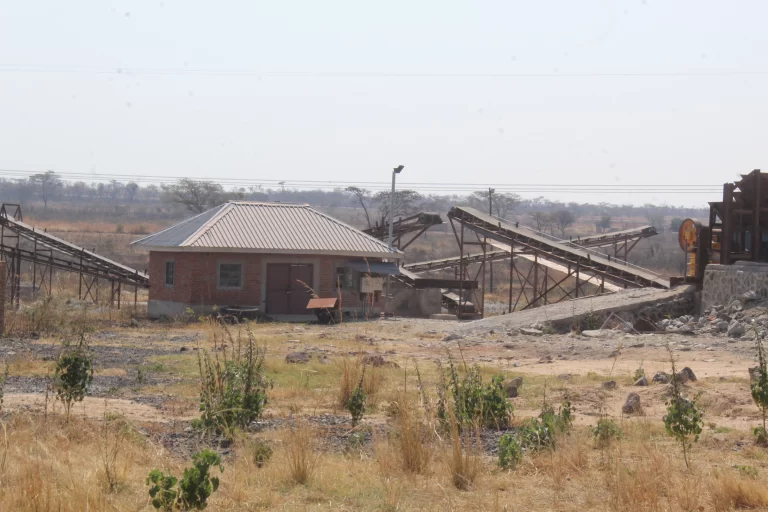
Some equipment in a shed is gathering dust as it is sitting idle with miners claiming the equipment is not of good use to them. The miners say the equipment they initially expected to be delivered and that which was delivered are completely different, which might have doomed the project from the beginning.

The Mines Committee arrived on-site before 9 am and departed after 13:00hrs, and at no time during that period did any miner bring in any ore. There also was no electricity and the centre was quiet yet unmistakable noise of mining equipment was heard from neighbouring mines. This led to Mines Committee members asking why the generator was not being used, while depending wholly on electricity which is unstable.

Zimbabwe Mining Development Corporation (ZMDC) Non-Executive Director Mr Peter Chimboza speaking at the visit yesterday said, his company which owns 60 per cent of Bubi Gold Milling Centre was failing to raise capital to increase its milling volumes as as such, there has not been enough apex to channel to the growth of the ASM sector in Bubi.

He said that because his company was under sanctions, it has been difficult for them to source for outside investment as investors are not willing to be associated or to risk their money in a project that can be blacklisted due to ZMDC sanctions.

Chimboza said it was of importance for the government to take a leaf from the Bubi Centre as it has proved that the project is achievable but there are things that needed to be addressed.

“We are not able to raise funds because of sanctions. The main thing that we want is to grow our milling volumes because the ore is there in this area but the equipment is not enough for small scale miners to bring big tonnes.

“We are hoping through the help of the government to fund the miners, if miners are capacitated we will have big volumes to mill here.

“This is however a pilot project, we hope after this we will have successful gold service centres,” Chimboza said.

Parliamentary Portfolio Chairperson on Mines and Mining Development Hon Edmond Mkaratigwa asked the Bubi Gold Milling Centre to write a proposal on what was needed to finish the project so that it may be presented in parliament.

The milling centre according to Chimbodza has provided a learning curve for the other gold service centres to be established. He said that financial support for the milling centre can be of huge significance to the US$12 billion mining roadmap.

Speaking to Mining Zimbabwe after the meeting, Mines and Mining development Portfolio Committee Chairman Hon Edmond Mkaratigwa said, “We have been informed that a CPA plant which will be able to handle more than a 100 tonnes per day is envisaged but it needs a budget of more than USD400 000 which we support.”

“We also hope that the gaps that are existing in terms of the operations around the facility are going to be addressed and that will see stakeholders who are the Artisanal and Small-scale miners responsible for the feedstock being properly funded and properly capacitated in terms of equipment and machinery to rump up their production. That will also see the replacement of the crushers on site to make sure we have morden crushers that can actually be able to process more material and rump up production which will feed into the dump and ultimately feed into the CPA plant. This will go a long way in ensuring that we meet the 4 Billion dollar target that we expect from the gold sector torwards the 12 billion dollar mining industry by 2023,” Mkaratigwa concluded.

Gold service centres are a priority for the achievement of the President Dr Emmerson Dambudzo Mnangagwa for the country to achieve an upper-middle-income economy by 2030 with the National Development Strategy-1 (NDS-1) emphasising on the state-run gold milling centres to help capacitate small scale and artisanal miners as well as increasing gold recovery methods among these micro miners.

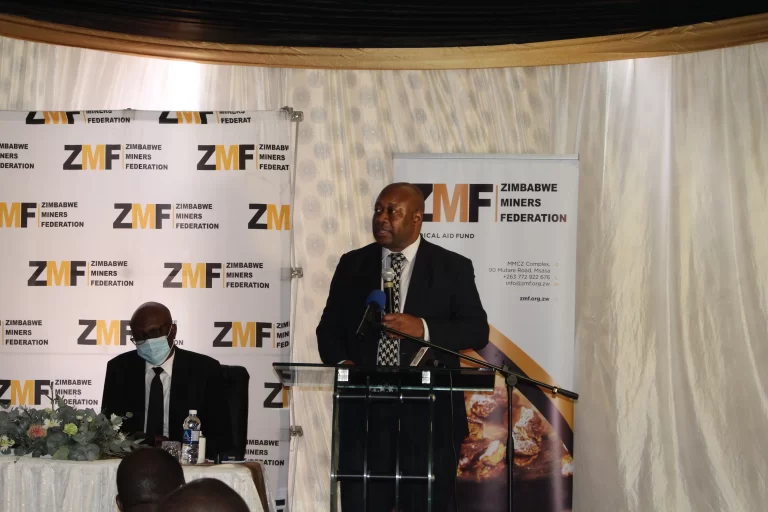
The Bubi Gold Milling Centre on paper is a project that is necessary for the growth and development of the small scale and artisanal gold miners whose vision through their representative body Zimbabwe Miners Federation (ZMF) is to see the ASM sector moving to an international standard of junior mining and achieving a US$4 billion annual revenue by 2023.

RBZ hails mining sector for 78% Forex contributions

0

The Reserve Bank of Zimbabwe (RBZ) has hailed the mining sector for contributing 78% out of the total foreign currency injections amid calls for the public to exercise discipline in avoiding exchange rate volatility.

Vongai Mbara

Addressing delegates at a function to launch the Mining Industry Report last week, RBZ governor, John Mangudya said the foreign currency realised through retention was significant.

“From January 25 to October 2021 stood at 78 %. During the period, US$3,4 billion in total was earned, out of which US$1,37 billion was surrendered through the 40% export surrender thresholds. We would like to appreciate miners for doing a good job,” he said.

The top five earners after retention threshold deductions during the period were Platinum at US$703 million, Gold US$147,9 million, Ferro Chrome US$105 million, diamonds US$45 million, and Coke US$23,6 million.

Quizzed by delegates on what the central bank is doing to close the gap between the two exchange rates, Mangudya said the problem bedeviling the economy has more to do with discipline.

He said all the countries have a gap between the official and parallel market exchange rates and underscored the need for consistency.

“For the past three weeks, the challenge has been the problem of the volatility of the parallel market rates. If the parallel market rate is at US$1: $140 and because of indiscipline some entities decide to increase the exchange rate to US$1 :$200 it will cause volatility.

“If the parallel markets remain stable, it means prices will remain stable, the volatility in the parallel exchange markets is often confused with the gap between the two exchange rates. In countries like Nigeria and Malawi, there are huge gaps between the two exchange rates. So we need to understand why we have such volatility in the markets,” he said.

He challenged business leaders to instill good corporate governance realising that the use of foreign currency in this economy alongside the local currency is a privilege that requires discipline and maturity.

Minerworkers fall into a 50m shaft

0

Two Mangwe mineworkers have died after falling into a 50m shaft. 

Vongai Mbara 

Cleopas Moyo (28) and Prosper Ncube (27) were reportedly descending into the shaft when a hoist they were using developed a fault and crashed down the shaft. 

Matabeleland South provincial police spokesperson Inspector Loveness Mangena confirmed the incident which she said occurred at Thuthukani Mine in Mpoengs on October 22 around 10 am.  

“I can confirm that we recorded a fatal mine accident at Thuthukani Mine in Mpoengs area where two mineworkers died. The two descended into a 50-metre-deep shaft using a hoist. 

“Along the way, the hoist developed a mechanical fault and made a free fall and crashed down the mine taking the two mine workers down with it. They sustained head injuries and bruises as a result of the accident and they died on the spot,” she said. 

Insp Mangena said other mine workers who were at the scene retrieved the bodies of their workmates from the shaft. She said the matter was reported to the police who attended the scene and the bodies were ferried to United Bulawayo Hospitals. Investigations are still underway. 

Insp Mangena called on mine operators to ensure that the work environment is safe for their employees. 

“We continue to record fatal accidents in mining areas as a result of mechanical faults. We call on mine operators, mine owners and managers to ensure that their equipment is constantly inspected and serviced to ensure that it’s working properly so that workers are not exposed to danger. Mine operators also have to ensure that their working environment is safe. 

“Mineworkers also have to ensure that their safety is prioritised and they should also work in safe areas. It’s also important for mine workers to put on safety clothing when working,” she said. 

Potential of 200g per tonne for Ragusa

0

Australian Stock Exchange-listed mining company, Ragusa Minerals Limited’s Underground Reconnaissance Works at the firms’ Tiberius prospect or Lonely mine in Bubi shows the potential of the mine to get up to 221g/t, the company’s quarterly activity report for the quarter ended 30 September shows.

Rudairo Mapuranga

The company said that underground channel/rock sampling works were completed at the Tiberius prospect during the quarter with 13 underground samples collected from the mineralised reef that returned significant analysis results, including 221g/t, 68g/t, 49.5g/t and 45.8g/t.

“Underground reconnaissance works (access via the Tiberius shaft), comprising underground surveying and channel/rock sampling works were conducted at the Tiberius prospect.

“Thirteen underground samples were collected from the mineralised reef (undiluted) and analysed, with results achieved up to 221g/t. Other significant sampling results include 68g/t, 49.5g/t and 45.8g/t.” the company said.

The company also said that, during the quarter, first stage diamond drilling works comprising 8 diamond drill-holes totalling 1236.64m were completed at the high-grade Tiberius prospect and laboratory analysis works are currently being conducted and sample results are due shortly.

“The first phase diamond drilling works at the Tiberius prospect was completed, with 1236.64m drilled at eight priority drill sites.

“The Company’s technical site personnel have completed core logging and sampling works, with selected samples currently undergoing laboratory analysis testing, with sample results due shortly,” said Ragusa.

Ragusa through its chairperson Jerko Zuvela said that it has received its Environmental Impact Assessment (EIA) approval to allow the full commercial development of gold mining and processing operations at the Lonely Mine Gold Project, including the Tiberius prospect for a period of two years (with renewal thereafter).

The Lonely Mine Gold Project is located ~88km north of Bulawayo, within the Bubi Greenstone Belt, in Zimbabwe. The Project covers greenstone belt lithology with multiple sub-parallel shear zones that host the historical Lonely and Tiberius gold mines and several other former mines, with similar geology as globally accepted Archean successions from Canada, Australia and South Africa. The Project area has not had any modern-day systematic exploration with the opportunity to benefit from utilising modern exploration techniques.

The Company conducted works on an exploration targeting program across the Tiberius prospect area, culminating in completing the initial diamond drilling campaign. The exploration targeting program fieldwork conducted during the Quarter comprised underground reconnaissance, surveying and channel/rock sampling, and completion of the first stage diamond drilling works.

Anjin, Marange villagers’ battle continues

0

Scores of villagers from Marange yesterday staged a demonstration against Chinese diamond mining company, Anjin which is yet to compensate nearly 500 families that it displaced from their traditional homes to Arda Transau.  

Vongai Mbara  

The villagers are demanding their land and cultural rights, compensation and consultation to access environmental information.  

According to Arda Transau residents, the outstanding Bill and Liabilities for Anjin diamond mining company to settle for households relocated from Marange includes compensation for 476 families, title deeds for houses, irrigation, Pastures and electrification of houses.  

The firm which operated in the area from 2009 – 2016 before its license was revoked by the Mugabe regime leading to the formation of the Zimbabwe Consolidation Diamond Company (ZCDC) has been accused of looting the country’s diamonds with the state getting very little in return.  

Its return during the second republic era sparked a lot of controversies with villagers calling the government to halt the company’s mining operations claiming that the company has a dark past including human rights abuses.  

According to the villagers, Anjin mining operations destroyed the community infrastructure such as roads, bridges, schools, degraded farming land, sacred areas and contaminated sources of (drinking) water.  

The villagers claimed that over 4 000 cattle were lost after falling into mining pits, gullies and slime dams, around 450 families were relocated to Arda Transau without secured livelihoods and compensation for their losses. 

Illegal miners invade a Mberengwa school

0

Illegal miners have invaded Vanguard Primary School in Mberengwa District where they are digging pits in search of gold, putting the classroom blocks at risk of collapsing.  

Vongai Mbara 

The miners reportedly discovered a gold belt near the school and are now advancing very close to classroom blocks, causing alarm in the community. 

Education ministry spokesperson Taungana Ndoro said he has not yet received any report about the issue, adding that they will probe the issue.  

According to the locals, they have taken the issue to the local traditional leaders and the police, but no action has been taken yet. 

The community is worried that the miners are causing land degradation in their environment, polluting the air and will possibly destroy their classroom blocks.

In addition, they say the blasting and mining activities within the school’s vicinity are making a lot of noise, making it difficult for learners to fully concentrate in class.   

Mberengwa Miners Association chairperson Anderson Tsikira condemned the illegal miners’ behaviour saying they were not part of his association.  

“These people are not registered under us and they do not subscribe to our code of conduct. If they were part of us, they were not going to behave this way.   

“We are pro-development and we do not condone any behaviour that seeks to destroy public institutions or any infrastructure that benefits the community. We will investigate more into this and establish who the culprits are,” he said.

Huge boost for Arcadia lithium

0

Australian Stock Exchange-listed mining and exploration junior Prospect Resources has received firm commitments for A$18 million in new equity proceeds via an institutional placement of 45 million new ordinary shares, funds raised from the Placement are to be principally used for advancing the development of the Arcadia Lithium Project in Goromonzi.

Rudairo  Mapuranga

According to Prospect Resources Managing Director Sam Hosack said the company was happy with the support it received. Hosack said that funds raised from the Placement are to be principally used for, Advancing development of the Arcadia Lithium Project (Arcadia or the Project) through Front End Engineering and Design (FEED), to undertake early works and secure long lead items; Advancing the current strategic partnership process; Undertaking further regional exploration and development activities; and General working capital purposes.

The Arcadia Lithium Project is projected by the Minister of Mines and Mining Development Hon Winston Chitando to be one of the biggest US$0.5 Billion lithium annual revenue generators by 2023.

Hosack said that the Placement was strongly supported by new Australian and international institutional investors and the Company’s largest shareholder Eagle Eye Asset Holdings Pty Ltd.

“We are very pleased with the strong support received for the placement as we look to accelerate the Arcadia Project. We thank our existing shareholders for their ongoing support and welcome a number of new, high-quality institutional investors to our register. We believe the size and depth of the interest received for this raising is a robust endorsement of Prospect’s management team and development strategy for the Arcadia Project.”

“We are working hard to complete the Direct Optimised Feasibility Study on the Arcadia Project during the current quarter. As previously flagged, the direct development route to 2.4 Mtpa throughput is the key focus of Prospect and the counterparties engaged in our current strategic partnership process.”

“This Placement provides us the flexibility to progress the project, select the best possible partner while also allowing us to pursue growth opportunities for REE and lithium resources, particularly if we were able to secure additional feedstock for Arcadia’s future,” Hosack said.

Zimplats in US$1.8 billion projects

0

Zimbabwe’s biggest platinum group of metals producers, Zimplats has invested US$1.8 billion in growth projects a development that will aid in the resuscitation of the country’s economy.

Anerudo Mapuranga

According to Zimplats Chief Executive Officer Mr Alex Mhembere, the company has invested US$386.2m towards Mupani Mine re-development and US$82m on Bimha mine upgrade. The mines are expected to replace for depleting Rukodzi, Ngwarati and Mupfuti mines. The Australian Stock Exchange-listed miner also invested US9m in Hartley mine development.

He said that the company invested US$133m on a third concentrator plant with the capacity to create 100 direct permanent jobs at the same time increasing its ore milling capacity from 6.7 Mtpa to 7.52Mtpa.

PGM base metal refinery (BMR) plant cost the miner US$200m. The base metal refinery has the capacity for local PGM base metal refining and has the capability to create 100 direct jobs and at least 1000 in-direct jobs.

The expanded smelter will cost a total of US$280m with smelting capacity increased from 132-kilo tonnes to 380 kilotonnes of smelted concentrates, Capacity to smelt own-sources and local third parties, Employment creation of 40 permanent jobs, saving on transportation of bulk concentrates across the border, and avails the opportunity for new mines to reduce capital requirements.

Zimplats according to Mhembere will invest US$200m in the Sulphuric acid plant that the company intends to install will produce 100-kilo tonnes per annum. The sulphuric acid will be used in the manufacturing of fertilizers in the country thereby reducing acid imports.

The mining sector plays a pivotal role in the country’s economic development, contributing more than 60 per cent of exports revenue, employing over 45 000 formal employees and attracting significant foreign direct inflows into the country.

Zimplats has been supportive of the government’s vision to see the economy achieving an upper-middle-income status by 2030 and the mining industry becoming a US$12 Billion industry by 2023. Platinum is targeted to contribute US$3 Billion in annual revenue by 2023.

Zimplats has reached a milestone towards sustainable development of the platinum sector by increasing melting capacity from 132-kilo tonnes to 380-kilotonnes of smelted concentrates with the capacity to smelt own-sources and local third parties.

Mhembere said the company will also build a 110 MWAC Solar power plant for US$201m with sufficient capacity to satisfy the needs of the company, including related mining and mineral beneficiation facilities.

The company will also invest US$20m to build houses for its workers.

Mining companies should take a leaf from Zimplats -Mnangagwa

0

The President of Zimbabwe Dr Emmerson Dambudzo Mnangagwa has encouraged mining companies to follow in the footsteps of the country’s largest platinum producer, Zimbabwe Platinum Mines (Zimplats) for the mining sector to achieve a US$12 Billion achieve revenue by 2023.

Rudairo Mapuranga

Speaking at the Signing Ceremony of The Memorandum of Agreement between the Government of Zimbabwe and Zimplats at the State House today, the President said the Platinum mining giant undoubtedly has the largest operations in Zimbabwe and it is leading by example in their desire to expand their operations.

His Excellency said that Zimplats’ desire to expand its operations is a clear sign that investors have confidence in how the current government is operating to create a safe environment for business.

“It is exciting to note that a number of developments are happening within the platinum mining sector, pointing towards growth in line with Government’s vision. The growth is mainly anchored on exploration, opening up of new mines as well as expansion of existing projects.

“The coming in of the new projects as well as the expansion of existing ones is a testimony of confidence that investors are showing towards the Second Republic. My Government will always strive to ensure there is an enabling environment that supports business growth and security of tenure. We invite all our investors to come to Zimbabwe and do business with us for mutual benefits,” Mnangagwa said.

Zimplats intends to expand its existing operations through various projects with a total investment of US$1.4 Billion. These projects include new mine development, additional concentrator, Platinum Group Metals (PGMs) smelter expansion, PGM Base Metal Refinery (BMR) plant, sulphuric acid plant as well as the 110 MW Solar power plant.

The expansion project will generate employment to more than 2000 employees and the net benefit of the government will be estimated at just over US$1 billion over a five-year period.

The Sulphuric acid plant that the company intends to install will produce 100 kilotonnes per annum. The sulphuric acid will be used in the manufacturing of fertilizers in the country thereby reducing acid imports.

The President also praised Zimplats for the desire to improve and establish value addition and beneficiation plant supporting the government’s vision for the country to become an upper-middle-income economy by 2030 in line with the National Development Strategy-1 (NDS-1) which aims to improve local beneficiation levels in the mining sector to ensure the country benefit meaningfully from its natural resources.

“I am glad, therefore that Zimplats in one of its projects intends to construct a Base Metal Refinery (BMR). This is another giant step forward in local mineral beneficiation and value addition, as we move towards full beneficiation of platinum in the country,” the President said.

Zimplats also intends to develop a 110 MW solar power plant, with sufficient capacity to satisfy the needs of the company, including related mining and mineral beneficiation facilities.

The President implored the government and the private sector to continue working together to ensure the development of the country towards the achievement of Vision 2030.