

Zimbabwe’s biggest platinum group of metals producers, Zimplats has invested US$1.8 billion in growth projects a development that will aid in the resuscitation of the country’s economy.
Anerudo Mapuranga
According to Zimplats Chief Executive Officer Mr Alex Mhembere, the company has invested US$386.2m towards Mupani Mine re-development and US$82m on Bimha mine upgrade. The mines are expected to replace for depleting Rukodzi, Ngwarati and Mupfuti mines. The Australian Stock Exchange-listed miner also invested US9m in Hartley mine development.
He said that the company invested US$133m on a third concentrator plant with the capacity to create 100 direct permanent jobs at the same time increasing its ore milling capacity from 6.7 Mtpa to 7.52Mtpa.
PGM base metal refinery (BMR) plant cost the miner US$200m. The base metal refinery has the capacity for local PGM base metal refining and has the capability to create 100 direct jobs and at least 1000 in-direct jobs.
The expanded smelter will cost a total of US$280m with smelting capacity increased from 132-kilo tonnes to 380 kilotonnes of smelted concentrates, Capacity to smelt own-sources and local third parties, Employment creation of 40 permanent jobs, saving on transportation of bulk concentrates across the border, and avails the opportunity for new mines to reduce capital requirements.
Zimplats according to Mhembere will invest US$200m in the Sulphuric acid plant that the company intends to install will produce 100-kilo tonnes per annum. The sulphuric acid will be used in the manufacturing of fertilizers in the country thereby reducing acid imports.
The mining sector plays a pivotal role in the country’s economic development, contributing more than 60 per cent of exports revenue, employing over 45 000 formal employees and attracting significant foreign direct inflows into the country.
Zimplats has been supportive of the government’s vision to see the economy achieving an upper-middle-income status by 2030 and the mining industry becoming a US$12 Billion industry by 2023. Platinum is targeted to contribute US$3 Billion in annual revenue by 2023.
Zimplats has reached a milestone towards sustainable development of the platinum sector by increasing melting capacity from 132-kilo tonnes to 380-kilotonnes of smelted concentrates with the capacity to smelt own-sources and local third parties.
Mhembere said the company will also build a 110 MWAC Solar power plant for US$201m with sufficient capacity to satisfy the needs of the company, including related mining and mineral beneficiation facilities.
The company will also invest US$20m to build houses for its workers.
The President of Zimbabwe Dr Emmerson Dambudzo Mnangagwa has encouraged mining companies to follow in the footsteps of the country’s largest platinum producer, Zimbabwe Platinum Mines (Zimplats) for the mining sector to achieve a US$12 Billion achieve revenue by 2023.
Rudairo Mapuranga
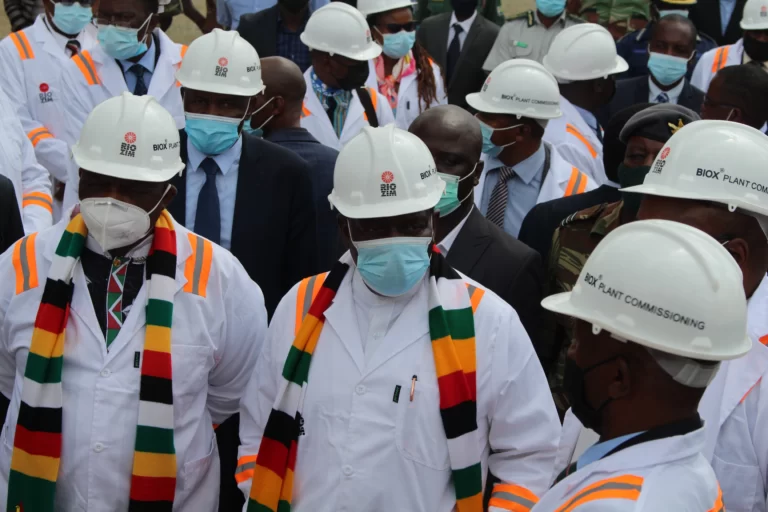
Speaking at the Signing Ceremony of The Memorandum of Agreement between the Government of Zimbabwe and Zimplats at the State House today, the President said the Platinum mining giant undoubtedly has the largest operations in Zimbabwe and it is leading by example in their desire to expand their operations.
His Excellency said that Zimplats’ desire to expand its operations is a clear sign that investors have confidence in how the current government is operating to create a safe environment for business.
“It is exciting to note that a number of developments are happening within the platinum mining sector, pointing towards growth in line with Government’s vision. The growth is mainly anchored on exploration, opening up of new mines as well as expansion of existing projects.
“The coming in of the new projects as well as the expansion of existing ones is a testimony of confidence that investors are showing towards the Second Republic. My Government will always strive to ensure there is an enabling environment that supports business growth and security of tenure. We invite all our investors to come to Zimbabwe and do business with us for mutual benefits,” Mnangagwa said.
Zimplats intends to expand its existing operations through various projects with a total investment of US$1.4 Billion. These projects include new mine development, additional concentrator, Platinum Group Metals (PGMs) smelter expansion, PGM Base Metal Refinery (BMR) plant, sulphuric acid plant as well as the 110 MW Solar power plant.
The expansion project will generate employment to more than 2000 employees and the net benefit of the government will be estimated at just over US$1 billion over a five-year period.
The Sulphuric acid plant that the company intends to install will produce 100 kilotonnes per annum. The sulphuric acid will be used in the manufacturing of fertilizers in the country thereby reducing acid imports.
The President also praised Zimplats for the desire to improve and establish value addition and beneficiation plant supporting the government’s vision for the country to become an upper-middle-income economy by 2030 in line with the National Development Strategy-1 (NDS-1) which aims to improve local beneficiation levels in the mining sector to ensure the country benefit meaningfully from its natural resources.
“I am glad, therefore that Zimplats in one of its projects intends to construct a Base Metal Refinery (BMR). This is another giant step forward in local mineral beneficiation and value addition, as we move towards full beneficiation of platinum in the country,” the President said.
Zimplats also intends to develop a 110 MW solar power plant, with sufficient capacity to satisfy the needs of the company, including related mining and mineral beneficiation facilities.
The President implored the government and the private sector to continue working together to ensure the development of the country towards the achievement of Vision 2030.
Large scale mining companies have said that foreign exchange retentions at 60% are inadequate to meet their operational requirements with the value of surrender potion that is liquidated into local currency at the official rate being ordered by the parallel market rate being charged by most suppliers.
Vongai Mbara
This was raised at the 2021 state of the mining sector report by the Chamber of Mines Zimbabwe. In the report, miners said they are losing 20% gross export proceeds due to exchange rate disparities.
“We have been asking for the increase of the foreign currency retention levels to above 60% and decrease of the forex surrender requirement but to date, nothing has been done. What we are now asking is for the RBZ to allow us to pay electricity, levies, taxes and royalties with the liquidated portion at a prevailing official market rate.”
Miners highlighted that the 60% retained catered for royalties, electricity bills, taxes and some statutory obligations in forex as well as the widespread preference for US$ by suppliers.
This comes at a time where miners are struggling to access foreign currency from the forex auction system with their bids rejected on the basis that they are net exporters.
“Most respondents are expecting the Chamber to engage authorities to improve the forex situation. Respondents are also looking forward to the government allowing them to pay for royalty, electricity, taxes and other statutory obligations indicating the value of the surrender portion that is liquidated into local currency,” reads part of the report.
According to the report, the miners indicated that the value of the surrender portion that is liquidated into local currency at the official auction-rate has been significantly eroded on the back of the parallel market which is used for pricing goods and services by local suppliers.
“To restore the value of the surrendered portion, respondents are looking forward to authorities to allow mining companies to pay taxes, royalty, electricity and other statutory obligations in local currency and pricing of taxes, fees and charges at the obtaining auction market rates,” the report said.
The miners said authorities should ensure that the auction market is driven by forces of demand and supply to dictate the exchange rate.
The miners are expecting the foreign exchange framework to remain suboptimal citing the reduction in foreign currency retention levels, the disqualification of mining companies from participating in the auction market, loss of value on the surrendered portion of export proceeds and delays in payments for mineral deliveries as undermining the foreign exchange situation for the mining industry.
They said Rural District Councils (RDCs) charges are high, unaffordable and vary with the district and some councils were invoicing miners in foreign currency.
In the outlook, mining executives are looking forward to the government intervention in unifying the charges for RDCs and expect the charges to be paid in local currency.
According to the report, mining executives said the Environmental Impact Assessment fee at 1.2% of project cost with a cap of US$2m is prohibitive for new projects and discourages investment into the mining sector.
In 2022, almost all respondents expect the government to reduce the fee in line with best practices.
Miners’ engagements with the monetary authorities on the matter are ongoing but the Chamber said the RBZ governor John Mangudya still sticks with his Monetary Policy Statement stance.
Last year, the Reserve Bank of Zimbabwe reviewed the forex retention to 70% from 55% as part of efforts to increase production.
In the report, the miners indicated that the foreign exchange retention at 60% was inadequate to meet their operational requirements.
However, the need to fund the forex auction system has pushed the monetary authorities to increase the export surrender requirement to 40% from 30% and the move has left miners short of requirements.
RBZ said it would maintain and sustain the auction system through the 40% export surrender requirement, 20% domestic foreign exchange sales surrender requirement and 15% foreign exchange contribution from the fiscus.
RBZ said maintaining the exchange auction system remains paramount in anchoring inflation and maintaining price and financial system stability.
The apex bank said it will continue refining the foreign exchange auction system taking into account fundamentals as well as closely monitoring the utilisation of funds.
The RBZ’s bid to stabilise the auction system has negatively affected the mining sector as the capital for production will be used to sustain the market.
Zimbabwe is in a serious fix over how best the authorities can deal with forex backlog, stabilise the exchange rate and address the forex challenges.
Miners said these are the issues that they have been grappling with over the last decade.
However, the RBZ said some issues will be addressed in due course to improve production levels.
The central bank expects mining export receipts to go up 20% to US$4.4bn from US$3.65bn due to firming international prices and improved mining policies.
The Chamber of Mines yesterday released the State of the Mining Industry Report, Prospects for 2022 which shows increased confidence in the sector’s outlook by mining executives.
The report, which comes out annually, gives an insight into the challenges and prospects for the capital-intensive mining sector – the largest generator of foreign currency for the economy.
According to the report, notable among the positive sentiments include optimism about commodity price outlook, improvement in capacity utilisation and anticipated mineral output growth.
On the negative side, mining executives expect the investment environment to be depressed, characterised by high costs of capital.
The executives anticipate foreign currency constraints and infrastructure deficits to persist in 2022.
They expect the fiscal framework to remain sub-optimal. This, the executives said, will undermine viability prospects.
The issues include high royalty beneficiation taxes, higher environmental management levies, misaligned Rural District Council charges.
Respondents in the PGMs and lithium sectors bemoaned the current beneficiation framework indicating that most potential investors view it as undermining projects net present value and resultantly some investors have rejected potentially viable projects, the report said.
“The PGMs producers indicated that they are currently engaging the government for an optimal PGMs beneficiation framework. Among the key recommendations cited by platinum producers are removal of beneficiation taxes and the introduction of beneficiation incentives to accelerate capital spending on beneficiation in the sector,” the report said.
It said respondents in the lithium sector raised concerns on beneficiation tax on petalite which they reported that they would have fully beneficiated and will be awaiting conversion into final products.
Lithium producers are looking forward to the removal of the tax on the fully beneficiated petalite.
Diamond producers said the royalty for diamonds at 10% is still one of the highest in the world and is “undermining the viability of diamond producers”. The executives in the sub-sector expect the government to review the royalty in line with best practices.
That the sector is a key player in the economy cannot be understated and the ball is in the court of fiscal authorities to nurture the mining sector which is the goose that lays the golden eggs.
Mining is one of the key sectors of the economy and its contribution to GDP has been on the increase, reaching 11.8% last year from 6.5% in 2016. The sector is projected to contribute 11.3% to GDP this year.
The sector’s contribution to export receipts is projected at 77% this year from 64% in 2016. The sector surrenders 40% of its export receipts which is used to fund the foreign currency auction system.
Despite the sector’s contribution to the economy, it seems to be getting the short end of the stick from fiscal and monetary authorities.
The government, however, sees the sector hitting US$12bn by 2023 on the back of increased exploration, enhanced investment, capacity building, increased productivity and value addition, among others.
The sector is projected to hit US$4.4bn this year. Critics say the US$12bn target will become a pipedream if Zimbabwe does not address housekeeping issues such as fine-tuning the fiscal regime.
Zimbabwe’s most preformation and largest platinum producer, Zimplats Holding Limited spent 56% of equipment supply and consumables on local suppliers as part of its responsibility to empower local communities, the group owners Impala Platinum Holdings Limited (Implats) said.
Anerudo Mapuranga
According to Implats, the company prioritises constructive and beneficial relationships as well as sustainable socio-economic development in mine-host communities.
Implats said Zimplats spent US$239 with Zimbabwe local suppliers while South African companies spent over R4.4 billion.
“In South Africa, the Group spent R126 million on community development initiatives, a further R212 million on the Group’s industry-leading housing development and R719 million on skills development. R3.5 billion was spent with local-tiered suppliers with >25% black ownership and US$239 million (or 56% of discretionary spend) was spent with local suppliers in Zimbabwe. In Canada, supplies to the value of C$39 million were procured from Indigenous communities in the areas of the mine’s operations.” Implats said.
During the financial year ended June 30, 2021, Zimplats spent US$159.1 million on capital projects including stay-in-business, replacement and expansion projects compared to US$104 spent in the previous year.
Revenue for Zimplats increased 56% to US$1.4bn in the period under the review, largely due to the increase in the prevailing average metal prices during the year.
Despite the 2% decline in volumes sold, the cost of sales increased by 14% to US$546.7m primarily due to an increase in revenue indexed expenses resulting from the higher revenue achieved in the year.
Operating cash cost per 6E ounce increased by 8% to US$661 per ounce from US$613 per ounce in 2020.
The gross profit margin increased to 60% from 45% in 2020 primarily due to higher metal prices while income tax expense increased to US$237.4m on higher profitability.
As a result, profit after tax stood at US$563.1m while net cash generated from operating activities increased to US$453.1m.
Zimbabwe’ largest Platinum producer Zimplats recently appointed a 30-year-old female mining engineer Tsitsi Dhambuza as its mine captain demonstrating that it is committed to diversity and inclusion.
Rudairo Mapuranga
Dhambuza said she was honoured to have been awarded the post and it shows that Zimplats recognizes qualifications, attitude and capability regardless of gender.
“Zimplats is committed to diversity and inclusion. Zimplats recently appointed its first female mine captain, Tsitsi Dhambuza, a 30-year-old mining engineer,” the miner said in a statement.
Commenting on the appointment Tsitsi said: “I am immensely proud and honoured to be the first female mine captain at Zimplats, as it shows the Company recognises the right qualifications, attitude and capabilities, regardless of gender,” Implats said.
The Zimbabwe mining sector did not have many women engineers before 2015. Tsitsi is one of the few female mining engineers that were from the post-2015 era and probably the first at Zimplats to attain such a role considering the background. It is applaudable that she has been given the role, it is a milestone to those who advocate for gender equity and empowering of women. Post-2015 era, at least more than five female mining engineers are graduating from the local institutions, and the country now has more than one institution offering Mining Engineering as a degree program.
Australian Stock Exchange-listed platinum mining company, Zimplats has proven that it is committed to environmental conservation and the reduction of food waste.
Anerudo Mapuranga
According to the miner’s parent company, Impala Platinum BV (Implats) Zimplats has had a 50 per cent reduction in food waste through vermiculture and vermicomposting resulting in the reduction in pollution.
“Zimplats has embarked on vermiculture and vermicomposting waste management initiative, which has led to a 50 per cent reduction in food waste sent to the landfill, which in turn will result in an extension of the operating life landfill facility, as well as a reduction in pollution. The sustainable waste management initiative aims to reduce food waste and other bridgeable wastes that are normally disposed of through landfilling while creating valuable by-products,” the company said.
Globally, the rapid urbanization, industrialization, technological advancement, and population increase has led to worrisome challenges associated with increasing solid waste production, and management of such huge amounts of wastes is increasingly burdensome. Over one billion tonnes of solid wastes are generated annually and are ending up unscientifically in the environment, producing social, economic, and environmental costs. Proper management of this enormous amount of waste is a big challenge for humankind.
Researchers across the world are searching for new, innovative, and eco-friendly technologies for waste management. Biological methods are more suitable for waste treatment, as they recycle the various constituents of waste into valuable end products and can be cost-effective. Vermicomposting is one such effective biological method for waste management in which microbes assist earthworms in waste degradation.
Vermicomposting is a bio-oxidative natural decomposition process that occurs under mesophilic conditions further aided by the biochemical action of microorganisms. Various categories of wastes are vermicomposted using different earthworm species. The mutual action of worms and microbes convert waste into fine, homogenized, odour-free, nutrient-rich, and humus-rich manure that is called vermicompost.
Earthworms fragment the waste substrate in their intestine and improve their physicochemical characteristics by enhancing organic matter decomposition. Microorganisms present in the guts of earthworms help in the biochemical degradation of the waste. Vermicompost is an efficient growth promoter for plants, as it contains plant-available nutrients, a rich microbial population, humic substances, growth hormones, and enzymes.
A number of studies on the use of vermicompost as an organic fertilizer have proved that it improves crop growth and yield. Furthermore, vermicomposting also helps achieve a circular bio-economy by converting waste into useful products that are necessary for the overall sustainable development of a country.
Platinum group metals (PGM) producer, Mimosa Mining Company has assisted frontline workers who have been impacted by the Covid-19 pandemic in Zvishavane and Mberengwa districts.
Rudairo Mapuranga
According to Mimosa’ parent company Implats, the company donated food hampers and Personal Protective Equipment to health practitioners in the districts in an effort to mitigate the effects of the Covid-19 pandemic.
“Our Mimosa operation has recently taken steps to mitigate the effects of Covid-19 on frontline staff, through donating food hampers and PPE to nurses, doctors and other health practitioners in Zvishavane and Mberengwa districts of Zimbabwe,” Implats said.
Also recently, Implats owned platinum miner, Zimplats partnered with the Mhondoro Ngezi Rural District Council (MNRDC) to construct a COVID-19 isolation centre, with Zimplats donating the furniture and equipment valued at US$43 000.
Since the beginning of the COVID-19 pandemic, Zimplats has demonstrated its core values of respect, care and delivery by donating ventilators, oxygen concentrators, oxygen tanks, disinfectants, sanitisers and knapsack sprayers and surgical masks to 8 hospitals as part of efforts to empower medical institutions.
The platinum mining giants have been instrumental in the fight against Covid-19 in Zimbabwe to help President HE Emmerson Mnangagwa for the country to achieve herd immunity by year-end.
Eliakem Hove, Freda Rebecca and Shamva mine boss – Interview
In August 2021 the Mining Zimbabwe team had a tour of Freda Rebeccagold mine the country’s biggest gold producer run by its Managing Director Mr Eliakem Hove. Hove doubles as Shamva mine Managing Director as well.
We couldn’t help but marvel at the smooth operations, monster machinery and best of all the visit to the “gold room” where gold is processed and smelted into gold bars. What an experience!
We had the privilege of interviewing the Freda Rebecca boss Mr Eliakem Hove a highly respected and prominent figure in the Zimbabwe Mining industry. The soft-spoken Hove gave us an insight into Freda Rebecca’s mining operations and his view of Zimbabwe’s mining industry. Here is how our interaction went.
KS: Thank you for having us Mr Hove, may you share a brief background of yourself.
Eliakem Hove: I am a Mining Engineer by profession with over 30 years in the Mining Industry encompassing senior operational, technical and production experience with various organizations. I am currently the Managing Director of Freda Rebecca and Shamva Gold Mines. I have a vested interest in team-building and personnel development.
KS: You are running one of the country’s biggest gold-producing companies. What is your working day like?
Eliakem Hove: It basically consists of a review of the previous week performance, Planning of the current week performance, Funding and Cashflow planning, Production momentum, Capital projects review, Critical stock review, Stakeholders’ in the tray.
KS: We understand that when Kuvimba Mining House took over Freda Rebecca Mine last year, the mine was producing about 150 kilogrammes of gold per month. Currently, how many kgs of gold are you producing per month?
Eliakem Hove: This financial year we have averaged 281kgs against an average budget of 248kgs. The highest performance was of course 311kg achieved in June.
KS: What is your 2021 target in terms of gold production?
Eliakem Hove: Our year runs from April to March. This current year is called FY2022 and it started last April. The target for FY2022 is 103,521Oz (3.22tons) which I am confident will be surpassed based on current performance.
KS: In terms of CAPEX, so far how much have you invested into the business?
Eliakem Hove: We have invested US$ 3.50 per ton milled in stay in business Capex (SIB). For FY 2020 -2021 we have invested over US$20m and the development Capex into Shamva and FRGM and we are looking forward to investing US$26m more this year and over US$180m into Shamva Hill project in the next 2 years.
KS: What are the major challenges are you facing as a mining company in Zimbabwe and how do you think those challenges could be solved?
Eliakem Hove: The main challenge we are facing is the cost creep that is coming through the discrepancy between the official ZWL: US rate and the alternate rate. Of course, our procurement strategy is to lean towards offshore procurement to mitigate this exchange risk but there are some local services and goods that we require as a mine. These are pegged at parallel rates most of the time as providers will be trying to mitigate the exchange risk.
The 60:40 split of proceeds is not favourable as the cost profile is dominated by offshore supply.
The impact of incremental incentives is yet to be implemented and the benefit for mature optimized mines will be minimal
Furthermore, limited access to forex auction by our service providers and contractors make it worse.
When we talk of changes we cannot afford not to mention the devilish Covid-19. Its effects are obvious. We have lost 2 employees already this current year.
Access to capital and the cost of capital has remained a challenge for the operation.
Eliakem Hove addressing Association of Mine Managers of Zimbabwe (AMMZ) at Shamva Mine in 2021
KS: Some mining companies in Zimbabwe have been decrying power challenges. Are you also facing similar challenges? If so, could you tell us how you have been affected?
Eliakem Hove: Yes we have not been spared. Despite being on a ring-fenced tariff agreement with ZESA that guarantees continuity of electrical supply, load shedding does occur but only when the utility supply is seriously suppressed. Our major power supply challenges are infrastructural because of ageing powerline infrastructure and equipment. We are losing 200 milling hours per month on average
KS: You recently dismissed the assertion that the resource left at Freda is less than five years! What are your expansion plans?
Eliakem Hove: It is true that FRGM has a remaining life of Mine of about 5 years and our thrust is to find its replacement. Organically, we have claims in the form of Alice, Topsman and Savoy that we anticipate spending money on for more information and confidence. We will also look at re-optimising the pit. Our anticipation is we will have a bigger pit. The exercise to assess that has already begun.
Outside our claims, we are open to synergies with other near mine ore sources. Already we have Shamva mine which is hauling its ore to Freda. We will also consider partnerships with other near mine producers.
KS: As a primary gold producer, how are you supporting small-scale miners in the country?
Eliakem Hove: There is no clear formal engagement framework yet. We offer technical support when approached and emergency services in response to distress. The biggest challenge that we face is the lack of organisation on the part of small-scale miners for us to offer significant support.
KS: We recently had a tour of your gold processing centre can you give our audience just a brief what happens in the hot room?
Eliakem Hove In the “Gold Room” – this where we acid digest gold loaded wire wool from the elution section, calcine “i.e. dry” them at high temperature to allow some partial oxidation of the wire wool. The calcined wire wool is then mixed with chemical fluxes that will allow the chemical removal of impurities when smelting at very high temperatures above 1200°C to give smelt gold bullion with a purity of between 65 to 85% gold.
KS: The 60/40 foreign retention seems to be a challenge on mine operations in Zimbabwe as operational costs are increasing. Any comments on that?
Eliakem Hove: The 60/40 split is not sustainable as the USD cost proportions are over 60%. Engagements for the removal of the 20% surrender portion for local Nostro payments are ongoing as suppliers are hedging against this loss through price escalation. The retention split strains capability to self-finance capital projects
KS: As Zimbabwe’s largest gold operating mine what’s your word of advice to those who say Zimbabwe is a bad investment destination?
Eliakem Hove: Zimbabwe is actually a good investment destination. It is the perception that requires changing to attract exploration and Greenfields investments. Opportunities to invest in brownfields, as well as existing operations, are available.
KS: What is Freda Rebecca doing to protect workers against COVID-19?
Eliakem Hove: Sound Covid-19 Management framework informed by WHO guidelines and MoHCCZ statutes are in place. We have established a Covid-19 screening centre which is currently busy with vaccinating employees and their dependents for free. To date, the clinic has vaccinated 1557 people. Of those, 699 have been fully vaccinated.
The mine has recruited additional nurses to screen employees at all our entry points. We have also put measures to maintain social distances when transporting employees, and the mine has had to hire 5 by 75-seater buses since the advent of the pandemic.
In addition to the Covid-19 screening centre, we also established a fully manned and fully equipped isolation centre for the positive cases.
KS: The world is going digital and in Zimbabwe, we seem to be lagging. How are you doing as a mining company on Digitalization?
Eliakem Hove: We are trying to keep pace with the world trends. Our meetings are now done online. The security system is largely digital. Most process controls have gone digital. Data analytics is now on a digital platform. In a nutshell, we are at an acceptable level of digitalization. Labour compliment on IT has recently increased to show our seriousness on digitalization.
KS: How is your safety record in 2021?
Eliakem Hove: The safety performance for the operation is good. For FY2022, we have had 25 incidents of which 17 are property and equipment damage largely because we are a mechanized mine and therefore, we have a high density of mobile equipment. Only 3 are lost-time injuries. Our goal is zero harm to people, equipment and the environment.
KS: Despite the Zimbabwe Gold Mining industry being a multi-billion dollar industry, we do not have young millionaires in the industry (or some keep it hush) what could be limiting the potential of young indigenous miners
Eliakem Hove: Equitable access to capital and resources has been a major challenge. The challenge has been taken and we should be seeing several upcoming young millionaires in future.
KS: Besides work what do you enjoy doing and family
Eliakem Hove: I’m an avid farmer specializing in poultry farming, piggery and free-range chickens.
The Ministry of Mines and Mining Development has requested for $8 million to enhance efforts towards the resuscitation of shutdown mines through engagement with investors and relevant stakeholders.
Vongai Mbara
Speaking at the 2022 pre-budget seminar that was held in Victoria Falls, Mines Minister Winston Chitando said his Ministry is working hard to ensure that closed mines dotted around the country are reopened to enhance employment creation and improve mining revenue going into the fiscus.
“The ministry will enhance its efforts towards the resuscitation of closed mines. A total of $8 172 604 is required to support promotional activities, engagement with investors and relevant stakeholders towards the reopening of the closed mines,” Chitando’s report read.
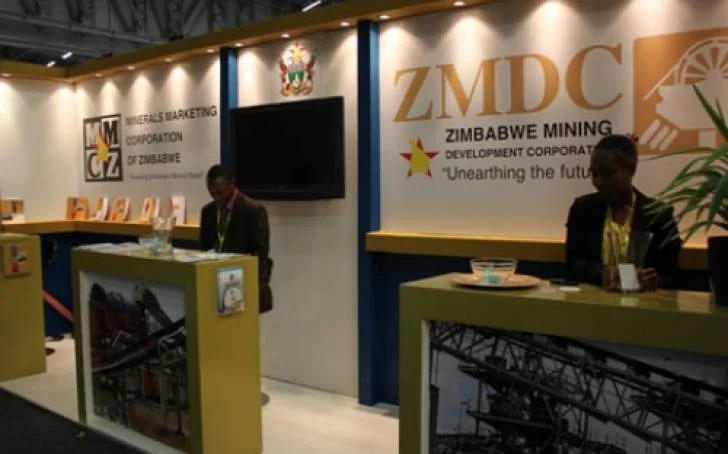
“More effort is also being made through Zimbabwe Mining Development Corporation (ZMDC) whereby they are engaging various investors to reopen closed mines. The Ministry intends to transform the Lupane office into a full-fledged provincial office. Currently, Bulawayo Metropolitan hosts most of the staff and operations of the province,” said Chitando.
Currently, Zimbabwe has a lot of large-scale mines that were shut down owing to the prevailing economic meltdown, leaving thousands of employees jobless.
Some of the mines that are comatose include Shabanie Mashaba Mines in Zvishavane, Nan Jiang Africa diamond mine in the Save Valley Conservancy in Bikita, among several others.
Chitando said in line with the government’s devolution and decentralisation policy, there is a need to develop the Lupane Mines office into a full-fledged provincial office.
“Funding will, therefore, be required for the acquisition of land, construction of appropriate offices, fully furnishing the offices and provision of requisite tools of trade. In this regard, the ministry requires $150 000 000 to achieve this target.”
He noted that in terms of the Mines and Minerals Act [Chapter 21:05], any mining company that invests more than US$100 million may apply for a Special Mining Lease which allows the company to negotiate various tax concessions with the Government.
Minister Chitando also said that the Ministry will capacitate Mining Promotion Corporation (MPC) by approximately $5 million to help it spearhead the exploration needs for the year 2022 by the private sector and that of the Zimbabwe Geological Survey.
He added, “It was also recommended that a lithium smelting and processing plant should be set up to produce products rather than export raw minerals. Value addition of raw lithium will bring more revenue to the government and production of finished products such as batteries given that this time due to climatic conditions, countries are moving to cleaner energy.”
Chitando said his ministry was on course in terms of achieving a US$12 billion mining industry by 2023 with a view to attaining an upper-middle-income economy by 2030.
To provide the best experiences, we use technologies like cookies to store and/or access device information. Consenting to these technologies will allow us to process data such as browsing behavior or unique IDs on this site. Not consenting or withdrawing consent, may adversely affect certain features and functions.
Functional
Always active
The technical storage or access is strictly necessary for the legitimate purpose of enabling the use of a specific service explicitly requested by the subscriber or user, or for the sole purpose of carrying out the transmission of a communication over an electronic communications network.
Preferences
The technical storage or access is necessary for the legitimate purpose of storing preferences that are not requested by the subscriber or user.
Statistics
The technical storage or access that is used exclusively for statistical purposes.The technical storage or access that is used exclusively for anonymous statistical purposes. Without a subpoena, voluntary compliance on the part of your Internet Service Provider, or additional records from a third party, information stored or retrieved for this purpose alone cannot usually be used to identify you.
Marketing
The technical storage or access is required to create user profiles to send advertising, or to track the user on a website or across several websites for similar marketing purposes.