At a time when the mining industry is under increasing pressure to modernise operations and improve worker safety, two final-year students from the Zimbabwe School of Mines (ZSM) are proving that innovation can start right at the classroom level. Their innovative projects, each tackling some of the most persistent safety and efficiency challenges in underground mining, demonstrate how emerging technologies can reshape the future of the sector, Mining Zimbabwe can report.
By Ryan Chigoche
Across Zimbabwe’s mining landscape, operations continue to grapple with hazards such as toxic gases, fall-of-ground incidents, and ventilation inefficiencies. These challenges not only threaten lives but also disrupt production and inflate operational costs.
Against this backdrop, two young minds — Ronald Danha, a final-year Mine Ventilation student, and Omar Abdulla Mkwala, a Mining Engineering student also in his final year — are stepping forward with creative solutions born out of research, passion, and practical experience.
Both students had the opportunity to showcase their innovations at the just-ended Zimbabwe International Trade Fair (ZITF) Mine Entra Exhibition in Bulawayo, where ZSM provided a platform to display technologies that reflect the future of mining in Zimbabwe and beyond.
Real-Time Ambient Condition Monitoring System
For his final-year innovative project, Ronald Danha developed a system designed to transform underground mine safety through continuous digital monitoring.
“My project is on the development of a real-time ambient condition monitoring system,” Danha explained. “Eventually, in a mine, we know there are gases during re-entry and also overheating of machines.”
The system operates using two components — the sender nodes and the receiver nodes. The sender units are equipped with sensors that detect gases such as carbon monoxide and methane, as well as temperature and humidity levels. Data collected underground is transmitted wirelessly to receiver nodes on the surface, where it is decoded and displayed on a web-based dashboard using ThingSpeak for real-time visualization.
The urgency of this innovation is underscored by recent safety statistics. In 2024, Zimbabwe recorded 11 gassing accidents in underground mines, resulting in 12 fatalities, highlighting the dangers of outdated ventilation systems and insufficient technical monitoring.
“Underground mining is always at risk of toxic gases,” Danha noted. His system directly addresses this problem by providing real-time data and automated alerts, enabling mine operators to respond immediately to hazardous conditions and prevent accidents before they occur.
Unlike conventional ventilation-on-demand systems, which merely adjust fan speed, Danha’s system introduces an intelligent function that can automatically switch fans on or off depending on real-time gas concentrations. This eliminates delays associated with manual readings, ensuring rapid response during re-entry after blasting and creating safer conditions for mine workers.
Danha, who spent months designing, coding, and refining the prototype, said the idea emerged from a desire to reduce the risks of gassing incidents and move beyond manual detection methods. “After the blast, the system starts to read,” he said. “It can also view the surface and say, if this section is now safe, we can go in.”
Challenges included sourcing components locally. “The actual challenge was finding components here in Zimbabwe,” he explained. “We don’t actually have much technology available locally, so I had to research online and source alternatives.” Despite these hurdles, his innovation demonstrates how accessible technology can be leveraged for proactive, life-saving mine safety management.
Automated Roof Bolter
While Danha focused on air quality and environmental monitoring, fellow student Omar Abdulla Mkwala turned his attention to one of mining’s most dangerous operations: manual roof bolting.
His innovative project introduces an automated system capable of navigating underground, assessing ground conditions, and installing support bolts without human intervention.
“This is an automated roof bolter which I designed to counter problems such as fall-of-ground incidents that were happening at the mine where I was attached,” Mkwala said. During his industrial attachment at one of the country’s leading mines, he observed that ground collapses often occurred while operators were still manually installing bolts after blasting. These incidents posed significant danger to workers and often led to costly operational delays.
The urgency of this innovation is underscored by recent statistics: between January and May 2025, fall-of-ground incidents were responsible for 37% of all mining fatalities.
Such accidents are particularly prevalent in underground gold mining operations, driven by ground instability, rock bursts, and inadequate support systems. Mkwala’s automated roof bolter directly addresses these risks by removing the operator from harm’s way while ensuring precise and consistent installation of support bolts in unstable conditions.
“In my solution, I came up with a fully automated roof bolter in which an operator is no longer required to be in the machine,” he explained. “The bolter can navigate on its own, detect the ground condition, and carry out bolting operations automatically — from drilling and resin insertion to bolt installation and monitoring.”
The innovation integrates sensors and autonomous navigation to assess rock stability in real time while transmitting performance data to a surface control office. Mkwala’s system embodies the concept of zero harm by minimizing human exposure to unstable environments and improving productivity through consistent, precise operations.
He believes institutions like the Zimbabwe School of Mines play a vital role in nurturing such innovation. “Since the school is recognised worldwide, it can help students like us find investors who are interested in our innovations,” he said. “At the end of the day, in mining operations, we need zero harm. If someone gets injured, the company loses, and if we leave unsupported ground, that’s a loss too.”
Both students expressed deep gratitude to their mentor, Mr. Paul Matshona, the Research and Innovation Officer at ZSM, whose guidance and encouragement played a key role in shaping their work.
Speaking to Mining Zimbabwe, Mr. Matshona called for greater collaboration between academia and industry so that the full impact of these projects can be realised.
“Together, these projects demonstrate the transformative potential of young technocrats from the Zimbabwe School of Mines in driving context-specific technological solutions. However, their full impact depends on stronger partnerships between academia and industry, where mining companies provide testing grounds, technical mentorship, and financial support to further develop, pilot, and commercialize such innovations. This collaborative approach will not only accelerate technology adoption but also build a culture of research-driven industrial modernization, positioning Zimbabwe as a regional leader in safe, efficient, and sustainable mining practices,” Matshona said.
The just-concluded Mine Entra was one such platform where the students got the opportunity to showcase their innovations.
Through such initiatives, the Zimbabwe School of Mines continues to position itself not only as a leading training institution but also as an incubator of practical, industry-ready innovation. The work of Danha and Mkwala demonstrates that Zimbabwean students are capable of creating solutions that make mining safer, smarter, and more efficient — a sign of a brighter, technologically empowered future for the sector.
“….Do not go charging into the battlefield without a plan”
This is the fourth article in the series on Strategic Sourcing. In my previous article, I explored the subject of Supply Market Profiling, which is essentially the process of gathering supply market intelligence with a view to gaining an in-depth understanding and insight into the supply market from which the goods and services targeted for Strategic Sourcing are obtained.
In this article, I turn my focus to stage three of the Strategic Sourcing process — Developing an Optimum Sourcing Strategy — to guide the acquisition of goods or services that meet business requirements.
One of the biggest errors of omission that Supply Management professionals can ever commit is to acquire business requirements without a defined strategy. The three-bid system, despite still being widely used as the default method of acquiring goods and services by many procurement practitioners, is far from a strategy. It is exactly what it is — a hard and fast rule applied as if cast in concrete without exception across all categories of business spend. Consequently, and quite expectedly, this yields only suboptimal value for the business. A Sourcing Strategy is a robust and game-changing blueprint that defines or redefines how the Supply Management professional will acquire the business requirements in question. Therefore, care must be taken to ensure that it is as practical as possible — even someone outside your business should be able to implement it.
The process of developing a comprehensive Sourcing Strategy invariably begins with synthesising the data gathered from the internal Spend Analysis as well as the Supply Market Profiling into a list of actionable insights about the product or category and the supply market. In a way, the Supply Management professional is basically asking him/herself: “What is all this information pointing to?” “What narrative is this information telling me about how the business is currently acquiring its goods and services, or how the supply market of the goods in question is organised?” “What gaps exist in how we are currently acquiring our business requirements?” “What opportunities exist in the supply market that the business can tap into or ‘siphon’ for even better value than what the business is currently getting?”
For stellar business results, this must be followed by identifying and documenting key value levers that the Supply Management professional can leverage to tilt the odds in his/her favor. Remember, Strategic Sourcing is not just about acquiring goods and services or securing the lowest prices. It is about acquiring supply market opportunities and capabilities that together form a truly “value-packed” deal for the business.
A robust Sourcing Strategy essentially helps the Supply Management professional answer crucial questions such as: “What is the most optimum way, and from where should we acquire our business requirements in the context of the insights from internal business and supply market analysis, as well as the key value levers identified?” “Should we go for a competitive sourcing method through consolidating our spend volumes or negotiating with one supplier?” “Should we opt for an internally generated solution (make) or outsourcing?” “Given the business’s strategic goals and priorities, what are the most ideal supplier capabilities that we should look for in the supply market?” “How are we going to select and evaluate the most suitable supplier(s) that best meet the business requirements?” “What is the most suitable supplier relationship that would deliver the most optimum value for the business?”
A Sourcing Strategy should therefore not be just a meaningless document that confuses people and ends up nowhere, but a robust, very practical, and game-changing blueprint that redefines how the business will acquire the requirements in question going forward. Care must be taken to ensure that it is not ironclad but has flexibility to be continuously adapted in line with changing supply market dynamics.
Views expressed in this article reflect the personal opinions and experience of the writer. Kindly send your feedback to [email protected]
Vice President Retired General Constantino Chiwenga has issued a clear framework for foreign investment, placing the welfare of citizens at the forefront of the nation’s mineral development strategy, Mining Zimbabwe can report.
By Rudairo Mapuranga
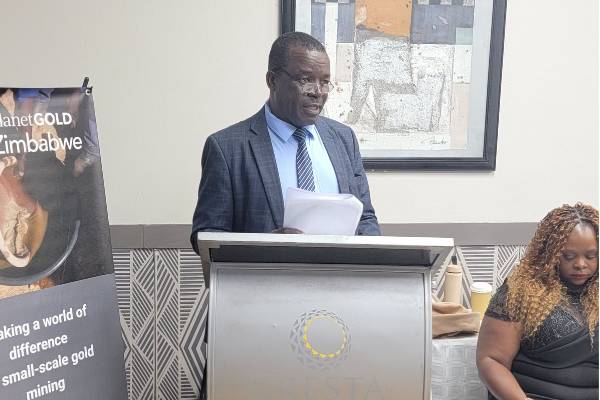
Speaking at the official opening of the 28th edition of the Mining, Engineering, and Transport Expo (Mine Entra) 2025, the Vice President underscored that while the Second Republic remains open for business, it will only welcome investors who align with core Zimbabwean values.
“The Second Republic remains committed to engagement and re-engagement. We welcome investors from all corners of the world who share our values of responsibility, transparency, and shared prosperity,” VP Chiwenga declared.
The speech, which struck a balance between invitation and firm expectation, served as a strategic response to growing concerns within the mining community about the conduct of some foreign operators. It signals a decisive shift from a model focused purely on extraction to one anchored in national development.
“We are building a Zimbabwe where mining is not just a source of revenue, but a foundation for national renewal and growth,” he stated, directly linking the sector’s activities to tangible benefits for the people.
The Vice President’s emphasis on responsibility and shared prosperity resonates directly with recent outcries from industry bodies, including the Zimbabwe Miners Federation, which has detailed the brutal treatment of local miners and environmental degradation by some foreign entities. By setting these non-negotiable values, the government is drawing a clear line for all current and prospective investors.
Concluding his address, VP Chiwenga issued a unifying call to action, urging miners, investors, and stakeholders to “join hands in building a mining sector that truly goes beyond extraction.”
“Let this conference unite bold ideas, partnerships, and innovations that transform our mineral wealth into sustainable prosperity,” he said before officially declaring the 2025 Mine Entra conference open. The message was unequivocal: Zimbabwe’s mineral wealth must be a catalyst for national renewal, and all investment must contribute to that foundational goal.
Zimbabwe Miners Federation (ZMF) President Ms. Henrietta Rushwaya has expressed unwavering confidence that national gold production will comfortably surpass the 40-tonne government target for 2025, revealing that a formidable 33 tonnes had already been delivered by the end of September, Mining Zimbabwe can report.
By Rudairo Mapuranga
The announcement, which signals a potentially record-breaking year for the country’s mining industry, was made by Rushwaya during a recent address at Mine Entra in Bulawayo. She highlighted the pivotal role played by both small-scale and large-scale miners in achieving this milestone.
“As small-scale miners, we have escalated our gold production to the extent that as of the end of September, our production combined with the large-scale miners had risen to 33 tonnes of gold,” Rushwaya stated. “And like we forecast at the beginning of the year, that we were looking at doing 40-plus tonnes of gold, I’m sure Fidelity, with your indulgence and concurrence, will gladly surpass the 40 tonnes of gold which we had committed to.”
This bullish outlook is firmly anchored in the sector’s sustained performance throughout the year, particularly the dominance of artisanal and small-scale miners (ASM). Recent data from Fidelity Gold Refinery (FGR) for August 2025 reinforces this trend, showing a sector in robust health.
Despite a marginal 0.36% month-on-month decrease, August deliveries stood at a strong 4,189.77 kg, representing a significant 22.57% surge compared to the same month in 2024. This year-on-year growth underscores the sector’s resilience and upward trajectory.
Crucially, the ASM sector remains the engine of this growth. In August, small-scale miners delivered 3,249.93 kg of gold, a 1.56% increase from July and a remarkable 35.96% jump year-on-year. This contribution meant the ASM sector accounted for nearly 78% of all gold delivered in August, while large-scale producers, who delivered 939.84 kg, saw a slight contraction.
This pattern is not isolated. The strong August figures followed a similarly robust July, where total deliveries of 4,205.02 kg were 20.3% higher year-on-year. The first half of the year had already set a powerful precedent, with gold deliveries skyrocketing 45.85% to 20,103.55 kg, driven by a near-doubling (96.31% increase) of ASM contributions.
Industry analysts attribute this stellar performance to improved trust in formal marketing channels, incentivized by Fidelity Gold Refinery’s competitive pricing, which has been offering over US$105 per gram. This policy has been critical in encouraging miners to channel their gold through official means, thereby boosting national deliveries.
With 33 tonnes already banked in the first three quarters and the consistent, record-setting pace of artisanal and small-scale miners, the ZMF’s confidence appears well-founded. The sector is not merely on track to meet the 40-tonne goal but is positioned to confidently surpass it, marking a historic achievement for Zimbabwe’s gold mining industry.
In an effort to promote responsible mining and ensure comprehensive regulatory compliance, the government has revealed a significant improvement in mining sector operations, with mine suspensions dropping from 30% to 23% between two major audit exercises conducted in 2023 and 2024, Mining Zimbabwe can report.
By Rudairo Mapuranga
The disclosure was made by the Chief Government Mining Engineer (CGME), Michael Munodawafa, while speaking at the Mine Entra 2025 conference. He detailed the progress of the government’s Responsible Mining Initiative, which was launched by President Emmerson Mnangagwa in May 2023 and followed up with a second edition in August 2024.
Munodawafa explained that the initiative was necessitated by widespread non-compliance among miners, who often focused solely on extraction while neglecting environmental, labour, and fiscal obligations.
“Our miners were, like I said, told to be so relaxed that they forgot they were responsible to the environment, their employees, the communities in which they operate, and also to the fiscus,” Munodawafa stated, highlighting cases of operations running for years without being registered with ZIMRA.
However, he reported tangible progress, citing comparative statistics from the two audit exercises. “In 2023, we visited 424 mining and related operations. During that period, we suspended 128 operations for gross non-compliance, which was about 30% of the mines we visited,” he revealed.
“The following year, in 2024, we visited 728 mines and suspended 161, which was now 23% of the visited mines,” Munodawafa added, noting the significant seven-percentage-point drop in the suspension rate. “It was a drop, which meant that people were now getting it into their heads that they have to be responsible somehow.”
The CGME emphasised that the audits, conducted by multi-stakeholder teams including Immigration, ZRP, ZIMRA, and the Ministries of Labour and Environment, are not purely punitive. He outlined a dual approach of enforcement and education.
“It’s not just that we are enforcing, but we are also advising the miners and even the communities,” he said, guiding operators on how to “do mining the right way” and plan for the future, rather than engaging in haphazard, short-term extraction.
Looking ahead, Munodawafa issued a warning to non-compliant operators, announcing that the 2025 edition of the Responsible Mining Audit will be launched before year-end and will cover all provinces simultaneously.
“Be prepared. We will be visiting all miners as much as possible in the next month or so,” he concluded, signalling the government’s unwavering commitment to entrenching responsible mining practices across Zimbabwe.
The Chinese Embassy in Zimbabwe has issued a detailed advisory to Chinese nationals engaged in investment and business operations across the country, urging strict adherence to local laws, enhanced security measures, and greater community engagement to promote responsible and sustainable business practices.
In a notice on its X account titled “Important Notice to Chinese Nationals: A Reminder on Investment and Business Operations in Zimbabwe,” the Embassy outlined eight key guidelines aimed at ensuring that Chinese investors operate safely, legally, and in harmony with Zimbabwe’s regulatory and social environment.
The advisory comes amid growing Chinese participation in Zimbabwe’s mining and infrastructure sectors, where issues of compliance, community relations, and environmental management have recently drawn national attention, leading to many Zimbabweans calling for the expulsion of Chinese nationals from the country.
The advisory comes after the death of a man who was shot and later died by a Chinese Engineer at the China Zhuhe Investments-owned mine.
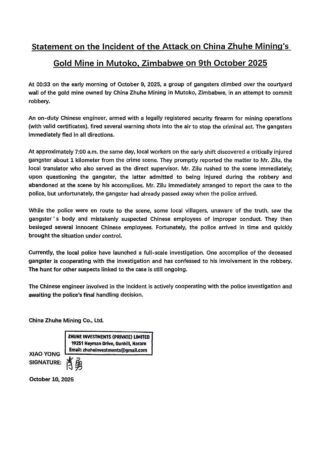
In its press release signed by one Xiayo Yong, the company China Zhuhe Mining claimed the man and his accomplices, whom it referred to as “Gangsters”, climbed the courtyard wall in an attempt to rob the mine.
Press statement by China Zhuhe Investments following the shooting of a Zimbabwean national
The killer, a Chinese Engineer who was on duty then, fired shots into the air, according to the press release. The press release does not state how the bullets hit the deceased after the initial claim of shooting into the air.
There is no mention of the Mine calling the Police after the attempted robbery and firearm discharge.
The press release goes on to say the injured man, whom it referred to as a “Gangster”, was discovered by workers on the morning shift, about a kilometre away, 6 hours and 27 minutes after the firearm discharge. Instead of notifying the Police, the workers notified a Chinese translator, Mr Zilu, who, the press release said, was a supervisor. Zilu then immediately went to the scene.
It is not clear from the press release how long it took Zilu to arrive at the scene or if he was even at the mine.
Zilu, according to the press statement, proceeded to question the injured man, who, according to the release, admitted to having been injured during what the company now referred to as “during the robbery” when initially it had referred to the act as “in an attempt to commit robbery” in the press release’s first paragraph.
It is not clear from the press release how long Zilu questioned the deceased.
Zilu is reported to have immediately “arranged” to call the Police after the questioning. The press release does not say how long it took Zilu to actually contact the ZRP, as it said he “arranged” to call the Police.
According to the press release, the deceased had passed away when the Police arrived on the scene.
There is no mention of any medical or any first aid assistance given to the now deceased, whom the company calls a “Gangster” in the Xiayo Yong signed Press statement. There is also no mention of how long it took the Police to arrive on the scene.
The press release went on to say that Villagers who were unaware of the whole incident mistakenly suspected Chinese employees of improper misconduct. It is not clear if China Zhuhe Investments sees the death as improper conduct or otherwise, as it does not mention whether procedures were followed.
The Press release continues and says the villagers then besieged several innocent Chinese employees, but it did not mention the shooter being part of the group.
The employees were rescued by the Police, according to the press release.
China Zhuhe Mining Co said the shooter is actively cooperating with Police investigations.
What to do when a person is shot (Mine Site or Workplace Emergency Guide)
In the event of any shooting incident, every second counts. Stay calm, act quickly, and follow these steps to protect life and ensure safety.
📞 Call for medical Help
Contact Mine/Plant Control Room or Emergency Services (999 or 112).
Report clearly:
Location of the incident
Number of injured persons
Type of injury (gunshot wound)
Whether the area is secure
🩸 Control the Bleeding
Put on protective gloves if available.
Apply firm, direct pressure to the wound using a clean cloth, gauze, or clothing.
If bleeding is severe on an arm or leg, apply a tourniquet above the wound.
Do not remove objects stuck in the wound — pad around them instead.
💨 Check Breathing and Responsiveness
If the person is unresponsive, check for breathing.
If not breathing, start CPR if trained to do so or call a person who can.
If breathing, place them in the recovery position (on their side, head slightly back).
🫀 Prevent Shock
Keep the victim still and calm — unnecessary movement can worsen bleeding.
Cover them with a blanket, jacket, or thermal wrap to keep them warm.
Reassure them continuously until medical help arrives.
⚠️ DO NOT:
❌ Remove the bullet or any embedded object.
❌ Give food, water, or medication.
❌ Leave the person unattended unless your safety is threatened.
🏥 When Help Arrives
Brief responders on what happened, what first aid was provided, and any changes in the victim’s condition.
Continue assisting as directed by medical or emergency personnel.
🧠 REMEMBER:
Have a heart. “Stay calm. Stop the bleeding. Save a life.”
The 2025 edition of Mine Entra lived up to its billing as the country’s premier mining exhibition, drawing an impressive mix of government officials, captains of industry, and mining professionals who turned the Zimbabwe International Exhibition Centre into a hive of networking, innovation, and forward-looking discussions, Mining Zimbabwe can report.
By Ryan Chigoche
This year’s edition ran under the theme “Beyond Extraction: Sustaining the Future of Mining.” Early reports indicate strong participation, with the 2025 showcase featuring over 260 exhibitors and the potential to attract even larger crowds than last year’s event, which hosted 289 exhibitors.
Representing the highest office in the land was Acting President Constantino Chiwenga, who toured various exhibition stands, taking time to appreciate new technologies and ideas reshaping Zimbabwe’s mining landscape.
His visit set the tone for this year’s expo, emphasising sustainability through responsible extraction and highlighting the importance of mining with the future in mind—ensuring that today’s development does not come at tomorrow’s expense.
The government showed a united front in its support for the mining sector, with Minister of Mines and Mining Development Winston Chitando leading the delegation, flanked by his deputies. They were joined by Transport and Infrastructure Development Minister Felix Mhona and Industry and Commerce Minister Mangaliso Ndlovu, reflecting a coordinated national effort to drive mining-led industrialisation and strengthen linkages between extraction, manufacturing, and infrastructure development.
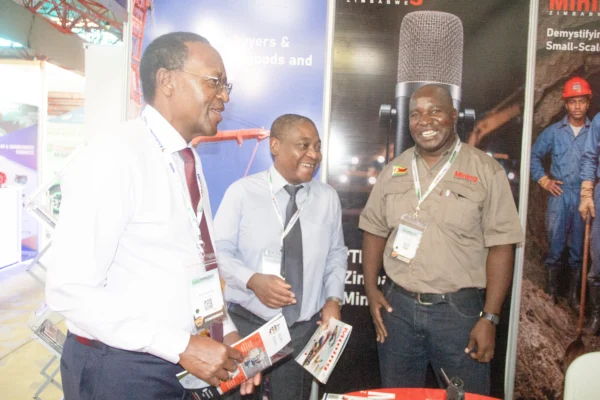
But it wasn’t just the government that made its mark. Industry leaders came out in full force—from Fidelity Gold Refinery (FGR) General Manager Mr Peter Magaramombe, Eng Steven Ndiyamba – Mimosa GM, Chamber of Mines CEO Isaac Kwesu and Kuvimba Mining House CEO Trevor Barnard to Mimosa Mining Company Managing Director Fungai Makoni, Zimasco CEO and Chamber of Mines President John Musekiwa, Mr Ye, Manager – Kamativi Mining Company (KMC), Sabi Gold Director – Mr Chandiwana, ZCDC COO Dennis Mthombeni and Mimosa’s Lloyd Shamu—all walking the exhibition stands to engage with innovators and suppliers.
Also spotted among the attendees were Busi Chindove from Zimplats, Aaron Malaba and John Shava, Chief Buyer at Unki Mine and his team, Hwange Colliery CEO William Gambiza, Godwin Gambiza, General Manager of Sandawana Mine, Engineering Manager of Blanket Mine Calvin Magwenzi accompanied by the mine’s Chief buyer, Eddington Vere, General Manager for Jena Mine, How mine procurement and operations teams and many others. The Ministry of Mines operations were equally well represented, with Michael Munodawafa, the Chief Government Mining Engineer (CGME), among others.
Professional associations were equally visible, with the influential Association of Mine Managers of Zimbabwe (AMMZ) and the Association of Mine Surveyors of Zimbabwe (AMSZ) among the key attendees. Buyers from large-scale mines also attended in full force, with several coming from as far as Eureka Mine of Guruve, ZCDC, almost 600km from Bulawayo.
Small-scale miners were also not outdone, with Prominent miners like Johanne Sithole gracing the stands and entering into deals with equipment suppliers. Their mining body, ZMF, also held a fully packed mining conference.
They toured the stands to explore new equipment and digital tools that could help modernise the country’s surveying capabilities.
Their presence symbolised how technical expertise and innovation continue to underpin the sector’s progress, also highlighting the Expo’s growing relevance in providing practical solutions to the mining industry.
Adding a global dimension to this year’s event were Chinese exhibitors, who continue to expand their footprint in Zimbabwe’s mining industry. Several Chinese firms showcased advanced equipment and engineering technologies, highlighting their growing role as key technical partners in local mining operations.
Their presence reflected China’s increasing investment in Zimbabwe’s lithium, chrome, and platinum sectors, as well as the strengthening industrial partnerships emerging between local and Chinese enterprises.
The atmosphere throughout the exhibition was one of optimism and purpose. Conversations centred on investment opportunities, technology adoption, and the role of local procurement in building a sustainable value chain.
For many attendees, Mine Entra 2025 was more than just an exhibition—it was a statement of intent that Zimbabwe’s mining sector is evolving, maturing, and positioning itself for long-term growth.
With over 260 local and international exhibitors participating, including firms from South Africa, China, and the United Kingdom, this year’s event once again affirmed Bulawayo’s role as the hub of mining dialogue and innovation.
Mine Entra 2025 captured the spirit of collaboration between government, industry, and professionals—all united by a shared vision of mining not just for profit, but for a sustainable and inclusive future.
To provide the best experiences, we use technologies like cookies to store and/or access device information. Consenting to these technologies will allow us to process data such as browsing behavior or unique IDs on this site. Not consenting or withdrawing consent, may adversely affect certain features and functions.
Functional
Always active
The technical storage or access is strictly necessary for the legitimate purpose of enabling the use of a specific service explicitly requested by the subscriber or user, or for the sole purpose of carrying out the transmission of a communication over an electronic communications network.
Preferences
The technical storage or access is necessary for the legitimate purpose of storing preferences that are not requested by the subscriber or user.
Statistics
The technical storage or access that is used exclusively for statistical purposes.The technical storage or access that is used exclusively for anonymous statistical purposes. Without a subpoena, voluntary compliance on the part of your Internet Service Provider, or additional records from a third party, information stored or retrieved for this purpose alone cannot usually be used to identify you.
Marketing
The technical storage or access is required to create user profiles to send advertising, or to track the user on a website or across several websites for similar marketing purposes.