Home Blog Page 511

A day out for pegging with the Pros

0

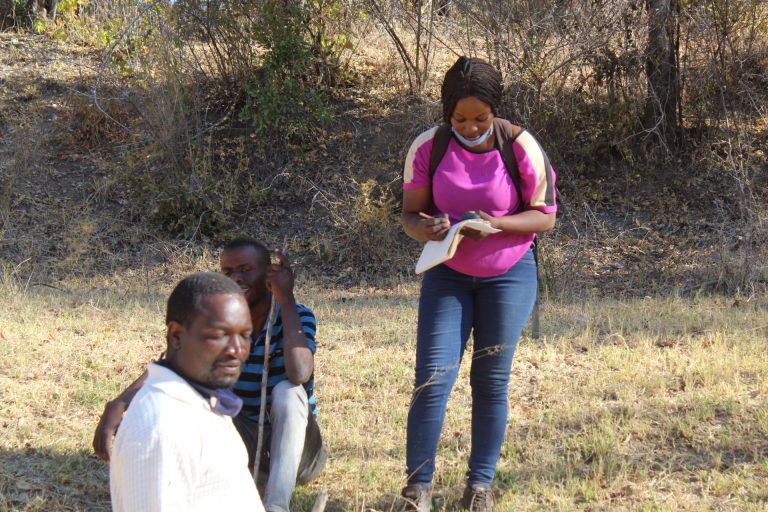
Timella Mining Consultancy afforded me the opportunity of experiencing first-hand pegging of mining claims in the Battlefields area of Mashonaland West.

A team of two, a Pegger and Geotech were introduced and we prepared for the 50km journey. We set off for the journey with Hazel (Geotech) and Ngoni (pegger) who joined later. As were 5km from the site the road became so bad that we had to leave our vehicle behind and foot the rest of the way.

Being used to office dwellings and almost no exercise 8km plus was a tough job. I also felt for Hazel with the scorching heat as we embarked on the thorny journey. To my surprise, we had to occasionally jog and ask her to slow down. The journey was through a dense thorny bushy area with no defined path. We had to endure getting our clothes caught in thorns.

We got to the coordinates of the claim and Ngoni sprang into action. I asked what about the pegging was and gladly the friendly guy said,

“Pegging is posting of prospecting notices and registration and establishment of temporal beacons before submitting an application for registration to the Ministry of Mines and Mining Development. When a Prospecting Licence holder has identified a mineral deposit that he/she is interested in, he/she appoints an agent or an Approved Prospector to peg on his behalf”. Ngoni continued.

“The agent is required to physically peg the area by marking the deposit with a Discovery Peg. So the first thing is for a person to have the prospecting license which allows the holder to an area suitable for mining. Once the prospecting license is acquired then the holder has to involve a prospector so that the prospector will then help to peg the area after consulting with the mining office to check if the area is allowed to mine”.

Meanwhile, Hazel was surveying the place and later gave us an update.

“There is scarce vegetation around the area and thorny bushes the reason being it might be the toxic conditions produced by mineralization underground which will create a harsh environment for vegetation to grow”.

“There are outcrops striking in an EW  direction with felsic rocks containing potassium feldspar and sodium plagioclase.

“A river with a dendritic drainage pattern lies on the southern part of the block. The area is still virgin land which I will place under greenfields. I recommend proper mapping and sampling procedures to be done before sinking shafts of course these will include geochemical and geophysical surveys in their stages”.

After the pegging process was complete I took the chance to protest to Hazel how fast she walked us and she laughed it off.

“People say I walk fast but I barely recognize it. Having a passion for becoming the best female exploration geologist of all time, drawn by what mother earth brings to humanity has turned me to enjoy spending 90 % of my time in the bundu mapping and pegging. So I am used to walking fast and long distances. I will boldly and proudly say I have been trained well with both my Geophysicist lecturer Mr. TL Matete and my Boss Dr. T Chizuzu. They did not spoonfeed me but rather adequately trained me. I have adopted the jungle law and this has greatly networked me in a short space of time. I love my work.


This article first appeared in the September 2020 Mining Zimbabwe Magazine

Day 20: Task Mining Syndicate shaft collapse

0

Twenty days ago a Mineshaft at Task Mining Syndicate in Chegutu collapsed trapping five miners underground.

Reports at the mine say the miners worked on mine pillars supporting the shaft leading to its collapse. The miners are believed to be still 110 metres beneath the ground and hopes of rescuing the “Task Five” are fading away daily.

The trapped miners are Constantino Dzinoreva (47) based in Chegutu, Charles Mutume (31) Based in Zvimba, Shingai Gwatidzo (20) from Mhondoro and brothers Crynos Nyamukanga (44) and under-aged Munashe Christian (17) from Zvimba.

Platinum mining giant Zimplats reportedly offered to help rescue the trapped five a request reportedly turned down by the mine owners.

A miner who spoke on condition of anonymity said the platinum miner suggested open cast as the best option to rescue the trapped miners. However when Zimplats said it would start working from 110 metres away going towards the collapsed shaft mine owners reportedly turned down the request opting to do it themselves.

A single “shift” of ten men has been working on rescuing the trapped miners.

According to Medical News Today, a typical, well-nourished male weighing 70 kilograms technically has enough calories stored to survive for between 1 and 3 months. However, people who have voluntarily stopped eating to participate in hunger strikes have died after 45–61 days, which suggests that a person would be unlikely to survive for 3 months.


Fidelity official gold buying prices Monday 28 September 2020

0

Fidelity Printers and Refiners (FPR) official gold buying prices Monday 28 September 2020

SG 90% AND ABOVE $53.51/g
SG ABOVE 85% BUT BELOW 90% $52.61/g
SG ABOVE 80% BUT BELOW 85% $51.41/g
SG ABOVE 75% BUT BELOW 80% $50.82/g
SAMPLE BELOW 10g BUT ABOVE 5g $52.01g
FIRE ASSAY CASH $53.81/g


Cash available. Fidelity Printers and Refiners prices will be changing daily in relation to world market prices.


Contact FPR

No. 1 George Drive, Msasa, Harare, Email: [email protected], Telephone: +263 242-486670, +263 242-486694, +263 242-487131, +263 242-447810-5

RioZim keeps focus on capital projects despite Covid-19

0

LISTED mining group, RioZim, says it is keeping focus on major capital projects despite the dampening impact caused by the Covid-19 pandemic, which crippled smooth operations as countries embraced lockdown measures.

The mining group has operations in gold and diamond sectors and is currently advancing projects such as the 178MW solar power generation, Sengwa Thermal Power Station and the Biological Oxidation (BIOX) projects.

The diversified resource group gold operations are Renco, Dalny, and Cam and Motor mines while in the diamond sector, RioZim owns Murowa Diamonds. In a statement accompanying financial results for the half-year ended 30 June 2020, RioZim said despite the prevailing Covid-19 setback, it remains focused on advancing the BIOX project, 178MW solar power project and Sengwa Power Project.

“These projects are hinged on an improvement in not only the local macro-economic environment but also on containment of the Covid-19 pandemic, which has resulted in most financiers adopting a wait and see approach due to the high level of uncertainty,” it said.

RioZim said a framework agreement for Phase two of the project, which entails expanding capacity from 700MW to a total of 2 800MW, was signed with the investment partner.

“The company, in conjunction with its investment partner, is in discussions with a potential financier for a targeted highly structured financing arrangement for Sengwa Phase l. While these discussions have been promising, the impact of Covid-19 has delayed the conclusion of this engagement,” said RioZim.

It said the BIOX project construction was negatively affected by the lockdown in South Africa and locally. This delayed the manufacture of key components as factories were closed.

“Civil works were halted for all of the second quarter due to lockdowns but work has commenced again in the second-half of the year. Funding of the project still remains a major stumbling block to project progression and commissioning within the targeted timelines.”

In terms of operational performance, the group recorded low production volumes of gold at 586 kilogrammes compared to the 962kg achieved in the comparative prior period. The low volumes were attributed to, among other challenges, acute power cuts, which resulted in depressed milling throughput, persistent mill breakdowns and lower grade ore from One Step Mine.

“Resultantly, the group’s revenue was subdued at ZWL$616,4 million. The low volumes were, however, partly offset by the favourable gold price, which averaged US$1,713/ounces; an increase of 27 percent from US$1,346/oz realised in the same prior period,” said RioZim.

The combined effect of low production attainment coupled with rising production costs, however, weighed down the company’s performance closing the period with a loss of ZWL$77,4 million, a decline compared to a profit of ZWL$38,2 million realised in the same prior period. At Murowa, RioZim said the business unit produced 250 carats compared to 390kcts in the comparative prior period. Consequently, the group realised a share of loss from the associate of ZWL$5,3 million. The decline in production was as a result of a decrease in the ore grade as the mine extracted ore from a lower grade pit.

“Given the decrease in ore grade, the company is working on expanding processing capacity to shift the operations to a low grade, high volume model. This project has stalled due to insufficient foreign currency and unavailability of funding to fast track and complete the project,” said the mining group.

On the base metal business, RioZim said its Empress Nickel Refinery (ENR) remained under care and maintenance during the review period.

“In the first quarter ENR focused on furnace relining and accumulating feed material for matte production,” it said.


Sunday News

US$30 million Matabeleland North coking plant takes shape

0

PROGRESS on the first phase of construction of a coking plant by a Chinese company in Hwange is now on course with 70 percent completion after Government facilitated the expatriation of skilled labour.

Work on most capital projects in the country had stalled following the outbreak of Covid-19 pandemic which forced Governments to impose national lockdowns to contain the spread of the disease resulting in expatriates who had gone to China for holidays being locked out.

The coking plant owned by Afrochine’s Dinson Colliery is a US$30 million project at Mpongola in Lukosi area in Hwange. Once completed the plant will be able to churn out 300 000 tonnes of coke per annum as well as 10 000 tonnes of coking tar.

Briefing the Minister of Mines and Mining Development Winston Chitando on Thursday, Afrochine general manager Mr Chen Weinglin said progress was continuing well with the first phase expected to be commissioned between March and April 2021.

“We have made a lot of progress on the ground particularly after managing to get experts from China with support from Government. Now the experts are working on the ground to facilitate the installation of the plant. We are targeting to commission the plant by March-April next year. We would like to thank Gvernment for their support in expediting their return,” said Mr Chen.

He said the company supported the Government’s stance that no mining activities should be done at national parks.

“Recently we heard reports that there is a directive from Government that people are not allowed to mine inside the (Hwange) national park. As a company we are very supportive of this initiative and we would like to work hand in hand with the ministry to explore other opportunities in Hwange in terms of securing the raw materials supply for the plant. In the meantime, we are also working on the concession. We want to make sure there is constant and stable supply of the material for the operations before the start because we need to ensure that there is enough coal stockpile before we commission the plant otherwise switching it off would damage the coke oven battery.”

Minister Chitando said he was pleased with progress, adding that the project was critical in the attainment of the US$12 billion mining industry through its unique integrated technology.

“I came here to assess progress being made in projects in the Hwange area as you are aware the President visited a number of projects in July and I am very pleased that since the visit there has been significant progress in these projects which are all towards attainment of the 2030 Vision and US$12 billion milestone by 2025. The phase one coke works project by Tiangi will produce 150 000 tonnes of coke and due for completion early next year and due for commissioning in March-April 2021. This project is very critical for us like all others because brick by brick we will be moving towards the $12 billion milestone. We are very happy as Government to see the progress being made here,” said Minister Chitando.

He added that the configuration of the project was such that it would be integrated to feed a ferrochrome and iron ore project by the same company.

“It’s 70 percent complete and this project sits on 30 hectares of land earmarked for two phases. Upon completion of phase one immediately the second phase will begin concurrently with construction of the steelworks in Mvuma. This is an integrated project where in Mvuma we will have the mining of the iron ore which will be fed into the steelworks which will commence production next year. The ingredients into the steelworks will be iron ore which will be mined in the vicinity of Mvuma, the coke from here will be shipped to Mvuma and ferrochrome from Selous so it’s an integrated project which is in the making. We are pleased to see the project being made. They have sources of coal which are being finalised but most importantly the project is well on course and we are pleased about that as Government.”

Minister Chitando said the Government was engaging stakeholders to ensure a constant supply of coal to support the coking plant.


Sunday News

Invictus eyes SA gas market

0

Invictus Energy, the Australia Stock Exchange (ASX)-listed firm exploring for oil and gas in Muzarabani, Mashonaland Central, believes that South Africa can be a key market for its supplies if it discovers commercially viable oil and gas.

The company plans to sink two test wells by September next year at a cost of US$20 million.

Recent reinterpretation of data gathered by global oil giant Mobil in the early 1990s using modern technology produced results, which promote the possible existence of oil and gas deposits.

Invictus Energy director Paul Chimbodza said South Africa is currently getting supplies of gas from the Tande Temane gas fields in neighbouring Mozambique, which are fast depleting.

New gas sources were, however, being developed at Mozambique’s Rovuma gas fields.

The distance and pipeline infrastructure required to supply South Africa from this area makes Mozambique a more expensive proposition than Zimbabwe.

“South Africa is a significant market (for Zimbabwe). South Africa is looking to decommission 10 000 megawatts of coal-fired plants and will need to replace that with cleaner alternative energy,” Mr. Chimbodza said.

Invictus recently entered into a non-binding Memorandum of Understanding (MoU) with private developer Tatanga Energy to supply gas for a 500MW gas-to-power plant project in the event of a commercial discovery.

The proposed plant will be built in two phases, with the first estimated at plus or minus 150MW while the second consisting of an additional plus or minus 350MW.

The potential gas supply of up to 100 million cubic feet per day for 20 years from Muzarabani is substantial, which will underpin the development of any commercial gas discovery.

South Africa’s 2019 Integrated Resource Plan (IRP) enables industrial users to generate power for their own use and to accelerate the purchase of power from independent producers, including from neighbouring countries, through the Southern African Power Pool (SAPP).

Eskom is targeting to purchase up to 5 000MW in the near term, which provides scope for Invictus to supply further gas volumes and become a major energy supplier to the region.

Natural gas is becoming increasingly important to the economies of southern Africa as a clean, reliable, and affordable energy source.

Studies have proved Muzarabani to be a potential multi-trillion cubic feet gas and multi-billion barrel condensate prospective.

The project dovetails with the Government’s ambitions to grow the mining sector from US$3,6 billion to a US$12 billion industry by 2023.

Presently, gold is the single biggest foreign currency earner, followed by tobacco.

Other key foreign currency earners include platinum, chrome, and tourism.

Mines and Mining Development Minister Winston Chitando recently indicated that the huge investment that is being sunk into drilling test wells shows Invictus Energy’s confidence in the project.

Investors are increasingly warming up to local investments, particularly in the mining sector. Current efforts to mobilise over US$3,5 billion to compensate white former commercial farmers as part of an obligation outlined in the country’s supreme law is largely being interpreted as a commitment to uphold the law and property rights by the Second Republic.

The government has since completed a production sharing agreement (PSA) draft with Invictus, which holds an 80 percent stake in the project. The agreement is presently under review. Commercial discovery of oil or gas in Muzarabani will materially impact on Zimbabwe in terms of energy security, export growth, and job creation, among others.

Invictus already has another offtake agreement with Zimbabwe’s biggest fertilizer producer, Sable Chemicals_The Sunday Mail

Zambezi gas invests US$3million, set to up production

0

Zimbabwe’s second-largest coal miner, Zambezi Gas has invested US$3 million in new open cast mining equipment as the company targets at increasing production to 200 000 tonnes per month by end of the year.

Bernard Rinomhota

At present, the Matabeleland North-based colliery is producing 100 000 tonnes of coal per month from its existing open cast pit.

Speaking by telephone to Mining Zimbabwe on Friday, Zambezi Gas operations director Engineer Menard Makota said his organisation has secured the new open cast mining machinery from China for use on their proposed open cast pit.

“We have procured a whole fleet of open cast equipment worth over US$3 million from China.

“The equipment comprises excavators, graders dump trucks, water browsers and dozers to be used on the new open cast pit that we have planned to open, which is a duplicate pit to the one we currently have,” he said.

Eng Makota said a majority of their equipment that is in transit from China was now between Beira and Harare and in the next few weeks the machinery is expected in the country.

“There is some duty stamp which we were waiting from the Ministry of Finance which we got on Monday (last week) and we had asked for rebates. So, as soon as the equipment arrives, it will proceed to the mine.

“We were supposed to ramp up production this September to 200 000 tonnes.

“But because of the delays associated with the Covid-19 pandemic, we are now looking forward to ramping up production in November when we start new open-cast operations,” he said.

Zambezi Gas is the country’s second coal producer by output after Makomo Resources.

The company also supplies its product locally to players in the agriculture sector like tobacco and sugarcane farmers, as well as hospitals and manufacturing companies in the food industry

Zambezi Gas also exports  coal in the region to Zambia and the Democratic Republic of Congo, among others.


This article first appeared in the September 2020 issue of Mining Zimbabwe magazine

Zimbabwe exposing Chrome miners to exploitation

0

Zimbabwe’s failure to formalize and “technocratize” Chrome buying and exporting has led to the exploitation of local miners by buyers who bargain predatorily leaving the miner with very low returns that will not sustain mining development or growth experts have said.

Rudairo Dickson Mapuranga

Zimbabwe has the world’s second-largest chromium reserves after South Africa, with about 12% of the global total. However, the country is not among the top Chrome producing nations.

Due to the closure of Zimbabwe Iron and Steel Company (Zisco), the country’s leading steel-making company, the Chromium market in Zimbabwe is near to zero with the country relying only on exporting raw chrome.

On paper, Zimbabwe has the best chromium ore grade in the world which gives the country’s chrome an advantage on the international market over other countries. However, since buying and exporting of chrome in Zimbabwe is not properly regulated and modernly formalized the appetite of the country’s chrome on the international market is very weak.

Zimbabwe’s all-weather friend, China is the world’s largest chrome consumer, Chinese demand for chromium is mainly driven by stainless steel. The country does not have its own chromium reserves and relies on imports. The country has failed to capitalize on Chinese chrome appetite due to untransparent marketing systems and poor marketing strategies.

The Minister of Mines and Mining Development Winston Chitando is on record saying that the country’s chrome production needed to be improved due to the increasing consumption in carbon and stainless-steel production world over, however, production of chrome in Zimbabwe has been rather decreasing than increasing.

“Chrome ore production will need to increase in line with increasing consumption in carbon and stainless-steel production, therefore there is a need for significant investment in developing the mining capacity of the country from exploration through to production,” the minister said.

According to Zimbabwe Miners Federation (ZMF) Mashonaland Central Chairperson Mr. Masango Mahlahla the country’s chrome industry has the potential to establish a USD Billion dollar industry with the small-scale sector able to generate over USD300 million in export sales.

“Small scale chrome miners held the potential to generate over USD 340 million in export sales revenue along with Government direct tax earnings of over USD 42 million.

“Over the last three years our continued research into chrome highlights that Zimbabwe Chrome production has the potential to become a Billion USD industry,” Mahlahla said.

There is a need for government-led reinvestment into the industry in the form of infrastructures such as roads, power, weighbridges, formal marketplaces for all minerals, along with the implementation of export and domestic sales pricing models to support Chrome trade and the creation of chrome sales depots to increase market visibility.

According to Norton Miners Association Chairperson, Mr. Privelage Moyo, many Chinese investors have tried to buy Zimbabwean chrome, however, due to low production, there is no Zimbabwean mining company that can sustain exporting the required tonnage frequently to the extent that, although the chrome is the best grade in the world, it is now being used as a blending steel-making production due to its limited supply.

Moyo further went on to say that, it was important for parastatals to be headed by technocrats who in turn would be independent to pass decisions without political or external influences that are not growth or development-oriented.

“Our Chrome is now used as a blending product in steel making yet it has some of the best grades in the world.

“Parastatals that are key to the economy should be headed by technocrats, who will as well create the best team, not on political grounds,” Moyo said.

It should be noted that the moment chrome production increases, countries will scramble to export chrome from Zimbabwe thus, the government needs to make sure that miners are supported for resuscitation.

Zimbabwe’s chrome market is dominated by predatory buyers who have formed domestic cartels that purchase chrome at an average price of US$12 per tonne instead of nearly US$90.

Chrome ore producers face major growth challenges because there is limited access to the international export market which reduces the opportunities for chrome producers to earn much-needed foreign currency to help resuscitate operations.

Zimbabwe, as a nation, is therefore losing significant foreign currency and tax revenues while at the same time opportunities to re-invest into production growth and efficiencies are being lost.


This article first appeared in the September 2020 Mining Zimbabwe Magazine issue

Tagwirei’s Sotic completes BNC takeover

0

Shares worth Z$3.43 billion were traded in Bindura Nickel Corporation (BNC) on Tuesday, as Mauritius-based commodity company Sotic International completed the takeover of Zimbabwe’s biggest nickel producer.

The bulk deal comprised 22 trades in 926.8 million shares at 370 cents per share. The transaction, valued at Z$3,429,090,000, accounted for the bulk of the day’s trade on the Zimbabwe Stock Exchange (ZSE), which totalled Z$3,436,143,199.

BNC’s market capitalisation is Z$4.62 billion and its share price is up 2186.7% since the start of the year. This makes the company the fourth biggest gainer on the ZSE so far in 2020.

Sotic, backed by Cayman Islands-registered Almas Global Opportunity Fund, agreed to acquire 74.73% of BNC from Asa Resources in October last year.

At the official US dollar rate, the shares are valued at just over US$42 million, a bargain for a company with BNC’s assets.

On Board

BNC has appointed Christopher Fourie and Jozef Behr to the board. Fourie is a director of Sotic, while Behr is the company’s head of trading.

Fourie, an investment banker, has served as head of Mergers and Acquisitions at Puma Energy, which is jointly owned by Trafigura and Sonangol, and was until earlier this year the Zimbabwe partner of businessman Kuda Tagwirei’s Sakunda Holdings.

BNC also appointed Obey Chimuka, MD of Fossil Contracting, a company associated with Tagwirei. Chimuka was last year also appointed to the board of Great Dyke Investments (GDI), the Zimbabwe-Russia joint venture developing a platinum mine at Darwendale.

David Brown, CEO of Sotic and chairman of GDI, has also recently joined the BNC board. Another new board addition is Craig Meerholz, executive director of Sotic and former head of Africa for Trafigura.

Earlier this year, Brown said the company was targeting six more mines after its arm, Landela Mining Ventures, completed the takeover of Metallon’s Shamva operation and BNC’s Freda Rebecca. Landela has also been announced as the winning bidder for mines owned by ZMDC, the state-owned mining company.

BNC’s investor search

BNC was founded in 1966. In 2004, Mwana Africa, owned by businessman Kalaa Mpinga, acquired 53% of the asset from Anglo American Corporation for US$8 million. Mpinga, however, lost control of the company in 2015, after a hostile takeover by China International Mining Group Corporation, an Asa associate, which had invested US$21 million in 2012 to rescue Trojan Mine.

Asa gained control of the 74.37% in BNC and 85% in Freda Rebecca gold mine. But claims of fraud and externalisation soon crippled Asa. In 2017, warrants of arrest were issued on chief executive Yat Hoi Ning and financial director Yim Kwan over allegations that they had illegally shipped out ore and stolen US$4.3 million from the company.

Asa was soon after placed under the administration of Duff and Phelps in London, who immediately began talks with various suitors to sell-off the company. Asa then faced a hostile takeover from Rich Pro, a Chinese firm allegedly tied to the sacked executives.

In June 2018, a year after it was suspended from the AIM board over the fraud, Asa cancelled its London listing after delays in fixing a deep cash flow crisis.

In 2018, London and Johannesburg-listed Pan African Resources announced that it was in “exclusive negotiations with the joint administrators of Asa Resource Group” for the acquisition of “certain of the assets and liabilities of the (Asa) group”. The talks were cancelled early 2019 before Sotic then came calling.  Source: Newzwire

Mimosa general manager dies

0

Mimosa General manager Alex Dzimbanhete Mushonhiwa has died. In a statement, the Midlands-based platinum miner, Mimosa, announced the untimely death of Mushonhiwa.

The 55-year-old Mushonhiwa passed away after a short illness.

In a statement the Platinum miner said:

“It is with great sadness that we advise of the untimely passing of our General Manager Mr. Alex Dzimbanhete Mushonhiwa on the 23rd  of September 2020, after a short illness. Mr. Mushonhiwa was a valued member of the Mimosa team, having initially joined in September 2001 as Mining Manager, serving in that post until 2004.

“He left the organisation and rejoined in April 2010 as the Mining Executive before his elevation to the post of Assistant General Manager in 2014. He rose to the position of General Manager in 2015, a position he held at the time of his passing”.

“During his years at Mimosa, Mr. Mushonhiwa imparted an invaluable wealth of knowledge and experience and contributed significantly to the growth and development of the organization.

“He was known for his humility and visionary leadership. He had the ability to build and nurture strong teams. His passing will leave a void in the Mimosa team that will be difficult to fill,” reads the statement.