Home Blog Page 522

Illegal mining threatens development

0

THE increase in illegal gold mining activities is becoming a threat to the country’s infrastructure and environment that could affect the socio-economic development.

Land degradation is said to have increased during the national lockdown period as little focus has been given to environmental issues.

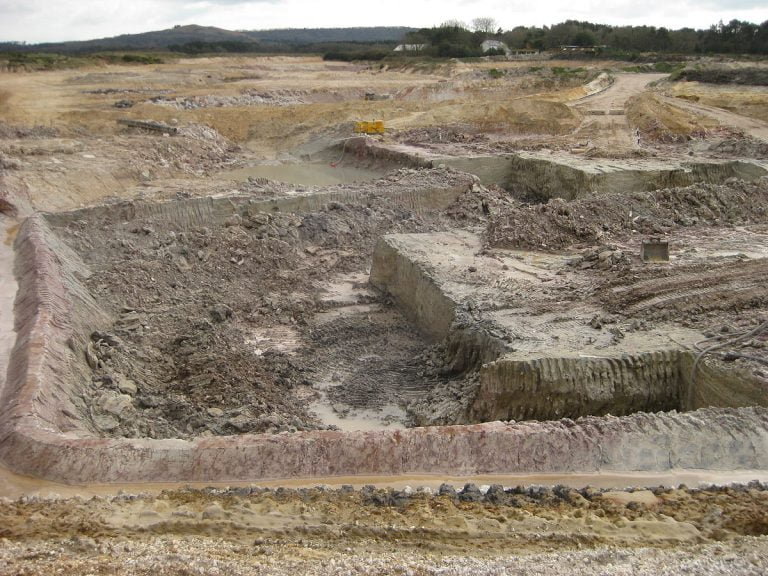
A study by the Environmental Management Agency (EMA) has revealed that illegal mining has damaged total of 11 163 hectares of land while degrading 1 555KM of riverbank ecosystems in the country.

The illegal miners’ activities are said to be damaging plantations, grazing areas, fields, urban areas, road, rail and electricity transmission servitudes and have become a threat to socio-economic development.

Bubi district in Matabeleland North and Umzingwane and Insiza rivers, and Ncema and Inyankuni dam catchment areas in Matabeleland South are among the gold hot spots that have been affected by illegal gold miners.
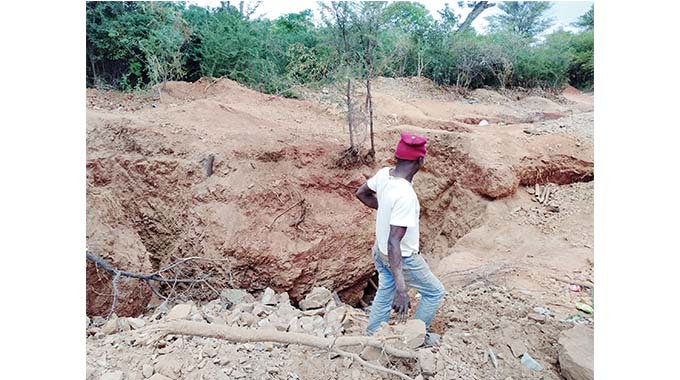
A gold panner looking at the damage caused to the environment

The environmental watchdogs estimate that there are 1,5 million illegal miners in the country.

In a statement on Sunday, EMA said it was in the process of creating an inventory on illegal mining and their environmental impact for decision making purposes.

EMA said it has observed that the Covid-19 pandemic induced lockdown has seen an increase in the number of panners violating the law and damaging the environment.

“The Agency has also noticed that restrictions associated with the Covid-19 pandemic have ushered in complacency within the public resulting in the surge in environmental violations. On that note, the Agency in collaboration with other law enforcement agencies, is seized with the obtaining situation and has put in place strategies to protect the environment from further damage,” it stated.

It said in partnership with law enforcement agents it has conducted several raids along the Umzingwane and Insiza rivers where rampant illegal mining activities are taking place.

“Illegal mining activities create conflict in land use, and have competing interests and claims with agricultural activities thereby affecting food security of the country. Land degradation characterised by open pits and loss of key forestry species remain a threat to lives, infrastructure, river flows and water quality and quantity,” read the statement.

EMA said unconventional mining activities has increased veld fire incidents as panners use metal detectors to clear land for panning activities.

The environmental watchdogs said there is an urgent need to contain illegal gold panning activities as failure do so will be very costly for Government and communities.

“It would actually be costly not to act, as land degradation, siltation and pollution of water bodies, destruction of infrastructure, outbreak of diseases, and possible loss of lives will worsen. The cost of rehabilitation will be unbearably high, and the cost of this will always be borne by the Government and local communities who own and use the land,” EMA said.

“Use of gold detectors by the illegal miners has also accelerated rate of land degradation in that heavy machinery is used to rip up the land to allow for gold detection to take place, hence scaring the land. The complexities of the groupings and fluidity characteristic of small-scale mining reduces the effectiveness of interventions that the Government and other stakeholders can put in place. Illegal mining trends tend to be very fluid on the ground as often illegal miners are very mobile and fugitive, thus effects of the activity are so fast, and very temporal and spatial.”

EMA also challenged communities to be heavily involved in fighting environmental crimes as they suffer the most in the long run.
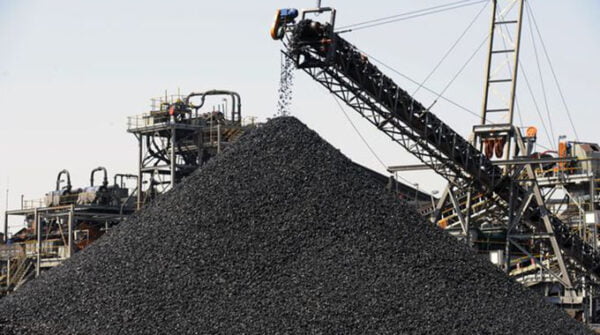
Truck drivers steal 50 tonnes of coal

0

TWO truck drivers employed by Zimbabwe Zhong Zhing Coking Company in Hwange have been arrested after they allegedly stole a combined 50 tonnes of coal from Makomo Resources while on duty.

Zimbabwe Zhong Zhing Coking Company is located at St Mary’s Lukosi just outside Hwange and was contracted by Makomo Resources to transport coal from mining pits to a stockpile within the coal miner’s premises.

Makomo Resources supplies coal to Zimbabwe Power Company’s Hwange Power Station for coal generation.

Meluleki Sibanda (35) of Makwika Village and Sam Ncube (42) of Gurambira Village in Hwange were arrested on Friday and charged with theft.

The two have not appeared in court after prosecutors referred the docket back to the police for further investigations before the case can proceed.

According to State documents, Sibanda and Ncube indicated that they would deny the theft charges.

“Makomo Resources contracted vehicles from Zimbabwe Zhong Zhing Coking Company to transport coal from the mining pits to the mine premises’ stockpile while waiting to be transported to Zimbabwe Power Company where the coal is used to generate electricity.

“On August 26 around midnight, the accused persons were on duty and were driving Zimbabwe Zhong Zhing Coking Company vehicles at the mining pits when they were loaded with 25 tonnes each to deliver to the mine’s stock pile. Instead the two accused persons drove the two vehicles to an unknown destination and offloaded the coal, thereby stealing from Makomo Resources,” the State alleges.

The coal was not supposed to leave Makomo Resources premises at that stage.

After offloading the coal, Sibanda and Ncube allegedly drove back to Makomo Resources mine premises.

A security guard who saw the two trucks loaded with coal, leaving the premises, later reported the matter to the mine authorities.

A report was made to the police leading to the duo’s arrest.

The coal was not recovered while its value is also yet to be ascertained.


The Chronicle

Cops In Court For Stealing US$23 000 From Bulawayo Gold Miner

0

TWO police officers Friday appeared before a Western Commonage Magistrate facing charges of stealing US$23 000 from a Bulawayo miner.

Joseph Marirangombe (29) and Tafadzwa Sibanda (31) appeared before Magistrate Gladmore Mushowe facing theft charges.

Marirangombe is stationed at the Bulawayo Central police station while Sibanda is based at CID stores.

Appearing for the state, Kenneth Shava told the court that early this month, the accused in the company of one accomplice still at large went to house number 4561 in Gwabalanda.

“Upon arrival, they introduced themselves as police officers and were looking for the complainant’s cousin only known as Prince whom they wanted to interview,” Shava told the court.

The prosecutor further told the court that after being told that Prince was at home, the accused handcuffed the complainant before searching the house. After the search, they stole a gold detector and cash amounting to US$23 000.

Shava told the court the trio informed the miner he was under arrest for illegal gold dealing and asked him to accompany them to Luveve police station.

“They parked outside the station and later told the complainant that they were releasing him pending further investigations. They gave him back the detector and remained with the cash, claiming they wanted to investigate its origins,” said Shava.

The complainant reported the case to the police after Marirangombe kept calling him claiming the police were still investigating the case.

“Complainant ended up doubting the accused’s story and made a report leading to the arrest of the two police officers.”

Magistrate Mushowe granted the police officers $3000 bail each and remanded them to September 11.

The accused were represented by Tinashe Runganga.

New Zimbabwe

Gold Panners Pollute Chimanimani Rivers

0

ILLEGAL gold miners in Chimanimani district are using prohibited lethal chemicals such as mercury in search of the precious mineral resulting in local water sources being contaminated and putting the lives of villagers, livestock, and flora and fauna at risk.

Chimanimani, a popular tourist district, is known for having the longest range of mountains in Africa and is home to more than 90 species of birds.

However, it is on the verge of environmental destruction as illegal gold miners derisively known as makozokoza have invaded the area and are causing untold destruction.

NewZimbabwe.com caught up with the vice-chairperson of the Chimanimani Tourist Association (CTA), Collen Sibanda who has been a ranger and tour guide in the area for over 26 years.

Sibanda said he was now living in fear after taking up the task of stopping illegal gold mining activities and the destruction of the land of his birth.

He said local rivers have been poisoned through illegal mining happening at the upper streams of Chimanimani which is evident by continued deaths on inhabitants of water such as frogs when one walks around in the area.

“The situation in Chimanimani is devastating as illegal gold miners have invaded the mountains and have polluted the waters with chemicals such as mercury they use when extracting the gold,” said Sibanda.

“As you walk down the streams of Chimanimani, you find dead frogs and other inhabitants of the streams, evidence of water contamination.

“It seems as if they are backed by influential people in government since some of the areas they are extracting the mineral from are sacred and national heritage sites but they have been invaded and are not arrested.

“I live in fear now for taking action against these people and I now fear for my life as these illegal gold miners have threatened me.”

Chimanimani played a great role in the liberation struggle of Zimbabwe with the vast mountain range in the district providing cover for freedom fighter recruits crossing into Mozambique to join the struggle.

One of the sacred areas known as the Bubbling Spring or Mutsero Tseri in the area is believed to have been a place where those crossing into Mozambique had to pass through to check if they were pure and if not, were not allowed to proceed.

Recently, the sacred shrine was dug up and a tragic event happened that shocked residents. Villagers narrate that a big fish popped out of the dry land they were digging.

Julie Pierini who is the chief executive of BirdLife Zimbabwe gave an expert opinion of the situation in Chimanimani.

She noted the effect illegal gold mining had on biodiversity and that over 1 000 villagers in both Zimbabwe and neighbouring Mozambique were at risk.

“Chimanimani is an area of top biodiversity and has more than 90 bird species found in the area. So it is important to recognise the area and protect the land,” Pierini.

“The situation is likely to affect more than 1 000 people on the Zimbabwean side and across the border to Mozambique if there is no immediate response to the situation.”New Zimbabwe

Gold advances as investors weigh Fed’s new approach on inflation

0

Gold climbed as investors weighed the impact of the Federal Reserve’s new approach to setting US monetary policy, with a more relaxed stance on inflation.

Chair Jerome Powell said that the Fed will seek inflation that averages 2 percent over time, a step that implies allowing for price gains to overshoot. He also noted that “if excessive inflationary pressures were to build or inflation expectations were to ratchet above levels consistent with our goal,” the central bank wouldn’t hesitate to act.

Bullion swung sharply Thursday as investors parsed the speech delivered virtually for the Fed’s annual policy symposium traditionally held in Jackson Hole, Wyoming. It rallied to an all-time high earlier this month as governments and central banks employed stimulus measures to curb the coronavirus pandemic’s damage on economies.

Higher inflation tolerance and low-interest rates should see US real yields fall in the medium-to-longer term, which is supportive of gold, said Vivek Dhar, an analyst at Commonwealth Bank of Australia.

Still, the fact that the Fed will also act if there are inflationary pressures adds doubt to how high US 10-year inflation expectations can reach, he said.

“The near V-shape rebound in US 10-year inflation expectations since mid-March is at risk of stalling,” said Dhar.

“This is negative for gold and has outweighed the Fed’s inflation-tolerance comments likely because gold markets weren’t expecting Powell’s intolerance for inflation getting too high.” Spot gold advanced 0.6 percent to $1 941 an ounce at 12:28 p.m. in Singapore.

On Thursday, prices slumped as much as 2.3 percent after rising 1.1 percent. The Fed’s shift to let inflation and employment run higher may signal that policymakers will keep interest rates low for years to come, lifting the appeal of non-interest-bearing gold. “Gold bulls initially rejoiced the announcement of seeking inflation to average 2 percent over time, but then quickly came crashing down after noting the inflation overshoots could be moderate,” Edward Moya, senior market analyst at Oanda, said in a note.

After the “record-long expansion failed to yield inflation, Wall Street is skeptical that the Fed will really see inflation anytime soon even when the economy is beyond the coronavirus.”Since the central bank officially set its inflation target at 2 percent in 2012, the Fed’s preferred measure of price increases has consistently fallen short of that objective, averaging just 1.4 percent.

That challenge was part of the impetus for the strategy review. Low inflation contributes to low-interest rates, which reduces the Fed’s ability to fight off economic downturns – potentially making them deeper and longer.

“While the Fed will likely need to ramp up their asset purchases to support the economy, they didn’t provide any signs that will happen soon,” Moya said. “Gold’s path back to record-high territory is still there, it will just take a while longer to get there.”


Reuters

Rhodium price on track for new record as mine output plummets

0

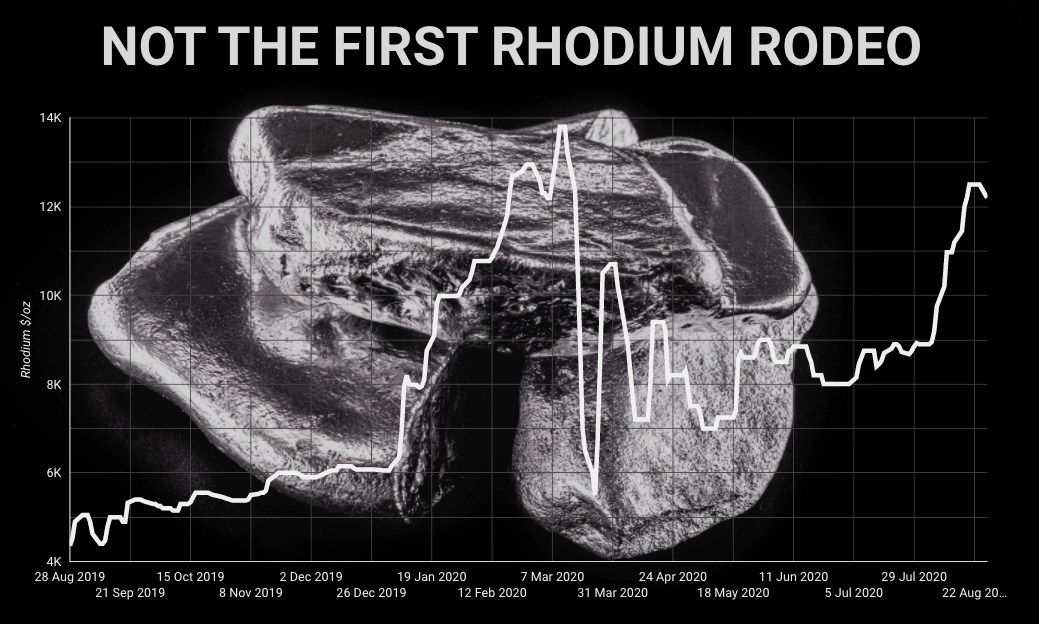
The price of rhodium has been on a stomach-churning ride this year, rocketing from $6,050 an ounce at the start 2020 to a record high of $13,800 an ounce by March 10, only to plummet to $7,800 an ounce before the end of that month as covid-19 spread around the world.

Like its sister metals palladium and platinum, rhodium’s main application is to clean vehicle emissions and the price quoted by Johnson Matthey, the world’s number one manufacturer of autocatalysts, showed the metal has clawed back much of its covid-19 losses to trade at $12,200 an ounce.

The fall in ounces leaving mine gates has forced producers to enter the open market as buyers to meet contracted volumes, says BMO:

The recovery in auto sales is boosting demand, particularly given the lack of alternatives in catalyst chemistry given rhodium’s role in reducing NOx (nitrogen oxide) emissions.

Given this, it is possible to see further new highs over the coming weeks.

Rhodium price on track for fresh record as mine output plummets
1 year rhodium price per troy ounce. Source: Johnson Matthey

South African PGM producers extract a mix of metals comprising roughly 60% platinum, 30% palladium and 10% rhodium.

Rhodium is also alloyed with platinum to make reinforcement fibre for the high-tech glass on consumer electronics, and used as a catalyst to make certain chemicals.

Due to rarity, the small size of the market (all of which is over the counter) and concentrated supply, prices are typically volatile.

Rhodium had a stunning run in 2019, rewarding investors with steady gains ending in 150% in annual returns.

But 2020 trading more resembles 2008, when rhodium touched $10,025 an ounce just before the global financial crisis hit – the metal would drop 90% before the end of that tumultuous year.

Bindura Nickel struggling to publish financials

0

The mining company, which initially committed to the market to publish financials not later than June 30, 2020, failed to beat the deadline and notified shareholders that it was now releasing them before August 14, 2020.

ZIMBABWE Stock Exchange (ZSE)-listed Bindura Nickel Corporation (BNC) is struggling to beat the target to publish its financial statements for the year ended March 30 2020, after shifting the date yet again.

The mining entity failed once again to publish on the aforementioned date and has now communicated that it will release the financials on September 18, 2020.

“On July 29, 2020, Bindura Nickel Corporation Limited (“BNC” or “the company”) published a notice in which shareholders and other stakeholders were informed that the company would not be able to meet its obligations in terms of the Zimbabwe Stock Exchange (ZSE’s) listing rules to publish its financial results for the year ended March 31, 2020 by not later than August 14, 2020,” company secretary Conrad Mukanganga said in a statement.

The local bourse granted the company a 30-day extension for the publication of its audited financial results for the year ended March 31, 2020 before further extending the deadline from July 31 to August 14, 2020.

“Subsequent to the foregoing, BNC realised that it would still not be able to meet the extended deadline of August 14, 2020. The company then approached the ZSE once again with an application for an extension by a further 30 days to enable it to publish the results by not later than 18th September 2020. The extension was granted. Accordingly, the company will no longer publish its results on or before August 14, 2020 as previously envisaged, but will now release them on or before 18th September 2020,” Mukanganga said
The company said it had failed to publish the results within the set timeframe due to the year-end audit which had been delayed by the lockdown which was imposed by authorities in March 2020 as a national response to curb the COVID-19 pandemic.

BNC said the revaluation of the BNC Smelter Complex by independent third parties could not be completed within the set year-end timelines.Last October, Sotic International, a company linked to businessman Kuda Tagwireyi snapped up ASA’s 74,13% stake from BNC.

Following the imposition of the lockdown a number of listed companies battled to beat an extended deadline of up to end of April to release their financial statements.
Subsequent to that, ZSE issued a blanket dispensation to all companies whose half-year and full-year financial statements were due for publication by March 31, 2020 on or before April 30, 2020 and most entities have since released their financials.

Zimbabwe has been under lockdown since March 30, 2020 and business has not been operating at optimum level_NewsDay

Mudzi widow in claim fight

0

Musukuma, a former Zanu PF director of information, through his company Minerals Identity (Private) Limited made an urgent chamber application compelling the courts to grant him a spoliation order to proceed with operations on the disputed mining claim that is owned by Munyoro and her family.

A MINE ownership wrangle between a Mudzi widow, Daina Mandiseka Munyoro, and Zanu PF politician Danny Musukuma has taken a new twist with lawyers representing the Munyoro family applying for the presiding judge to recuse himself from the matter.

The matter (HC4276/20) was heard before High Court judge Justice Clement Phiri on Tuesday with the ruling set to be handed down this week.

On Wednesday, Munyoro through her lawyer Kudzaishe Gama of Gama and Partners, asked for Justice Phiri to recuse himself from the matter, arguing that although “parties do not choose their own judges, similarly judges should not choose the matters to adjudicate”.

“In the directions handed down in court, his Lordship indicated that he will hear the chamber application for amendment which the applicant intends to file on August 26 2020,” the lawyers indicated.

“We have noted that the handwritten ruling, Annexure 1 hereto, omits that part of the directions given in court. We, therefore, humbly seek clarification concerning that part of the court’s directions/ruling. Is his Lordship still minded to hear the chamber application himself or he will allow the Judge President or responsible judge to allocate it as usual? If his Lordship is still minded to hear the chamber application, our clients wish to make the following entreaty.

“Our clients hereby humbly request that the matter be allocated to a judge as per the usual practice and procedure. There are two reasons why we make this request. First, in his earlier ruling handed down in court, his Lordship found that the purported “correction” of the founding affidavit in and by the answering affidavit was “well-conceived” and in order.

“Our clients reasonably believe that this is the same manner in which the chamber application for amendment of the same founding affidavit to correct the same alleged errors will be determined by his Lordship. In other words, his Lordship has already taken and communicated a position on the purported correction of the alleged errors. In our most respectful submission, it is highly unlikely that his Lordship will contradict his earlier ruling.”

Yesterday, Musukuma’s lawyers Chanaiwa Law Chambers, argued that the matter should proceed under Justice Phiri.

“In respect of the urgent chamber application for ammendments of documents directed to be filed on or before August 26, 2020 by his Lordship Justice Phiri, we wish to bring the following to your attention,” the lawyers argued.

“Although it is not captured in the written ruling, his Lordship directed that the matter be heard before him.

“The attached letter from third, fourth, fifth and sixth respondents should suffice as confirmation of his Lordship’s direction.

“Kindly proceed to have the matter set before him.”

Musukuma also cited police boss Godwin Matanga, Mines minister Winston Chitando, Munyoro family partner Mathias Madzivanzira, officer-in-charge Support Unit Makosa, Mutoko and one Ndemera as respondents.

In his application filed on August 12, Musukuma said the police forcibly dispossessed him of control of KooDoo 10 mining site. In their opposing papers, the Munyoro family, however, said they were the legal owners of the gold claim and that Musukuma was leading a team of illegal miners_NewsDay

China launches unusual attack on Zim journalist over Anjin, angers scribes

0

China this week launched an unusual attack on a senior Zimbabwean journalist, Tawanda Majoni, accusing him of corruption and harbouring political ambitions over a recent article he wrote on the return of Anjin Investments Ltd to mine diamonds in Marange.

But the Zimbabwe Union of Journalists (ZUJ), in a statement on Thursday, came out guns blazing and described the response by the Chinese embassy as “ominous”, “unwarranted” and capable to “inflame the persecution” of Majoni who runs a free weekly column on corruption in one of the local newspapers.

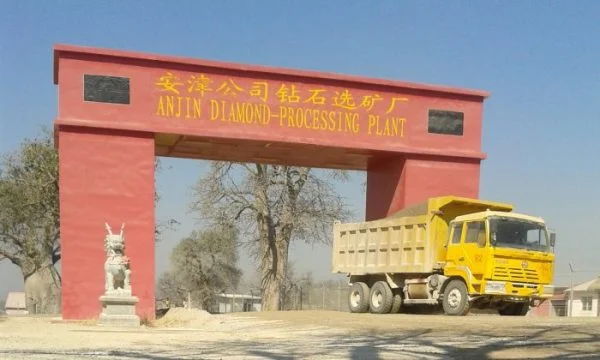
In his latest article last Sunday, Majoni queried the secretive readmission of Anjin, which was booted out of the diamond fields by the late ex-president Robert Mugabe in 2016 together with six other companies for allegedly looting gems worth billions of dollars.

The journalist, who is also the national coordinator at Information for Development Trust (IDT), a non-profit media advocacy institution currently supporting reporters to investigate corruption, questioned government’s decision to readmit Anjin without availing the audit it promised in 2016.

He argued that the Chinese government pressured Zimbabwe to take Anjin back, following a visit to Beijing by President Emmerson Mnangagwa in 2018.

Polite Kambamura, Zimbabwe’s Mines deputy minister, in an interview with the Bloomberg early last year, insinuated that Chinese pressure led to the readmission of Anjin.

“Anjin was brought back because of an agreement with the Chinese government. We had to bring them back for public relations reasons,” Kambamura was quoted by Bloomberg as saying.

Anjin made a silent comeback as early as the first quarter of 2019, but resumed ground operations towards the end of the year.

Mnangagwa recently officially commissioned the Anjin project, which is running alongside a merger, the Zimbabwe Consolidated Diamond Company (ZCDC) that was set up when the licences of the previous seven miners were revoked.

Anjin is a joint venture between Matt Bronze, which is linked to the Zimbabwean army, and Anhui Foreign Economic Construction, a Chinese firm suspected to be linked to the Asian country’s military.

The Chinese statement that was attributed to a nameless embassy spokesperson refuted the claim that Beijing had demanded Anjin’s return and launched a personal attack on Majoni over his opinion article.

“The piece (article) is full of unfounded accusations, conjectures and sheer lies, proving nothing but an appalling lack of commonsense and self-confidence.

“The only motive for cooking up these absurdly far-stretched claims is to attract attention, sow discord in China-Zimbabwe bilateral friendly relations, and drag China into Zimbabwe’s internal affairs, all serving the author’s (Majoni’s) own hidden political agenda.

Majoni said he was still consulting on how to engage the embassy regarding the statement.

“We do understand this as an easy way for him to make money and gain political capital, even to live a better life. For this reason, sympathy is due,” read the three-page statement by the embassy.

The embassy claimed it was involved in “dedicated and selfless help” to Zimbabwe, having availed grants and financial support and built hospitals, schools, power stations, boreholes and airports across the country.

It also claimed it was helping rebuild shelter and infrastructure destroyed by Cyclone Idai last year, but recent media reports show that the Chinese have hardly done any work in the affected areas as promised.

The ZUJ expressed concern at the Chinese statement, describing it as an “undiplomatic and unusual personal attack” on Majoni.

“As ZUJ, we acknowledge that the Chinese embassy must be given the right of reply on issues that pertain to it and China. That right was availed when it issued the response to Majoni’s article through the local media.

“However, the tone and attitude of the response are extremely disturbing and uncharacteristic of a foreign embassy. The Embassy launched a personal and defamatory attack on the author of the article.

“More disturbingly, it accused Majoni of harbouring a “hidden political agenda” and seeking “an easy way to make money”. This insinuates that Majoni is a corrupt political activist “writing for bread”, rather than a bona fide journalist who has been running a free weekly column on corruption for the last four years,” wrote ZUJ.

The union added: “The Zimbabwean Constitution provides that the country’s citizens must be treated with dignity, which must always be protected. Majoni, as a Zimbabwean citizen, must also enjoy the freedom of conscience as provided under Section 60 of the Constitution. This freedom entails that he has the right to freedom of thought, opinion or belief”.

ZUJ said Majoni also had the constitutional right to practice, propagate, and give expression to those thoughts, opinions and beliefs.

“In addition, Zimbabwean citizens, journalists included, have the freedom to seek, receive and communicate their ideas and information, just as the media also has the right to operate freely. This is also enshrined in Article 19 of the Universal Declaration of Human Rights (UDHR) as well as the African Union and SADC principles,” added the union.

It said accusing Majoni of having a political agenda and insinuating that he is corrupt militated against his constitutional rights as a person and journalist and the “potential of instilling fear in him— considering prevailing persecutions on journalists, civil society and human rights defenders in many countries—and can inflame his persecution”.

ZUJ urged the Zimbabwean government to engage the Chinese embassy “over its unsettling and unprecedented statement because we fill that the foreign mission overstepped its mandate.”

“Zimbabwean citizens are entitled to the State’s protection as provided under Section 35 of our Constitution. Failure to censure the embassy may set a wrong precedent as its statement amounts to harassment of a Zimbabwean citizen by a foreign mission,” concluded ZUJ.

China has been accused of lending intelligence and military help to Zimbabwe to rig elections and is widely seen as holding the country to ransom for loans worth billions of dollars that the southern African country is failing to repay.

Responding to the Chinese embassy statement, a Zimbabwean columnist based in the UK, Wilbert Mukori, on Wednesday dismissed Beijing’s claim that it was a selfless friend of the country and described China as Zimbabwe’s new colonial master_New Zimbabwe

Gold miners, Fidelity Printers and Refiners impasse settled

0

ARTISANAL and small-scale gold miners have said they will continue to work hand in glove with Fidelity Printers and Refiners (FPR) even though there had been delays in the issuance of remittances from the country’s sole gold buyer.

FPR was said to have failed to pay miners on time in the last two weeks, a situation that almost threatened gold deliveries. FPR pegs payments on the London Bullion Market (LMBA) scale, which has seen local miners getting paid in United States dollars only.

On Thursday last week, it took the intervention of the Reserve Bank of Zimbabwe (RBZ) Governor Dr John Mangudya to put the matter to rest. Dr Mangudya had a meeting with the Zimbabwe Miners Federation (ZMF) where he clarified that the payment impasse will be resolved in a week.

ZMF chief executive officer Mr Wellington Takavarasha said small-scale miners appreciate the RBZ boss’ mediation.

“ZMF and the Reserve Bank of Zimbabwe Governor Dr John Mangudya had a meeting with regards to delays in payment for bullion and nuggets remitted to Fidelity Printers and Refiners. He has sincerely apologised and committed that all outstanding arrears FPR Bullion Payments will be done starting next week,” said Mr Takavarasha.

He said miners must commit to deliver to FPR and whenever they are aggrieved, they have to engage all stakeholders concerned amicably. Artisanal and small-scale gold miners have delivered more gold to FPR. In July, they delivered 700 kilogrammes, while large-scale miners brought in 650 kilogrammes. FPR general manager Mr. Fradreck Kunaka is on record saying they were committed to give miners the right charge for their gold.

“At Fidelity Printers and Refiners we always aim at offering the miners’ value for their gold.”

A gold miner at Umzingwane district Mr. Elliot Moyo said while they appreciate the challenges faced by FPR, communication between the miners and the buyer were key.

“We work to deliver our gold in the formal market but when we fail to get our money on time it boggles the mind. As miners we will commit to build the country’s gold reserves and that calls for mutual engagement of all concerned parties all the time,” he said_Sunday News