Reuters: First Quantum Minerals sees no risk of nationalization in Zambia following the sale last month of Mopani Copper Mines to the country’s mining investment arm ZCCM-IH, the Canadian miner’s chief operating officer, Tristan Pascall, said on Wednesday.
“We don’t see any contagion or any element or risk in that more broadly in Zambia,” he said on a call.
Zambia became Africa’s first pandemic-era sovereign default in November, but ZCCM-IH in January agreed to take on $1.5 billion in debt for Glencore’s Mopani stake, making it the sole owner of the mine.
ZCCM-IH has said it expects to find a new investor for Mopani by the end of the year as it looks to boost copper output from a little more than 34,000 tonnes to 150,000 tonnes.
First Quantum, which previously held 16.9% of Mopani, operates the Kansanshi and Sentinel mines in the country.
The miner aims to resolve talks with the Zambian government over expansion of the smelter at Kansanshi before August elections, Pascall said. First Quantum wants a deal that allows it to deduct royalties from costs, he said.
He said efforts to sell minority stakes in the Zambia mines continue, but the company has to take rising copper prices into account.
“That’s the challenge for copper producers looking to embark in M&A,” he said.
Reuters: Some resource-rich developing countries are seeking to rewrite mining contracts and accelerate dividend payouts, which can take years to materialize under deals that experts said are tilted in companies’ favor.
Any move to renegotiate agreements will trigger pushback by miners wary of threats to their profit margins, experts said, and previous attempts have caused protracted disputes.
Mongolia became the latest country to demand better terms, asking for more tax revenue from Rio Tinto’s Oyu Tolgoi copper-gold mine while it waits for dividends. In West Africa, Mali has said it would try to reopen mining contracts that leave the state waiting years for dividend payments.
“What we’re asking for today is for African countries to be able to benefit more from their mineral production,” said Abdoulaye Pona, president of Mali’s Chamber of Mines.
THE HISTORICAL POWER IMBALANCE BETWEEN MINERAL-RICH BUT CASH-POOR COUNTRIES AND MULTINATIONAL MINING COMPANIES HAS LEFT A LEGACY OF BAD DEALS THAT HAVE BEEN OVERLY GENEROUS TO INVESTORS
The historical power imbalance between mineral-rich but cash-poor countries and multinational mining companies has left a legacy of bad deals that have been overly generous to investors, said Alexandra Readhead, tax and extractives lead at the International Institute for Sustainable Development.
The financial strain governments are under from the covid-19 pandemic could lead to stricter implementation of existing tax laws and closer scrutiny of deals, Readhead said.
Governments are pushing for speedier payouts as prices for metals from gold to copper scale multiyear highs, signaling what investment bankers said is the start of another commodity supercycle.
Glencore remains at odds with the Democratic Republic of Congo nearly three years after the country signed a new mining code into law, CEO Ivan Glasenberg said on Tuesday. The 2018 code hiked royalties on cobalt, copper and gold.
“We are still in discussions with the government… we have not accepted the change from the old code to the new code,” Glasenberg told investors on a call.
‘Not likely to change’
Mongolia, which owns 34% of the Oyu Tolgoi mine, is unlikely to get dividends until 2051 based on Rio’s latest cost estimate for an underground expansion, a source familiar with negotiations said.
Delays and rising costs have eroded the expected benefits of the project, the state argued.
Rio, whose majority-owned Turquoise Hill Resources owns the rest of the mine, declined to comment.
Some are skeptical Mongolia’s government will win better terms under a new pact, given that previous agreements limit its taxation powers.
“It’s not likely to change to their benefit,” said Vincent Kiezebrink at the Netherlands-based Centre for Research on Multinational Corporations.
In Mali, the transitional government is reviewing mining deals after the auditor general last year identified problems including “non-distribution of dividends” in the contracts.
In September, Barrick Gold unit SOMILO paid its first dividend to Mali, 15 years after production at the Loulo mine started and a year after the auditor general criticised the firm for not paying dividends.
Barrick did not respond to questions. The Loulo mine is part of the Loulo-Gounkoto gold-mining complex, West Africa’s biggest, and Barrick said the project generated $240 million in dividends for 2020.
CEO Mark Bristow has said he does not expect major changes to mining deals in Mali.
Last year Mali’s auditor general demanded Resolute Mining pay dividends to the state, a 20% shareholder in the Syama mine which started producing in late 2008.
Resolute’s Mali subsidiary SOMISY will begin paying dividends to the government once it reaches profitability, the company told Reuters.
While pushing for reforms, countries in need of investment must still tread carefully, Pona at Mali’s Chamber of Mines said.
“You can’t create a (mining) code which will make mining companies avoid your country,” he said.
(By Helen Reid and Jeff Lewis; Editing by Cynthia Osterman)
Despite relatively stable consumer demand for diamonds in established markets like the U.S. and notable growth from newer markets like China, for the most of last decade the diamond industry has felt apathetic. This can in part be explained by an arguably oversupplied supply-chain, insufficient marketing efforts and a general pessimism towards the diamond business as a changing consumer economy challenges traditional industries.
That said, as of late, the diamond industry has been acknowledging these challenges, in some areas more proactively than others, with various macro as well as more micro initiatives. Perhaps serendipitously, the events of 2020 seemed to pressure the industry to take a more accelerated approach to many of these initiatives, five of which are more pronounced in my opinion. These are briefly analyzed below:
1. Prioritization of sustainability:
I would love to see the diamond industry be a leader in the area of sustainability. Apart from simply being the right thing to do for future generations, from strictly a business standpoint, I think a robust approach to sustainably is actually a necessity for the industry given that diamonds are discretionary item that appeal to consumers emotions –simply put, the product has to have a positive connotation with people and make consumers feel good.
In terms of mining, the diamond industry is uniquely positioned given that most diamonds are found in kimberlite rock. Kimberlite is classified as an ultramafic rock that has a unique property that allows it to naturally absorb very high concentrations of CO2 (note: ultramafic rocks only represent a low-single digit percentage of accessible rocks on the planet).
I think this is one of the most exciting developments in sustainability, not just for the diamond mining industry but for the larger mining industry as a whole, as this process of “mineral carbonation” could result in not only carbon neutral mining but net-negative carbon mining. De Beers has been co-developing this technology for about five years now along with other sustainable mining technologies like hydrogen powered mining fleets –which is being spearheaded by De Beers’ parent Anglo American (LSE: AAL).
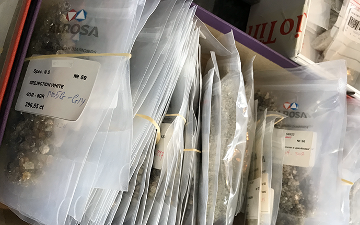
Primary market goods from ALROSA (MICEX: ALRS) and Rio Tinto (LSE: RIO). Image source: Paul Zimnisky
2. Tracking diamond provenance:
In the coming years when a customer buys a diamond I think they will be provided with the source provenance of the diamond (i.e. the country where the diamond was mined or even the specific mine) in addition to the traditional quality characteristics provided with a grading report. Diamond provenance initiatives have become a priority in the industry, boosted by the availability of new technologies that makes verifiable tracking of a diamond through the (sometimes convoluted) supply chain a reality.
At first, source provenance will likely only be available with larger, center-stone-quality diamonds, however, I think eventually the supply-chain could adapt to allow traceability of smaller goods as well. Tiffany & Co. (now private), the largest jeweler in the world by valuation, is already providing “geographical sourcing information” on all diamonds 0.18-carats larger.
Providing customers with the original source of a diamond increases its “story telling” appeal but also communicates that it is a real, natural diamond that is conflict-free. In the past, most customers have been reluctant to pay a significant premium for a diamond with a source provenance, as has been seen with Canadian-branded diamond campaigns, however, in the near future, I think most consumers, especially in developed regions of the world, will simply demand source information.
3. A more discipline supply chain:
An oversupplied market was arguably the greatest plague to the diamond industry for most of the last decade. Too much upstream supply (i.e. from the miners), which was in part prompted by record-high diamond prices in the early-2010’s, along with over-speculation by some mid-stream participants (i.e. the manufacturers), led to more supply than the industry could handle over the given period of time.
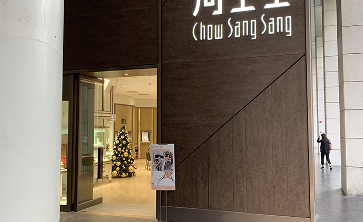
A Chow Sang Sang (HK: 0116) store in downtown Guangzhou, China. Image source: Paul Zimnisky
However, it now appears that greater business discipline has begun to take hold as both the upstream and mid-stream segments of the industry have shown to be practicing more supply restraint in recent quarters. A trend of industry inventory deleveraging that begun to take hold pre-2020, was further accelerated by the pandemic. The major miners have reduced production guidance and have provided unprecedented flexibility with their contracted rough diamond buyers. Further, De Beers has recently taken structural steps to more efficiently allocate rough to its buyers which should keep supply in the hands of the strongest players, those that can profitably add-value to it.
In addition, external forces are reshaping the way that the midstream segment of the industry operates; for example, there has been a trend of reduced (relative) credit availability to manufactures after multiple years of apathetic income –which has forced more conservative buying practices. Also, the midstream industry itself has also taken measured action to encourage more conservative practices which was seen following the onset of the pandemic. For example, Indian diamond manufacturing trade organizations called for a voluntary import ban on rough diamonds last year in an effort to sustain manageable levels of inventory aimed at supporting polished prices and preserving the creditworthiness of the industry.
4. Secular consumer demand growth out of China:
2020 reiterated the strength and resilience of the Chinese consumer market for diamonds. Despite lockdowns and economic uncertainty, Chinese demand for diamonds has continued to surprise to the upside. Multiple major jewelers have indicated high double-digit sales growth in the Mainland in recent quarters.
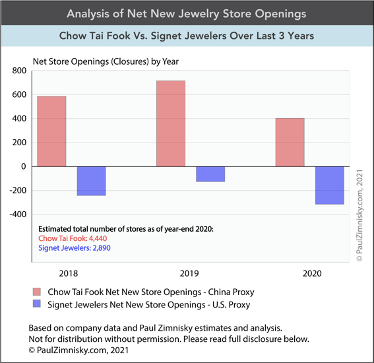
Boosted by evidently consistent wealth creation and a budding middle and upper-middle class with a penchant for lux, China has shown to be a consistent driving force for diamond demand; whereas growth in more developed Western markets seemingly remains more sensitive to volatile economic conditions and changing consumer buying patterns. As a proxy, Greater China’s largest gem-set jeweller, Chow Tai Fook (HK: 1929), has continued to open net new stores at an impressive pace –the company even opened new stores during the pandemic. Whilst, the U.S.’s largest jeweller by store count, Signet (NYSE: SIG), has closed hundreds of stores in recent years as the company restructures (see figure below).
5. Downstream innovation:
The global pandemic-related lockdowns showed us that jewelers with reliable eCommerce functionality were not only able to withstand weeks and months of brick-and-mortar closures, but in some cases actually thrive by taking market share from non-eComm equipped competitors. The lockdowns also showed us that a significant number of consumers are willing to buy expensive diamond jewelry over the internet without actually seeing and feeling it in person.
Further, the jewelry industry is showing to be a leader in consumer goods marketing innovation. For example, Chow Tai Fook has embraced “live streaming” using social media and other digital platforms with celebrities and influencers to discuss and generate interest in products via real-time streaming video. In April of last year, in the midst of the pandemic, a company representative told me that live streaming events with top KOL’s (“key opinion leaders,” i.e. influencers) were generating almost 10 million views a month on average.
While the diamond industry has certainly had its share of up and downs in recent years (which has felt like more downs than ups), it has shown time and time again to be a very resilient industry, even in times of crisis. Jewelry, and diamonds specifically, continue to resonate with consumers on an increasingly global basis while industry participants have time and again shown to be a committed group, loyal to keeping the industry alive and relevant.
———-
Paul Zimnisky, CFA is an independent diamond industry analyst and consultant based in the New York metro area. For regular in-depth analysis of the diamond industry please consider subscribing to his State of the Diamond Market, a leading monthly industry report; an index of previous issues can be found here. Also, listen to the Paul Zimnisky Diamond Analytics Podcast on iTunes or Spotify for wide-ranging and interesting discussions with prominent guests from around the industry. Paul is a graduate of the University of Maryland’s Robert H. Smith School of Business with a B.S. in finance and he is a CFA charterholder. He can be reached at [email protected] and followed on Twitter @paulzimnisky.
Disclosure: At the time of writing Paul Zimnisky held a long position in Lucara Diamond Corp, Mountain Province Diamonds, Star Diamond Corp and North Arrow Minerals Inc. Please read full disclosure below.
HUNDREDS of villagers in the Dinde area, Hwange district in Matabeleland North are living in fear of eviction from their ancestral land to pave way for a Chinese coal-mining project
This has attracted the interest of the Centre for Natural Resources Governance (CNRG), a civil society advocacy group and the Zimbabwe Lawyers for Human Rights (ZLHR) who are taking legal action to stop the eviction of the villagers.
The proposed coal-mining project comes a few months after government was forced to reverse a decision to allow Chinese firms to explore for coal at the Hwange National Park.
Environmentalists took government to court in September 2020 to prevent ecological degradation after two Chinese firms, Zhongxin Coal Mining Group and Afrochine Smelting were controversially given exploration rights inside the country’s biggest national park.
The Beifa Investment Company’s coal project in Dinde is failing to take off after villagers resisted eviction.
It was alleged that the Chinese were working with the local traditional leadership, particularly chiefs, to push for the eviction of their subjects.
The Chinese reportedly claim to have been given special mining concessions by the government.
According to the Mines and Minerals Act, special grants are issued by the President in respect of land not reserved for prospecting, like communal lands.
Farawu Maguwu, director of CNRG said the advocacy group responded to the distress call of the Dinde community by visiting the area last week to gather “information about the events unfolding there.”
“We cannot be a sovereign country that allows so-called investors to come and evict our people from their homes willy-nilly. There is also a high possibility they are abusing the name of the President to put fear in the community and break down any resistance to their nefarious activities,” Maguwu said.
“Making Zimbabweans homeless, landless and destitute in their own country is unpatriotic and against the values of our society. No Zimbabwean citizen has ever evicted Chinese people off their land in China. Our dignity must be respected.”
Maguwu revealed that CNRG had engaged ZLHR to stop the evictions.
ZLHR spokesperson Kumbirai Mafunda confirmed the developments.
“Indeed, our lawyers are working together with our partner CNRG and are in the community consulting with villagers in Dinde,” Mafunda told Southern Eye early this week.
“ZLHR is worried by the ill-treatment of villagers in Dinde and we are doing all we can, including taking legal action to protect their rights which are being violated.”
Beifa Investments Company officials could not be reached for comment.
Dinde is home to thousands of Nambyas and Tongas with a preponderance of the Tonga who first settled in the then Whange district up to Victoria Falls upstream of the Zambezi River centuries ago.
They were settled in Dinde area after relocation from Sinamatela area in the 1920’s to pave way for the Hwange National Park.
The Dinde villagers’ fight against eviction is one of the many battles on the continent between environmentalists and Chinese companies financing the construction of coal plants.
In Zimbabwe, Chinese companies are undertaking, among others, the US$1,5 billion project, being carried out by Sino Hydro, which entails the building of two additional power-generating units 7 and 8 at the Hwange Power Station. Upon completion, the new units will add 600 megawatts to the national grid.
The much-hyped meeting between the Zimbabwe Miners Federation (ZMF) and Mines and Mining Development Ministry which was scheduled for today failed to take off.
In a statement the Zimbabwe Miners Federation Chief Executive Officer Mr. Wellington Takavarasha said ZMF officials had travelled to Kadoma to attend an accident that occurred in the early hours of yesterday.
In a statement ZMF said,
“Due to circumstances beyond our control, the weekly meeting between ZMF /Ministry of Mines and Mining Development that was pencilled for today was not held as ZMF team travelled in the morning to attend an ASM disaster in Kadoma. The meeting has been deferred to next week. Meanwhile, all issues and concerns tabled by yesterday 20:00 hrs were captured for presentation. The Ministry will then advise on the way forward,” read the statement.
It was earlier this week announced that the Ministry of Mines and Mining Development and the Zimbabwe Miners Federation (ZMF) officials will be holding weekly meetings on issues and concerns affecting artisanal, small and medium-scale mining operations.
The Department of Research, Value Addition and Beneficiation (headed by Dr. Manyuchi, The Chief Director) was also named as the ZMF focal point at the Ministry of Mines.
After the announcement the Henrietta Rushwaya lead ZMF invited artisanal, small and medium scale miners to forward any issues and concerns on Policy and legislative issues, Administrative issues at PMD offices, Institutional and, also make recommendations/suggestions.
Issues and concerns, suggestions opinions and recommendations should be forwarded to [email protected] or WhatsApp platform ZMF Issues and Concerns. Please note that these forums are strictly for relaying information AND NOT for debate or discussions.
(ATF) Japanese oil refiner Idemitsu Kosan plans to launch an electric vehicle next year through a joint venture with unlisted carmaker Tajima Motor, signalling a further shift out of internal combustion engines.
Idemitsu has stepped up its transformation into a supplier of low-carbon energy and materials as local oil demand drops, although in Japan that is largely due to a shrinking and ageing population rather than progressive ideas about conservation and sustainability.
Idemitsu and Tajima aim to unveil their first ultra-compact vehicle in October and start selling the product next year, with a price tag of between 1 million and 1.5 million yen ($9,500 and $14,250). The vehicle will be available for rental at Idemitsu petrol stations.
The refiner began its move into EV production last year, when it installed solid electrolyte production equipment for the manufacture of batteries at its plant in Chiba prefecture and aims to start operating next year.
Idemitsu’s automotive production materials unit has been increasingly important, Thanh Ha Pham, an equity analyst at Jefferies in Tokyo, said. Idemitsu’s oil business has suffered in recent years, although its styrene monomer margins have been high, Thanh said.
SHORT DISTANCES
The companies hope the new model, a 4-seater EV with a driving range of up to 120 km and a maximum speed of 60 km per hour, will draw demand from individuals and businesses using cars for short distances for shopping and deliveries.
The venture is an ambitious move for Tajima, best known as a maker of parts, ranging from oil pans to door handle covers. Started by former race-car driver Nobuhiro “Monster” Tajima, the company said its entry into EV manufacture reflected the founder’s desire for a “sustainable earth environment, to save lives and protect what is valuable”.
The Idemitsu-Tajima JV debut car is 2.5 metres long and 1.3 metres wide, smaller than conventional mini-vehicles in Japan.
“We believe there is about 1 million potential demand for ultra-compact EVs as it is safer than bicycle or small motorbike and easier to drive than a conventional mini-vehicle,” Idemitsu president Shunichi Kito told a news conference.
“We plan to offer various services including sharing and subscription of the EV at our 6,400 petrol stations,” he said.
Petra Diamonds raised doubts about its ability to continue as a going concern and warned that additional funding may be required if support from one of its creditors falls through.
The company, which has been hit by weak diamond prices, said on Tuesday it was relying on the successful completion of its restructuring to continue as a going concern.
Platinum has broken out of more than a decade of price weakness to reach its highest since 2014, as investors anticipate that rising demand, including from the budding hydrogen industry, will surpass supply and support a lasting rally.
Years of oversupply and weak demand for platinum, used by auto makers, industry and jewellers, dragged prices from $2,290 an ounce in 2008 to $558 last year.
But prices have rebounded as the global economy started to recover from the covid-19 pandemic and gained more than 20% this month to above $1,300.
“WE NOW SEE SIGNS OF SPECULATIVE EXCESS”
Carsten Fritsch, Commerzbank
“I can see further price increases coming,” said Bank of America analyst Michael Widmer, saying the market would see large deficits from 2023 and platinum could mimic palladium, which surged because of consistent undersupply.
“Look at palladium – you had a 10-year bear market (from 2001) – and then prices moved up by 1500%.”
Auto makers account for around 40% of annual platinum demand of around 8 million ounces, embedding it in exhaust pipes to neutralise harmful emissions.
Manufactures have for years preferred palladium and rhodium for the task, but high prices of those two metals have begun to push many back to platinum, Johnson Matthey said in a report.
Analysts at Citi expect auto makers to use around 800,000 ounces less palladium and 800,000 ounces more platinum by the end of 2022, reducing total palladium demand by 8% and increasing total platinum demand by 10%.
Tighter Chinese emissions rules and higher sales will meanwhile raise the use of platinum in heavy duty vehicles by 50% this year alone, Johnson Matthey said.
Over the longer term, a shift from gasoline and diesel will reduce demand for platinum to clean exhaust fumes.
But an alternative to fossil fuels is hydrogen, and platinum is used in electrolysers to make hydrogen and fuel cells using it to power cars, trains and ships.
Demand for platinum in fuel cell-powered vehicles could rise to 2-4 million ounces a year by 2030, Bank of America’s Widmer said.
Investors are taking note, ramping up their bets on higher prices in U.S. futures markets and stockpiling bars in exchange traded funds.
But with big deficits still a couple of years away they may be unable to maintain recent momentum.
“We now see signs of speculative excess,” said Carsten Fritsch at Commerzbank, suggesting prices may need to fall in the near term.
Anglo-American has announced the appointment of Elisabeth Brinton to the board as a non-executive director with effect from the beginning of March 2021.
By Shantel T Chisango
Chairman of Anglo-American, Mr Stuart Chambers said he is looking forward to work with Ms. Brinton considering the experience she has in the development of clean energy all over the world.
“Elisabeth Brinton’s experience of developing clean energy strategies around the world, with a clear commercial focus on the potential for digital technologies, will bring additional insights to our Board discussions. I look forward to welcoming Elisabeth to Anglo American.”
Ms. Brinton (53) is Employee Value Proposition (EVP) of Global Renewables and Energy Solutions (formerly New Energies) at Royal Dutch Shell. Ms. Brinton joined Shell in 2018 from AGL Energy, one of Australia’s largest energy companies, where she led their commercial new energies business and built at the time Australia’s largest portfolio of renewables in partnership with the AUD$3 Billion Powering Australia Renewables Fund.
Prior to that, she spent 15 years in a number of senior executive technology roles in the USA, leading the development of cloud-based customer solutions and broader digital transformations for the energy industry, having begun her career as a successful entrepreneur. She also has a bachelor’s degree in English and History from Principia College, Illinois, USA, and is a Harry S. Truman Scholar.
She will join the Board as a non-executive director, with effect from 1 March 2021.
About Anglo- American
Anglo American is a leading producer of PGMs, essential metals for cleaning vehicle exhaust emissions and as the catalyst in electric fuel cell technology.
Anglo owns and operates three mining complexes in South Africa’s Bushveld complex, including Mogalakwena – the world’s largest open-pit PGMs mine, Amandelbult and Mototolo, as well as the Unki mine, in Zimbabwe.
In South Africa, Anglo also owns smelting and refining operations which treat concentrates from its wholly-owned mines, our joint venture operations and third parties.
To provide the best experiences, we use technologies like cookies to store and/or access device information. Consenting to these technologies will allow us to process data such as browsing behavior or unique IDs on this site. Not consenting or withdrawing consent, may adversely affect certain features and functions.
Functional
Always active
The technical storage or access is strictly necessary for the legitimate purpose of enabling the use of a specific service explicitly requested by the subscriber or user, or for the sole purpose of carrying out the transmission of a communication over an electronic communications network.
Preferences
The technical storage or access is necessary for the legitimate purpose of storing preferences that are not requested by the subscriber or user.
Statistics
The technical storage or access that is used exclusively for statistical purposes.The technical storage or access that is used exclusively for anonymous statistical purposes. Without a subpoena, voluntary compliance on the part of your Internet Service Provider, or additional records from a third party, information stored or retrieved for this purpose alone cannot usually be used to identify you.
Marketing
The technical storage or access is required to create user profiles to send advertising, or to track the user on a website or across several websites for similar marketing purposes.





 “We don’t see any contagion or any element or risk in that more broadly in Zambia,” he said on a call.