South African miner Anglo American Platinum Ltd’s (Amplats) first quarter production fell 6 percent, hit by problems at power supplier Eskom, operational challenges and ore stockpiling in the same period the year before.
Power cuts implemented by Eskom, which supplies more than 90 percent of electricity in Africa’s most advanced economy, pose a threat to miners which are among the biggest users of power in the country and are already grappling with weak profits.
Amplats’ total platinum group metal (PGM) production fell 6 percent to 998,900 ounces for the quarter ended March. 31, from 1,062,800 ounces in the same period a year ago.
Eskom cut power across the country in February and March as low coal supplies, a severe cash crunch, and multiple failures at its ageing fleet of power stations throttled supply.
Amplats said the power cuts hit PGM production at its Mogalakwena operations, which declined by 6 percent to 307,200 ounces, and at its Amandelbult operations, which decreased 7 percent to 192,800 ounces.
In February, Amplats said it lost 14,000 platinum ounces when Eskom implemented five straight days of power cuts and was considering building a 100 megawatt solar power plant at its Mogalakwena operations.
Amplats said if power disruptions persisted, there could be an impact on the timing of refining the built-up work-in-progress inventory in full, which it expects to have refined by the end of 2019._Reuters
South Africa’s labour registrar said he intended to de-register the militant AMCU trade union for breaking rules on how unions should operate, a move which could reshape the balance of power on the country’s platinum belt.
The Association of Mineworkers and Construction Union (AMCU), one of the largest trade unions in South Africa’s mining sector, has thousands of members at mines operated by companies including Sibanye-Stillwater and Lonmin.
The union, which is known for its uncompromising stance after leading bruising strikes, rose to prominence during labour unrest which led to the 2012 killing of striking mine workers at Lonmin’s Marikana mine.
If the labour registrar goes ahead with his threat to de-register AMCU, it would not be able to operate as a trade union. That would be a victory for the rival National Union of Mineworkers (NUM), with is aligned with the governing African National Congress (ANC) party.
The de-registration could also spark unrest in mining communities if AMCU members protest. AMCU originally started as a breakaway from NUM.
“I, Lehlohonolo Daniel Molefe, Registrar of Labour Relations,…give notice of my intention to cancel the registration of Association of Mineworkers and Construction Union,” a notice in South Africa’s government gazette published on Wednesday said.
Giving reasons, Molefe said: “The trade union has ceased to function in terms of its constitution and the trade union is not a genuine trade union as envisaged in the Act.”
An AMCU spokeswoman said the union’s leader, Joseph Mathunjwa was not available for comment.
A spokesman for the labour ministry said labour registrar Molefe had found that AMCU had violated its own rules by not holding a national congress for more than five years. That means its senior officials have not been elected as they should, he said.
Last week AMCU ended a five-month walkout that cost Sibanye-Stillwater more than $100 million in lost revenue._Reuters
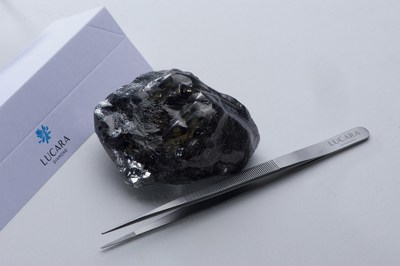
Lucara Diamond Corp has unearthed the largest uncut diamond in recent history in its Karowe mine in Botswana, the Canadian company said on Thursday, beating its own record discovery from November 2015 that it struggled to sell for nearly two years.
The 1,758-carat diamond is larger than a tennis ball and weighs close to 352 grams (12.42 ounces), it said in a statement. The stone is second in size only to the 3,106-carat Cullinan Diamond, recovered in South Africa in 1905.
Lucara’s shares rose as much as 11.4% to the highest in more than two months, before trading up 7% at C$1.69 shortly after midday as the Toronto stock benchmark edged down 0.1%.
The stone is the latest in a series of high-value recoveries for the Vancouver-based company at Karowe. Since introducing its XRT diamond recovery technology, Lucara has recovered 12 diamonds over 300 carats, the company said, including a 472-carat and a 327-carat diamond in April 2018.
The 1,109-carat “Lesedi La Rona,” which Lucara recovered in November 2015, failed to meet its undisclosed reserve price at a June 2016 auction, putting pressure on the company’s shares. British diamond dealer Graff Diamonds finally bought it for $53 million in September 2017.
Forbes reported late last year that Graff had created 67 finished gems from the stone._Reuters
South Africa’s Sibanye-Stillwater on Thursday revised its offer for Lonmin, with new terms that gave a valuation for the struggling platinum miner that was about 60 million pounds ($77 million) less than originally proposed.
Lonmin said Sibanye was offering an additional 0.033 Sibanye shares per Lonmin share in a deal to create the world’s No.2 platinum producer. Sibanye had initially said in December 2017 that it was offering 0.967 new shares for each Lonmin share.
Although the revised offers gives more Sibanye shares to Lonmin investors, an analyst said this still led to a lower valuation because Sibanye shares have fallen in value since the offer was first made in 2017.
Sibanye’s revised offer also does not fully compensate for the impact of its recent share sale that raised $120 million, meaning Lonmin shareholders will end up with less of the revised group, the analyst said.
The revised terms value Lonmin at 226 million pounds and give Lonmin shareholders 10.9 percent of the combined group, compared to a value of 285 million pounds and 11.3 percent in the original offer
The revised terms value Lonmin at 226 million pounds and give Lonmin shareholders 10.9 percent of the combined group, compared to a value of 285 million pounds and 11.3 percent in the original offer.
The boards of both firms said the new offer balanced a recovery in platinum group metal prices against Lonmin’s financial difficulties and its inability to fund investments to sustain its business and staff levels, Lonmin said.
Lonmin also said in its statement that its directors unanimously recommended shareholders accept the offer, which was conceived as a bid to ride out depressed platinum prices.
Lonmin and Sibanye shares were both up at 1500 GMT, rising 2.7 percent and 0.5 percent respectively.
London-listed Lonmin was hit hard by the drop in platinum group prices, and has had to work to cut spending in order to retain a positive balance sheet, required by conditions of Sibanye’s proposed offer.
It warned last month that it did not have sufficient liquidity to fund new projects needed to avoid shaft closures and job losses._Reuters
Mlilo a 35 year old Gweru based gold dealer appeared before Gweru magistrate on Tuesday facing murder and attempt murder charges after shooting two suspected machete illegal miners popularly know as “Mashurugwi”.
Mike Mlilo of Magola village under Chief Masila of Silobela appeared before Gweru magistrate Beaulity Dube, facing murder and attempted murder charges.
Mlilo was not asked to plead, but was remanded in custody to May 3.
It is the State’s case that on April 18, Mlilo was driving a white Ford Ranger twin-cab when he dropped off Innocent Mkandla at Dam Site Bottle Store, Insukamini Business Centre.
The court heard that Mlilo parked his car outside the bottle store and was allegedly approached by a group of patrons who were armed with machetes, knives and stones. The mob is said to have accused him of flashing them with his car lights.
A heated argument ensued, the court heard, resulting in Mlilo drawing his pistol, fired at Xolani Magigwana and hit him on the thigh.
Mlilo also allegedly fired a second shot at Gift Bhebhe, hitting him on the neck. Bhebhe collapsed and died on the spot.
The other patrons fled in different directions, while Bhebhe and Magigwana were rushed to Lower Gweru Mission Hospital, where the former was confirmed dead.
Magigwana is reportedly battling for his life at Lower Gweru Mission Hospital.
The matter was reported to police, leading to Mlilo’s arrest_NewsDay
Ivanhoe Mines is ready to finish building its giant copper mine in the Democratic Republic of Congo after its largest shareholder pumped an additional C$612 million (about $454m) into the Canadian company.
China’s state-owned CITIC Metal is paying C$3.98 per share, a premium of 29% over Ivanhoe’s last closing price. The investment, the second major one in less than a year, paired with the Vancouver-based miner’s current cash balance of about $512 million, will increase the company’s total cash on hand to C$1.3 billion ($1 billion), the parties said.
“The investment announced today will comfortably provide Ivanhoe with the equity cushion required to fast-track Kamoa-Kakula’s six million-tonne-per-annum Phase 1 mine to production,” billionaire Robert Friedland, the company’s founder and executive chairman said in the statement.
If fully developed, the Kamoa-Kakula mining complex could produce 382,000 tonnes of copper a year during the first 10 years, climbing to 700,000 tonnes after 12 years of operationsFriedland, who made his fortune from the Voisey’s Bay nickel project in Canada in the 1990s, has said the capacity of the project’s first phase could later be easily tripled. He believes Kamoa-Kakula has the potential to become the world’s second-largest copper mine.
“CITIC Metal has been a shareholder in Ivanhoe Mines for eight months now, and in that time, CITIC has seen what we already know — that the Kamoa-Kakula is unquestionably the best copper development project in the world,” Friedland said.
Mine grades at Kamoa-Kakula, an independent pre-feasibility study (PFS) released in February shows, will average 6.8% copper over the initial five years, and 6.4% in the first decade, with production starting in early 2021.
If fully developed, the mining complex could produce 382,000 tonnes of copper a year during the first 10 years, climbing to 700,000 tonnes of copper after 12 years of operations. Friedland believes it could restore the DRC to its historical position as one of the world’s top copper producing countries.
Kakula and Kipush first
Ivanhoe’s joint venture partner in the project, Zijin Mining Group, will have to fund its equivalent share of about $540 million of the mine’s initial capital costs.
Ivanhoe’s JV partner Zijin will have to fund its equivalent share of about $540 million of the mine’s initial capital costsThe companies also said they were in financing discussions with international export-credit agencies and equipment-finance providers. If successful, those investments will reduce the amount of funding that Ivanhoe and Zijin would need to contribute.
“We now are in a position to finance our first two mines ─ Kakula and Kipushi ─ to commercial production, and significantly advance, or achieve, production at the Platreef project,” Friedland said. “Ivanhoe also is positioned to have its planned expansions at the Kamoa-Kakula Project funded from internally generated cash flows.”
CITIC’s financing deal is expected to close by the first week of September.
Shares in Ivanhoe rocketed on the news, trading almost 12% higher in Toronto to C$3.46 in early trading. Year-to-date, the stock is up about 49%, valuing the company at about C$3.5 billion ($2.6 billion).
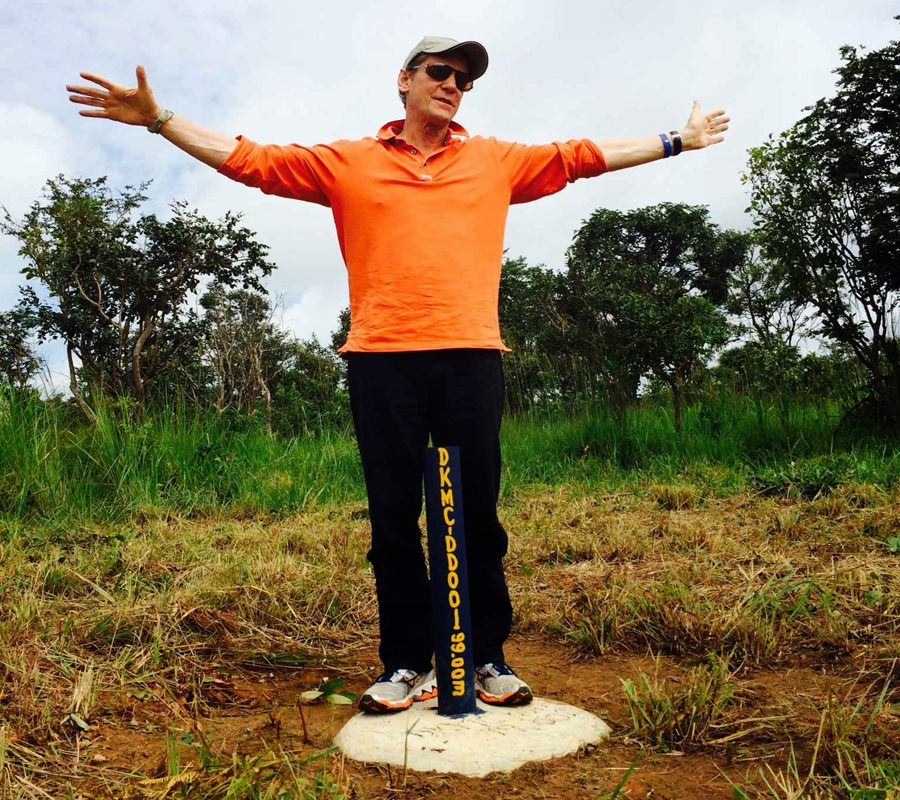
Ivanhoe Mines executive chairman Robert Friedland in 2014 at the site of the initial Kamoa discovery. (Image by Govind Friedland,
Acacia Mining Plc reported a slump in underlying core earnings on Thursday as it struggled with production issues at its North Mara gold mine in Tanzania, where it said pressure was building for a settlement of its row with the government.
Acacia, majority-owned by Barrick Gold, is embroiled in a long-running tax dispute with Tanzania. It has cut output by a third since the government banned the export of mineral concentrates in 2017.
London-listed shares of the mid-cap company were down 4 percent by 1020 GMT, deepening a 12 percent drop year to date.
Underlying earnings before interest, tax, depreciation and amortisation (EBITDA) slipped to $24 million for the three months ending March 31, from $44 a year earlier.
Gold output dropped 13 percent to 104,899 ounces during the quarter, due to problems preventing access to higher-grade ore at the North Mara Gokona underground mine, the company said.
Underlying earnings before interest, tax, depreciation and amortisation (EBITDA) slipped to $24 million for the three months ending March 31
However, it stood by its production target for the rest of the year and said it believed it was nearing a settlement with the Tanzanian government that could transform its fortunes.
“We think the pressure is building on all parties to get a settlement,” Interim Chief Executive Peter Geleta said in an interview. Among the factors increasing the pressure was an international arbitration hearing in the third quarter, he said.
The company also said new board members with long experience in the mining sector would bring fresh ideas as Alan Ashworth, Deborah Gudgeon and Adrian Reynolds were appointed independent non-executive directors with immediate effect.
Mike Kenyon and André Falzon will step down at the end of July after around nine years at Acacia.
The company is focused on addressing its challenges in Tanzania, but also has exploration projects, including in Kenya, where Geleta said Acacia could seek to bring in a strategic partner depending on further research into the prospect._Reuters
Zimbabwe intends to vigorously pursue local value addition of its lithium resources to maximise export earnings from the mineral, a cabinet Minister has said.
Lithium is used to make various items including special glasses and ceramics, lithium-ion batteries and can also be alloyed with aluminium and copper to make strong, lightweight metals for aircraft.
According to estimates, the global lithium-ion battery market alone is expected to reach $93,1 billion by 2025 due to their increased usage in electric vehicles and portable consumer electronics.
The prospect creates greater scope for prioritising local value addition and beneficiation of the mineral.
Mines and Mining Development Minister Winston Chitando said Zimbabwe ought to maximise benefits from its mineral resources.
“As Zimbabwe we are one of the few countries which are blessed with lithium resources and the more we can have in terms of lithium value addition can be good for the country,” he said.
Last year, the Government indicated that Zimbabwe was aiming to produce at least 10 percent of global lithium output within the next four years, following the discovery of new deposits of the mineral in different parts of the country over the past year.
The discovery of the new deposits in areas including Matabeleland North and Mashonaland Central provinces has spawned a scramble for lithium exploration and extraction by foreign investors. Some of the projects that are being pursued include the Zulu Mine located about 80 kilometres outside Bulawayo, Zimbabwe’s second largest city, which is being spearheaded by Premier African Minerals.
Another company, Bikita Minerals is currently extracting the mineral in Masvingo province. Lithium has been described as a “hot commodity” due to rising demand, with another Australian listed firm, Prospect Resources also pushing another project in Zimbabwe. — New Ziana.
BHP, Barrick Gold, Teck Resources and Antofagasta are some of the major mining companies that, together with equipment suppliers and universities, have helped develop global guidelines on automation.
The document, published this week by Canada-based Global Mining Guidelines Group (GMG), outlines a framework for miners to follow when they’re considering adding autonomous equipment to their operations. It also provides a maturity model for companies to emulate as they expand the scope of their unmanned fleets.
Document divides operations into six levels, from zero (entirely manual ) to five (fully autonomous), and assists in the preparation of a business case for autonomous mining for each.
More specifically, the publication divides operations into six levels, from zero (entirely manual operations) to five (fully autonomous operations), and assists in the preparation of a business case for autonomous mining, depending on level and stakeholder needs.
Its advice includes guidance for the slow, phased or fast implementation of autonomous systems, depending on stakeholder needs.
BHP principal, risk and business analysis technology, Chirag Sathe, said the outlined recommendations are relevant even to those who have already embraced autonomy.
“I would say that even though some mining companies have implemented autonomy, it hasn’t been a smooth ride and there are a number of lessons learned,” said Sathe, who also is one of the project’s co-leaders. “This guideline would be a good reference material.”
Although implementing autonomous systems creates new challenges, such as changes to the workforce and the workplace, the authors of the new guideline believe if successfully deployed, the technology adds definite value, with improved safety and efficiency and lower maintenance costs._Mining.com
Anglo American’s De Beers is stepping up efforts to remove so-called “conflict” diamonds from the market by expanding a pilot program in Sierra Leone, which is set to help trace the route of precious stones dug up there by small miners.
The world’s largest rough diamond producer by value said Wednesday the decision to scale up its GemFair trial was made to give more artisanal and small-scale miners (ASM) the opportunity to benefit from the program.
After training ASM in 16 mine sites across Sierra Leone on how to use provided tablets to digitally track their diamonds throughout the supply chain, De Beers has extended the pilot to work with a further 38 sites and widen its impact, it said in the statement.
De Beers’ GemFair program gives small miners an app and dedicated tablet as well as a diamond “toolkit” that enables the digital tracking of diamonds throughout the supply chain.
The company has also partnered with the Diamond Development Initiative (DDI), an NGO in helping to formalize the diamond ASM sector in Africa.
De Beers’ plan to encourage mine owners to join GemFair is based on a membership model whereby mine sites that meet a strict set of core requirements, aligned with the OECD’s standards can join the program sell diamonds to GemFair.
Miners then work with DDI towards achieving full Maendeleo Diamond Standards (MDS) certification, within a one-year timeframe, De Beers said.
“While registered miners have no obligation to accept offers to purchase diamonds through the GemFair buying office, they are provided with free training in diamond valuation, so they can make an informed assessment about the value of their diamonds and negotiate the best possible deal,” it added.
Since the launch in April 2018, GemFair has seen significant progress across its operations, opening offices in both Koidu and Freetown, and developing a set of publicly available ASM standards to ensure a best practice approach for responsible sourcing.
The program has developed a digital solution to ensure the traceability of all diamonds mined by members. The toolkit contains an application and dedicated tablet that creates a digital record of each diamond found using GPS locations and QR-codes.
Tainted reputation
Artisanal mining accounts for only 20% of global diamond production, but carries a tainted reputation that’s damaged consumer confidence for almost 20 years.
Between 1991 and 2002, the district of Kono, in Sierra Leone, was at the centre of the “blood diamond” trade that funded the country’s brutal civil war as rebel groups exchanged gems for weapons.
Despite the establishment of the Kimberley Process in 2003, aimed at removing from the supply chain the now called “conflict diamonds” (those mined in an area of armed conflict and traded illicitly to finance the fighting), experts say trafficking of precious rocks is still ongoing.
According to Canada-based Centre for Research on Globalization (CRG) about one-fifth of diamonds on the global market in value terms are still a significant source of funding for regimes accused of committing crimes and human rights violations.
De Beers sells its diamonds mostly to authorized buyers at a series of so-called “sights” in Botswana, Namibia and South Africa. Then, they are normally sent to be polished or cut before ending up with retailers._Mining.com
To provide the best experiences, we use technologies like cookies to store and/or access device information. Consenting to these technologies will allow us to process data such as browsing behavior or unique IDs on this site. Not consenting or withdrawing consent, may adversely affect certain features and functions.
Functional
Always active
The technical storage or access is strictly necessary for the legitimate purpose of enabling the use of a specific service explicitly requested by the subscriber or user, or for the sole purpose of carrying out the transmission of a communication over an electronic communications network.
Preferences
The technical storage or access is necessary for the legitimate purpose of storing preferences that are not requested by the subscriber or user.
Statistics
The technical storage or access that is used exclusively for statistical purposes.The technical storage or access that is used exclusively for anonymous statistical purposes. Without a subpoena, voluntary compliance on the part of your Internet Service Provider, or additional records from a third party, information stored or retrieved for this purpose alone cannot usually be used to identify you.
Marketing
The technical storage or access is required to create user profiles to send advertising, or to track the user on a website or across several websites for similar marketing purposes.