Home Blog Page 731

Duty free on electric vehicles

0

The Zimbabwe Energy Regulatory Authority (Zera) is lobbying for suspension of import duty on all electric vehicles (EVs) as it seeks to promote local use.

Further, Zera wants a preferential licensing fee for EVs given their importance in reducing the fuel import bill.

They are also considered to be environmentally friendly.

This was said by Zera senior engineer (electricity) Samuel Zaranyika in his presentation on “The future of the energy industry” during the Employers’ Confederation of Zimbabwe (Emcoz) human resources indaba in Kariba recently.

Eng Zaranyika added that awareness campaigns are set to start next month, with a workshop set to be convened by Zera.

“What we are doing as Zera is that we want to promote this (EVs) technology; we are actually buying an electric vehicle, which would be used for demonstrations,” said Eng Zaranyika.

“What sort of expectations do we have for this car? From Zimra (the Zimbabwe Revenue Authority), we look at waiver of duty on the electric vehicle,  (from) Zinara, we would be looking at issues like preferential licensing; for instance, if you are charging a Honda Fit, say RTGS$300 per term, for an electric vehicle, we are looking at a tenth of that.

“Zera would also be conducting a workshop on this particular technology, maybe some time in April.”

Zera is pushing for the popularisation of the EVs as they would not only displace fossil fuel and carbon emissions, but the technology is also more energy efficient than internal-combustion engines.

In the recent past, Zimbabwe gobbled about 7,6 million litres of both diesel and petrol, but the numbers have shrunk to about 5,5 million litres between January and February on the back of price adjustments.

Eng Zaranyika also said EVs are cheaper to run since a single charge for a 375km trip from Harare to Kariba requires RTGS$10 compared to about 40 litres of petrol that costs about RTGS$140.

EVs are also cheaper to maintain as they have less moving parts, environmentally friendly given that they have no gas emissions, while their engines are also quieter than petrol or diesel vehicles, implying less noise pollution.

Critically, the electricity that would have been charged into an EV can also be used as alternative power for the home.

Eng Zaranyika said to promote the EV technology, Zera is also calling on the local vehicle assembly firms and the public to play ball.

Government has cleared Zera’s proposal to purchase an EV for demonstration.

The vehicle is expected in the country by December.

The number of EVs is rising exponentially,  with latest figures suggesting they are now over 3 million on the world’s roads.

Sales are also reportedly spiking at almost 75 percent per annum.

The International Energy Agency now forecasts that there would be 125 million EVs in use globally by 2030.

President Emmerson Mnangagwa also has ‘Vision 2030’ by which the country would have attained upper middle-income status, with a per capita income of US$3 500.

The Sunday Mail

Anjin set to resume operations, while Alsora setting up office by end of month

0

Anjin is set to resume mining in Chiadzwa in May this year, while Russia’s Alsora will complete setting up its office by the end of next month, raising expectations Government will achieve its targeted haul of US$400 million in revenues from diamond mining.

It is believed that the Chinese mining company, which was forced to shut operations in February 2016 as the old administration designated mining of the precious stones to the Government-owned Zimbabwe Consolidated Diamond Company (ZCDC) — will pour an initial US$20 million to restart operations.

Mines and Mining Development Minister Winston Chitando told The Sunday Mail that the new diamond policy will naturally attract additional investments into the sub-sector.

Minister Chitando said fresh investments will complement the “huge expansion drive” presently being implemented by ZCDC.

“ZCDC is on a huge expansion drive and is going to produce 4,1 million carats this year on the back of the conglomerate plant that was commissioned by His Excellency, President Mnangagwa, towards the end of last year.

“Anjin, which used to operate in the area, is now back on the ground. We expect that it will commence production, at the latest, by end of May. We are looking at it being a significant producer in that regard,” he said.

In addition to mining its old claims, Anjin will also work on new areas, as well as carry out exploration.

Last year, Zimbabwe produced 2,8 million carats.

Minister Chitando believes that the diamond industry will anchor Government’s vision to earn US$12 billion from the sector within the next four years.

An executive from Anjin, who elected to remain anonymous, said the company would replace some equipment that was either stolen or vandalised during its three-year hiatus.

“There is need to replace some of the equipment at the mine which was stolen or vandalised. It is sad that some of the equipment was stolen despite the presence of police officers. We are, however, going to import new equipment. So we hope to resume operations at the old mine in a matter of weeks. Furthermore, we are going to purchase more equipment for exploration in other areas,” he said.

The company, he added, will employ 300 people from the Chiadzwa community.

“So far, we have already shown our commitment by donating US$70 000 to some of the people in nearby areas who were affected by Cyclone Idai,” he added.

Alrosa team on the ground
The Sunday Mail

ZESA ready to fight misgovernance, corruption and nepotism

0

The new Zesa Holdings board says it is sharpening its swords for a brutal fight against misgovernance at the State-owned power utility, especially alleged corruption in tender awards and nepotism.

Further, the new board, led by former Cottco managing director Mr Collins Chihuri, plans to ensure stable and consistent power supplies.

The board, which would sign performance contracts, also intends to successfully complete electricity generation projects currently underway such as the US$1,4 billion Hwange Power Station Expansion, which will add 600MW to the grid.

Government appointed a seven-member board for Zesa on March 19, made up of Engineer Benson Munyaradzi, Ms Jacqueline Sande, Mr Trust Chifamba, Mr Hussein Omar, Mrs Cathrine Befura and Mr Thomas Timire.

On the day of appointment, Energy and Power Development Minister Dr Joram Gumbo, said the board has several tasks that include superintending over the re-bundling process of Zesa, eliminating corruption and completing ongoing power projects.

Mr Chihuri told The Sunday Mail Business that while the task awaiting them at Zesa is gigantic, it would only be overcame if all members pulled in the same direction.

“Certainly as the minister said, there are great challenges but the challenges are not insurmountable as long as we put in good effort,” said Mr Chihuri.

He promised that the new board will hit the ground running, and largely look at ensuring that power is available for both domestic and commercial consumers. Zimbabwe has not had load shedding since December 2015 mainly due to investments in new energy projects and refurbishments of existing infrastructure, particularly since 2009.

“We will certainly look at making power availability a core issue. Since 2015 there have been no challenges, so it’s one aspect we have to ensure that it’s maintained.

“There are also big projects underway, and our task is to ensure that we support them. We also have to look at corruption and other governance shortcomings. Certainly, we have to look at such issues. So it’s a big task but we are equal to the task,” said Mr Chihuri.

Tackling corruption will test the resolve of the new board to the limit.

Zesa has had the tag of having the “most corrupt” officials stuck on it for a long time.

Management has previously been accused of offering themselves humongous salaries and perquisites (incidental benefits) even at a time when the entity was not operating profitably and efficiently.

The Sunday Mail

West Africa — an emerging gold exploration investment hotspot

0

West Africa is well endowed with mineral resources, and many world-class deposits have been discovered there in recent years. The region is a key source of gold, iron ore, bauxite, diamonds, phosphate, uranium, and its mainly untapped mineral wealth provides exceptional greenfield development potential.

But despite increased interest in the whole spectrum of commodities in West Africa, the region is a hotspot for investment in gold exploration.

Foreign companies invested billions of dollars in gold exploration activities over the past few years, resulting in West Africa having the biggest growth rate in the yellow metal’s resources in the world.

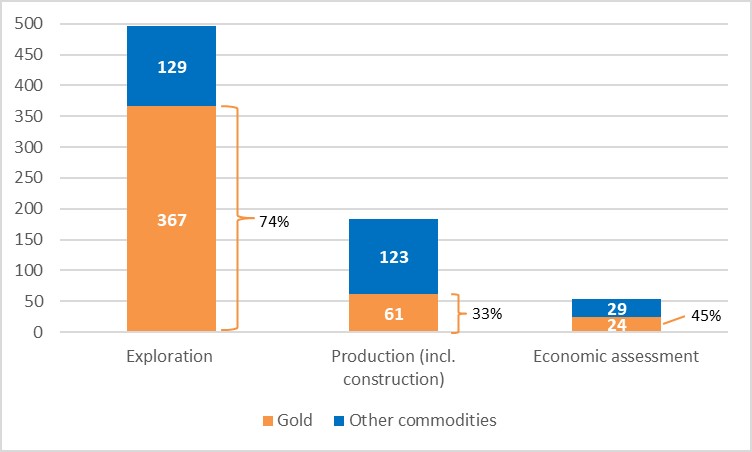
Data compiled from Mining Intelligence’s proprietary database demonstrates the number of gold asset changes within West Africa’s mining development pipeline.

West Africa’s mining development pipeline: Number of mining/explorations projects at different stages of development. Source: Mining Intelligence.

Moving down the pipeline from operating mines to exploration projects, the number of gold assets increases, with 61 assets (33% of all assets, regardless of commodity) in the production or construction stages, 24 assets, or 45% of all projects undergoing economic assessment studies, and a whopping 367 assets in the exploration phase.

74% of all exploration projects are focused on gold.

This focus on gold in the exploration stage indicates that the importance of gold in West Africa’s mining sector will only increase in the future, as new projects will enter the production phase.

Experts are confident that significant local gold resources were underexplored, and this can spark even more interest from the international mining community.

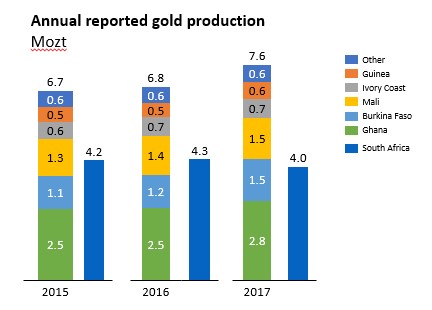
Recent gold production numbers show that South Africa was still the biggest gold producer in the region in 2017, but West Africa’s gold mining industry, led by Ghana, Mali and Burkina Faso, already produces nearly twice as much gold as South Africa, and Ghana alone has chances to overtake its struggling southern peers in gold output in the foreseeable future.

Gold production, South Africa vs. West Africa, Mozt. Source: Mining Intelligence, based on companies’ reports; artisanal miners and non-reporting companies are excluded.

Another important indicator of West Africa’s gold mining sector enticement for investors is production costs measured by the World Gold Council’s all-in sustaining costs (AISC) metrics. AISC shows that in Q2 2018, two West Africa mines were in the global list of top 6 lowest cost gold operations.

B2Gold’s new open-pit high-grade Fekola mine in Mali was the second lowest cost mine by AISC ($445/ozt), and Perseus Mining’s new SGP mine in Ivory Coast was sixth ($520/ozt).

With South Africa’s gold mining sector struggling with increased production costs at underground mines, socio-political turmoil and regulatory headwinds, West Africa is quickly becoming the continent’s main gold mining hub.

Mining Intelligence focused on primary gold operations’ AISC, i.e. mines where gold contributed to 80% and more of revenues from operating activities generated during the quarter. The ranking excludes tailings re-processing operations, mines where the precious metal is produced as a by-product and operations where companies report gold-equivalent output. Get access to the wealth of data about mineral resources in West Africa and globally, and click here for Mining Intelligence’s 2018 Western Africa Mining Map that shows the locations of more than 180 producing mines and development “shovel in the ground” projects, 20 metallurgical facilities, major roads, railroads, ports and shipping distances and regional geology._Mining.com

EPOs, what needs to be done?

0

Exploration of ground is vital for any mining industry to flourish, experts believe that for any company large or small to grow, large scale exploration should take place. Zimbabwe is losing quite a large some of revenue due to the fact that there is little or no exploration that is taking place in mining areas in Zimbabwe. For example In gold exploration Zimbabwe depends on the results that were carried out long back no new deposits were found during this information society era in Zimbabwe.

By Rudairo Dickson Mapuranga

What are EPOs?

Exclusive Prospecting Orders (EPO) is a large area of ground targeting the selected minerals for exploration. The maximum is 65,000 hectares in Zimbabwe. Minimum size is up to the company to choose. In Zimbabwe EPOs tenure are 3 years with an option to renew for another 3 years.


EPOs are used by companies as first pass exploration areas. This means that companies after doing the highly technical exploration studies will eventually drop most of the EPO ground in 3 years. Generally companies will in most cases eventually remain with less than 1000 hectares for mining operations that is if they find an economic mineral deposit in the EPO.


According to figures released by the renowned on Consulting Groups in the past, Zimbabwe’s spending on exploration is “the lowest among leading mining countries”. Between 1989 and 2017 Zimbabwe’s share of the global exploration budget fell from 0.2% to literally 0%.

It is clear that Zimbabwe has lagged behind the rest of the world in terms of mining, Zimbabwe used to be one of the largest producers of gold in Africa but has for now it is nearly close to nowhere to be found.

According to Kennedy Mtetwa a mining geological expert, Zimbabwe is not even making an effort in funding new exploration. To him, Zimbabwe is satisfied in producing very little and is not worried about tomorrow’s explorations.

“Globally, around 10% of all capital expenditure in mining goes towards exploration, in Zimbabwe, it’s around 0%. We are not really replacing the minerals that we are mining” said Mtetwa.


Exploration died in Zimbabwe while booming elsewhere in Africa.

In countries like South Africa, Democratic Republic of Congo and Uganda among others exploration has been key factor to the growth of the industry in those countries. Zimbabwe boost of having nearly all minerals found on earth but the way the mining industry is producing send an otherwise message. Exploration need to be at a centre stage in the mining industry in Zimbabwe just like in other countries in Africa. Factors leading to a limited exploration need to be addressed.

Legal environment

To a large extent, this reflects the lack of investor confidence in recent years. Extreme policy uncertainty, political risk and rising cost inflation have made companies wary of committing money to the local industry.

The lack of exploration in the country is not however only because of the broader environment. Exploration companies have faced particular challenges of their own.

Primary among these is that the legal framework in Zimabwe has been largely tailored towards the big mining companies that dominate the local industry. Smaller companies and exploration operations have had to meet the same level of compliance as their larger counterparts, which is, relatively, a much heavier burden.


“Junior exploration companies have been over-regulated,” “They have had to comply with the same rules that operating companies comply with, which is a barrier to the freedom that they need to operate properly” said Mtetwa.


Investors show appetite for projects on ‘largely unexplored’ continent

Many specialist exploration firms simply lack the resources to deal with this situation.

According to experts, In a large company, compliance comes more easily, one need have a large legal team, so being able to understand sophisticated rules is something a firm can deal with in-house. But if an investor is an amateur firm or a small group of investors, dealing with the legal intricacies may hamper them more than in a larger company.


The Indigenous Act (51% local ownership) law made sure no serious exploration company comes with 100% of it’s money to explore and take the risks and when they find an economic deposit the locals take 51% of that deposit. This policy rank madness, hence there here been 0% exploration expenditure.

According to Kennedy Mtetwa, exploration and the granting of EPOs gives citizens in Zimbabwe a certain advantage over foreign companies, exploration of land for mining will eventually lead the land to be bankable giving citizens an opportunity to lease or sell their deposits to bigger players thereby creating mining environment in Zimbabwe that will compete at a greater level.

“One has to recognise that the exploration space is a good capital raising ground for junior miners, particularly junior black miners,” “If you can take a number of projects to the bankable stage and then sell them to bigger players, that allows you to build up your own balance sheet to compete on a greater level. That needs to be encouraged, and so on a whole, the regime needs to be bifurcated” said Mtetwa

Wider support

Creating a more supportive legal environment may be the most important step in encouraging the exploration activities that Zimbabwe needs to sustain its mining industry, but it’s far from the only one.

“As a starting point, we need to look at what other countries are doing,”. “For instance, creating tax incentives or allowing companies to write off exploration costs as a way to mitigate the risk of non-discovery.”


Security of tenure is also a vital issue.

“One of the concerns of government is if we approve long tenure over large tracts of land for single explorers,” “But companies can be required to submit a plan and show progress against the plan. As long as they are investing continually, they can hold their tenements, but if they do nothing for a period of time, the government can take them back again.”

There is also a need for greater transparency in the mineral rights application process. Currently there is no online database that potential explorers can visit to see what land is available, who holds which licences, or when those licences expire. That makes it very difficult for companies to do strategic planning even before coming to Zimbabwe.


Zimabwe’s top priority: Ethical leadership

Vitally, establishing a more stable and investor-friendly climate will naturally encourage more interest.

“It’s not only about fixing the regulatory environment, or creating incentives; it’s also about what happens at the next stage,” “There is no exploration just for the sake of exploration. You are doing it with a purpose. So are you in an environment where you can produce competitively, where you can raise capital? Exploration companies will go to environments where the next stage is set in a way that is favourable.”


This article first appeared in the Mining Zimbabwe magazine march issue

 

Lawyers urges DMR not to take Minerals Council court application lightly

0

Law firm Dentons partner Brandon Irsigler says the Department of Mineral Resources (DMR) should not take the Minerals Council South Africa’s court application for a judicial review of Mining Charter 3 lightly, since the council is representative of the miningindustry.

He noted, however, that taking a negotiated document like the charter on review is a major step in a process that has already created uncertainty for the mining industry for many years.

The Minerals Council on Wednesday announced that it had filed an application for a judicial review of the charter with the aim to have certain clauses set aside.

The council believes most aspects of the charter represent a reasonable and workable framework, but says the fact that the charter does not fully recognise the continuing consequences of previous empowerment transactions, particularly in respect of mining right renewals and the transfers of these rights, remains untenable.

In response, the DMR stated its intention to oppose the application.

Irsigler told Mining Weekly Online that the uncertainty, delay and costs should be carefully considered by the DMR when it considers whether or not to amend the charter.

He added that the Minerals Council would not have initiated the court action without the backing or consent of most of the industry. “This action has ostensibly been taken to retain its right to seek meaningful court intervention at a later date – not to begin driving a new action aggressively.”

He also pointed out that the council was relying on a previous High Court judgment that broadly endorsed the “once empowered, always empowered” principle.

The principle is articulated in the charter as promulgated, but only really applies to steady-state mining operations where the black economic empowerment (BEE) shareholders have exited before the charter was enacted. Such an operation does not need to acquire new empowerment partners for their mining rights to remain valid.

However, if a mining right holder changes equity ownership or transfers an already-empowered mining right, an additional empowerment of 4% is required. New miningrights acquired by a previously empowered company require fresh empowerment investment of 30%, which could be viewed as penalising expansion growth and investment by a company that previously empowered itself, while its BEE investors have chosen to exit.

Irsigler noted that all of this moves the needle from a strict once-empowered-always-empowered position. The increase of a relatively minor 4% equity empowerment requirement needs to be carefully thought through, he said, saying the DMR should consider whether the social benefit is worth the confusion and delay this causes local and international investors in corporate transactions?

“Does it attract global investment and create fresh opportunities for substantial empowerment investment into significant greenfield projects?”

He added that, secondly, a company whose BEE investors exit their investment pre or post the promulgation of MiningCharter 3 incurs different obligations.

“If the investor exited prior to the enactment date of September 27, 2018, the once-empowered-always-empowered principle is applied. Post promulgation, the company incurs substantial reporting and compliance obligations – some of which the company itself cannot control, as the issues in question vest with the companies’ shareholder.

“Again, the social benefit of the provision of information and a semblance of control by the DMR versus the uncertainty, delay and costs should be carefully considered.“

Irsigler, in his view, suggested that the once-empowered principle should be locked in – regardless of when the BEE entity exited its investment, without the needless reporting and further compliance obligations.

“The need for additional empowerment on transfer of a previously empowered right should be scrapped; a previously empowered company should receive credit for prior BEE transactions/scorecard achievements when seeking fresh mining rights or renewing an existing right; and onerous financial penalties for noncompliance with BEE undertaking and targets should be introduced, but mining rights should not be placed at risk of withdrawal.”

Moreover, Irsigler lamented that, at some stage, the country needs a charter that proclaims a fixed duration of around 15 to 20 years and the Minerals and Petroleum ResourcesDevelopment Act needs to be amended to lock this in.

He said mining was the ultimate in long-term fixed asset investment.

“A regulatory environment that constantly tweaks the fundamental nature of investment – shareholding – needs to understand the impact steady accretive change has on investor sentiment and the effect this has on growing a super capital-intensive sunrise industry.”_MiningWeekly

Petra Diamonds shares jump on 425.1-carats discovery at Cullinan

0

Shares in Petra Diamonds (LON:PDL) jumped more than 8% on Friday after the miner announced it had dug up a 425.1 carat, D-colour, Type II gem quality diamond at its iconic Cullinan mine in South Africa.

The discovery comes less than a month after Petra found a 100.83 carat gem-quality white diamond at the same mine, source of the world’s biggest-ever diamond, which was unearthed in 1905.

Earlier in March, Petra had recovered a 100.83 carat, white D-colour type II gem-quality stone.

The company, which appointed last month former gold miner Richard Duffy as chief executive, said both recoveries demonstrated the frequency of such large stones at Cullinan.

The stock climbed on the news, trading 8.3% higher in London at19.60p by 12:32 p.m. local time.

Petra, which has been seeking to turn around its fortunes after piling up debt to expand the operation, plans to sell the 425.10ct diamond during the June quarter.

Diamond miners are struggling across the board, especially those producing cheaper and smaller stones where there is too much supply. In December, some of Rio Tinto’s (LON, ASX: RIO) customers refused to buy cheaper diamonds, while De Beers has been forced to cut prices and offer concessions to buyers.

This week, Africa-focused Firestone Diamonds (LON:FDI) put plans to extend the life of its 75%-owned Liqhobong mine in Lesotho on the back burner, saying that current market conditions don’t support the project._Mining.com

Golden Star boosts Ghana gold resources despite depletion

0

Golden Star Resources(TSX: GSC; NYSE: GSS) has increased its overall reserves by 6%, net of mining depletion. It offset a loss in reserves at its Prestea gold mine by adding reserves at its Wassa gold mine, both located in Ghana.

In total the company has 19.4 million proven and probable tonnes grading 2.86 grams gold for 1.79 million oz. gold across its Wassa and Prestea gold mines.

Its biggest loss came at the Prestea mine, where reserves decreased by 36% net of depletion. Prestea now contains 853,000 proven and probable tonnes grading 11.57 grams gold for 317,000 oz. gold.

It also increased reserves at its Wassa mine 23% net of depletion. Wassa now contains 18.6 million proven and probable tonnes at 2.48 grams gold for 1.47 million oz. gold.

It boosted reserves at Wassa underground in particular by 47% net of depletion. Wassa underground now contains 7 million proven and probable tonnes at 3.95 grams gold for 949,000 oz. gold.

In February 2019, the company also increased inferred resources by 93% at its Father Brown gold project in Ghana. The project now contains 2.3 million inferred tonnes at 6.4 grams gold for 474,743 oz. gold.

(This article first appeared in The Northern Miner)

Gold faces worst month in eight; palladium recovers

0

Gold steadied on Friday, but was headed for its worst month since August 2018 predominantly on stronger dollar and equities, while palladium bounced back after three straight sessions of sharp selloffs.

Spot gold was flat at $1,290.34 per ounce by 0620 GMT, after declining about 1.5 percent in the previous session, the most in over seven months.

The metal is set for its first weekly fall in four and has lost about 1.7 percent this month. But on a quarterly basis, gold is on path for a second straight rise, due to a dovish U.S. Federal Reserve and concerns about a global economic slowdown.

U.S. gold futures were down 0.1 percent at $1,288.70 an ounce.

The dollar was poised for its strongest monthly gain in five, while Asian shares rose on hopes that Washington and Beijing are making progress in trade talks.

The world’s two largest economies started the new round of talks on Thursday to end the year-long tit-for-tat tariffs war.

“If we have a positive outcome from the trade talks, gold will be under pressure as investors will rotate out into more risk seeking assets,” said Jeffrey Halley, a senior market analyst with OANDA.

“But, if we have disappointing outcome then stocks will go down and people will move into safe-haven assets like gold. The market is very much in a wait and see mode.”

White House economic adviser Larry Kudlow said on Thursday the United States could lift some tariffs on China, while leaving others in place as part of an enforcement mechanism on a trade deal.

Meanwhile, spot palladium rose 0.7 percent to $1,357.68 an ounce on Friday, recovering from a two-month low touched in the previous session.

The metal, used in the making of catalytic converters in vehicles, slid 6.6 percent on Thursday, the most since January 2017, and was set for its worst week since November 2015, as worries about a slowdown in global economic growth triggered a sharp sell-off.

On a monthly basis, it was headed for its biggest drop since end-2016.

“Negative market sentiment due to slowing economic growth triggered speculative selling in palladium,” ANZ analysts said in a note.

Elsewhere, silver was flat at $15.02 an ounce, while platinum rose about 0.5 percent to $841 an ounce. (Reporting by K. Sathya Narayanan and Swati Verma in Bengaluru; Editing by Subhranshu Sahu and Rashmi Aich)_Reuters

Miners takes Mugabe to court

0

Former President Robert Mugabe’s family business, Gushungo Holdings (Pvt) Ltd, has been dragged to court by two Mazowe miners, who are seeking an order to reinstate their dismissed land dispute with the former Head of State.

The gold miners, Shepherd Nyazvigo, who is represented by Phillip Makanya in the matter together with his co-applicant, Bright Mawonga, recently filed a court application, seeking rescission of a default judgment granted against them in November last year.

“In this application, the applicants (Makanya and Mawonga) are seeking an order to set aside the dismissal of their application which was done in default on November 12, 2018 and reinstatement of the terms of the provisional order,” Makanya said in his founding affidavit.

According to the court papers, Makanya got embroiled in a dispute with Gushungo Holdings after the latter, through its employees, barred them from accessing the mining claims at Mondo 3 and 4 in Smithfield Farm in Mazowe.

At that time Mugabe’s firm was claiming ownership of the farm where the mining claims are located, hence it was barring the two miners from accessing and operating on their mining claims.

However, on April 24, 2018, the two miners were granted a provisional order by the High Court, in terms of which Gushungo Holdings was barred from interfering with the two men’s mining operations pending the finalisation of the dispute.

But, seven months down the line, Makanya and Mawonga did not pursue their matter, prompting Gushungo Holdings to approach the court seeking dismissal of the miners’ application and it was granted in default.

“The application was then dismissed in default of the applicants on November 12, 2018. I submit that the applicants were never served with the set down date, hence they were not aware of the hearing date,” Makanya said.

“It is the applicant’s intention to pursue their application so that the final order can be confirmed. The applicants, as the holders of the rights and title to the said blocks of mine, have the right to mine on their blocks of mine without any interference from anyone including the respondent (Gushungo Holdings).

The matter is pending._NewsDay