Home Blog Page 462

Platinum giants eye solar power

0

The world’s biggest platinum miners are ramping up plans to build renewable energy plants to free them from power outages that have plagued South Africa for more than a decade and to reduce their carbon footprint.

Sibanye Stillwater  the number one platinum miner  Impala Platinum Holdings and Anglo American Platinum said they plan to scale up solar and wind farms for their own use to cut reliance on state-owned utility Eskom, some of whose aging coal-fired plants have failed to keep up with electricity demand. 

South Africa has been dogged by power outages since 2005 and rolling blackouts are a big problem for the world’s deepest mines, which are often forced to reduce some operations when power is rationed. 

By using more renewables, the miners may also ease pressure from investors wary of carbon-intensive industries as the shift from fossil fuels accelerates. Sibanye has approved plans to build a 50-megawatt solar plant to provide power to its gold mines. 

It’s also assessing plans for a 175-megawatt facility at its Rustenburg platinum mines and for additional supplies to come from a 250-megawatt wind farm, Wellsted said. The company will outline construction timelines at its half-year results next month. 

Anglo Platinum aims to start generating from the end of 2023 about 100 megawatts of renewable power at Mogalakwena.   Bloomberg.

, or about a quarter of the daytime electricity demand of the world’s biggest palladium mine, said Jana Marais, a spokeswoman for the miner.  


Bloomberg

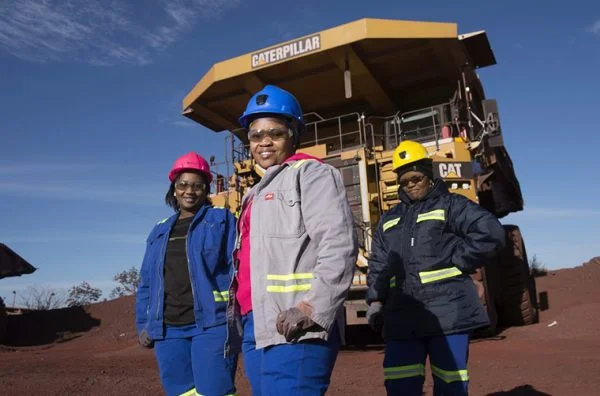
Women in mining continue to face challenges

0

WOMEN in the mining sector say the Covid-19 pandemic has further worsened their plight amid revelations that some unscrupulous individuals were invading their mining claims resulting in theft and vandalism of mining equipment.

The women miners have further revealed that they continue to face gender related challenges and abuse from men.

According to a report from the Pact Institute, a Washington DC-based development non-profit making organisation, women make up 10 percent of Zimbabwe’s 535 000 artisanal and small-scale miners.

In an online presentation on violence in mining areas, Miss Benhlilder Manyewende from Gokwe North said women miners in the area face various forms of abuse. She said even the language used towards women at the mines was usually abusive.

“There are various issues of abuse that women here face. The abuse could be physical, sexual and even emotional whereby human rights are being violated and our culture is being washed away. This results in premature deaths, unplanned marriage plots, rape cases leading to STIs and HIV or Aids,” said Miss Manyewende.

Miss Manyewende said with most mines located near communities, this had resulted in children under the age of 16 years no longer going to school and joining mining.

“Most of the children, girls included too have dropped out of schools and joined the mining field whereby child labour is taking place. They are the ones exploited to do most of the work such as fetching water and digging the pits, but at the end of the day what they are paid is way below the work they would have done,” she said.

Miss Manyewende said there were myths that when a gold miner sleeps with a virgin girl, they would discover more gold on their claims, hence a lot of girls as young as 13 years old were being exploited.

Another woman miner, Miss Primrose Ndlovu from Filabusi said conflicts were the order of the day in their area.

She said even though Filabusi was rich in gold, men would make sure that they are the ones to work at mines and discriminated women who would want to venture into mining.

“It is in rare instances that you find peace in mining areas here in Filabusi. Most of the times there are conflicts and women are the ones who suffer the most from all sorts of abuse that are so unbearable. It becomes hard for these women to survive, whenever they get lucky or hit a belt rich in gold, when men in the community find out these women’s claims are taken away. Even when they report to the police the assistance they get is less,” said Miss Ndlovu.

Meanwhile, Zvishavane women miners are counting losses as their workplaces are being invaded, equipment stolen and mine peggings shifted in their absence.

A member of the Zvishavane Women Miners, Mrs Tsitsi Matumba said female miners were being defrauded of their gold or chrome at both mining sites and milling sites by both the millers and their own workers.

“We are suffering a double blow as Covid-19 situation itself has degenerated our energies while men are taking advantage of our absence to invade our mines. Our mining machinery is being vandalised in our absence and in worst cases mineral ore stolen. Also, when we take our ores to the milling sites, we are facing challenges in that the millers use their own prices to buy our chrome, they also use their weighbridge scaling rates, assay reports are exclusively done by the millers and we strongly feel defrauded in that regard. Under normal circumstances there must be transparency but the millers are monopolising the process,’ said Mrs Matumba.

Mukasiri Sibanda of the Zimbabwe Environmental Law Association (ZELA) says there is need to avail financial support to women miners in Zimbabwe as they are still lagging behind in terms of machinery.

Women miners are finding it difficult to penetrate fully into the lucrative industry. Their challenges revolve around societal opinions on gender equality, exploitation, lack of financial capital, equipment and tools, legal and policy restrictions and lack of adequate support from the government.


The Sunday News

Prospect Resources to takeover Farvic’s stake in Acardia

0

Australia Stock Exchange-listed mining junior Prospect Resources has initiated the takeover of Farvic Consolidated Mines’ equity stake in Arcadia mine increasing its shares to 87 per cent from 70 per cent.

Rudairo Mapuranga

Earlier this year, the company announced that it has deferred a planned takeover of Farvic Consolidated Mines’ equity stake in Arcadia mine to the end of this year, it, therefore, appears completion has come early with the company reporting it has received receipt of requisite approvals and subsequently issued Farvic the agreed 9.4 million new fully paid ordinary shares and a cash payment of $1.1 million.

“Following receipt of requisite approvals (including Prospect shareholder approval), completion of this transaction has resulted in the issue of 9,497,680 new fully paid Prospect ordinary shares and the payment of A$1,187,210 cash to Farvic Consolidated Mines Pvt Ltd (Farvic). Prospect Resources now has 383,523,535 shares on issue.

The shares issued to Farvic are subject to a voluntary escrow, with 25% of the shares set to be released every 6 months,” the company said.

According to Prospect Resources Managing Director, Sam Hosack the increased ownership reinforces the strength of support of its project-level partners.

“Completing the Farvic transaction provides an immediate benefit to Prospect Resources as it now owns an additional 17% of the quality Arcadia Lithium project.”

“The increase in ownership will have a major positive impact on our funding of the Arcadia Lithium project.”

Prospect funds 100 per cent of the project expenditure and this transaction means the company increases its share of future revenues and profits from the mine, without an increase in expenditure.

The Arcadia Lithium project is eyed by the government of Zimbabwe as critical in the achievement of the President’s mining roadmap where the mining sector is expected to become a US$12 Billion industry by 2023.

Lithium mining was designated as an integral part US$12 billion mining industry roadmap with the strategically key sector expected to earn US$0.5 billion annually.

In June Prospect resources commissioned the Arcadia lithium pilot plant and handover of the first production to the company’s offtaker, Sinomine becoming the second lithium producer in the country.

Zimbabwe is the world’s fifth-largest lithium producer with only one mine, Bikita Minerals operating. Lithium has attracted world recognition as a significant mineral playing a substantial role in electric cars and other clean tech gadgets and its popularity will earn the country significant dollars in the world market.

About Prospect Resources

Prospect Resources Limited (ASX: PSC, FRA:5E8) is a battery minerals company with a focus on lithium in and around Zimbabwe, with the flagship project being the 70% owned Arcadia Lithium project, located in Goromonzi, Zimbabwe.

Invictus in seismic field crew vaccination

0

Australia Stock Exchange Listed oil and gas exploration junior Invictus Energy has begun a vaccination program for its seismic field crew in an endeavour to help the government in the fight against the Covid-19 pandemic.

Rudairo Mapuranga

The company which is exploring for oil and gas in Zimbabwe has delivered over 200 Covid-19 vaccines to Muzabani clinic to ensure that its seismic field crew has been vaccinated against the pandemic.

Seismic Project Manager of the oil and gas hopeful company, Barry Meikle has thanked the Ministry of Health and Child Care as well as St Alberts Mission Hospital for the provision of vaccines.

“Invictus Energy Seismic Project Manager Barry Meikle delivering 250 COVID vaccines to the Muzarabani Clinic for our seismic field crew. Sincere thanks to Ministry of Health and Child Care and St Alberts Mission Hospital for the provision of vaccines,” the company said.

Earlier this year Russian diamond producer Alrosa PJSC through its Chief Executive Officer Sergey Ivanov said it will buy and donate the Sputnik V coronavirus vaccines to Zimbabwe to help the country’s inoculation programs.

Afrochine Smelting Private, huge ferrochrome producing plant in Selous has organized Covid-19 vaccinations for its staff, with more than 800 already having had their first jabs and all the 1 105 expected to be done by tomorrow.

It then plans on rolling out its privately funded programme to the spouses and families of staff.

The company procured the vaccines from the national Covid-19 stocks and brought in Chegutu district health department, using Selous Clinic staff, to administer the jabs.

Vaccination rollout in the mining industry in Zimbabwe has been impressive with many mining companies showing that they have a duty to fight the Covid-19 pandemic with big companies like Zimplats taking centre stage in the fight against the pandemic.

Mining companies have pledged to support the government in the rollout of covid-19 vaccines as the nation battles a surge in infections.

About Invictus Energy

Invictus Energy is an independent upstream oil and gas company listed on the Australian Securities Exchange (ASX: IVZ). Our asset portfolio consists of a highly prospective licence, Special Grant 4571, in the Cabora Bassa Basin in Zimbabwe, one of the largest under-explored interior rift basins in Africa.

SG 4571 contains the Mzarabani conventional gas-condensate prospect, the largest undrilled prospect onshore Africa with an independently estimated 8.2 Tcf + 247 million barrels (gross mean unrisked basis) of conventional gas-condensate in a stacked target.

High grade ore excites Arcadia MD

0

AUSTRALIA Stock Exchange-listed lithium miner, Prospect Resources says it has produced 25 kilogrammes of spodumene concentrate from core samples collected at Arcadia Mine, a world-class asset under development in Zimbabwe.

Spodumene is considered the most important lithium ore mineral, which is crashed to form a concentrate before shipment to chemical manufacturing companies worldwide.

The firm is targeting strategic markets in Japan, China and Europe, as it fine tunes its systems before full-scale production kicks off in Zimbabwe.

In a statement yesterday, Prospect said sample assays from Arcadia had confirmed the high purity nature of the spodumene concentrate.

“These results confirm Arcadia as a producer of high purity spodumene concentrate and demonstrate the value of the Arcadia project,” managing director, Sam Hosack said.

“The production of spodumene in conjunction with the successful operation of the petalite pilot plant at Arcadia Mine put the team in a strong position as we focus on progressing due diligence discussions and the development of the Arcadia project. The spodumene concentrate product samples have been produced for supply to, and potential qualification with, strategic groups across Japan, China and Europe. Prospect has been progressing engagement with a range of these groups that have an interest in spodumene concentrate offtake and assisting with development of the Arcadia project. The shipment of samples is being co-ordinated over the next few weeks,” Hosack said.

There has been significant progress by companies prospecting and developing lithium assets in Zimbabwe.

Early this month, London Stock Exchange-listed Premier African Minerals said results from its drilling programme at Zulu Lithium near Bulawayo were encouraging.

The developments mark an important step in the southern African country’s ambition to transform its mining industry, turning over about US$2 billion annual revenue, into a US$12 billion sector by 2023.

Following recent finds, Zimbabwe has placed its lithium assets at the heart of this ambition, and also looks to gold, platinum and diamonds in the expansion drive.

About four lithium projects are currently under development in Zimbabwe, where firms including Premier and Prospect expect to invest up to US$300 million in the coming years to reach full throttle production.

Premier said the results of the samples confirmed significant lithium grade and lithium mineralisation.

It said final analysis from drill hole Zulu 1A confirmed lithium grade of up to 2,33% lithium oxide and lithium mineralisation from 214 metres to 238 metres down hole. Another hole returned lithium mineralisation from 78 metres to 121 metres with grades up to 2,35%.

“When all results are in, the company intends to issue a maiden lithium resource report on what the company sees as a project of significance,” Premier chief executive officer George Roach said.

“We have seen lithium bearing pegmatites (mainly spodumene and petalite) to vertical depths of over 200 metres and along the entire strike length of some 3,5 kilometres, with some holes showing visible lithium mineralisation over drilled widths of up to 37 metres. We await the balance of the drill-hole results from this extensive drilling programme over the 3,5-kilometre strike of the Zulu deposit drilled to date,” Roach said.


NewsDay

Future of coal ‘bright’ in Zim

0

While Zimbabwe is committed to the global transition towards cleaner energy, amid growing calls for the adoption of such energy sources, the country says it has no immediate plans to dump its fossil fuel energy sources.

Secretary for Energy and Power Development Dr Gloria Magombo said in an interview that while efforts were underway to adopt cleaner energy sources, fossils remained a key element of Zimbabwe’s energy security mix.

Dr Magombo said Zimbabwe had demonstrated commitment to the global transition towards cleaner energy when it crafted a renewable energy policy, but will retain fossils in its energy mix.

She said while there was palpable growing conversation over the need to switch over to less carbon-emitting energy sources, Zimbabwe would stagger its transition over the period to 2050.

Dr Magombo said the movement towards cleaner energy sources, as provided for in terms of the global charter, will be anchored on the most viable alternatives available to the country.

“What is key is that the energy mix of a country is dependent on the resources within that country. It (however) is important to have a certain amount of power coming from renewable,” she said.

Dr Magombo pointed out that while cognisant of the growing pressures on financiers to stop funding fossil energy projects; Zimbabwe will seek to supply energy those that still have the appetite. Zimbabwe, Dr Magombo said, will continue to support investment and partnerships that seek to develop both fossil and renewable energy projects, among them coal bed methane, natural gas and hydro power.

“We are looking at engaging in an energy mix which is sustainable for us as a country…we are going to include a certain amount of renewable energy in our energy mix,” Dr Magombo said.

“As Government, we want to make sure that we optimise the use of our natural resources,” she said, adding Zimbabwe will also make full use of the most viable technologies available to it.

She stressed the country was not sitting on its laurels regarding the adoption of cleaner energy, saying apart from drifting towards renewables, it was switching to fossil technologies that limit less carbon emissions and dust.

“For instance, the technology that we are putting on Hwange Power Station 7 and 8 is not the technology that was used on Hwange Power Station (generators) 1 to 6,” Dr Magombo said.

It is an undeniable fact that the world is moving away from fossil fuels over environmental concerns. The shrill calls from environmentalists are getting louder and their influence expanding.

In the past, Zimbabwe has shown commitment to addressing the climate change issues by being among the first countries to ratify the United Nations Framework Convention on Climate Change.

Yet despite this, the country is considered to have failed to reduce carbon emissions released by its coal power stations, which account for a significant portion of the country’s power output.

Notably though, a less than 1 percent (0.2 percent), the country’s carbon emissions global footprint is deemed too insignificant to warrant any special attention or campaign to dump fossils.

Zimbabwe has reason to be worried, for the longer term. Coal, a fossil fuel and resource Zimbabwe has in limitless abundance, forms a major part of the Southern African’s country’s national energy policy.

For a long time, Zimbabwe has had its based load energy production capacity largely steeped in fossils, specifically coal. Its major coal power plant, Hwange, has an installed capacity of 900 megawatts.

The power station is however now only capable of producing half its design potential due to advanced age. But the Government has engaged Chinese firm Sinohydro to add two more generators with capacities of 300MW each.

Further, the Government has secured funding from India banks to finance nearly half a billion US dollar life extension programme on Hwange Power Station generators 1 to 6 to improve output.

But the recent withdrawal by the Industrial and Commercial Bank of China (ICBC) from financing RioZim’s 2 300 megawatt (MW) project, at the behest of environmentalists, is a cause for concern.

The southern African country is signatory to international treaties on transition to clean energy, specifically environmental targets under the United Nations’ National Development Goals (NDSs).

Former ZESA Holdings managing director Ben Engineer Rafemoyo, said while it was a good idea for countries to switch to renewables, it was unlikely Zimbabwe would make a full transition in 40 years.

He pointed out that the loudest calls for a transition to clean energy sources were coming from first world countries whose industrialisation and development was driven by fossil fuels.

Eng Rafemoyo also noted that while clean energy sources were the future, at this point in time they have their own limitations in terms of availability, especially wind and solar systems.


Business Weekly

Oil prices cast shadow over global economic recovery

0

Global oil demand is rising following an accelerated vaccination campaign and an economic recovery, pushing oil prices to two-and-a-half-year highs amid an output deficit.

Although an agreement for more output reached among the Organisation of the Petroleum Exporting Countries (OPEC) and its allies on July 18 is expected to calm rising oil prices, concerns for a further climb in the coming months or longer remain, which would dampen a global recovery from the Covid-19 pandemic.

Rising oil ouput

OPEC together with non-OPEC countries, known as OPEC Plus, agreed to boost oil production by 400,000 barrels per day (bpd) each month from August until December this year as demand increases.

Last year, the OPEC cartel cut production by a record 10 million bpd amid a pandemic-induced decrease in demand and dropping prices. Countries including Iraq, Kuwait, Russia, Saudi Arabia and the United Arab Emirates would see their baseline production rise from May 2022. By then, total output quotas of OPEC Plus will be adjusted upward from the current 43,853 million bpd to 45,485 million bpd.

Oil market fundamentals have continuously strengthened with oil demand showing clear signs of improvement and the Organisation for Economic Co-operation and Development stocks falling, as the economic recovery continued in most parts of the world with the help of accelerating vaccination programs, said OPEC.

Oil prices on July 19 plunged by more than 6 percent for both West Texas Intermediate (WTI) for August delivery on the New York Mercantile Exchange (NYMEX) and Brent crude for September delivery to below the level of US$70 per barrel.

Prior to the agreement, both crude oil spot prices and futures prices rose firmly in June amid higher oil demand from refiners and the transportation sector.

According to the latest monthly oil market report issued by OPEC on July 15, North Sea Dated averaged US$72,96 a barrel in June, while NYMEX WTI averaged US$71,35 a barrel for crude oil futures, with ICE Brent at US$73,41 a barrel.

Future oil prices worry

Although the OPEC Plus agreement has stabilised market speculation, market insiders remain mixed over future oil prices due to the uncertainties facing the global economy, particularly with the spread of the Delta variant.

Credit Suisse expects the average Brent crude price to settle at US$70  a barrel in 2021, up from a previous prediction of US$66,5, and WTI crude at US$67 from US$62.

“The oil market is still facing a supply deficit over the remainder of the year. This should limit the downside for oil prices,” said the London-based PVM Oil Associates in a research note.

“The market is clearly unsettled about the demand outlook. And rightly so. The rise in Delta variant cases is raising questions about the sustainability of demand,” said the note.

Even though some countries have lifted almost all restrictions, fresh constraints on economic activity are still possible if Delta becomes more rampant.

Phil Flynn, senior market analyst at the United States-based Price Futures Group, said OPEC’s deal should have supported oil yet more concerns are being raised about the Delta variant of the coronavirus. 

“It is now causing a risk-off situation that is weighing on global markets.”

UBS strategists said in a report that they “remain positive on oil” and maintain their forecast for Brent prices to rise to 80 dollars per barrel by the end of September. 

Global oil demand is now likely above 97 million bpd, up from a low of 78 million bpd in April 2020 and global demand is anticipated to exceed 99 million bpd this year.

According to OPEC’s monthly oil market report, global demand in 2021 is projected to increase by 6,0 million bpd to average 96,6 million bpd, and increase by 3,3 million bpd in 2022 to average 99,86 million bpd. 


 Xinhua.

Gold export receipts up 23%

0

Zimbabwe’s gold export receipts rose 23% to US$464.2m in the first six months of this year from US$377.9m achieved in the prior comparative period propelled by firming prices on the international markets.

The yellow metal was on average fetching US$46,600 per kilogramme (kg) during the reviewed period compared to US$35,600 per kg in 2020.

However, gold deliveries to the country’s sole buyer and marketer of the yellow metal, Fidelity Printers & Refiners (FPR), fell 6% to 9.948 tonnes during the reviewed period from 10.6 tonnes in the same period in the previous year.

“For the month of June gold export receipts went 113.1% up to US$141.5m from US$66.1m achieved during the same month last year, taking our total tally for the half year to US$464.2m from US$377.9m during the same period last year,” central bank governor John Mangudya told said this week.

“This is a result of firming commodity prices and improved mining policies which encourage miners to deliver gold through formal channels.”

Gold deliveries more than doubled to 2.92 tonnes in June 2021 from 1.409 tonnes during the same period last year due to improved mining policies introduced last month.

Mangudya said the US$141.5m export receipts achieved in June was the highest this year. He said this was the first time gold export receipts have breached US$100m this year. Before the June haul, April had the highest export receipt of US$97m.

Zimbabwe achieved US$78 in May.

Having realised that the country is losing over 2.5 tonnes per month, RBZ introduced   a 5% incentive for those who deliver above 20kg a month and cut royalties and the cost of importing cash on small scale miners to improve gold production in the country.

The central bank is now paying the prevailing international gold prices which had spurred on gold deliveries.

With the recent surge in production, mining experts are projecting a huge recovery during the second half of the year.

However, an FPR executive recently revealed that the country could be losing over 30 tonnes yearly valued at US$1.7bn due to smuggling.

Gold experts say given the current set up, Fidelity is guaranteed huge volumes of gold with smuggling expected to go down significantly.

Gold Miners Association of Zimbabwe chief executive Irvine Chinyenze said: “The sky is now the limit for the country’s gold sector as the authorities have put in place good policies that encourage deliveries through the formal channels.

Business Times

RBZ tables Fidelity shareholding deal

0

Zimbabwe’s central bank has tabled a shareholding agreement for its subsidiary, Fidelity Printers and Refiners (FPR), almost eight months after a proposal to unbundle the company into two entities was announced.

The Reserve Bank of Zimbabwe (RBZ) wants to unbundle FPR into two entities — gold refining and printing and minting.

Under the proposal, RBZ wants to retain the printing and minting business but would dispose of its 60% shareholding in the gold refining unit.

RBZ governor John Mangudya (pictured) told Business Times this week an agreement on shareholding had been submitted and the deal would be concluded by the end of the third quarter.

“We have made significant progress on the FPR unbundling as we have submitted an agreement of shareholding to the relevant parties and they are going through them so that they will give us feedback on the issue,” Mangudya said.

Under the proposal, big mining houses have been offered a 50% stake in the gold refining unit, while the small-scale miners and FPR gold buying agents were offered 7% and 3% respectively.

The proposal follows the model of Rand Refinery, South Africa’s biggest refinery, which is owned by the five largest gold miners — AngloGold Ashanti, Gold Fields, Harmony, Sibanye Gold and DRDGOLD.

Mangudya said the unbundling of FPR is designed to partially privatise the gold refining business by allowing private players to acquire a stake therein and in the process secure and endear the private sector’s interests in the production and marketing of gold in Zimbabwe.

RBZ is expecting  that the gold producers’ compliance levels in the trading of gold will significantly increase the output due to the fact that gold dealers will be part of the decision-making process in gold trading.

The privatisation of FPR comes after lobbying from some players in the mining business.

Large scale miners’ representative arm, Chamber of Mines of Zimbabwe  CEO Isaac Kwesu said: “Some of our members are confirming the development but we only wait to hear from them if they have agreed or not.

“We don’t tell them to agree or turn down the offer but it is best for them to do so.”

Gold Miners Association of Zimbabwe chief executive officer, Irvine Chinyenze  said progress has been made in the unbundling processes.

However, there was a need to bring in more players in the gold buying sector to promote competition in the sector, he said.

“The unbundling process is going on smoothly but we need  more players in the buying of gold to be competitive and give the miners a good run  for their money,” Chinyenze said.

Among the country’s biggest gold producers are RioZim and Caledonia Mining.

FPR started refining gold in 1988, and at its peak producers from abroad sent in their gold for refining at its Msasa refinery. However, FPR has not used most of its installed capacity to refine 50 tonnes of gold per year.

With more gold expected through the formal channels, experts believe FPR full capacity will be reached by 2022.


Business Times

Zim dollar slightly eases against US$

0

THE Zimbabwe dollar has slightly weakened to 85,63 against the United States dollar at this week’s foreign currency auction platform conducted on Tuesday.

Last Tuesday, the exchange rate at the auction was $85.50.

A total of US$46 million was allotted this week, according to the Reserve Bank of Zimbawe (RBZ) with the bulk of the allotment channelled towards raw material procurement followed by machinery and equipment.

The Apex Bank said a total of US$8,7 million was allocated to the Small to Medium Enterprises auction against US$37,3 million that was allocated to the main auction.

The main auction received a total of 402 bids from which 370 were accepted while 32 were disqualified. The SMEs auction received 588 bids with 544 accepted and 44 disqualified, it said.


The Chronicle