Zimbabwe’s mines minister has informed Todal Mining Ltd., a venture controlled by Eurasian Resources Group, that its platinum mining concessions could be seized because no progress has been made in developing them.
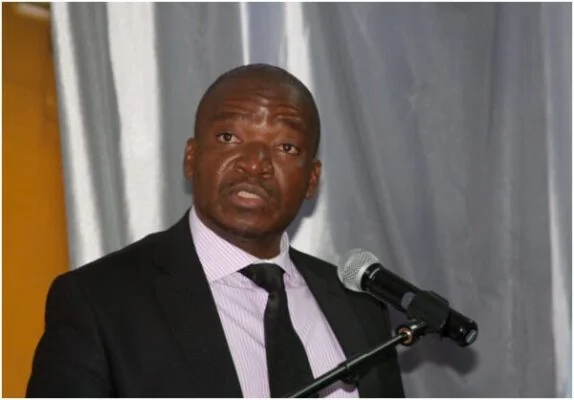
The Bokai and Kinonde concessions may be taken over under the “use-it/lose-it principle” which allows the state to repossess idle mining claims, Minister Winston Chitando said in a letter to Todal dated May 28 and seen by Bloomberg. The mines ministry confirmed the veracity of the document.
“I note with concern that over the last few years there have been several changes to the work program to make this project progress to production stage,” Chitando said in the letter.
ZIMBABWE, WHICH HAS THE WORLD’S THIRD-BIGGEST PLATINUM GROUP METAL RESERVES, HAS STRUGGLED TO DEVELOP ITS MINING POTENTIAL
Zimbabwe, which has the world’s third-biggest platinum group metal reserves, has struggled to develop its mining potential with investors from Russia, Cyprus, Nigeria and Kazakhstan yet to bring projects into production.
The Todal assets were taken from Anglo American Platinum Ltd., which does operate a mine in Zimbabwe, more than a decade ago and handed to Central African Mining & Exploration Co. That company was bought by Eurasian Natural Resources Co., which later became Eurasian Resources Group. Central African Mining lent the Zimbabwean government $100 million at the time.
‘Chance to respond’
“This is due process in the spirit of administrative justice,” Polite Kambamura, Zimbabwe’s deputy mines minister, said by phone. “We will give the asset holder a chance to respond through the mining affairs board. If there are any developments that they have made on it which we are not aware of they will make those submissions and a final decision will be made after all due process has been done.”
ERG didn’t immediately respond to questions sent by email and text message.
In 2013, the government said production on the mine was due to start that year. In 2008, Camec said a mine producing 150,000 ounces of platinum annually could be built for $200 million.
PPC Zimbabwe managing director, Kelibone Masiyane said on Thursday that the country’s largest cement maker had invested almost US$120 million across its Zimbabwean operations to ramp up production.
The firm operates a clinker plant at Colleen Bawn near Gwanda and cement milling plants in Harare and Bulawayo.
Masiyane projected a robust economic rebound, which will stimulate strong demand as construction projects get back on track.
The PPC boss said there had already been signals of a swing back to stability after demand surged in the past quarter, underpinned by public infrastructural deals.
But he spoke a few hours before the markets were rattled by jitters after government announced wide-ranging regulations and penalties to punish firms that were accused of manipulating the exchange rate.
The reaction to the shocking move was swift, with some products’ prices spiralling within hours.
The markets were still digesting the potential impact of the radical reforms at the weekend, but for now, the PPC boss said the firm was positioning itself for fresh opportunities to be unlocked under the new era.
“Excluding the Harare plant (US$82 million), we have re-invested in our plants right from Colleen Bawn to our Bulawayo plant over US$35 million to improve operational efficiencies,” Masiyane told NewsDay Business.
He said PPC’s priorities in the aftermath of the COVID-19-induced lockdowns remained the same — to provide enough cement to help Zimbabwe rebuild its struggling economy.
“Mostly our priorities remain unchanged,” said the PPC MD.
“We will fulfil our mandate as a business to play our part in the infrastructural development of our country. Right now, you can see that Zimbabwe is on a growth trajectory and cement demand is a good indicator of that growth and as PPC we want to be part of that growth. Our philosophy is that we don’t just sell a bag of cement, but we sell a home, a bridge, a school, a dam, etc and that is what we call in PPC terms, strength beyond,” he added.
“We see our volumes growing compared to last year in line with Ministry of Finance projections. Government is investing heavily in terms of infrastructural development and this will drive our volumes going forward,” Masiyane told this paper.
He said PPC had posted strong first quarter recoveries as the COVID-19 scourge appeared to be under control, with abandoned projects being revived.
Projects were frozen most of 2020, as government announced hard lockdowns to tackle the pandemic that was turning economies upside down, claiming a string of casualties along the way.
Demand for cement collapsed, hitting revenues and clobbering volumes across sectors.
In the aftermath of lockdowns, construction market jitters were compounded by reports of shortages.
Masiyane told NewsDay Business that despite the jitters PPC surpassed targets by 5% during the first quarter due to strong demand.
“We have experienced a phenomenal surge in terms of sales volumes despite the challenging operating environment,” Masiyane said.
MINING industry executives yesterday commended the central bank’s move to give the Zimbabwe Revenue Authority (Zimra) the sole mandate to collect fees and commissions previously paid to the Minerals Marketing Corporation of Zimbabwe (MMCZ), saying this would go a long way in curbing bureaucracy.
They said the move would also help mineral exporters circumvent problems related to economic sanctions imposed on Zimbabwe.
The MMCZ has been under United States of America Office of Foreign Assets Control (OFAC) sanctions since 2008.
“There are a number of issues that need to be dealt with,” an executive told NewsDay Business.
“MMCZ is under OFAC sanctions which have been there since 2008 and OFAC can deduct money from its clients. I don’t know why MMCZ remains on sanctions while others have been removed. But whether it is MMCZ or Zimra, the fees and commissions need to be collected,” the executive said.
Announcing the changes last week, the Reserve Bank of Zimbabwe (RBZ) said after wide consultations, it had decided to help exporters in the industry by having fees and commissions collected under one roof.
Zimbabwe’s mines are projecting recovery this year following a difficult 2020 when COVID-19-induced lockdowns disrupted the entire global economy, forcing mining firms to suspend operations.
The changes came after requests from mineral exporters for government to implement growth-stimulating policies to help the mining sector recover and achieve US$12 billion in annual revenue from 2023.
The sector currently generates about US$2,3 billion per annum.
On Friday, Chamber of Mines of Zimbabwe (CoMZ) chief executive officer, Isaac Kwesu said pandemic-induced headwinds were fizzling out, with companies returning to production after being buffeted by a brief 2021 lockdown and capital shortages during the first quarter.
“For us, 2020 was not a good year and the 2021 first quarter was no better,” Kwesu said.
“Capital constraints are still an issue. Last year we were constrained by COVID-19 and operating costs remain high. The first quarter was generally bleak but we are going to see a rebound in the second quarter. We continue to work closely with government so that we achieve our targets,” he said.
In a statement announcing the new policy last week, the RBZ said: “The bank has received numerous requests from mining exporters on the need to continuously improve the ease of doing business arising from complications around payment of fees and commissions to the Minerals Marketing Corporation of Zimbabwe (MMCZ)”.
“To make payment of statutory deductions easy for exporters of minerals, with immediate effect, all commissions and royalties that are due will no longer be deducted by MMCZ. All applicable taxes shall now be paid to Zimra in the normal manner,” said the RBZ.
CoMZ president Elizabeth Nerwande said the last financial year was difficult due to COVID-19.
She thanked authorities for granting them permission to operate during the pandemic-induced lockdown.
This week, the CoMZ holds its annual general meeting and conference in Victoria Falls, where several key issues affecting the sector will come under the spotlight.
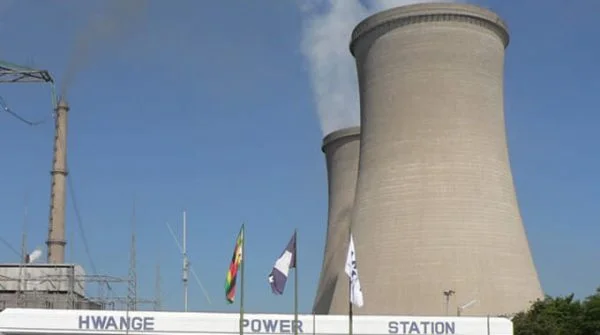
THE Hwange Thermal Power Station expansion programme closed the first quarter at 62,54 percent against a planned progress of 85,9 percent as the project was affected by interim payment certificates and the Covid-19 pandemic.
The US$1,5 billion expansion programme entails the addition of Units 7 and 8 with each unit expected to generate 300MW.
In an update on the first-quarter performance, the Zimbabwe Power Company (ZPC) said the period under review was a challenging one as generation at Hwange, which is the country’s largest thermal power station, was depressed.
“Taking a closer look at the projects being undertaken by Zimbabwe Power Company, Hwange 7 and 8 Power Station Expansion Project, which is expected to add 600MW to the national grid, registered progress of 58,29 percent at the beginning of the quarter and closed at 62,54 percent against a planned progress of 85,9 percent.
“The project was affected by Interim Payment Certificate (IPC) outstanding payments as well as effects of Covid-19. Significant milestones in the quarter included arrival and hoisting of Unit 7 and 8 generator transformers, tower erection as well as steam turbine installation,” it said.
During the period under review, ZPC produced 745,70 Gigawatt hours against a target of 1813,02GWh, representing a negative variance of 3,71 percent.
The output was, however, 34,92 percent above the output for the same period in 2020.
A MINER from Gwanda is on the run after he pushed his workmate down a 15-metre-deep shaft and set him on fire during a dispute over an undisclosed matter.
Matabeleland South acting provincial police spokesperson, Assistant Inspector Thabani Mkhwananzi confirmed the incident which occurred at Joy 4 Mine in Vhovha area on Saturday at around 7PM. He said the suspect, only identified as Mjoza, pushed Moffat Madera (22) down the shaft, threw a pile of clothes inside and threw in a burning log.
Asst Insp Mkhwananzi said a post-mortem report was yet to confirm whether the now deceased had died because of the fall or burns.
“I can confirm that we recorded a murder case which occurred at Joy 4 Mine in Vhovha area.
“Workmates who were seated by a fire fled from the scene as the two fought. Another mine worker who was working in another shaft heard noises and when he rushed to inquire everyone was gone and Madera was in the shaft which was now filled with smoke,” he said.
Asst Insp Mkhwananzi said the matter was reported to the police who attended the scene and Madera’s body was retrieved from the shaft.
He said Madera sustained serious burns.
Asst Insp Mkhwananzi said investigations were underway and appealed to members of the public with information on the identity and whereabouts of Mjoza to contact the police.
“As police we continue to urge people to desist from engaging in violence when facing disputes. People should find amicable ways to solve their disputes. We are concerned with violence which is occurring especially in mining areas as it appears to be on the rise and we as police will descend heavily on these perpetrators.
“Mine owners are also urged to maintain registers of their workers and to take down necessary particulars of their employees. In this case the suspect was employed at a mine but his name isn’t known. An identity of a person is crucial when they are on the run,” he said.
Last year Tesla surprised the electric car industry when it said its entry-level Model 3s made in Shanghai will be equipped with lithium iron phosphate (LFP) batteries.
LFP batteries are significantly cheaper and simpler to manufacture compared to NCA (nickel-cobalt-aluminum) and NCM (nickel-cobalt-manganese) cathode chemistries, but fare badly in terms of energy density – and therefore range, still motorists’ no 1 reason for not going electric.
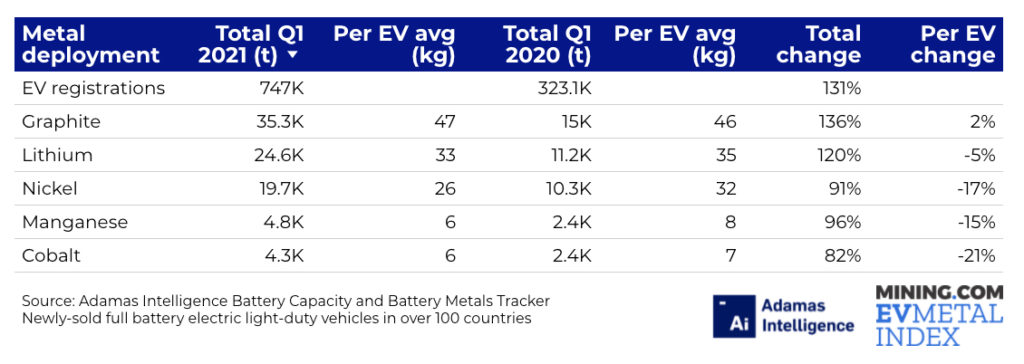
Barely eight months after the cobalt and nickel-free version of the Model 3 first went on sale, it cornered 7.2% of the global market for full electric vehicles. It also constitutes 45.7% of total sales of Tesla’s most popular model in terms of battery capacity, according to data from Adamas Intelligence, which tracks demand for EV batteries by chemistry, cell supplier and capacity in over 100 countries.
VOLKSWAGEN HAS COMMITTED TO LFP FOR ITS LOWER END, HIGH VOLUME CARS AS PART OF ITS $29 BILLION PUSH INTO THE MARKET
Worldwide in the first quarter of this year, LFP-equipped cars like the Model 3, BYD Han and Hongguang Mini made up 15.7% of the overall market for battery-electric passenger cars – up from near zero in the first three months of 2020.
While in absolute terms nickel and cobalt deployment is rising rapidly as EV sales more than double year-on-year, on a sales-weighted basis the impact of LFP is startling.
The average nickel use per vehicle tumbled by 17.3% from Q1 2020 to Q1 2021, while per vehicle cobalt deployment is down 21.5%. For manganese, the equivalent number was 15.1%.
The decline in lithium is a function of a greater proportion of smaller vehicles being sold but a shift from nickel-rich chemistries would have an impact on the lithium market – increasing demand for carbonate relative to hydroxide.
In China, where LFP uptake over NCM and NCA was also boosted by new regulations concerning battery fires, the sales-weighted average nickel, cobalt and manganese deployment per vehicle was down 42.3%, 45.3% and 38.3% respectively.
European invasion
That compares to Europe, where the average use of these metals has declined only by around 2% year on year, almost entirely due to the scarcity of LFP-powered cars in showrooms on the continent.
That may well change quickly too with Volkswagen, the most ambitious of the traditional carmakers to pursue EVs, committing to LFP for its lower end, high volume cars as part of its $29 billion push into the market.
The LFP Model 3 is only available in China, with small quantities exported to Europe, but Tesla appears to be doubling down on the technology after reports, as yet unconfirmed, that the California company is adding a second LFP battery supplier to its Shanghai factory and the Model Y to its LFP line-up.
Alla Kolesnikova, Head of Data and Analytics at Adamas, expects in the near term to see more made-in-China Model 3s with LFP cells entering Europe and key right-hand-drive markets globally, including the UK, Ireland, Australia and New Zealand:
“Apart from Tesla, there are a few other Chinese brand vehicles hitting foreign markets with LFP cells, including several passenger and light commercial EV models made by Maxus, JAC, BYD and Seres.
“Some key Tesla rivals in China, including Xpeng and Nio, are expanding their lineups to include model versions powered by LFP cells, which could follow Tesla’s lead into Europe by as early as this year.”
Over the next ten years, the outlook for the lithium sector is “as bright as ever” amid fast production and demand growth, a new report from Fitch Solutions and Country Risk shows.
The global acceleration towards decarbonisation, the electrification of vehicles, and energy storage continues. It provides a backdrop for fast-paced change in a market traditionally dominated by only a handful of participants and opening up many new production opportunities elsewhere in the world.
However, the constant technological advancements on both the supply and demand sides pose risks to the market outlook. Fitch cautions that since lithium is now considered a ‘strategic mineral’, it will likely lead to rising government intervention in its production and sourcing.
“THE LITHIUM SUPPLY LANDSCAPE WILL EVOLVE QUICKLY AND DRAMATICALLY OVER THE NEXT FEW YEARS”
Fitch
The lithium supply landscape will, therefore, evolve quickly and dramatically over the next few years.
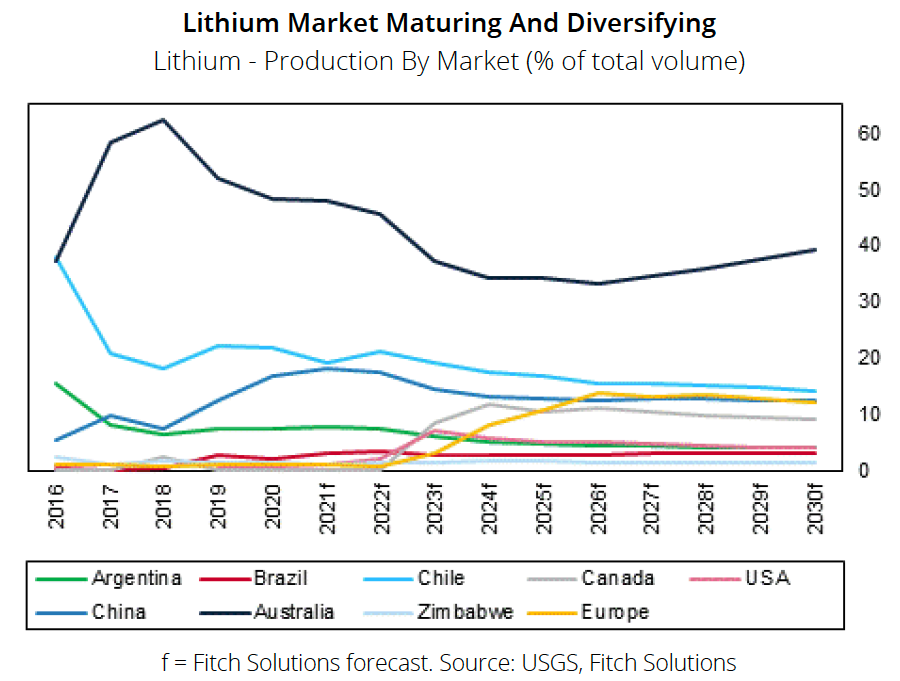
Fitch forecasts global lithium production will more than triple from 442,000 tonnes of lithium carbonate-equivalent (LCE) in 2020 to 1.5 million tonnes of LCE by 2030.
Well-established producing countries will record further growth, while several new lithium-producing markets will emerge in the next ten years. Production growth is expected to accelerate in Australia, which Fitch forecasts will remain the largest lithium-producing country through 2030, given an expected trebling of output over the 2020 to 2030 period.
Production in Chile and China will also more than double, while Brazil output is expected to grow five-fold. Argentina output will double over this timeframe.
The impending boom in energy storage, of which rechargeable batteries are the dominant aspect driven by the electric vehicle (EV) revolution, will be the growth engine behind the lithium upstream sector, Fitch says.
First price forecast
Fitch has, for the first time, also launched lithium carbonate and hydroxide price forecasts. It expects a sharp acceleration in demand for lithium-ion batteries will outpace supply growth, keeping prices elevated.
Fitch forecasts Chinese lithium carbonate 99.5% prices to average $13,450 per tonne this year and at $15,025 per tonne in 2022, and Chinese lithium hydroxide monohydrate 56.5% prices to average $11,950 per tonne in 2021 and $14,300 per tonne in 2022.
Risks to the price outlook include a faster-than anticipated adoption of EVs (upside risk to prices), a faster-than-anticipated advancement of new lithium extraction technologies (downside risk), and a faster-than-anticipated advancement of battery-recycling technology (downside risk).
Fitch forecasts EV sales to drive lithium consumption growth by as much as seven times over 2020 through 2030, while yearly EV sales will grow from 3.1 million to 21.2 million units.
Fitch forecasts the EV sector will account for about 80% of total lithium demand by 2030, compared with between 40% and 45% currently.
China is expected to remain the largest battery manufacturer by a wide margin, for the time being, accounting for about 80% of installed manufacturing capacity as of 2020. However, other existing manufacturers including Japan, South Korea, the US and Hungary will most likely record a rise in battery manufacturing, Fitch says.
Relatively new entrants, including Germany, Poland, Sweden, France, the UK, Thailand and Indonesia, will also establish themselves as increasingly essential manufacturers.
Green premium
The rapid rise of a green premium for lithium amid heightened demand for more environment-friendly resources from downstream players is another critical price trend Fitch is monitoring. Another of the analyst’s recent reports considered how lithium extraction techniques are increasingly under ESG scrutiny.
Currently, only hard rock and conventional brine resources from salars are used to produce lithium at a commercial scale; Fitch estimates about 65% of global output comes from hard-rock lithium mines such as those in Australia, while 35% come from brines in Latin America and China.
A SLEW OF NEW MARKET ENTRANTS ARE WORKING ON NEW EXTRACTION TECHNIQUES WHICH COULD UPEND PRIMARY SUPPLIES OF LITHIUM.
However, a slew of new market entrants are working on new extraction techniques such as geothermal brines and sedimentary (clay) deposits, which could upend primary supplies of lithium.
As the development of these new extraction techniques progresses, the industry structure, the shape of the cost curves, and the environmental, social and governance (ESG) considerations will continue to evolve. Providers of more environmentally friendly lithium with lower water usage and carbon emissions will most likely be rewarded.
Rising demand for the most sustainable lithium, coupled with tight supply, means that over-the-counter transactions, offtake agreements and long-term strategic supply partnerships are here to stay in the coming years.
Technological advancements, meanwhile, are at different stages of development, which Fitch flags could cause supply to rise faster than expected.
These developments will keep the lithium market opaque to some extent, according to Fitch, and lithium will remain more of a speciality chemical market, characterised by clients requiring specific and often differentiated products and less of a bulk commodity market.
The upcoming development of lithium recycling could also ease some of the lithium supply issues in the longer term.
Further, Fitch notes that the lithium content of the promising next generation of batteries is even higher than the batteries that will be dominating over 2021 to 2025.
Mineral output is projected to rebound in the second half of this year after production fell across the sector in the first quarter compared to the same period the prior year
Mining is Zimbabwe’s single largest foreign currency earner, accounting for over 70 percent of export receipts. Major exports include gold, platinum, chrome, and diamond.
The government says is working on growing mining from a US$3,5 billion industry to a US$12 billion sector by 2023 with gold, platinum, chrome, diamond, and lithium among the major contributors.
The targeted growth is part of the architecture forming the basis for Government’s Vision 2030 by which the southern Africa country should have attained upper middle-income status.
CoMZ president Elizabeth Nerwande told a media briefing on Friday that 2020 was very challenging due to the Covid-19; but applauded the Government for allowing mining firms to operate; as an essential service sector.
She was speaking ahead of the CoMZ annual general meeting (AGM) slated for Victoria Falls next week. President Mnangagwa will be the guest of honour at the yearly mining Indaba, which is scheduled to run from 3-5 June, 2021.
“In the first quarter, we saw a dip in production. This year’s theme is…“Navigating…The times and The Need to Build Resilience,” she said. Declines were recorded across key minerals including gold, nickel, and chrome.
Similarly, CoMZ chief executive Isaac Kwesu said 2020 was a very difficult period as was the first quarter of this year. He said mines were not spared the challenges of Covid-19.
Capital constraints are still an issue…Last year it was constrained by Covid-19. Operating costs remain high. The first quarter was generally bleak, as most minerals; gold, nickel, and chrome declined,” Kwesu.
He said the sector would “see a rebound in the second quarter. We continue to work closely with the Government so that we achieve our targets. Most key minerals recorded output declines in the first quarter of 2021″.
Challenges besetting the sector include the coronavirus, which prompted national lockdowns across the globe and disrupted global supply chains, the shortage of forex, high costs, and capital constraints.
“Despite the subdued first-quarter performance, we are anticipating the mining sector to rebound in the second half and attain annual targets,” Kwesu told journalists.
Zimbabwe’s mining industry growth plan entails increasing individual mineral output, among the over 40 mineral occurrences, including but not limited to gold, platinum chrome, nickel, coal, lithium, steel, and asbestos production.
A Chinese national in possession of 21 grams of gold was arrested at the Robert Mugabe International airport on the 26th of May 2021 as he was exiting Zimbabwe on his way to Mali.
Court heard that Jianming checked into the airport on his way to Mali on the 26th of May 2021. He went through all the necessary protocols and his passport was even stamped out at the exit desk.
When he arrived at the last check point his luggage was scanned and one button weighing 21,21grams and gold amalgam weighing 3,41g were detected.
Jianming was asked to provide proof that he was authorised to be in possession of the precious metal and he failed to.
The state pushed for a mandatory jail term and argued that it was becoming problematic and the country was being deprived of much-needed revenue.
His defence attorney, Muchadehama, argued that there are special circumstances that do not warrant the imposition of a mandatory jail term. The lawyer said Jianming did not know it was an offence for one to be in possession of gold in Zimbabwe as it is not a crime in China. Jianming claimed he was given the two pieces as a gift by a friend and he has had them in his wallet since November 2019.
Muchadehama said another mitigating factor was his client did not try to hide the pieces as he was going through the airport to which the state argued that Jianming had total disregard of the law as he had knowledge of the stones but didn’t bother to verify if there are precious or not.
Jianming was also in violation of immigration laws and was also fined for overstaying in the country.
Oil and gas giant Total will be rebranded as TotalEnergies as it shifts some of its focus towards renewable energy sources.
Shareholders voted overwhelmingly in favour of the move and approved the firm’s environmental goals. “We want to become a sort of green energy major,” said chief executive Patrick Pouyanné.
Big energy firms are coming under increasing pressure to adjust to a lower-carbon world.
Last week, a small hedge fund investor succeeded in ousting two board members at Exxon in the US, in a bid to alter the firm’s direction on climate change.
And a court in the Netherlands ordered Royal Dutch Shell to cut its emissions more quickly than the Anglo-Dutch oil firm had planned.
Total, the world’s fourth-largest privately-owned oil and gas producer, is aiming to reach carbon neutrality by 2050, in part by investing in more solar and wind power projects. While several small investors opposed the company’s plans at the annual general meeting, arguing they did not go far enough, the resolution was passed with more than 90 percent of the vote. European energy firms have moved more quickly than their US counterparts to begin the transition away from fossil fuels, said Mike Coffin, senior analyst in oil and gas at financial think tank Carbon Tracker. — BBC
To provide the best experiences, we use technologies like cookies to store and/or access device information. Consenting to these technologies will allow us to process data such as browsing behavior or unique IDs on this site. Not consenting or withdrawing consent, may adversely affect certain features and functions.
Functional
Always active
The technical storage or access is strictly necessary for the legitimate purpose of enabling the use of a specific service explicitly requested by the subscriber or user, or for the sole purpose of carrying out the transmission of a communication over an electronic communications network.
Preferences
The technical storage or access is necessary for the legitimate purpose of storing preferences that are not requested by the subscriber or user.
Statistics
The technical storage or access that is used exclusively for statistical purposes.The technical storage or access that is used exclusively for anonymous statistical purposes. Without a subpoena, voluntary compliance on the part of your Internet Service Provider, or additional records from a third party, information stored or retrieved for this purpose alone cannot usually be used to identify you.
Marketing
The technical storage or access is required to create user profiles to send advertising, or to track the user on a website or across several websites for similar marketing purposes.





 The Bokai and Kinonde concessions may be taken over under the “use-it/lose-it principle” which allows the state to repossess idle mining claims, Minister Winston Chitando said in a letter to Todal dated May 28 and seen by Bloomberg. The mines ministry confirmed the veracity of the document.