Home Blog Page 647

AngloGold to go ahead with underground expansion of Tropicana

0

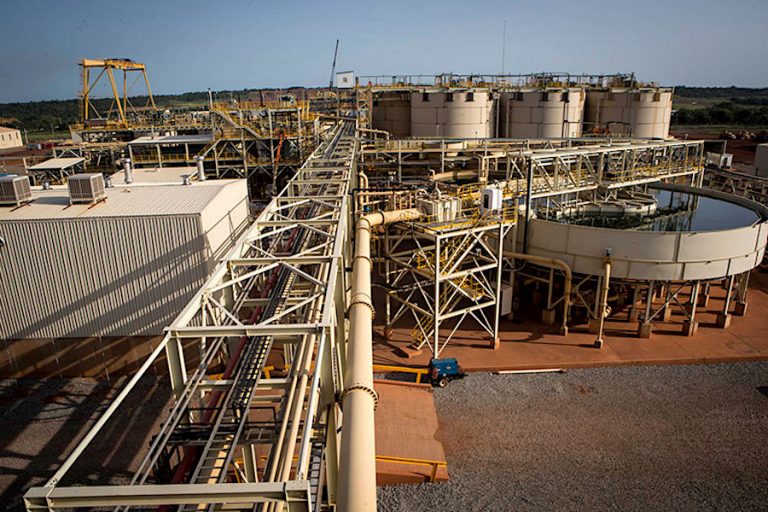
Joint venture partners AngloGold Ashanti (JSE:ANG) (NYSE:AU) and Independence Group (IGO) have approved $79.3 million underground expansion at their Tropicana gold mine in Western Australia.

The project, dubbed the Boston Shaker, is expected to contribute higher-grade mill feed, resulting in an improved gold production profile and enhanced cash flow.

Once the underground portion is operative, Tropicana — located 200km east of Sunrise Dam and 330km east-northeast of Kalgoorlie — will be able to maintain gold production at between 450,000-500,000 ounces annually over the five years to and including the 2023 financial year.

The Boston Shaker extension is expected to contribute an annual average of 100,000 ounces to Tropicana’s production profile from the 2021 financial year.Boston Shaker is expected to contribute around 100,000 ounces a year, with first gold expected during the September 2020 quarter. The feasibility study estimated a capital cost for the project of A$105 million, higher than the $95 million estimated in December.

“Underground mining at Boston Shaker will leverage further value from this high performing operation, achieving pay-back in just over three years,” Ludwig Eybers, AngloGold Ashanti’s Chief Operating Officer International, said in the statement.

The Boston Shaker ore body remains open at depth and the JV partners will continue to test high grade extensions to the mineral resource beneath the Tropicana and Havana pits to assess the opportunity for further underground mining operations, they said.

Macmahon Holdings has been awarded a five-year, $170 million mining services contract for the underground mine. The work adds to the supplier’s existing agreement at Tropicana, which is already the site of the company’s largest mining contract in Australia.

AngloGold, now under the leadership of Kelvin Dushnisky, a Barrick Gold veteran, looks very different from four years ago. The company has become increasingly global, with only about 13% of its output from South Africa after selling mines to stem losses in the country. That’s down from 43% in 2007.

AngloGold’s other mines stretch from Australia to Argentina and Ghana, and the company owns 70% of Tropicana while Independence Group NL holds the rest._Mining.com

Bell tolls for gold mine that once powered South African economy

0

The final demise of South Africa’s gold industry came a step nearer on Wednesday with the announcement that Sibanye Gold Ltd. won’t extend the life of Driefontein, once the biggest mine on the continent.

Last year the mine, more than 2 miles (3,200 meters) deep, produced about 300,000 ounces of gold, just a fifth of its peak output two decades ago. Now Sibanye will wind down Driefontein’s operations within 10 years, with plans to cut thousands of jobs as it shuts unprofitable shafts.

Driefontein used to be the heartbeat of mining, but that was many many years ago

South Africa’s gold industry employs just over 100,000 people, less than a fifth of the number that used to drive the apartheid economy. With most of the nation’s gold operations unprofitable, more job cuts are inevitable. Moreover, the geological challenges faced by the world’s deepest mines saw fatalities at Sibanye’s gold operations soar last year.

“Driefontein used to be the heartbeat of mining, but that was many many years ago,” said Rene Hochreiter, an analyst at Noah Capital Markets Ltd. in Johannesburg. “Below 3,000 meters you are not going to make money and you probably end up killing a lot of people.”

Sibanye Chief Executive Officer Neal Froneman said the investment climate in South Africa isn’t “conducive” to spending billions of rand to deepen Driefontein further and extend its life.

Mined out

“To all intents and purposes, Driefontein is mined out,” said Froneman, who will consider opportunities to expand in gold outside South Africa.

The mine, acquired from Gold Fields Ltd. in 2013, has also been crippled by a wage strike over the past four months.

“It came as a bit of a surprise, I didn’t anticipate Driefontein nearing its end,” said Bernard Swanepoel, a former CEO of Harmony Gold Mining Co. “It’s an old lady, a grand old lady, it’s been around for a long time.”_Bloomberg News

African mining firms seek charter changes over past black ownership deals

0

Mining companies have requested a judicial review of South Africa’s 2018 mining charter to change clauses related to transactions made in the past to increase black ownership, an industry body said on Wednesday.

In a bid to rectify the wealth disparities of apartheid more than two decades after the end of white minority rule, South Africa has demanded that a proportion of a mining company’s shares are owned by black investors.

Originally set at 26 percent, the black ownership level was raised to 30 percent in 2017

Originally set at 26 percent, the black ownership level was raised to 30 percent in 2017, although companies that had already achieved 26 percent were not required to meet the higher target.

Mining companies have argued that, while they accept the need to raise black ownership to the required level, they should not be required to maintain that level should black investors sell any of their shares later.

The Minerals Council, which represents mining companies, said most aspects of the new charter unveiled in 2018 were “reasonable and workable” but said it should be changed to ensure it recognised past deals related to black empowerment.

It said this should be taken into account when a mining firm seeks to renew or transfer mining rights, deals that are now blocked if black investors do not hold an appropriate stake.

The Minerals Council said it had applied for a judicial review to set aside certain clauses in the charter, including those related to the Precious Metals Act and Diamonds Act.

Minerals Council CEO Roger Baxter said the existing provision in the charter would “have a severely dampening effect on the attractiveness of mining in the eyes of investors.”

He also said it breached an order by the High Court in April, ruling that mining companies did not have to maintain at least 26 percent black ownership in perpetuity.

The new mining charter, which sets ownership and other industry targets, is part of efforts to provide regulatory and policy certainty and attract more investment.

The mines ministry said it would oppose the application for a judicial review and defended the new charter, calling it a workable framework to economically transformation the industry.

“Delaying the implementation of the charter will impact negatively on the positive climate characterising mining and economic investment at present,” the Department of Mineral Resources said in a statement._Reuters

Sibanye-Stillwater considering changing primary listing

0

South Africa’s Sibanye-Stillwater will explore changing its primary listing in a bid to access more capital as it explores growth opportunities outside its home market, chief executive Neal Froneman said on Wednesday.

The precious metals producer, which has both gold and platinum mines in South Africa and platinum group metals (PGM) operations in the United States, said it was looking into opportunities in gold and the battery metals sectors.

Gold producers in South Africa have had their profits squeezed by rising costs, labour unrest and declining grades

“In the future we will probably have to look at our primary listing from the point of view of accessing capital more efficiently and we don’t know where that will be,” said Froneman on the sidelines of an industry breakfast without providing detail on the listing.

The company, which is domiciled in South Africa, is also listed on the New York Stock Exchange.

Sibanye said it has begun looking at opportunities in the battery electrical metals sector and could unfold a strategy in the next two years.

“You cannot always do this through debt. Debt markets might be closed therefore you need a combination of debt and equity,” said Froneman.

Last month, Sibanye bought SFA (Oxford), which provides market intelligence on battery materials and precious metals, to leverage the knowledge it has on future power train requirements.

The company, which has been trying to reduce its debt levels after an acquisition spree, made an all-share offer for London-listed Lonmin in December 2017 in a deal that was worth 285 million pounds at the time. That deal, to create the world’s No.2 platinum producer has yet to be concluded.

Sibanye, which said in February, it could cut nearly 6,000 jobs in a planned restructuring of its South African gold mining operations, said there is potential for growth in gold outside of its local market.

“Is there potential for future growth in the [South Africa] gold sector? probably not, but is there potential for growth in gold outside of South Africa? Absolutely,” said Froneman.

Gold producers in South Africa have had their profits squeezed by rising costs, labour unrest and declining grades._Reuters

NEP, ethical investors join miners’ quest for global tailings rules

0

The International Council on Mining and Metals (ICMM), a London-based industry group representing 27 major companies, said Wednesday it was working with the United Nations Environment Programme (UNEP) and ethical investors to devise global standards for tailings dams.

The initiative is in response to the recent tragedy at Vale’s Corrego do Feijão mine in Brazil, where a tailings collapsed in January, killing about 300 people.

ICMM is working with the United Nations Environment Programme (UNEP) and the Principles for Responsible Investment (PRI) group on global standards for tailings dams.In addition to UNEP, ICMM is also working with the Principles for Responsible Investment (PRI), a group that brings together ethical investors overseeing around $80 trillion worth of investments.

Currently there are no established global standards defining exactly what a tailings dam is, how to build one and how to care for it after it is decommissioned.

There are about 3,500 tailings dams around the world. Unlike the ones used to build reservoirs or hydroelectric projects, tailings dams are not usually made from reinforced concrete or stone. They are mostly constructed from the waste material left over from mining operations, which — depending on the type of mine — can be toxic.

Only three countries in the world ban upstream dams — Chile, Peru, and now Brazil. Chile, the world’s No.1 copper producer, also regulates the minimum distance between dams and urban centres. But the nation still has 740 tailings deposits, only 101 of which are active, with the rest abandoned or inactive, according to data from mining agency Sernageomin.

ICMM, which announced its intention to work on global standards last month, counts among its members major companies including BHP, Rio Tinto, Glencore, and Vale itself._Mining.com

Gold steadies after declining the most previous session

0

Gold steadied on Wednesday, after declining the most in nearly two weeks in the previous session, as a firm dollar offset bullion’s gains emanating from fears of a possible recession in the United States.

Spot gold was flat at $1,315.11 per ounce as of 0820 GMT. U.S. gold futures were down 0.1 percent at $1,313.20 an ounce.

Falling Treasury yields has given the market sufficient reason to take some hedging measures, which along with weaker-than-expected U.S. data has supported the non-interest bearing gold, said Margaret Yang, a market analyst with CMC Markets, Singapore.

“Investors are very cautious on Treasury yield curve inversion, which had proven many times as early signal for a recession.”

U.S. homebuilding fell more than expected in February, while consumer confidence ebbed in March, offering more evidence of a sharp slowdown in economic activity early in the year._Reuters

Palladium prices drop the biggest in 2 years

0

Palladium prices plummeted around 7 percent on Wednesday, the biggest daily percentage drop in more than two years, as investors worried that prices had risen too far too fast and breaks below technical levels triggered automatic selling.

Palladium, used to curb harmful emissions from vehicle engines, had almost doubled to a record high of $1,620.52 an ounce last week from $832 in August last year.

But it was down 6.7 percent at $1,444.51 an ounce at 2:13 pm est (1813 GMT), its second day of steep losses and the biggest plunge since January 2017.

Helping trigger the declines were comments by chief executive of miner Anglo American, who said palladium was a “bubble” and auto makers who account for some 80 percent of demand could replace the metal with cheaper platinum, said ICBC Standard analyst Marcus Garvey.

But Garvey said prices were likely to end the year around $1,500.

“It’s not the beginning of a huge re-evaluation … you still have a market that is fundamentally in industrial deficit,” he said, adding that substitution of palladium for platinum is some time away and it will be gradual if it happens.

The price fall gained momentum as palladium broke below technical levels, triggering automated selling, a trader said.

Palladium fell out of a steep upward trend channel and below its 50-day moving average for the first time since August.

Investors were also happy to sell metal for a profit after the rally, said Tai Wong, head of base and precious metals derivatives trading at BMO.

Some analysts had warned that prices could not sustain their high levels, particularly as auto sales have weakened in key markets including Europe and China, meaning car makers may need less metal.

Concerns over the health of the global economy pushed down world stock markets on Wednesday.

“It seems that global recession fears start to hurt palladium as well,” Commerzbank analyst Carsten Fritsch said.

The gloomy economic outlook offered only limited support to gold, traditionally seen as a safe investment in times of uncertainty, which dipped 0.4 percent to $1,310.56 an ounce.

A stronger dollar helped push prices lower by making bullion more expensive for non-U.S. buyers.

Gold had on Monday risen to $1,324.32, the highest in more than three weeks.

U.S. gold futures settled down 0.3 percent at $1,310.4 per ounce.

Investors were looking ahead to the latest round of China-U.S. trade negotiations in Beijing on Thursday, as well as a fraught week for the UK as Prime Minister Theresa May attempts to push through her twice-rejected Brexit deal.

Silver was down 0.9 percent at $15.29 an ounce and platinum was 0.1 percent lower at $854 an ounce._Reuters

Oil prices mixed

0

Oil prices were mixed yesterday, with Brent extending the previous session’s rise, but gains were kept in check amid growing fears over the impact of a global economic slowdown on demand.

Brent added 16 cents, or 0,2 percent, to $68,13 by 0706 GMT, reversing earlier losses, and was not far off its year-to-date high of $68,69 reached last week.

US crude futures were down 3 cents at $59,91 after spending much of the session in positive territory. The US benchmark rose 1,9 percent in the previous session.

“We seem to have reached a state of equilibrium after the recent headline-driven choppy trading and we need to see some new impetus for price direction,” said Jeff Halley, senior market analyst at OANDA in Singapore.

That is unlikely until a conclusion is reached on US-China trade talks, he added, referring to negotiations due to restart today as the world’s two largest economies seek to end an eight-month old trade war.

Oil rose on Tuesday as Venezuela’s main oil export port of Jose and its four crude upgraders were unable to resume operations following a massive power blackout on Monday, the second in a month.

Prices have risen more than 25 percent this year, supported by supply curbs by the Organisation of the Petroleum Exporting Countries and other major producers, along with US sanctions on exports from Venezuela and Iran.

But worries about demand have limited oil’s rally as manufacturing data from Asia, Europe and the United States pointed to an economic slowdown.

The American Petroleum Institute, a trade organization, said late on Tuesday that US crude inventories rose 1,9 million barrels in the latest week, while analysts had forecast a decrease of 1,2 million barrels.

Hedge funds and other money managers have increased bets that demand for oil will be sustained, even as the market rallied last week.   Reuters

S.A Minerals Council seeks judicial review of mining charter

0

The industry body representing South African mining companies said on Wednesday it had filed an application for judicial review and setting aside certain clauses of the 2018 Mining Charter.

A new version of the mining charter, which sets ownership and other industry targets was unveiled last year, a crucial step to attracting further investment to a sector laid low by depressed prices, soaring costs and murky policy_Reuters

B2Gold goes ahead with $50 million expansion of Fekola mine

0

Mid-tier Canadian miner B2Gold (TSX:BTO)(NYSE: BTG) will invest $50 million expanding its 80%-owned Fekola mine in southwestern Mali, which could take the operation’s gold output to 7.5-million tonnes a year from the current 6-million tonnes.

The decision comes as the results of a preliminary expansion assessment (PEA), published on Wednesday, recommended an expansion of the existing plant to process an additional 1.5-million tonnes a year, without requiring an extra ball mill or additional power generation capacity.

The Vancouver-based company, which poured first gold at Fekola in the last quarter of 2017, said that as result of the expansion the mine will produce more gold over a longer life. It will also have “more robust economics and higher average annual gold production, revenues and cash flows than the previous life of mine,” it said in a statement.

In 2018, its first full year of commercial production, Fekola exceeded expectations, churning out 439,068 ounces of gold, while B2Gold expected a maximum of 430,000 ounces.

Utilizing additional resources discovered in October, the mine could produce 550,000 ounces a year between 2020 and 2024 and 400,000 ounces between now and 2030, B2Gold said.

The PEA also predicts an increase in the net present value of Fekola of some $500 million and forecast life of mine pre-tax net cash flow of about $2.8 billion. The revised life of mine operating cash cost and all-in sustaining cost (AISC) would be between $500 and $700 per ounce respectively.

B2Gold  said it was also assessing various optimization alternatives, including processing gold-bearing ore from the company’s Anaconda project, which is situated north of Fekola, as well as installing solar power at the Fekola premises and “… various tailings and waste disposal strategies”.

This process would continue through the second quarter of this year and would be incorporated into a revised Fekola life of mine plan, which is expected to be available early next year.

Fekola is located near Mali’s border with Senegal, and about 520 km from the country’s capital, Bamako. The country’s government owns the reminding 20%._Mining.com

error: Content is protected !!