Home Blog Page 419

Gold panners destroy infrastructure in Mat South

0

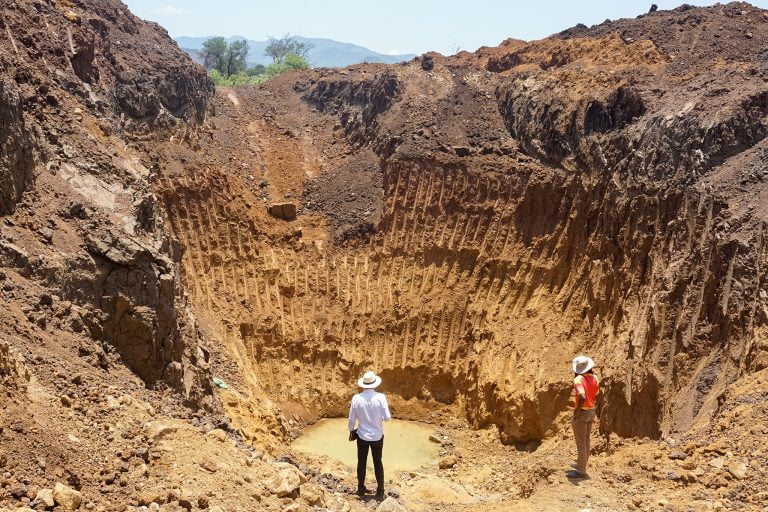
Illegal gold panners are wreaking havoc in Matabeleland South, damaging public infrastructure such as roads and schools as they search for the yellow metal.

Matabeleland Institute for Human Rights Coordinator Khumbulani Maphosa said it was criminal and irresponsible when they dig underneath the railway line or under the road.

“When you do that it’s criminal because you are vandalising infrastructure and it’s irresponsible because you are risking people’s lives,” Maphosa said.

He said the government should put in place stricter policing on the activities by omakorokoza.

“But beyond that we feel it is now time to ban detectors because the carriage of a detector outside the claim zone is destroying infrastructure,” Maphosa said.

“In other places they destroy some people’s houses. We have received reports on that, some are destroying school infrastructure that shows how metal detectors are destroying our infrastructure.”

It is also understood that Loreto Mission in Silobela, Midlands province is in danger of losing its infrastructure after illegal gold panners invaded the institution and dug large pits in search for gold.

Gold is the most liquid commodity as it can be easily sold.

The government estimates that the economy could be losing US$100m through the smuggling of the yellow metal.

The government has put incentives to encourage gold deliveries to Fidelity Printers and Refiners.

The sweetener includes 5% incentive for those who deliver above 20 kilogrammes, removal of royalties, and payment at the prevailing international gold prices rate.

This has triggered gold deliveries through official channels with gold deliveries to Fidelity averaging over 2.8 tonnes per month in June and July from an average of 1.3 tonnes that existed before the incentives.

Zimbabwe is targeting a US$12bn mining economy annually by 2023. Gold is expected to lead the charge with a haul of US$4bn.


Business Times

Uzumba villagers block Chinese miner

0

Villagers in ward 14 (Nhakiwa), Uzumba constituency are against the proposed granite mining project by a Chinese company Heijin and have since written to the Mines and Mining Development ministry through their leaders raising their objections.

Heijin wants to mine in Nenzou village, Kaseke 1256BM and Chibvi ME1253BM, blocks covering more than 300 hectares.

Councillor Zvondai Marowa, Nenzou village head Sailors Kaseke and Chief Nyajina have all appealed to the Mines ministry for its intervention.

He accused the company of pegging the area without consulting villagers.

Marowa said villagers were objecting to displacement from their ancestral land.

The area, he said, was grazing land for the whole community and the mining activities would also result in desecration of graves of freedom fighters buried in the sacred Chemadende Mountain.

“We believe that tampering with these traditional and cultural sites will have a negative impact on our society,” Marowa said.

“The negative externalities arising from the mining activities such as dust, chemical emissions and pollution of water sources and air will have a negative impact on the environment in general.”

On August 24, Kaseke also wrote to the ministry with other signatories, Lovemore Kaseke and Tozivepi Nyamuridzo, identified as committee members, citing the same reasons.

“We (villagers) and others from surrounding villages are against the mining of granite in our area by Ndemera’s company which came and put pegs without the residents’ approval,” he said.

In his letter, Chief Nyajina said: “I am objecting to proposed mining plans for Kaseke and Chibvi 2 by Heijin Mining Company because I was not consulted. There are at least 39 families who will be affected. We don’t have any place to resettle these people. There are sacred shrines in the hills for our ancestors.

“Villages that will also be affected by the project are Chimina, Mukonzi, Manyani, Machanzi and Gotora.”

Efforts to contact Ndemera were futile, but he is on record as having apologised for not following due process.


NewsDay

One killed, 8 injured in machete gang attack

0

A MINE worker died while his eight workmates were seriously injured after they were attacked by a gang of 14 men who were armed with machetes in what is believed to be a conflict between rival mining gangs.

National police spokesperson, Assistant Commissioner Paul Nyathi confirmed the incident which occurred on Saturday at Cobra Mine in Gwanda.

“We are investigating a case where one person died and eight others were injured after they were attacked with machetes by a gang. The victims were asleep in their shacks at their workplace when they were attacked by the gang.

The suspects went on to damage some property at the mine before fleeing,” he said.

“The injured were taken to Gwanda Provincial Hospital where one died upon admission and the others were further referred to United Bulawayo Hospitals (UBH). We are conducting investigations and we want to ascertain the cause of the conflict or whether these could be rival mining groups.

The suspects are 14 and they are based at Bina Mine which is close to the mine where the incident occurred. We want to warn people against using violence to resolve disputes.”

Asst Comm Nyathi appealed to members of the public with information that could lead to the arrest of the suspects to contact the police.

Zimbabwe Christian Alliance Gwanda District coordinator who is also an ex-officio member of the Gwanda Local Peace Committee (LPC), Reverend Sipho Mhizha said the peace committee had scheduled a meeting for today to come up with an intervention strategy that will be implemented at Cobra and Bina Mines.

“We learnt with great concern of the incident which occurred at Cobra Mine where one person died and eight others were injured. From the information we have gathered so far it appears that these are rival mining gangs and they have had previous conflicts,” he said.

“As a peace committee we will be holding a strategic planning meeting in order to see how best to intervene and if need arises, we might even set up a peace committee in the area. We set up a peace committee at Vhovha Mine and it’s yielding some positive results. As peace ambassadors, we are concerned by the violence ongoing in mining areas and we hope to engage small scale miners in order to address this problem which keeps recurring in various mines around Gwanda.” 


The Chronicle

Nduna Sues RioZim For Invading His Mine

0
CHEGUTU West legislator, Dexter Nduna has taken gold mining conglomerate, RioZim Ltd (RioZim) to court on allegations of invading his Danly mine situated in the mining town.
RioZim is being sued together with one  Langton Ndlovu, Zimbabwe Republic Police (ZRP) officer In-charge Chakari, Provincial Mining director Mashonland West, Police Commissioner-General, Godwin Matanga, and Home Affairs minister Kazembe Kazembe.
To this end, he has filed an urgent chamber application seeking a spoliation order.
He wants an order suspending the current activities being carried out by Ndlovu and that he be declared the lawful owner of the controversial mine claim.
Nduna said he is the holder of Danly Mine and has been peacefully mining until Rio Zim, Ndlovu and the ZRP on the 24th of August this year.
“On the strength of the prospecting licence related above, I took up and have been in peaceful and undisturbed possession of the said claims carrying out my prospecting operations. On or about the 24th of August 2021, I went to the mine to go about my normal business there and the three barred me from operating on my claim without my consent and had thus halted all mining activities,”he said in his founding affidavit.
Nduna said upon inquiring with the respondents he was that they had been given a “verbal authority by Provincial mining director and could not give any lawful explanation to conduct themselves in that manner.”
Nduna said they went on to the extent of erecting a fence within his boundary.
“It is this conduct on the part of the first to third respondents which has necessitated the bringing of the present application. The respondents have claimed that the officer in charge has given them authority to dispossess me.
“Without my consent and authority, the first, second and third respondents have illegally barred me access to my claim and have halted all of my mining and prospecting activities claiming authority from the fourth respondent. Ndlovu has commenced illegal mining activities on my claim and continues to carry such out at the time of this application,” said Nduna.

Two die in Masvingo mine shaft collapse

0

Two artisanal gold miners died in Mushandike resettlement area after a mine shaft they were digging for gold collapsed and trapped them on Saturday.

Paul Mhuka (20) and Cephas Pandasvika (41) of villages 15 and 23 respectively in Mushandike were found lifeless after fellow artisanal miners at Golden Echo, 7B removed rubble that had covered them.

The pair were working underground in the 25 metres-deep shaft with their third colleague who was lucky to escape after the shaft collapsed.

The trio had entered the shaft the previous evening around 8pm for the night shift when disaster struck.

According to eyewitness tragedy struck after boulders and mounds of earth fell into the shaft where the two deceased and the lone survivor were digging for the yellow metal.

Masvingo provincial police spokesperson Inspector Kudakwashe Dhewa said when police attended the scene bodies of the deceased had already been retrieved from the shaft by their colleagues.

The bodies were taken to Masvingo General Hospital for post-mortem.

Gold mining by artisanal miners is rife in the highly mineralised reefs in Mushandike where scores of fortune seekers lose lives every year in deep shafts.

Miners Call For Mobile Vaccinations At Mining Sites

0

THE Zimbabwe Diamond and Allied Minerals Workers Union (ZDAMWU) has called on government to establish mobile vaccination sites at mines so that workers will not lose productive time in vaccination queues.

In an interview with NewZimbabawe.com Sunday, Zdamwu General Secretary Justice Chinhema said workers are losing productive time in queues waiting to be vaccinated.

Some mines are now demanding that workers must be fully vaccinated before they report for duty.

“Zdamwu is pro vaccination and we are encouraging workers to get vaccinated. Further instead of forcing workers , the mines must prioritize awareness campaigns . People are receiving a lot of fake news through social media and it is our request that mines work with us in educating workers. Instead of putting those restrictions which are meant to force workers , we must work towards awareness to workers, their families as well as communities,” Chinhema said.

He said mines must make arrangements with government to bring mobile vaccination sites.

“We are also urging the mines to make arrangements with the ministry of health to bring the vaccination at the mines rather than workers spending time looking for vaccination centers, Mine workers are losing productive time in vaccination queues. We are therefore, calling for mobile vaccination to be introduced in mining sites. Mining is a critical economic sector and there mustn’t be any disruptions to production,” he said.

Government has since said all its workers must be vaccinated.


NewZimbabwe

TotalEnergies Mozambique LNG project may resume within 18 months: AfDB

0

TotalEnergies’ liquefied natural gas (LNG) project in Mozambique could be back on track within the next 18 months after African armies deployed to help quell an insurgency, the president of the African Development Bank (AfDB) said on Friday.

The French energy giant declared force majeure on the US$20 billion project in April after Islamic State-linked fighters overran the town of Palma, on the doorstep of its facilities in the northern Cabo Delgado province. It estimated at the time the disruption would delay development by at least a year.

Troops from Rwanda and members states from the Southern African Development Community (SADC) have since deployed to support Mozambican forces to help put down the insurgency.

AfDB president Akinwumi Adesina told Reuters he did not expect the interruption to affect the LNG project’s long-term viability.

“The return of security in that place will give assurances to Total and others to return,” he said. “In one year to 18 months, I expect it to be stabilised enough to get back on track.”

TotalEnergies declined to comment on Adesina’s remarks.

The AfDB is lending $400 million to the project, which is Africa‘s largest ever foreign direct investment and a lynchpin of Mozambique’s economic development strategy.

“It gave us real concern when Total declared force majeure and they had to move out. But you can understand because of the insecurity situation,” Adesina said.

Southern African nations agreed in June to send troops to assist Mozambique, and Rwanda, which is not a SADC member, deployed 1,000 soldiers a month later.

Mozambican President Filipe Nyusi has said the army is now retaking ground in Cabo Delgado. Last month, Mozambican and Rwandan security forces recaptured the port town of Mocimboa da Praia, previously an insurgent stronghold.

But Adesina said insecurity was still restricting investment in other parts of Africa, pointing to conflict zones in Chad, Mali, Burkina Faso, northern Nigeria and Cameroon.

He said the AfDB was developing facilities, including security-indexed investment bonds, to help African countries tackle insecurity and rebuild after unrest.

“Without security, you can’t have investment and you can’t have development,” he said-Bloomberg


Women affected by mining beyond the workplace

0

While most of the current focus on women in mining tends to be on their employment and advancement, there are a range of gender-related issues confronting the sector in its downstream value-chain.

These include the position of women in stakeholder groups like local communities and suppliers, for instance, where mines can still improve their contribution to inclusive development. According to Lisl Pullinger, principal ESG consultant at SRK Consulting, this might express itself in the mine’s social engagement processes – where traditional community structures are often male-dominated.

“Being aware of gender dynamics not only in the workplace but among important stakeholder groups will enable mines to raise the bar on managing impacts on women,” says Pullinger. “It is important to make more space for women’s voices and input in mine decisions ranging from corporate social investment and procurement, to resettlement and environmental permitting.”

She highlighted a growing appreciation of the fact that women in mine-host communities are often impacted differently by the presence of a mining operation. While many women are engaged formally or informally in the mine’s supply chain, their contribution is seldom ‘mainstreamed’ in company policies or even national mining regulations.

“This has led to calls by organisations like the Intergovernmental Forum on Mining, Minerals, Metals and Sustainable Development for clear standards for stakeholder consultation in licencing processes, for example,” she said. “Such clarity would emphasise the need for mines to consult equally with men and women in host communities.”

This was particularly important in the context of communities dealing with contributing factors to systemic vulnerability like poverty, illiteracy and women’s lack of access to education. Mines and their service providers would then have to take more meaningful measures to ensure women fully understand the scope of the project, what is being proposed, and potential consequences.

Equally important, an ongoing and effective gender strategy would allow mines to identify opportunities for interventions. The ways that this could be done include the mine’s CSI function – to support community-based initiatives against gender-based violence faced by women in local communities, making special provision to log grievances in a safe and protected manner – and through procurement playing a more active role in empowering women suppliers in the local area.

“The inclusion of more women in the workforce remains an important element of enhancing mines’ positive impact,” she said. “However, employment equity is not about numbers on their own. Women working in mining companies will add value when they participate more fully in daily decision-making.”

The insights that women bring can be well-leveraged in improving the mine’s broader impact among stakeholders, helping guide the company’s engagement, recruitment and procurement strategies to best effect. Numerous studies have showed, she said, that expenditure by women heading poor households has a more positive spin-off in terms of family welfare and education.

“As with any development effort, it is important for the mining sector’s impact on female stakeholders to be assessed regularly,” said Pullinger. “This can be done by integrating gender into the impact assessment process, and reporting gender disaggregated data.”

Gender-sensitive monitoring can help understand how the changes that mining brings to a community often affect men and women differently. Women may not benefit directly from the financial gains of resettlement processes, for instance, if their ownership of certain assets is culturally or legally prescribed. At the same time, certain types of social change associated with mining such as site-induced migration, may raise the risk of gender-based violence.

“A broader focus on women’s participation in mining can ensure that mining’s impact does not exacerbate gender inequality and discrimination,” she says. “Rather, it needs to support women in sharing the benefits and opportunities the sector can offer.


About Lisl Pullinger

Lisl has over 20 years’ experience working on stakeholder communication and community development projects. Her experience in working with host community and mining executives places her in a unique position to provide advisory services regarding sustainability and environmental, social and governance (ESG) performance. Lisl’s experience included a wide range of sustainable development management areas – developing in-migration management plans, leading due diligence teams and developing digital stakeholder engagement plans. Lisl has worked extensively in the African mining environment and has a thorough understanding of how social license to operate can influence operations and projects. She has deep insight into sustainability requirements across disciplines and how it collates into developing and maintaining sustainable frameworks for projects and operations. Lisl has recently worked on sustainable development projects in the SADC-region, Namibia, Zimbabwe and Mozambique and is currently supporting the European Union’s ReSourcing project with advisory services on responsible sourcing. Lisl is passionate about creating shared value between communities and mines through local procurement and enterprise and supplier development. She is a member of two technical societies. 


About SRK

SRK is an independent, global network of consulting practices in over 45 countries on six continents. Its experienced engineers and scientists work with clients in multi-disciplinary teams to deliver integrated, sustainable technical solutions across a range of sectors – mining, water, environment, infrastructure and energy. For more information, visit www.srk.co.za

Gold incentives lift output

0

INCENTIVE schemes announced early this year to boost gold deliveries to the State-run Fidelity Printers and Refiners (FPR) have bolstered shipments into the formal market, Reserve Bank of Zimbabwe (RBZ) governor John Mangudya said on Friday, projecting higher year-end output.

Speaking during a mid-term monetary policy statement (MPS) review webinar organised by the country’s biggest circulating business weekly, Zimbabwe Independent, Mangudya said the strategy helped the country halt high-level smuggling.

Mangudya said following the introduction of incentives, small-scale miners alone boosted output by 1,3 tonnes between May and July this year.

“Gold deliveries have been going up,” Mangudya said in his keynote address.

“It was higher in June and July. That was the impact of the gold delivery incentive scheme which was implemented by government. If you look at the totals from January to May and you look at June and July totals, you can see the immediate impact of an incentive of 5%.

“If you remove that incentive, (you can see) incidents of smuggling gold out of Zimbabwe.

“It means that all that gold has been produced in Zimbabwe all along, but instead of bringing it to the formal market, to Fidelity Printers, it has been going out of the country.

“People (small-scale miners) produced 1,8 tonnes in July, almost two tonnes. But they were producing only about 700kg in May, it means that difference between 700kg and two tonnes, 1,3 tonnes, was just going out of the country.

“It was not going to the formal market. The incentive is a motivation for them to bring gold to the formal market,” the central bank chief noted.

The MPS announced early this month projected stronger gold output and exports this year, underpinned by the incentives, which range between 2,5% and 5%.

Finance minister Mthuli Ncube’s package of incentives include incremental output schemes, which will see mining firms that opt to list on the Victoria Falls Stock Exchange earning much higher incentives on their incremental output. Easing of COVID-19-induced restrictions that prevailed most of last year have also boosted gold output as markets reopened and supply chains got back on track.

“There was a remarkable surge in gold deliveries to Fidelity Printers and Refiners (FPR) in the months of June and July 2021.

“June 2021 gold deliveries to FPR were 2 924,3 kg compared to 1 409,6kg delivered in June 2020. Similarly, gold deliveries for July 2021 stood at 2 824,6 kg compared to July 2020 deliveries of 1 406,4 kg,” Mangudya said in the MPS.

He said small-scale gold producers contributed 52,8% of the total gold deliveries to FPR during the first seven months of 2021, which compared favourably with the 55,8% delivered for the same period in 2020.

Mines minister Winston Chitando has announced an ambitious plan to transform the sector into a US$12 billion industry by 2023, from the current total revenue of about US$2,5 billion.

Gold mines are expected to play a big role in this strategy.


NewsDay

Inflation slows, threatens to rear ugly head again

0

As largely expected, Zimbabwe’s annual inflation rate fell to the lowest level in close to three years in August, but the scourge threatened to rear its ugly head again.

The year-on-year inflation rate for the month of August 2021 as measured by the all items Consumer Price Index stood at 50,24 percent down from 56,37 percent in July 2021.

However, the month-on-month inflation rate in August 2021 was 4,18 percent gaining 1,62 percentage points on the July 2021 rate of 2,56 percent. This is the highest monthly inflation rate since January this year when inflation stood at 5,4 percent.

While inflation is always and everywhere a monetary phenomenon, according to American economist Milton Friedman, the Reserve Bank of Zimbabwe (RBZ) is on record saying unavoidable shocks to international food and administered prices such as higher freight
rates is also a major contributor to current price instability. In revising its inflation rates from the previous year-end rate of 10 percent to 25 and 35 percent, the central bank said deviation from the initial end period forecast was due to unavoidable shocks to international food and administered prices.

“The recent sharp increase in international food prices has already slowly started to feed into domestic consumer prices in some regions as retailers, unable to absorb the rising costs, are passing on the increases to consumers,” said the RBZ in its Mid-Term Monetary Policy Statement.

“International food prices are expected to increase by about 25 percent in 2021 from 2020, before stabilising in 2022. A pass-through of 20 percent (13 percent in the first year and 7 percent in the second) would, thus, imply an increase in consumer food price inflation of about 3,9 percentage points and 2.1 percentage points on average in 2021 and 2022, respectively for Zimbabwe.

“An additional one percentage point to the 2021 global consumer food inflation could be added by the higher freight rates,” reads part of the Mid-Term Monetary Policy statement.

Other market watchers, however, attributed high inflation levels on an unstable parallel market exchange rate which spent the better part of August between 140 and 150 to the greenback. The official exchange rate was below 86 throughout August, making little
impact, if any, on prices.

Many economic players in the country have been using parallel market rates to price their goods and services, driving inflation up.

According to economists, the country’s monthly inflation rate will have to stay below 3 percent to close within the RBZ’s targeted range.

For annual inflation to remain on a downward path as it did in August month on month inflation for the rest of the year should be below 3,8 percent for September; 4,4 percent for October; 3,2 percent for November; and 4,2 percent for December. But for it to close within the targeted range of between 25 and 35 percent, month-on-month inflation should fall below 3 percent or much lower. But with the widely used parallel market exchange rate heading north, with street money changers quoting rates as high as 160 yesterday, monthly inflation levels could close the year above the target range.

In a note to clients, economist John Robertson said the 4,19 percent increase this month can be attributed mainly to the movement in the black market exchange rate to around $140:US$1, “so a further weakening of the black market rate in the coming months could
prevent the annual inflation rate from falling”.

“Official mention has been made of the need to eliminate the currency black market, but so far the attempts made to bring it under control have failed.”

In August, consumers felt the most inflationary pain in the purchase of non-food items with the month-on-month non-food inflation rate at 4.95 percent, gaining 2,35 percentage points on the July 2021 rate of 2.60 percent.


Business Weekly