Home Blog Page 444

Rains could trigger mining accidents – Labour official

0

Zimbabwe Diamond and Allied Mineral Workers Union secretary-general Justice Chinhema has warned that there is a high likelihood of mining accidents this rainy season due to the poor state of shafts in many mines dotted around the country. 

Vongai Mbara 

Chinhema has urged mine owners to invest more in safety rather than profits. 

“We are expecting the responsible stakeholders to ensure that the sector is in a position to deal with mining accidents during the rainy season.” 

Miners are being encouraged to ensure they practice safe mining and adhere to the relevant mining Laws and Regulations. 

Previous rainy seasons have seen the country witnessing a series of fatal accidents that have occurred mainly at gold mines around the country. 

In September 2020, five artisanal miners were trapped underground when a shaft collapsed at Task Gold Mine in Chegutu, Mashonaland West Province. 

One body of the five miners was only retrieved, 51 days after the tragedy.  On November 10, 2021, six illegal miners, including four from one family, were trapped underground when a mine collapsed in Matshetshe, Esigodini, Matabeleland South Province. 

Chamber of Mines challenges workers’ wages review demand

0

The Chamber of Mines (CoMZ) and Associated Mine Workers Union of Zimbabwe (AMWUZ) have filed a challenge against some mine workers and the Zimbabwe Diamond and Allied Mineral Workers Union (ZDAMWU)’s application for review of wages.

Vongai Mbara

Recently, ZDAMWU and mine workers filed a court application challenging the Chamber of Mines (CoMZ) and AMWUZ’s proposal that their wages be increased by only 24% with effect from July 1, 2021, saying it was too insignificant.

They cited the National Employment Council for Mining Industry, AMWUZ, and CoMZ as respondents.

According to papers filed last week, CoMZ chief executive officer Isaac Kwesu said the collective bargaining process that ushered in the new wage increase was not reviewable.

“A decision which is capable of being reviewed by this court must be that of a judicial, quasi-judicial or administrative nature. In the present matter, the applicants are seeking the review of the collective bargaining process between the 2nd and 3rd respondents (NEC and AMWUZ). This is not a judicial, quasi-judicial, or administrative decision or process and as a result, the application is improperly before this court,” Kwesu submitted.

Kwesu said if the court was to do so, it should first make a finding that the collective bargaining process was unlawful or invalid premised on any ground for review that the applicants have relied on.

He said the applicants should not have sought such relief.

“Accordingly, the application ought to be dismissed with costs on this ground,” Kwesu submitted.

AMWUZ secretary-general Gideon Chirwa supported the CoMZ submission and hoped for the dismissal of the application.

NEC announced the increment through a circular to mines dated September 28. 2021.

The increase in salaries saw mineworkers earning new gross salaries of between $30 500 and $70 740.

Following the announcement, Allen Shoko, Philip Nyajeka, Gracious Sibanda, Mako Butau, and ZDAMWU filed an application for review of the salary increase at the Labour Court.

The workers noted that the collective bargaining agreement of September 28, 2021, was irrational in that the mining industry had agreed in general that the wage negotiation should be quarterly, yet the statutes stated otherwise.

Anglo can uplift livelihoods of many thousands

0

Diversified mining company Anglo American can uplift the livelihoods of many thousands of people living around its communities in South Africa and support many jobs through its sustainability projects, attendees of Anglo’s second 2021 sustainability update were told.

The London- and Johannesburg-listed company outlined how it is moving away from isolated one-off community-related sustainability projects towards much larger longer-term interventions that support broader economic diversification in the regions where it operates.

“Governments obviously do development planning but we think we can bring something with a business approach to complement and to build on that,” Anglo head of responsible business partnerships Jon Samuel said during the sustainability update covered by Mining Weekly.

The sustainability approach involves deep engagement with stakeholders to understand their aspirations, which the company backs up with regional data analysis.

Climate, soils, infrastructure, skills, tourism and environmental resources are included in the many factors taken into account to build an holistic grasp of regions.

“From that, we can identify the untapped opportunities such as the tourism resources that are not being exploited, and whether there’s a mining value chain that’s not developed as much as it could be, given the demand that exists for the region and further afield,” Samuel explained.

Once the untapped potential is identified, partnerships are built and projects taken forward under a multi-stakeholder governance framework.

“We think it’s really important that we, as Anglo American, aren’t seen as driving all of this,” he said.

Buy-in from many stakeholders is sought, including government, commercial enterprises, other mining companies and non-governmental organisations (NGOs).

“Then this is all underpinned by a project management cycle,” Samuel outlined.

Principles are applied that support big, long-term, scalable interventions – to allow for more rigorous planning and improvement evaluation, and to attract the best partners.

Partnerships are seen as essential to bring expertise, credibility and new funding pools to support the interventions being promoted.

Anglo itself invariably tries to introduce a productivity lens to, for example, support the efficiencies of small businesses being supported or improving the quality of education and health care through allowing existing public service providers to be more effective and efficient.

“We always try to pull the levers that we have within the company and the biggest of those is our supply chain and our procurement, which is roughly about $11.5-billion a year, which is typically about 100 times our social investment budget.

“But we also look at things like the skills within the business and we’ve been rolling out a group-wide skills-based employee volunteering programme to tap into some of that expertise,” said Samuel.

BACKYARD AGRICULTURAL OPPORTUNITIES

Agriculture as just one example of how community development can work out. What has been identified in many host regions is that more valuable crops can be grown than existing crops.

However, higher-value crops invariably need in-region processing, which requires the correct volume and quality of feedstock and which isolated action generally cannot achieve.

“If we work with partners, we think we can bridge that gap and bring in the offtake partners to do the processing and then find a route to overseas markets,” Samuel said.

Good news is that this is under way in South Africa, involving the use of either Anglo’s land or that of commercial farmers.

Anglo will put in the correct infrastructure to support high-value agriculture and will draw on mine infrastructure for water, power and logistics.

“Around that, we’ll allow other participants to use that infrastructure as well,” said Samuel. Such participants might be other commercial farmers or other smallholder farmers.

“It can even be people growing small amounts of crops in their backyards. Some of the things we’re looking at can be literally grown in oil drums.

“By doing this, we believe that we can get better value for our land from the landholders, so there’s a commercial win for us potentially, but also there are lots of jobs we can support and we can uplift the livelihoods of many thousands of people around our communities in South Africa,” said Samuel.

ZIMBABWE, BRAZIL, CHILE AND PERU

In South America, Anglo has been working with Inter-American Development Bank and TechnoServe, a specialist NGO, on business solutions to poverty in Brazil, Chile and Peru. (See attached slide.)

The Beyond Extraction programme has created close to 5 500 jobs and met the programme targets, with businesses participating benefiting from an almost one-third increase in turnover.

A newer three-year programme in Zimbabwe called Takura is focussed on horticulture and poultry value chains. Working with TechnoServe, Anglo is planning to support about 600 farmers to generate nearly 2 000 jobs. The second year of the programme is slightly ahead of track despite COVID-19 and is already exporting fresh produce to the UK and the Netherlands. It does not rely on local economies and it brings in much-needed foreign income.

Zesa Threatens To Cut Off Mining Firms Over US$37m Debt

0

ZESA Holdings has threatened to switch off mining houses over a US$37 million legacy debt, which it blames for crippling the power utility’s operational efficiency. 

Vongai Mbara  

Speaking during the recent launch of the 2021 Mining Industry Report by the Chamber of Mines of Zimbabwe (CoMZ) in Harare, Zimbabwe Electricity Transmission and Distribution Company (ZETDC) acting managing director Engineer Howard Choga said the owing companies are going to be switched off. 

“Currently, mining sector companies owe the power utility a total US$37 million and $400 billion in local currency. 

“The money owed is in operating payment plans, that’s how we have arrived at the balance. Those not paid up will be switched off.” 

He said ZETDC’s collection rate ranged from 106 percent to 110 percent, adding that Zimbabwe Electricity Supplier Authority, (ZESA) was grateful for the support it was receiving from international institutions. 

Eng Choga highlighted that the retention threshold set by the Reserve Bank of Zimbabwe (RBZ) was a limiting factor also curtailing mining houses from settling the outstanding debt. 

“The 60 percent foreign currency being received by companies is not enough to enable settling of the electricity bills in foreign currency. 

Therefore, there is a need to increase the thresholds going forward,” he said. 

The mining sector has been recognised as one of the major economic mainstays to anchor the economy for Zimbabwe to attain an upper middle-income economy by 2030. 

The sector is buoyed by rich minerals such as gold, platinum, diamond, iron and steel, chrome, coal and lithium among others. 

In the 2021 Mining Industry Report, CoMZ indicated that the foreign exchange framework remains sub-optimal on the back of a reduction in forex retention levels as well as the disqualification of mining houses from participating in the auction market. 

The Chamber of Mines also pointed out that the above situation was compounded by the loss of value on the surrendered portion of export proceeds and mining delays in payment for mineral deliveries. 

“Almost all respondents indicated that the foreign exchange retention at 60 percent were inadequate to meet their operational requirements. 

“They highlighted that the retention was under pressure from requirements to pay royalties, electricity bills, taxes and some statutory obligations in foreign currency as well as the widespread preference of US dollars by suppliers,” it said. 

“Some respondents indicated that their bids on the auction market to cover their foreign currency shortfalls were being rejected on the basis that they are not net exporters” 

The CoMZ said its membership expects the mining representative body to engage authorities to improve the forex situation within the sector. 

Players in the mining industry also look forward to the Government allowing them to pay for royalties, electricity bills, taxes and other statutory obligations in local currency. 

“Almost all respondents indicated that the value of the surrender portion that is liquidated into local currency at the official auction-rate has been significantly eroded on the back of the parallel market rate, which is used for pricing goods and services by local suppliers,” said CoMZ. 

Platinum miners seek exemption on beneficiation

0

Local platinum miners are seeking tax holidays on beneficiation projects to stimulate investments into the sector, a recent report says, citing views from a survey of industry executives. 

Vongai Mbara

The same concerns have been raised by Lithium producers who are arguing that the current tax beneficiation framework is discouraging investments into value-addition facilities. 

Mineral beneficiation has been identified as critical towards achieving the Government’s target of a US$12 billion mining industry by 2023. 

According to Platinum producers, tax incentives could boost investments into new and existing projects. 

“The PGMs producers indicated that they are currently engaging the Government for an optimal PGMs beneficiation framework,” says the report, which was commissioned by the Chamber of Mines of Zimbabwe (CoMZ). 

“Among key recommendations cited by platinum producers are removal of beneficiation taxes and the introduction of beneficiation incentives to accelerate capital spending in the beneficiation sector. The producers are looking forward to the Government adopting the recommendations and improving capital inflow into the sector.” 

The current platinum tax structure which took effect on January 1, 2018 penalises miners for export of white concentrate at 5 percent, white matte 2,5 percent and base metals 1 percent. The charges are levied on gross export value. 

The miners are saying they should not pay penalties for failure to beneficiate. 

Zimbabwe holds the world’s second-largest deposits of platinum after South Africa and has been pushing mining firms to build refineries to stop the export of raw platinum ore and optimise earnings. 

The report said potential investors view the current beneficiation tax framework as undermining projects’ net present value, resulting in some rejecting potentially viable projects. 

“The tax breaks on beneficiation projects are quite critical in the sense that they encourage investment into beneficiation facilities, especially at a time the Government is targeting to boost revenue from the mining industry,” Mr Carlos Tadya, an analyst with a local research firm, said. 

“It is an issue the Government needs to seriously look into.” 

On Thursday, Zimplats, a unit of Impala Platinum, announced that it would invest US$200 million in a base metal refinery (BMR) as part of its US$1,8 billion medium- to long-term investment plan for Zimbabwe. 

The BMR plant would have capacity for local PGM base metal refining as well as create more than 1000 jobs directly and indirectly. 

South Africa-based Anglo-American Platinum in 2019 commissioned a smelter at its Unki Platinum Mine in Zimbabwe, enabling the company to partially process ore in the country before sending it to South Africa for refining. 

Zimplats and Mimosa Mining Company are currently sending platinum matte to SA for refining. 

Zimbabwe plans to grow mining revenue to US$12 billion by 2023 as it seeks to transform the country into an upper middle-income economy by 2030. 

Gold exports are expected to reach US$4 billion while platinum exports are forecast to top US$3 billion. 

In the latest report, mining executives expressed confidence about future prospects on the back of positive commodity price outlook, improved capacity utilisation and anticipated increase in output. 

But they expect the domestic investment climate, characterised by high costs of capital, foreign currency constraints and poor infrastructure, to remain depressed. 

The Mining Business Confidence Index (MBCI), which gauges confidence among local miners, is expected to increase to 17 next year, from 9 in 2021 — the biggest jump in nearly four years. 

The index scale ranges from -100 to +100, with the lowest score representing the least level of confidence and the biggest score representing the highest. 

“Generally, mining executives are confident about the prospects for their businesses in 2022. 

“Notable among the positive sentiments include optimism about commodity price outlook, improvement in capacity utilisation and anticipated mineral output growth.” 

The majority of the mining executives surveyed said they were planning to ramp up production in 2022 by ranges of between 3 percent and 100 percent. 

Mines Committee visit unearthern a host of challenges at Bubi Gold centre

0

A tour by Hon Edmond Mkaratigwa led Mines and Mining Development Portfolio Committee has revealed a host of challenges that need urgent addressing at the Bubi gold Centre Mining Zimbabwe can reveal.

Yesterday the Portfolio Committee on Mines and Mining Development led by Hon Edmond Mkaratigwa went for a fact-finding mission at the popular gold service centre where ZMDC and local Small-scale miners converged to air their concerns and views on the operations at the service centre.

The purpose of the visit is dubbed: Enquiry into the gold mining sector problems.

Speaking at the visit, Bubi Small Scale Miners Association Chairperson Mr Siqduthando Ncube said the project was headed for failure as ZMDC was failing to fund small scale miners to bring gold ore at the milling centre.

He said the pilot project has failed on its mandate to be exemplary for other provinces to take a leaf because the implementation of the whole idea was offside.

“The only way this project can flourish is by empowering small scale miners. The resources are there but we are still using picks and shovels to extract ore. A pilot project should be adequately funded and be exemplary and it seems we have lacked on the implementation of the idea on paper, on the ground.

Bubi Miners Association Secretary Mr Benjamin Ndlovu implored the government to finish the project as it has not been as successful as was anticipated. Government must however draw lessons from that, and improve on the idea as it is still noble.

“We thought we were very lucky to get a milling centre but it has not been as expected. These milling centres do not need too much capital; but this has failed since 2018. The government must fully fund this project so that the investment benefits are fully realised” he said.

The small-scale miners also reported that ten compressors were ordered yet only three were delivered as of now, and time has lapsed, giving speculation of corruption.

Some equipment in a shed is gathering dust as it is sitting idle with miners claiming the equipment is not of good use to them. The miners say the equipment they initially expected to be delivered and that which was delivered are completely different, which might have doomed the project from the beginning.

The Mines Committee arrived on-site before 9 am and departed after 13:00hrs, and at no time during that period did any miner bring in any ore. There also was no electricity and the centre was quiet yet unmistakable noise of mining equipment was heard from neighbouring mines. This led to Mines Committee members asking why the generator was not being used, while depending wholly on electricity which is unstable.

Zimbabwe Mining Development Corporation (ZMDC) Non-Executive Director Mr Peter Chimboza speaking at the visit yesterday said, his company which owns 60 per cent of Bubi Gold Milling Centre was failing to raise capital to increase its milling volumes as as such, there has not been enough apex to channel to the growth of the ASM sector in Bubi.

He said that because his company was under sanctions, it has been difficult for them to source for outside investment as investors are not willing to be associated or to risk their money in a project that can be blacklisted due to ZMDC sanctions.

Chimboza said it was of importance for the government to take a leaf from the Bubi Centre as it has proved that the project is achievable but there are things that needed to be addressed.

“We are not able to raise funds because of sanctions. The main thing that we want is to grow our milling volumes because the ore is there in this area but the equipment is not enough for small scale miners to bring big tonnes.

“We are hoping through the help of the government to fund the miners, if miners are capacitated we will have big volumes to mill here.

“This is however a pilot project, we hope after this we will have successful gold service centres,” Chimboza said.

Parliamentary Portfolio Chairperson on Mines and Mining Development Hon Edmond Mkaratigwa asked the Bubi Gold Milling Centre to write a proposal on what was needed to finish the project so that it may be presented in parliament.

The milling centre according to Chimbodza has provided a learning curve for the other gold service centres to be established. He said that financial support for the milling centre can be of huge significance to the US$12 billion mining roadmap.

Speaking to Mining Zimbabwe after the meeting, Mines and Mining development Portfolio Committee Chairman Hon Edmond Mkaratigwa said, “We have been informed that a CPA plant which will be able to handle more than a 100 tonnes per day is envisaged but it needs a budget of more than USD400 000 which we support.”

“We also hope that the gaps that are existing in terms of the operations around the facility are going to be addressed and that will see stakeholders who are the Artisanal and Small-scale miners responsible for the feedstock being properly funded and properly capacitated in terms of equipment and machinery to rump up their production. That will also see the replacement of the crushers on site to make sure we have morden crushers that can actually be able to process more material and rump up production which will feed into the dump and ultimately feed into the CPA plant. This will go a long way in ensuring that we meet the 4 Billion dollar target that we expect from the gold sector torwards the 12 billion dollar mining industry by 2023,” Mkaratigwa concluded.

Gold service centres are a priority for the achievement of the President Dr Emmerson Dambudzo Mnangagwa for the country to achieve an upper-middle-income economy by 2030 with the National Development Strategy-1 (NDS-1) emphasising on the state-run gold milling centres to help capacitate small scale and artisanal miners as well as increasing gold recovery methods among these micro miners.

The Bubi Gold Milling Centre on paper is a project that is necessary for the growth and development of the small scale and artisanal gold miners whose vision through their representative body Zimbabwe Miners Federation (ZMF) is to see the ASM sector moving to an international standard of junior mining and achieving a US$4 billion annual revenue by 2023.

RBZ hails mining sector for 78% Forex contributions

0

The Reserve Bank of Zimbabwe (RBZ) has hailed the mining sector for contributing 78% out of the total foreign currency injections amid calls for the public to exercise discipline in avoiding exchange rate volatility.

Vongai Mbara

Addressing delegates at a function to launch the Mining Industry Report last week, RBZ governor, John Mangudya said the foreign currency realised through retention was significant.

“From January 25 to October 2021 stood at 78 %. During the period, US$3,4 billion in total was earned, out of which US$1,37 billion was surrendered through the 40% export surrender thresholds. We would like to appreciate miners for doing a good job,” he said.

The top five earners after retention threshold deductions during the period were Platinum at US$703 million, Gold US$147,9 million, Ferro Chrome US$105 million, diamonds US$45 million, and Coke US$23,6 million.

Quizzed by delegates on what the central bank is doing to close the gap between the two exchange rates, Mangudya said the problem bedeviling the economy has more to do with discipline.

He said all the countries have a gap between the official and parallel market exchange rates and underscored the need for consistency.

“For the past three weeks, the challenge has been the problem of the volatility of the parallel market rates. If the parallel market rate is at US$1: $140 and because of indiscipline some entities decide to increase the exchange rate to US$1 :$200 it will cause volatility.

“If the parallel markets remain stable, it means prices will remain stable, the volatility in the parallel exchange markets is often confused with the gap between the two exchange rates. In countries like Nigeria and Malawi, there are huge gaps between the two exchange rates. So we need to understand why we have such volatility in the markets,” he said.

He challenged business leaders to instill good corporate governance realising that the use of foreign currency in this economy alongside the local currency is a privilege that requires discipline and maturity.

Minerworkers fall into a 50m shaft

0

Two Mangwe mineworkers have died after falling into a 50m shaft. 

Vongai Mbara 

Cleopas Moyo (28) and Prosper Ncube (27) were reportedly descending into the shaft when a hoist they were using developed a fault and crashed down the shaft. 

Matabeleland South provincial police spokesperson Inspector Loveness Mangena confirmed the incident which she said occurred at Thuthukani Mine in Mpoengs on October 22 around 10 am.  

“I can confirm that we recorded a fatal mine accident at Thuthukani Mine in Mpoengs area where two mineworkers died. The two descended into a 50-metre-deep shaft using a hoist. 

“Along the way, the hoist developed a mechanical fault and made a free fall and crashed down the mine taking the two mine workers down with it. They sustained head injuries and bruises as a result of the accident and they died on the spot,” she said. 

Insp Mangena said other mine workers who were at the scene retrieved the bodies of their workmates from the shaft. She said the matter was reported to the police who attended the scene and the bodies were ferried to United Bulawayo Hospitals. Investigations are still underway. 

Insp Mangena called on mine operators to ensure that the work environment is safe for their employees. 

“We continue to record fatal accidents in mining areas as a result of mechanical faults. We call on mine operators, mine owners and managers to ensure that their equipment is constantly inspected and serviced to ensure that it’s working properly so that workers are not exposed to danger. Mine operators also have to ensure that their working environment is safe. 

“Mineworkers also have to ensure that their safety is prioritised and they should also work in safe areas. It’s also important for mine workers to put on safety clothing when working,” she said. 

Potential of 200g per tonne for Ragusa

0

Australian Stock Exchange-listed mining company, Ragusa Minerals Limited’s Underground Reconnaissance Works at the firms’ Tiberius prospect or Lonely mine in Bubi shows the potential of the mine to get up to 221g/t, the company’s quarterly activity report for the quarter ended 30 September shows.

Rudairo Mapuranga

The company said that underground channel/rock sampling works were completed at the Tiberius prospect during the quarter with 13 underground samples collected from the mineralised reef that returned significant analysis results, including 221g/t, 68g/t, 49.5g/t and 45.8g/t.

“Underground reconnaissance works (access via the Tiberius shaft), comprising underground surveying and channel/rock sampling works were conducted at the Tiberius prospect.

“Thirteen underground samples were collected from the mineralised reef (undiluted) and analysed, with results achieved up to 221g/t. Other significant sampling results include 68g/t, 49.5g/t and 45.8g/t.” the company said.

The company also said that, during the quarter, first stage diamond drilling works comprising 8 diamond drill-holes totalling 1236.64m were completed at the high-grade Tiberius prospect and laboratory analysis works are currently being conducted and sample results are due shortly.

“The first phase diamond drilling works at the Tiberius prospect was completed, with 1236.64m drilled at eight priority drill sites.

“The Company’s technical site personnel have completed core logging and sampling works, with selected samples currently undergoing laboratory analysis testing, with sample results due shortly,” said Ragusa.

Ragusa through its chairperson Jerko Zuvela said that it has received its Environmental Impact Assessment (EIA) approval to allow the full commercial development of gold mining and processing operations at the Lonely Mine Gold Project, including the Tiberius prospect for a period of two years (with renewal thereafter).

The Lonely Mine Gold Project is located ~88km north of Bulawayo, within the Bubi Greenstone Belt, in Zimbabwe. The Project covers greenstone belt lithology with multiple sub-parallel shear zones that host the historical Lonely and Tiberius gold mines and several other former mines, with similar geology as globally accepted Archean successions from Canada, Australia and South Africa. The Project area has not had any modern-day systematic exploration with the opportunity to benefit from utilising modern exploration techniques.

The Company conducted works on an exploration targeting program across the Tiberius prospect area, culminating in completing the initial diamond drilling campaign. The exploration targeting program fieldwork conducted during the Quarter comprised underground reconnaissance, surveying and channel/rock sampling, and completion of the first stage diamond drilling works.

Anjin, Marange villagers’ battle continues

0

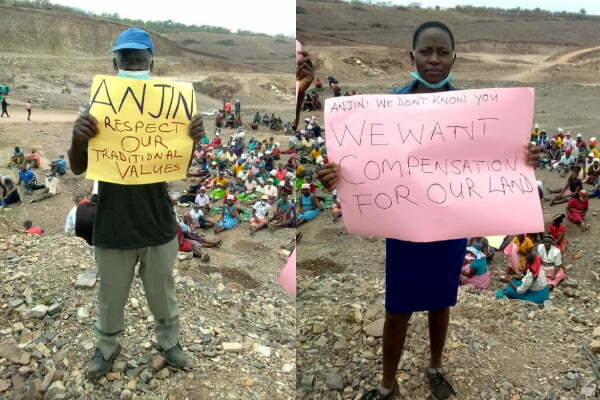
Scores of villagers from Marange yesterday staged a demonstration against Chinese diamond mining company, Anjin which is yet to compensate nearly 500 families that it displaced from their traditional homes to Arda Transau.  

Vongai Mbara  

The villagers are demanding their land and cultural rights, compensation and consultation to access environmental information.  

According to Arda Transau residents, the outstanding Bill and Liabilities for Anjin diamond mining company to settle for households relocated from Marange includes compensation for 476 families, title deeds for houses, irrigation, Pastures and electrification of houses.  

The firm which operated in the area from 2009 – 2016 before its license was revoked by the Mugabe regime leading to the formation of the Zimbabwe Consolidation Diamond Company (ZCDC) has been accused of looting the country’s diamonds with the state getting very little in return.  

Its return during the second republic era sparked a lot of controversies with villagers calling the government to halt the company’s mining operations claiming that the company has a dark past including human rights abuses.  

According to the villagers, Anjin mining operations destroyed the community infrastructure such as roads, bridges, schools, degraded farming land, sacred areas and contaminated sources of (drinking) water.  

The villagers claimed that over 4 000 cattle were lost after falling into mining pits, gullies and slime dams, around 450 families were relocated to Arda Transau without secured livelihoods and compensation for their losses.