The role of the mine surveyor is shifting rapidly beyond its traditional focus on spatial measurement and analysis, as both technology and ESG (environmental, social and governance) demands begin to reshape the mining landscape.
Surveyors are increasingly taking on a more strategic role, one that places them at the centre of sustainability, compliance, and long-term mine planning, Mining Zimbabwe can report.
By Ryan Chigoche
This shift is no longer theoretical. It is already playing out on the ground and was a key focus at the Association of Mine Surveyors of Zimbabwe (AMSZ) Q1 Technical Visit to Dallaglio’s Pickstone.
Industry leaders pointed to a profession in transition, one moving from purely technical execution into ESG-driven decision-making across mining operations.
Speaking at the event, AMSZ Secretary General Takunda Mubaiwa said mine surveyors must adopt a more deliberate and proactive approach to ESG, given their expanding influence across the mining lifecycle.
“I think we as mine surveyors really need to take the ESG framework seriously and approach it directly. For any corporate, especially in mining, the question from financiers is always: what are you doing in terms of ESG? As surveyors, we’re involved from the start, through operations, and even after mine closure. We’re the ones measuring spatial movements, excavations, tailings management, and subsidence monitoring. In every part of our work, we need to make sure ESG is incorporated into our plans, even before anyone asks,” Mubaiwa said.
What is driving this shift is the growing weight ESG now carries in mining. It is no longer just a reporting requirement, but increasingly a condition for doing business, especially when it comes to securing funding.
As investors tighten expectations, mining companies are being forced to embed environmental, social, and governance considerations into everyday operations rather than treat them as an add-on.
That pressure is naturally filtering down to technical roles and, in many ways, landing squarely on the surveyor.
Positioned at the intersection of planning, monitoring, and reporting, surveyors are now expected to provide the data and insights that underpin ESG compliance.
In practical terms, this is expanding their scope across the entire mine setup.
From tracking tailings facilities and monitoring ground movement to supporting environmental rehabilitation and contributing to social governance processes, the surveyor’s work now feeds directly into all three ESG pillars.
Technology is accelerating this transition. With access to real-time data, improved spatial analysis tools, and more precise monitoring systems, surveyors are better equipped to detect risk early, whether it is subsidence, instability, or deviations in tailings structures.
This level of insight is becoming critical, particularly as scrutiny around environmental and safety standards intensifies.
The result is a profession steadily moving closer to the core of mining strategy.
Surveyors are no longer just measuring what has already happened; they are helping shape decisions before they are made, from mine design and operational adjustments to closure planning and rehabilitation.
In that sense, the message coming out of the Technical Visit was clear: as ESG expectations rise and technology deepens its footprint in mining, the mine surveyor is fast becoming one of the industry’s most important links between compliance, risk management, and sustainable operations.
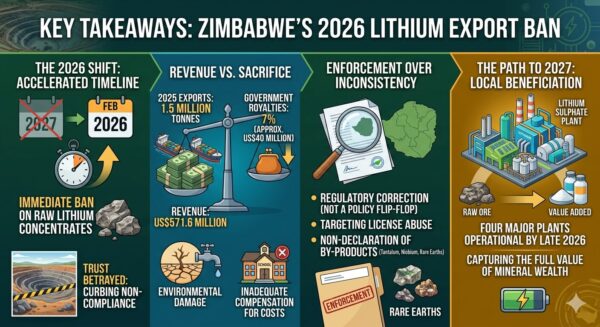
The 2026 Shift: In February 2026, Zimbabwe accelerated its original 2027 timeline, imposing an immediate ban on raw lithium concentrates. This move aims to curb “trust betrayed” by companies allegedly under-declaring minerals and stockpiling resources across borders.
Revenue vs Sacrifice: Despite exporting 1.5 million tonnes of lithium in 2025 (generating US$571.6 million), the government received only 7% in royalties (approx. US$40 million)—a figure considered inadequate given the environmental and social costs of extraction.
Enforcement over Inconsistency: The ban is framed as a regulatory correction rather than a policy flip-flop, targeting widespread license abuse and the non-declaration of valuable byproducts such as tantalum, niobium, and rare-earth minerals.
The Path to 2027: The government is transitioning the industry toward local beneficiation, with four major lithium sulphate plants expected to be operational by late 2026 to ensure Zimbabwe captures the full value of its mineral wealth.
In the weeks since Zimbabwe suspended all raw lithium concentrates and mineral exports, a narrative has emerged that the government acted abruptly, changing the rules without warning. But this framing misses a fundamental truth: the ban was not a policy reversal. It was the inevitable consequence of trust betrayed.
By Rudairo Maparanga
For years, the government extended an extraordinary level of trust to mining companies, particularly Chinese lithium producers, granting them 100 per cent ownership of mining rights, allowing them to employ their own personnel, and providing a regulatory environment that treated them as partners in national development. No country in the world gives foreign investors such unfettered access to its strategic resources without expecting reciprocal responsibility.
That trust, it appears, was misplaced.
The PGMs Example: What Responsible Players Do
The platinum group metals (PGMs) sector provides a stark contrast. Companies like Zimplats, Mimosa, and Unki operate in Zimbabwe with a clear understanding of their obligations. When they export concentrates, they declare the full range of minerals found in their ore bodies. They adhere to international Environmental, Social, and Governance (ESG) standards. They recognise that integrity is not optional, it is the price of doing business.
“PGM players declare the minerals found in their cake concentrates. But why weren’t lithium players doing the same?”
The answer, according to the Ministry of Mines and Mining Development, lies in a systematic failure to comply with existing law.
The Law Was Clear: Declare What You Find
Zimbabwean law has long required miners to declare all minerals discovered in their operations. This is not a new regulation. It is a basic principle of resource governance: a nation cannot benefit from what it does not know it has.
Yet the lithium sector, despite being dominated by major international companies, some listed on respected stock exchanges, all claiming adherence to rigorous ESG standards, chose to ignore this fundamental obligation.
“They were trusted to do the right thing, and they bothered not to,” Permanent Secretary of the Mines Ministry, Pfungwa Kunaka, said in a recent address to Parliament.
Why Enforcement Became Necessary
The government was not equipped to conduct day-to-day monitoring of every mining operation across the country. In a mature, responsible industry, such constant oversight should not be necessary. Companies operating in Zimbabwe are not artisanal miners working in the shadows. They are sophisticated, well-capitalised corporations with dedicated compliance departments, sustainability reports, and public commitments to ethical operations.
But when trust is abused, the calculus changes.
Kunaka outlined the specific factors that forced the government’s hand:
Multi-mineral deposits being stripped of value: Studies revealed that Zimbabwe’s lithium ore bodies contain significant quantities of other valuable elements, rare earth minerals, tantalum, niobium, and others, that were being exported without declaration, depriving the country of their value.
Widespread license abuse: Temporary export permits, granted to allow companies time to build processing capacity, were being recycled endlessly, with a single license used dozens of times by multiple operators.
Misdeclaration and falsification: Minerals were being exported under false descriptions, with high-grade lithium declared as low-grade waste to evade taxes.
Illicit stockpiling across borders: Disturbing reports emerged of substantial quantities of Zimbabwean lithium stockpiled in neighbouring countries, awaiting export without any benefit to Zimbabwe.
The 2027 timeline is being abused: The government had announced a 2027 deadline for the transition to local processing, expecting companies to use the intervening years to build capacity. Instead, many used the window to extract and export as much raw material as possible before the deadline.
“This behaviour amounts to nothing less than the plunder of our national heritage,” government spokesperson Nick Mangwana said at the time. “It is a direct undermining of our sovereignty and our collective economic future.”
The Numbers: What Was Zimbabwe Getting?
Let us examine the returns Zimbabwe received before the ban.
In 2025, Zimbabwe exported over 1.5 million tonnes of lithium, generating approximately US571.6million in revenue. Of that,the government′s share, primarily through royalties, was just 7 per cent, or roughly US40 million.
For context, consider what Zimbabwe gives up in exchange for that US$40 million. Mining, by its nature, destroys the environment. It consumes vast quantities of water in water-scarce regions. It displaces communities. It degrades land that could otherwise support agriculture. It creates health risks for workers and nearby residents. And it depletes a non-renewable resource that future generations will never see.
Is US$40 million adequate compensation for that level of sacrifice? The answer is self-evident. And that calculation does not even account for the value of the undeclared minerals, the rare earths, the tantalum, the niobium, that were shipped out without any contribution to Zimbabwe’s treasury.
No Country would tolerate this
Nowhere in the world would such arrangements be accepted. In Australia, Canada, Chile, or any other major mining jurisdiction, companies that systematically under-declare their production, falsify export documents, and abuse permits would face not just regulatory action but criminal prosecution.
Zimbabwe extended trust. It offered 100 per cent ownership, a favourable fiscal regime, and the confidence that comes from a stable policy environment. It asked only that investors comply with the law and act with integrity.
That trust was repaid with plunder.
The Ban: A Necessary Correction
The suspension of raw mineral exports is not a policy inconsistency. It is policy enforcement. It is the government finally doing what it should have done years ago: closing the loopholes that allowed a few operators to enrich themselves at the expense of the nation.
The ban creates space for several critical interventions:
Day-to-day monitoring will be established, with MMCZ officers now stationed at border posts and equipped with testing technology to verify every shipment.
New legislation is being developed to criminalise the non-declaration of minerals, creating real consequences for those who choose to operate outside the law.
A legal framework will ensure that companies are held accountable for what they extract, not just what they choose to declare.
Processing capacity will be developed, with at least four lithium sulphate plants expected to be operational by the end of 2026, ensuring that Zimbabwe finally captures the value of its resources.
The Role of Chinese Investors
The Chinese companies that dominate Zimbabwe’s lithium sector have made substantial investments. They have built relationships. They have contributed to the economy. But they have also, according to government findings, been central to the practices that necessitated the ban.
Chinese-owned firms were among those granted temporary export permits and those found to be abusing them. Chinese investors were implicated in the undervaluation of exports through transfer pricing. Chinese buyers were the primary cash purchasers at the border, fueling the parallel market that drained Zimbabwe of its resources.
When the government says it was betrayed, it is not speaking in abstractions. It is speaking about specific companies, specific practices, and specific individuals who chose short-term profit over long-term partnership.
The ban is not the end of the story. It is the beginning of a new chapter, one in which Zimbabwe’s resources will be processed in Zimbabwe, where the full value of multi-mineral deposits will be captured, and where companies that operate here will be held to the same standards as they would be in any other jurisdiction.
The PGMs sector shows what is possible. Zimplats, Mimosa, and Unki have demonstrated that world-class mining and compliance with Zimbabwean law are not mutually exclusive. They have built processing capacity. They employ Zimbabweans at senior levels. They declare what they find. And they are profitable.
There is no reason the lithium sector cannot do the same.
Trust, But Verify
The adage is now government policy: trust, but verify. Companies that wish to mine Zimbabwe’s resources will be trusted to comply with the law. But where that trust is abused, the government will act.
The ban on raw mineral exports is not about chasing away investment. It is about ensuring that the investment that remains is the kind that benefits Zimbabwe. It is about integrity. It is about accountability. And it is about a nation finally demanding what it should have demanded all along: that those who take from the country also give back.
As one government official put it: “We gave them everything, the right to own 100 per cent, to employ their people, to operate in a stable environment. They gave us betrayal. The ban is not a policy change. It is a response to that betrayal.”
The era of trust without accountability is over. The era of enforcement has begun.
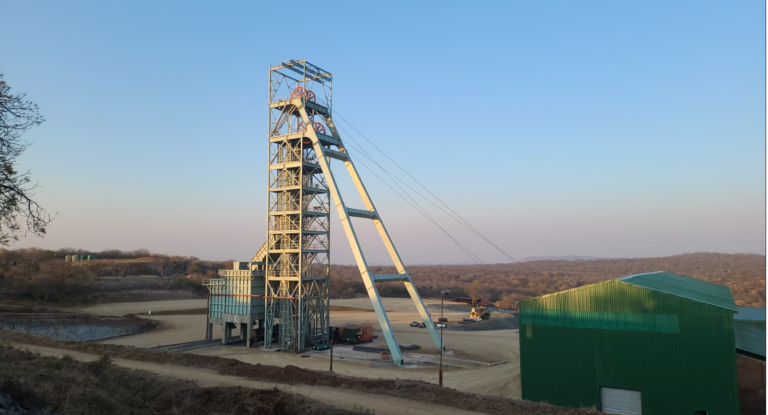
Padenga Holdings’ Dallaglio-owned Pickstone Peerless Mine is positioning itself at the forefront of digital transformation in Zimbabwe’s narrow-reef underground mining sector, with a strategic push to replace paper-based systems with fully integrated digital processes across all operations, Mine Technical Services Manager Mathew Mamina told a technical visit by the Association of Mine Surveyors of Zimbabwe (AMSZ).
By Rudairo Mapuranga
Speaking at the first-quarter AMSZ gathering hosted at the mine on Friday, Mamina outlined the operation’s ambition to become “fully digital in all the processes that we do,” identifying the surveying function as the critical foundation upon which that digital future will be built.
“If we don’t know where we are mining, if we don’t know what’s happening underground when we are mining, then we can never plan for the future in the digital sense that we want to achieve,” Mamina said. “The key pillar for our digital journey is the surveying pillar.”
The Pickstone Peerless operation combines a deep history with a modern revival. Mining in the area dates back to the 1800s, with underground operations last active in 1971 before the current owners reopened the mine. Production from underground resumed in September 2023, following an extensive dewatering campaign, resurfacing of workings, and the re-establishment of digital mine maps.
Since restarting operations, the mine has completed resource modelling and mine planning, laying the groundwork for a technology-led approach that sets it apart from many narrow-reef operations in Zimbabwe.
“If you go to narrow-reef underground mines, you realise that most of them in Zimbabwe do things on a paper-based system,” Mamina said. “There are some that are moving forward into the digital space, but our goal as Pickstone Mine is to be fully digital.”
The mine is currently operating at the “point-scanning stage” in terms of surveying technology, but Mamina expressed interest in advancing to more sophisticated tools, including drone-mounted scanners and other instruments that can improve surveying capabilities.
Mamina urged the visiting surveyors to challenge his team and share ideas freely, encouraging them to ask what he called “the stupid questions” during their underground visit.
“When you go underground, please ask the stupid questions. What are you doing here in terms of surveying? Why are you doing it? So that we open up our minds,” he said.
He emphasised that his team remains open to feedback and new ideas beyond the visit itself.
“Even when you leave this place, please contact me, contact my surveyors to say, ‘There is something that I saw, and I think you are doing it wrong. Please do it this way.’ I’m still open to all that.”
The AMSZ technical visit to Pickstone Peerless provided a platform for surveyors from across Zimbabwe to examine the mine’s operations and share best practices. Mamina welcomed the gathering, noting that the exchange of ideas would help the mine refine its approach as it pursues its digital transformation.
“You can only grow if you are open-minded. You can only learn new things if you say, ‘I didn’t know this. Please tell me how to do it better,’” he said.
A month after Zimbabwe introduced a ban on the export of raw minerals and lithium concentrates, the policy continues to be viewed as a defining step in the country’s evolving mineral strategy. Announced and enforced on 25 February 2026, the move signalled a faster-than-expected transition toward value addition, bringing forward earlier plans that had initially set 2027 as the starting point.
Kelvin Sungiso
The groundwork for the decision had already been laid in June 2025, when authorities outlined their intention to phase out exports of lithium concentrates over time. That initial timeline was widely seen as a measured approach, allowing mining companies and investors to prepare for a shift toward local processing. However, developments in the months that followed appear to have prompted a recalibration. Strong global demand for lithium, combined with increased export activity, highlighted both the opportunity and the urgency to retain more value within the domestic economy.
In this context, the decision to advance the ban by several months reflects a policy environment that is responsive to market dynamics while remaining anchored in long-term development goals. At its core, the move is aimed at encouraging beneficiation, ensuring that more of Zimbabwe’s mineral wealth is processed locally before entering global markets.
For industry players, the adjustment presents both challenges and opportunities. The immediate focus is on aligning operations with the new framework, particularly by scaling up or investing in processing capabilities. At the same time, the policy provides a clearer directional signal, positioning Zimbabwe as an emerging hub for mineral value addition within the region.
The potential outcomes are significant. With the right support systems in place, the ban could help stimulate investment in refining and processing facilities, deepen industrial linkages, and create employment across the value chain. Over time, this may enhance Zimbabwe’s participation in sectors such as battery manufacturing, where demand for processed lithium products continues to grow.
Realising these outcomes will depend on how the transition is managed. Continued dialogue between government and industry will be critical in ensuring that implementation remains practical and predictable. A coordinated approach, linking policy with infrastructure development, particularly in energy and logistics, can help create the conditions needed for beneficiation to take root.
Investment is likely to play a central role in this next phase. Companies already operating in Zimbabwe’s mining sector are well-positioned to expand into processing, building on their existing presence and resource base. In addition, international partners are expected to remain key contributors. Investors from China, with established expertise in mineral processing and battery supply chains, are likely to continue playing a significant role. There is also growing interest from other global players seeking to diversify sources of critical minerals, creating scope for a broader mix of partnerships.
Support from development finance institutions, including the African Development Bank, could further strengthen this transition by facilitating funding for large-scale projects and essential infrastructure. Such collaborations can help bridge the gap between policy ambition and implementation capacity.
One month on, the export ban represents more than a regulatory change; it marks a step in Zimbabwe’s broader economic transformation. While the transition will take time, the direction is increasingly clear. By fostering value addition and encouraging investment in local processing, Zimbabwe is positioning itself to capture a greater share of the opportunities presented by the global shift toward clean energy and advanced technologies.
For the business community, the focus now turns to how best to engage with this evolving landscape, one that offers both complexity and considerable long-term potential.
VFEX-listed bullion producer Caledonia Mining Corporation is ramping up its planned capital expenditure for 2026 to US$178.9 million. This is a 10% increase from the US$162.5 million originally set in January, reflecting strong gold prices and a push to accelerate growth across its Zimbabwean assets.
By Ryan Chigoche
The increased spend reflects a clear pivot toward growth, with the Bilboes Gold Project emerging as the centrepiece of the group’s next phase. Around US$132.1 million has been set aside for the project, subject to final approvals, as the company positions it to become its flagship operation within the next few years.
Bilboes holds nearly 1.75 million ounces in reserves and is expected to deliver an annual production of roughly five tonnes, a scale that could significantly alter Caledonia’s production profile and shift it toward a multi-mine structure.
While growth is taking priority, sustaining operations remains a key focus. Blanket Mine will account for US$43 million of the budget, complemented by US$3.8 million allocated to exploration activities at Motapa.
The company is also directing capital toward improving operational efficiency. A US$14.2 million project to connect Blanket Mine to the national grid via a 34km transmission line is expected to reduce diesel dependence, cut costs, and enhance reliability, potentially lifting annual output by about 1,000 ounces.
The shift comes as Zimbabwe’s diesel prices climb to among the highest in the SADC region, pressured by global supply disruptions linked to the US-Israel conflict with Iran. Completion is scheduled for the second quarter of 2027.
A further US$2.2 million has been approved for upgrades to the Central Shaft winder system, with commissioning targeted between late 2026 and early 2027.
Strengthened Financial Position
The expanded capital plan comes as Caledonia’s financial position strengthens markedly. The group generated US$76.2 million in operating cash flow in 2025, an 82% increase year-on-year, while revenue rose to US$267.7 million. Cash balances climbed to US$35.7 million by year-end.
This performance has been closely tied to the gold price environment. Bullion rallied to approximately US$4,332 per ounce at the end of 2025, up sharply from US$2,690 a year earlier, driving a surge in profitability. Net earnings rose 193% to US$67.5 million, highlighting the leverage gold producers currently have regarding price movements.
Access to external funding has further strengthened the balance sheet. Earlier in the year, Caledonia secured about US$130 million through a convertible notes issuance, providing additional headroom to fund its development pipeline.
The 2026 capital budget was initially set at US$162.5 million, but the upward revision signals growing confidence in both internal cash generation and the broader gold market outlook.
Across the sector, elevated bullion prices are increasingly translating into higher capital deployment, as producers move to lock in growth while margins remain favourable. For Caledonia, this is evident in the pace at which it is advancing Bilboes and supporting infrastructure.
Looking ahead, the durability of the gold price rally will be critical. Continued strength would sustain the current investment momentum, while any meaningful pullback could slow the rollout of capital-intensive projects. For now, the company appears to be leaning into the cycle, using strong cash flows and improved funding access to push ahead with expansion and reposition itself for long-term growth.
President Emmerson Mnangagwa has re-emphasised Zimbabwe’s drive to process minerals locally, stressing the need for mutually beneficial partnerships and making it clear there is no turning back on the country’s beneficiation drive, Mining Zimbabwe can report.
By Ryan Chigoche
The remarks come as authorities enforce a lithium concentrate export ban ahead of the 2027 deadline, marking a decisive shift from phased reform to immediate value retention within the domestic economy.
Speaking at the National Heroes Acre during the burial of national heroes, Mnangagwa said the country’s mineral wealth must be harnessed in a way that delivers direct benefits to Zimbabweans, placing responsibility on investors to align with national development priorities.
“Meanwhile, we will continue to structurally transform our economy, ensuring that our finite resources are processed and value-added at source for the benefit of our people. Our partners and investors across all sectors, particularly in mining, have a duty to ensure durable and mutually beneficial collaboration. The doors of my Administration remain open for complementary economic relations,” he said.
The latest remarks reinforce a policy direction that has been steadily taking shape. In June 2025, regulators outlined plans to gradually phase out lithium concentrate exports, giving mining companies and investors time to adjust to in-country processing requirements. However, rising global demand for lithium and increased export activity in recent months appear to have accelerated that transition.
The shift is now being felt across the sector. Last week, the Chinese Embassy in Zimbabwe urged its nationals operating in the country to comply fully with government directives, signalling alignment with Harare’s beneficiation agenda.
With global market dynamics shifting and competition for battery minerals intensifying, Zimbabwe’s approach is increasingly focused on locking in value at source.
The government’s message is now unequivocal: beneficiation is no longer a future goal, but an immediate and irreversible pillar of the country’s mining strategy.
Premier African Minerals has reported significant progress at its Zulu Lithium and Tantalum Project. The new Xinhai flotation plant is now fully installed, and commissioning activities are advancing toward a targeted start in the second quarter of 2026, Mining Zimbabwe can report.
By Rudairo Mapuranga
In an operational update released on Wednesday, the company confirmed that the new flotation cells have been aligned, levelled, and connected under the supervision of the manufacturer’s installation engineer. Launder installation is underway, structural steelwork for walkways is progressing, and the piping crew has mobilised to begin integrating the new circuit with existing infrastructure.
Product and tailings pumps have been installed on plinths, while the motor control switchgear is being assembled off-site. It is expected to arrive within the next two weeks following factory acceptance testing.
Graham Hill, Managing Director, said the level of coordination between the on-site team and the manufacturer’s engineer gave the board confidence as the project moves toward commissioning.
“We are very encouraged by the continued progress being made on-site at Zulu Lithium. The installation of the Xinhai flotation plant is advancing well and, importantly, in line with our planned timeline,” Hill said.
He added that operational readiness is increasing, with the process engineering team mobilising and approximately 5,000 tonnes of ore available on the run-of-mine stockpile for early commissioning. That material, which has already been mined, will be used at no additional mining cost to the company.
Discussions are ongoing with a mining contractor to support ore supply continuity beyond the initial commissioning phase.
Premier reiterated that commissioning and optimisation remain on track for Q2 2026, with the goal of achieving steady-state production of on-spec spodumene concentrate.
In a move that puts the practical needs of the “man in the pit” before immediate policy shifts, the Reserve Bank of Zimbabwe (RBZ) has hit the brakes on the new 90% gold retention threshold for small-scale miners, Mining Zimbabwe can report.
By Rudairo Mapuranga
The Reserve Bank of Zimbabwe (RBZ) announced a temporary suspension of the recently introduced 90% export retention threshold for small-scale gold miners, following a meeting of the Monetary Policy Committee (MPC) on March 24, 2026.
While the promise of keeping 90% of their hard-earned US dollars was welcomed with open arms, the reality on the ground told a different story. The Zimbabwe Mining Federation (ZMF) stepped in to remind the central bank that many of the country’s artisanal and small-scale miners—the very people driving the nation’s record-breaking gold deliveries—are still unbanked and need more time to get their paperwork in order.
The People’s Victory: Practicality Over Policy
The Monetary Policy Committee (MPC), led by Governor Dr. John Mushayavanhu, acknowledged that while the policy is a massive win for miners, the “logistical hurdles” at Fidelity Gold Refinery (FGR) were simply too high to jump over right now.
Rather than forcing a system that wasn’t ready, the RBZ has chosen to temporarily suspend the rollout. This ensures that miners who haven’t yet opened bank accounts won’t be left in the lurch or forced into the shadows.
Mining: The Engine Keeping Zimbabwe Afloat
The suspension comes at a time when the mining sector is proving itself to be the true backbone of the economy. The numbers don’t lie:
Massive Inflows: Foreign currency coming into the country skyrocketed to US$3.35 billion in just the first two months of 2026.
Gold is King: Gold and PGMs are the primary reason Zimbabwe’s new currency, the ZiG, remains stable and backed by solid reserves.
Beating Inflation: Thanks to the sweat of the miners, annual inflation has been crushed down to 3.85%, the lowest it’s been in over three decades.
What’s Next for the “Makorokoza”?
The RBZ isn’t abandoning the 90% dream; they are simply making sure the “smooth operationalisation” includes everyone. To help with the transition, the new BiG 5 ZiG Banknote Series is set to hit the streets on April 7, 2026, making it easier for everyone to trade and save.
For now, the message to the small-scale sector is clear: The 90% is coming, but the government is listening to the challenges you face on the ground.
To provide the best experiences, we use technologies like cookies to store and/or access device information. Consenting to these technologies will allow us to process data such as browsing behavior or unique IDs on this site. Not consenting or withdrawing consent, may adversely affect certain features and functions.
Functional
Always active
The technical storage or access is strictly necessary for the legitimate purpose of enabling the use of a specific service explicitly requested by the subscriber or user, or for the sole purpose of carrying out the transmission of a communication over an electronic communications network.
Preferences
The technical storage or access is necessary for the legitimate purpose of storing preferences that are not requested by the subscriber or user.
Statistics
The technical storage or access that is used exclusively for statistical purposes.The technical storage or access that is used exclusively for anonymous statistical purposes. Without a subpoena, voluntary compliance on the part of your Internet Service Provider, or additional records from a third party, information stored or retrieved for this purpose alone cannot usually be used to identify you.
Marketing
The technical storage or access is required to create user profiles to send advertising, or to track the user on a website or across several websites for similar marketing purposes.