Home Blog Page 716

3rd GENERATION POLYMER FOR MINING

0

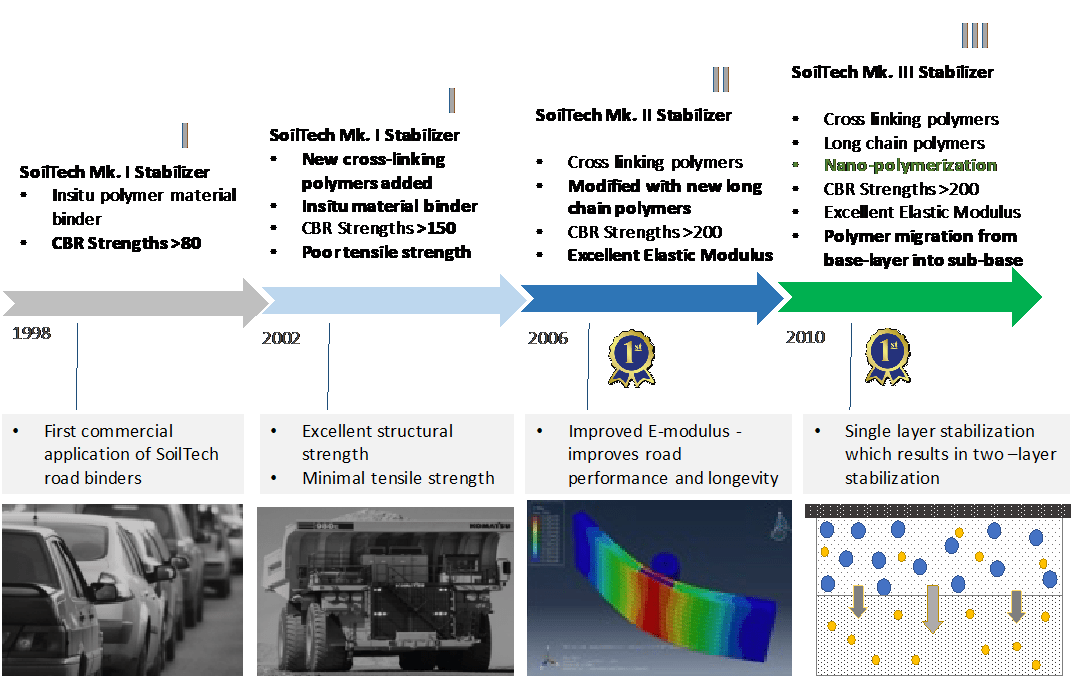
Polyroads, A South African company is leading the technology race in heavy haul road stabilization, with their third generation polymer, namely SoilTech MK. III.

1998 the first commercial application of SoilTech Mk. I was in 1998. Initially the product was developed as binder for rural roads. Over the next couple of years, Polyroads modified SoilTech with new cross-linking polymers to improve compressive strengths – SoilTech Mk. I.

2006 major technology advances saw the introduction of long-chain polymers into SoilTech and thereby adding a second performance dimension to SoilTech. The high CBRs achieved in materials with SoilTech were complimented with new and highly improved elastic modulus in the stabilized pavements, allowing greater flexural strengths and loading capabilities, not to mention improved longevity in the pavements – first of a kind – SoilTech MK. II.

2010 Polyroads chemical engineers introduced nano-polymerization into SoilTech. The specific nano-polymers being substantially smaller than the normal SoilTech polymer particle, allows for easier sliding velocity on capillary adhesion in the materials. Specifically engineered surfactants, mixed with the nano-polymers, further reduces tensions as SoilTech nano-particles migrate from the stabilized base-layer into the sub-base, resulting in two-layer stabilization. First of a kind – SoilTech Mk. III.

Benefits of SoilTech Mk. III

  • Binds the road materials and turns the haul roads into all weather roads, ensuring zero production losses in rainy weather
  • Non-skid in the wet
  • Reduced rolling resistance – less tyre and engine wear
  • Environmentally friendly – SA Bureau of Standards certified
  • Cost-effective

Smart Materials manufactured by Polyroads, includes road stabilization, dust suppression and dam lining products,  have been successfully implement at various mining groups including DEBSWANA, ARM, Glencore and Petra Diamond.

30 feared dead after mine collapse

0

30 illegal gold miners are feared dead after a mine collapsed at Chipindo municipality in Angola.

Zimbabwe Miners Federation applies for fuel import licence

0

The ZMF has applied for a licence to import fuel for its members.

In an interview last week, Zimbabwe Miners’ Federation chairman Mr Makumba Nyenje said the move will ease pressure on service stations which have been battling to supply fuel.

“We have applied for the licence because miners have been facing challenges due to fuel shortages,” he said. “We await Government’s response at the earliest possible time.”

Mr Nyenje said they submitted their application to the Ministry of Energy and Power Development through the Zimbabwe Energy Regulatory Authority (ZERA).

He said they were embracing Government’s move to liberalise the importation of fuel by allowing big companies with free funds to import fuel for their own consumption.

Mr Nyenje said they wanted to have fuel ready for the miners for improved efficiency in the mining sector.

“We would like to have fuel in mining towns and our members will be using their e-cards or coupons to access the fuel,” he said.

Mr Nyenje said last year, ZMF in partnership with Met Bank, launched an electronic multi-purpose membership card for miners, which is linked to the mobile phone and enables a miner to have access to multiple services such as loans and mining equipment offered by the bank, confirm membership, buy goods, pay bills and make transfers, among other things.

He said many small-scale miners are embracing the e-card.

Zim Daily

Fidelity accused of buying “stolen gold”

0

THE country’s sole gold buyer, Fidelity Printers and Refiners (FPR), a subsidiary of the Reserve Bank of Zimbabwe responsible for the purchasing, refining and exporting of gold, is under fire for buying “stolen gold” from illegal artisanal miners who have invaded Gaika Mine in Kwekwe.

Court documents seen by this publication show that FPR was ordered by the High Court not to buy any gold being mined by the mainly Zanu PF youths who invaded Gaika Mine from February 2018.

Duration Gold Investments, Gaika mine owners, approached the High Court seeking an interdict to stop FPR from purchasing “stolen gold”.

Court documents issued in March 2018 under case number HC 622/18 ordered FPR, which is cited as the fourth respondent, “not to accept any gold won return from Gaika Mine from any person other than an authorised representative of applicant, that fourth respondent be and is, hereby, ordered to pay to an authorised signatory or credit applicant’s bank.”

However, an investigation this week revealed that FPR agents were buying gold from the illegal miners in defiance of the court order.

“I have a certificate to buy gold and this is legal,” an FPR agent in Kwekwe said.

“FPR has agents in and around Kwekwe who buy gold. We do not smuggle gold, we take it to Fidelity.”

Former Mbizo legislator Vongaishe Mupereri (Zanu PF), who is said to be the ring leader of the invaders, was also ordered by High Court judge Justice Nicholas Mathonsi to pay all the costs which were met by Duration Gold Investments.

“That first respondent (Mupereri) be and is, hereby, ordered to pay the costs of suit of this application on the attorney and client scale,” part of the court order read.

The court also ordered FPR not to be involved in any dealings with illegal miners from Gaika, since it would be a violation of the mine owner’s rights.

“That fourth respondent be and is, hereby, ordered not to deal with anyone other than an authorised representative of applicant in respect of any gold won from Gaika mine,” the court order read.

Illegal miners on the ground confirmed to this publication that they sold their gold to FPR agents in Kwekwe.

FPR spokesperson Chelesani Moyo directed all questions to Mehluleli Dube, who is the head of gold operations at FPR.

Dube told NewsDay that: “I am not aware of any court order, but if that is the case, then it will be easier for the complainant to track how much gold they would have lost. My logic is, if it is not bought by Fidelity, then it will be taken to the black market.”

NEWSDAY

80% salary increment to the Mining Industry

0

THE workers in the mining industry have been awarded an 80% salary increment following collective bargaining negotiations which will see the lowest paid employee in the sector earning ZWL$468,58 per month.

The workers will receive the new salary structure which back date to January 1, 2019.

Before the adjustment, the least paid employee in the mining sector was earning $260,32 a month, while the highest was taking home $603,78.

With the current adjustment, the highest paid employee will now be getting ZWL$1 086, 80.

Associated Mine Workers’ Union of Zimbabwe (Amwuz) president Tinago Ruzive said the salary adjustments were necessitated by an increase in the cost of living.

“Yes, it’s correct that we negotiated and came up with an 80% wage increase across all grades. The increase will be implemented on dollar value,” Ruzive said.

However, a trade unionist Abraham Kavalanjila said the increment was a drop in the ocean, given the economic situation obtaining in the country.

“We can’t say the employer is at fault but the government has to fix the economy. If the increment had gone up by 300%, yes, we could be singing sweet music right now as workers. The mine workers are living like destitutes in a rich country like Zimbabwe,” he said.

Inflation pressures have seen the cost of living go beyond the reach of many in the southern African nation as prices of basic commodities have more than doubled in recent months.

Government does not have the capacity to sustain a salary increase for public sector workers, while most private sector players are failing to pay due salaries regularly.

The mine workers, through their representatives, have been pushing for poverty datum line-linked salaries.

Mining is the country’s largest source of export revenue and together with agriculture and tourism, the sector is expected to anchor economic growth this year

We do not owe RioZim $92Million – RBZ

0

The Apex bank has filed a High Court application denying a debt worth over $92 million allegedly owed to RioZim.

This comes after RioZim sued the central bank for breaching provision of the exchange control directives whereby the mining company is supposed to be given access to utilise the foreign currency it generated externally. RioZim alleges it only received $26 130 967 of the $84 297 364 in hard foreign currency, This constituted 15 percent of the amount due since 2016.

Representing the central bank and Fidelity Printers, lawyers Gerald Mlotshwa and Wellington Magaya respectively, have denied the debt saying all payments were made by bank transfer in USD.

Pindula

Caledonia Mining takes near-term hit against backdrop of improving outlook

0

The Shares in Caledonia Mining Corporation PLC (LON:CMCL) took a bit of a dive at the end of February after the Zimbabwe government announced that it was ending its export credit incentive scheme.

Under the terms of this scheme, gold producers were able to secure a premium to the spot price by selling directly to a Zimbabwean government agency. The idea was that for a country starved of foreign exchange the government could get its hands on very valuable US dollars by selling the gold itself. In return, the gold companies booked their premiums, and everyone was happy.

Or so it was supposed to go.

It seems though that what ended up happening was that entrepreneurial criminals were smuggling gold or gold concentrate into Zimbabwe from elsewhere and then securing the premium by selling to foreign-produced metal to the government. The paradoxical effect was a net outflow rather than a net inflow of foreign exchange.

New Zimbabwean President Emerson Mnangagwa has promised to revitalise Zimbabwe’s shattered economy, and addressing this issue was a high priority.

The negative effects on legitimate producers like Caledonia are seen by the government as a necessary cost to be borne on the road to economic normalisation.

That doesn’t help Caledonia shareholders very much, given that the company estimated that the hit to earnings resulting from this change would amount to around US$5.4mln or between US$0.40 and US$0.46 per share.

But beyond this immediate financial setback, there is actually some significant good news to tell.

The first item is that Zimbabwe’s economic liberalisation is proceeding with gusto. It’s not always been an easy process, to be sure, as the widespread unrest related to increased fuel prices bears witness to.

But Mnangagwa has set out his stall, particularly on inflation, and there is widespread optimism in financial circles that the Reserve Bank of Zimbabwe is going to move towards a transparent currency market.

This is seen as key because real-terms inflation remains very high, but has until very recently been officially hidden behind a government-backed currency that has been kept at artificial levels.

Moves to address this issue with the creation of a newer freer-floating currency exchangeable on foreign markets have gone some way towards mitigating the problem, but the feeling is there is still some reserve bank intervention going on in the background, perhaps to allow the new currency a slower and more gentle move towards the true market rate.

This currency change is also related to the demise of the export credit incentive scheme, since the government has now created, in theory, its own currency capable of securing foreign exchange reserves, and no longer needs to rely on gold sales to secure US dollars.

The resolution of the currency complexities in Zimbabwe would be more than welcome, especially to workers at the operations like Caledonia’s Blanket mine. By law Caledonia has had to pay its workers at the official rate, but with the twin currencies trading well off their official parity on the black market, that meant real-terms pay was cut to 14 cents in the dollar.

The disparity is no longer that extreme, but there is still some way to go.

Still, Caledonia’s Mark Learmonth expresses cautious optimism that progress will be made. The company has met with Mr Mnangagwa and with the governor of the reserve bank and sees, he says, “a genuine attempt by the Zimbabwean government to liberalise the economy.”

He points out that for the last four months the government has been running a surplus, which is virtually unheard of in the recent economic history of Zimbabwe.

“We are comfortable that there is a genuine attempt to open up the country for business,” says Learmonth.

“We’re very clear on that.”

For Caledonia the upside could be significant. The hit from the cancellation of the export credit incentive will be a one-time event, but longer-term, the environment for deal-making is likely to improve.

Markets will become more transparent, and Caledonia’s own arrangements for selling its gold will no longer be subject to arrangements of byzantine complexity designed to gerrymander foreign exchange into government coffers.

Plans for expansion at Blanket remain very much on track, and although grades have recently slipped, longer-term the 80,000 ounce target is likely to deliver a major boost to earnings. That in turn will allow Caledonia the flexibility to go after other assets with significant potential.

Indeed, the company has already started looking, although at this stage Learmonth is keen to emphasise that no major financial outlay is contemplated.

Instead the company will stick to its knitting, keeping its fingers crossed that the inflation problem will be brought under control, and freer in any case to sell its gold independently and out into the international markets.

ABOUT CALEDONIA

Caledonia is an exploration, development and mining company focused on Southern Africa. Caledonia’s primary asset is a 49% interest in the Blanket Mine in Zimbabwe which produced 50,351 ounces of gold in 2016 at an All in Sustaining Cost of US$912/oz.

 

Zim secures $6m investment for RHA Tungsten?

0

Premier African Minerals has announced that it has received notice from the Zimbabwe Ministry of Industry, Commerce and Enterprise Development that is has secured a proposed investment of $6-million for the RHA Tungsten project being developed by Premier.

Speaking to Report Focus News the spokesperson for the mining company said. “The funds will be used for the recommissioning of mining operations, subject to the completion of necessary agreements.”

Further, Zimdiv Holdings, which is a wholly-owned subsidiary of Premier and which manages the RHA mine, will be awarded another management agreement on similar terms to the current management agreement which was entered into in September 2013.
The company will provide further updates once the agreements have been signed.

The RHA Project is located in Hwange an area of historic production, approximately 270km northwest of Bulawayo. Premier has advanced the RHA project from an exploration project through to a producing tungsten mining operation.

The project comprises 50 Mineral Claim Blocks, covering 1,800 hectares, consisting of 10 owned by Premier and 40 which are under option. Small-scale surface and underground mining was conducted at the site between 1931 and 1979. Total production from the RHA mine was 1,247.65 tonnes of wolframite concentrate, containing 65% WO3.

The deposit is approximately 800m in strike length and 300m wide. Premier African recently announced a resource of 22.14 million tonnes at 2.45kg per tonne in both the underground and open pit operations. (Please see resource table below)

To date, Premier African Minerals has invested around US$18million in the acquisition and development of the mine as well as the plant and necessary infrastructure.

Rwanda aims to sell stake in cement firm

0

Rwanda’s government aims to put its 49 percent stake in the country’s biggest cement maker, Cimerwa, up for sale this month, the prime minister said on Saturday.

The company, which is 51 percent owned by South Africa’s PPC Ltd, has an installed annual production capacity of 600,000 tonnes.

“We have asked our partners if they are interested and the timeline is one month,” Edouard Ngirente told a meeting of senior officials broadcast on national television. “By the end of this month we will auction (the stake).”

He said PPC had yet to specify if it was interested in the stake, which he gave no valuation for, adding that other buyers would be sought if necessary.

A construction boom in Rwanda has driven up demand for cement as the government builds roads, power plants and a new international airport. Private developers have also been building new houses and office blocks.

The head of Cimerwa told Reuters in July that demand for cement was growing at 7-8 percent annually as new building projects come up. Rwanda also imports cement from neighbours Uganda and Tanzania._Reuters

Gold inches lower as firm dollar offsets falling equities

0

Gold inched down today, after rising about 1 percent in the previous session, as a firm dollar offset support from fading appetite for riskier assets due to mounting global growth concerns.

FUNDAMENTALS

As of 0115 GMT, spot gold was down 0.1 percent at $1,296.73 per ounce, after briefly breaching the $1,300 ceiling in the previous session.

U.S. gold futures were also down 0.1 percent at $1,298.10 an ounce.

Asian shares were on a back foot on Monday after U.S. payrolls data raised doubts on the strength of the global economy.

The dollar rose 0.1 percent against major currencies in the early Asian trade and hovered close to its near two-month peak.

U.S. employment growth almost stalled in February, with the economy creating only 20,000 jobs, adding to signs of a sharp slowdown in economic activity in the first quarter.

China and the United States are still working day and night to achieve a trade deal that matches the interests of both sides and the hopes of the world, including eliminating tit-for-tat tariffs, a senior Chinese official said on Saturday.

Concerns that U.S. President Donald Trump will not accept a bad trade deal with China and Trump administration officials have not made any new plans to send a team to Beijing for face-to-face trade talks, White House trade adviser Clete Willems said on Friday.

Trump said on Friday he would be disappointed if Pyongyang were to resume weapons testing and reiterated his belief in his good relationship with North Korean leader Kim Jong Un despite the collapse last week of their second summit.

Federal Reserve Chairman Jerome Powell said on Sunday the U.S. central bank does “not feel any hurry” to change the level of interest rates again as it watches how a slowing global economy affects local conditions in the United States.

Brexit could be reversed if lawmakers reject the government’s exit deal, British foreign minister Jeremy Hunt said on Sunday after two major eurosceptic factions in parliament warned that Prime Minister Theresa May was facing a heavy defeat.

 Hedge funds and money managers slashed their net long position in COMEX gold in the week to March 5, to its in over a month, the U.S. Commodity Futures Trading Commission (CFTC) said on Friday.

Physical gold demand picked up pace in major Asian hubs this week, with bullion being sold at a premium for the first time in more than three months in India, while China saw improved appetite for jewellery._Reuters