


Home Blog Page 743

Miners affected by Zim drop from S&P?

0

…a major blow to the mining sector

S&P Dow Jones announced that they will be removing Zimbabwean domiciled companies from its indices from 24 December due to serious cash shortages in the country, high inflation of the bond money and foreign currency shortages.

What does this mean for the miner?

Dickson Rudairo Mapuranga

Miners are of the view that the move to remove Zimbabwean companies from Standard and Poor African indices will negatively impact on Zimbabwe’s development and investment opportunities in the mining sector, according to S&P Dow Jones Indices statement, Zimbabwean companies will be rated at zero price in 14 different indices thereby reducing the chances of Zimbabwe attracting foreign investors, the move according to experts will lead to Zimbabwe only attracting bogus investors mainly who have nothing to lose but more to gain due mining exploits.

According to one mining expert, this will to some extent affect Large Scale Mines particularly those partnered with publicly traded companies and small scale miners to a greater degree are safe, although the effect will be felt by every Zimbabwean, this will have a slim effect on Zimbabwe’s economy which already is in shambles.

“The truth is our risk rating was already unfavorable. Small Scale Mines will not be affected as much, private investment has always been measured differently regarding investment decisions into small scale operations, potential for return on investment being the major driving factor. Investment prospects for the Small Scale Miner in Zimbabwe will remain unaffected because of the great growth potential in our sector and opportunity to obtain significant returns, besides our type of investment has a higher risk tolerance and does not necessarily rely on S&P when making decisions.”

Some miners are of the view that, Standard and Poor is an American firm, under the authority of Americans, therefore, with United States’ current stance on Zimbabwe, it is bound to negatively portray Zimbabwe to the international community. However, miners are positive that this move will not affect the mining industry in anyway, since miners have been operating without the influence of S&P, and the fact that not all investors abide with S&P.

‘’… it’s an American company. America currently doesn’t view us in a good light, so I’m not surprised. Do you think all investors abide with this S&P thing? Definitely not. That’s why the Chinese and Russians are making so much headway into Africa.” Said one miner.

One mining expert said that, miners do not care about these ratings which mainly focuses on other firms that are not in the mining sector, the mining industry will sustain itself and can even go to become bigger and attract attention from these rating organisations.

“Personally I don’t care about S&P ratings, they never rated China until China was already too big for them to ignore.  Anyway, what I do agree on is the fact that we are going nowhere slowly” he said.

Falgold fails to publish financial results

0

LISTED miner Falcon Gold Zimbabwe has failed to publish its financial results for the financial year to September 30 this year, citing operational challenges which have been worsened by inadequate foreign currency allocations by the Reserve Bank of Zimbabwe (RBZ).

The company said the publication of results will now be expected after the end of 2018.

In a recent cautionary statement, the struggling firm said it was failing to pay creditors and was being cut off supply of critical operating inputs, thereby impacting normal operations.

“The directors of Falcon Gold Zimbabwe Limited (the “Company”) wish to advise all shareholders of the following pertinent matters, The Number 2 mill at the Golden Quarry processing plant (Shurugwi) had a catastrophic engineering failure late last week,” reads the statement.

“In the intervening period, management has been undertaking a full impact assessment and is now evaluating various options to deal with the matter at hand.
Notwithstanding this mill failure, to date the funding required to execute the 2019 financial budget has not been received by the company and discussions with regards this funding are ongoing”.

The Bulawayo-based mine owns Venice Mine in Kadoma; and Golden Quarry Mine located in Shurugwi.

Falgold is 84,7% owned by Canadian-listed New Dawn Mining Corporation.

For the six months ended March 31 2018, Falcon Gold Zimbabwe Limited reported revenue of $ 2,5 million down from $3,6 million recorded over the same period last year.
Loss from continuing operations before taxation was $ 1,6 million compared to $2,5 million in the prior year.

In 2016, Falgold disposed its Dalny Mine to one of the country’s top producers RioZim for $8million.

RioZim has also been facing similar challenges of inadequate foreign currency to meet its operational requirements.

The central bank has since reviewed the forex retention threshold of gold miners to 55% of export earnings from the previous 30% after the Chamber of Mines Zimbabwe, which represents large-scale miners warned of imminent closures and job losses in the extractive sector.

But as the dollar note shortage persists, some miners have only received part of their allocation from the central bank, while others have not received anything at all.
Outstanding foreign payments for gold producers are in excess of $15 million.

This year, the country is targeting output of 35 tonnes of gold, but hopes of achieving that target have been dented, because of the slump in production.

Mining contributes more than 60% of the country’s foreign earnings and the sector is expected to anchor revival of the southern African economy.

source: NewsDay Zimbabwe

Oil prices decline

0

Oil prices fell yesterday after reports of swelling inventories and forecasts of record US and Russian output combined with a sharp sell-off in stock markets as the outlook for global growth deteriorated. US crude oil dropped $2,04, or 4,1 percent, to a low of $47,84, its weakest since September 2017. It recovered to around $49,28, down 60 cents, by 1420 GMT. North Sea Brent lost $2,41, or 4 percent, to $57,20, a 14-month low. Brent last traded around $59,01, also 60 cents lower.

Both oil benchmarks have shed more than 30 percent since early October due to swelling global inventories. World stock markets tumbled yesterday as fears about a slowing global economy gripped investors, just as the US Federal Reserve looked set this week to deliver its fourth interest-rate hike of the year.

Investor confidence is deteriorating with more fund managers expecting global growth to weaken over the next 12 months, the worst outlook in a decade, Bank of America Merrill Lynch’s December investor survey showed. Japan’s Nikkei lost 1,8 percent after US stocks dropped to their lowest in more than a year.

“A large part of the move is due to a broader market sell-off, with both US and Asian equity markets coming under pressure,” said commodities strategist Warren Patterson at Dutch bank ING in Amsterdam.  — Reuters.

Gold rises

0

Gold rose to a one-week high yesterday, helped by a weaker US dollar and a fall in global stock markets, but moves were limited as investors sought clarity on the path of U.S. interest rates as concerns about a slowing global economy deepened.

Spot gold was up 0,1 percent at $1,247.06 per ounce at 1310 GMT, having earlier touched its highest since December 10 at $1,250.27, just short of a five-month peak of $1,250.55 hit last week. US gold futures were steady at $1,251.30 per ounce.

“There has been a slight increase in the minority view that the Fed might not raise rates, given the recent weakness in the equity markets. It would be quite a shock if they didn’t increase rates in this week’s meeting,” said Capital Economics analyst Ross Strachan.

“Most of the attention will be on how many more interest rates rises there may be next year.”

The Fed is widely expected to raise interest rates for the fourth time this year at its two-day policy meeting ending on Wednesday. But weak stock markets and slowing global growth may prompt the central bank to signal a slowdown in rate increases.

“We have seen quite a broad-based sell-off across many other markets, from equities to other commodity markets, and an increase in risk aversion. In that climate, gold is edging gradually higher towards a multi-months peak,” Strachan said.

World stock markets tumbled as fears about a slowing global economy gripped investors, while the dollar index slipped 0,3 percent against a basket of major currencies. Gold tends to gain when interest rate hike expectations ease because lower rates reduce the opportunity cost of holding non-yielding bullion and weigh on the dollar, in which it is priced.

In euro terms, gold reached its highest since June at 1 100,57 euro an ounce. —Reuters.

Hwange Communities raise concern over Deka river pollution

0

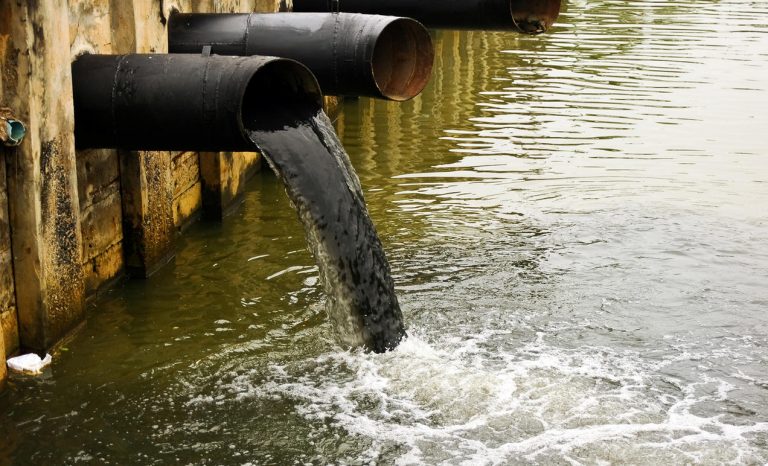
COMMUNITIES in Hwange who, for years, have been affected by Deka River pollution, have raised concern over coal mining companies’ failure to address the problem and reneging on their promise to provide safe water.

This was revealed recently by a taskforce comprising of Hwange district administrator, Hwange Rural District Council, communities from affected areas and other interested stakeholders at a feedback meeting organised by Basilwizi Trust.

The taskforce, which is looking into the pollution problem, was set up in March this year.

Villagers said the mining firms had reneged on honouring their pledge to drill boreholes leading to loss of livestock due to the acidity of the water.

The mining firms have been blamed for the death of hundreds of fish in December last year.

Hwange Colliery Company, Zimbabwe Power Company, Chilota and Sandledge Mining (formerly Coalbrick Mine), who are discharging effluent into the river, were summoned by the taskforce and pledged to, among other things, investigate the source of pollution and drill three boreholes each in the affected communities.

Preliminary studies conducted by the Environmental Management Agency (EMA) revealed that acid mine drainage (AMD) from the mining activities in the area was affecting aquatic life. Other pollutants from mining activities such as coal dust or fines were cited as contributors.

AMD refers to the outflow of acidic water from a mining site. In most cases, this acid comes primarily from oxidation of iron sulfide, which is often found in conjunction with valuable metals.

“We are disappointed at the pace these companies are taking in addressing access to water issues, which they pledged to do sometime in March after effluent was discharged into the Deka River, which is an important water source for us and our livestock. Fish continue to die and our livestock is also being affected by this pollution. The water is not safe to drink, bath or wash as it leaves skin itching, which has forced us to travel distances of between 3km and 5km to access drinking water,” Mashala village head Patrick Nyoni said.

Nyoni said they need to find lasting solutions to stop pollution. He said environment authorities took samples of the water, which was sometimes yellow or dark green in colour, but have not released the results.

Rosemary Shoko from Chachachunda said women were the most affected, as they were in constant contact with the water.

“This a crisis that needs urgent attention, and the delay that is taking place has become a great worry to us. We as women are the most affected as we have to walk for several kilometres to access clean water, and since our primary food source has been polluted, it is us who have to look for alternative relish. We are very worried about our health, considering the tenderness of women skin which when exposed to the contaminated water from the river becomes itchy. We have continued to say these companies have been gambling with our lives, polluting the water without restraint. What are we going to eat when our animals are also dying from this calamity?” she said.

Communities in Chachachunda, Zvabo, Mukuyu, Mashala and Mwemba, home to a population of about 1 200, blamed the mining companies’ poor rehabilitation systems for the catastrophe.

Acting Hwange district administrator, Simbarashe Kayela said the companies had committed to start drilling boreholes in December.

“Your concerns are noted, and I want to assure you that the DA’s office is doing everything in its power to ensure that boreholes are drilled as per pledge. So far, I can confirm that Hwange Colliery has been rehabilitating some of the boreholes that had broken down long back as part of its short-term plan to resolving the problem. I’m happy that they have put tentative timelines to start drilling, which is a positive development, though the process has been slow. It’s not going to be a one day activity, but it’s an ongoing process of engagement,” he said.

Kayela said ZPC would take advantage of a second pipeline which is going to be constructed under the Stage 7 and 8 expansion schemes of the power station to connect taps to the communities.

He said Sandledge had asked for drilling quotations and would commence work before monthend, while Chilota has not been mining for sometime and are yet to advise.

Meanwhile, HRDC said it was engaging mining companies with a view to finding a permanent solution that would eliminate pollution.

EMA revealed that similar patterns were experienced in 1996 and 2007. The agency said there was need for long term commitment such as the installation of a treatment plant to stop pollution.

“We have engaged companies that are dumping effluent into the river to do so after treating it. There has been compliance in that regard. However, it has also been noted that AMD, which finds its way into the river, is the main culprit causing the deaths of fish. There is need for concerted efforts in establishing effective treatment mechanisms such as installing a treatment plant downstream,” EMA Matabeleland North provincial manager Chipo Mpofu-Zuze said.

Though the Environment Management Act has a provision for the setting up of an Environment Fund, which is meant to assist in cleaning up, rehabilitating degraded and polluted environments, nothing has been done to utilise it in addressing the Hwange issue. Setting up of the treatment plant reportedly costs around $30 million, a figure most companies cannot afford.

Source: Newsday

Pelgin introduces a new model truck in Zimbabwe

0

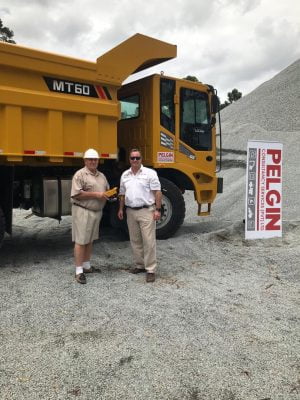
Last week Gary Moorcroft, the Managing Director of Pelgin Consultancy Services, handed over a LGMG Rigid Dump truck to Collin Campbell of Pomona stone quarries at a ceremony held at Pomona Stone Quarry in Harare.


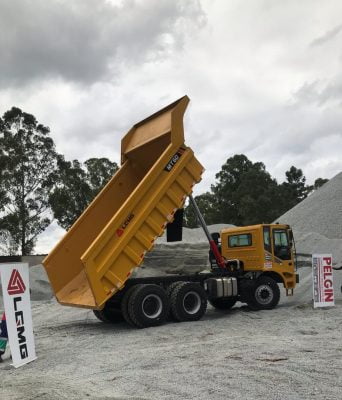
The truck which is a LGMG MT60 Rigid Dump Truck, the first MT60 model to operate in Zimbabwe, offers a payload of 45 tons, and is ideally suited for medium size mines and stone quarries. However, there are a number of smaller LGMG MT50 and larger MT86 Models already operating on chrome mines in the Country.

Pelgin, are confident that this product range is set to become a major solution for mining operations looking for a productive, but price competitive solution for their haul requirements. There are a number of medium to large projects that Pelgin are currently working on for the supply of the LGMG Range of equipment, and Zimbabwe will soon become a major destination for these products.

According to Pelgin, the truck handed to Pomona Quarries LGMG MT60 Truck, has a payload of 45 tons, and is being loaded with a Volvo EC700 Excavator, fitted with a 4.1m3 rock bucket.


Pelgin is proud to handover the first LGMG MT60 Rigid Mining Truck to Pomona Quarries in Harare.

“This is an ideal match, and the excavator is needing 7 passes to load the truck, which hauls the blasted grey granite in the pit to the primary crusher. The truck is standard, but does include the more robust tyres fitted with 15.00R25 E4 Tyres. This unit has a 20m3 bin purpose built to take the higher SG rated material. Standard bin size for the 45 ton payload is 25m3. The Body is made of NM400 steel and is designed to take the harsh conditions found in mining and quarrying operations. Pelgin also provided Pomona with a LGMG Technician to offer operator training as well as maintenance training.” Said one Pelgin consultant member.

Pelgin are the official Volvo CE Dealer in Zimbabwe and have become a major source of equipment for the mining and construction industries in Zimbabwe. In addition SDLG is also offers by Pelgin, a Company that is jointly owned by both Volvo CE and LGMG. This gives Pelgin the unique advantage of offering the full spread of mining and construction equipment that offers complete solutions to their customer base. There is no doubt that LGMG will become a popular Brand for Pelgin in Zimbabwe as the mining industry embraces them in the years to come.

Pelgin also offer LGMG MT86H model, which is a 55 ton payload. It is extremely popular in larger mining operations around the world, reports have it that, over 3 000 of these units are sold each year. LGMG can offer up to a 70 ton payload model, for example their LGMG CMT106. The truck is a dedicated rigid off road mining dump truck, built from the ground up. LGMG trucks are tougher, more productive and dedicated to harsh mining conditions. This, coupled with being extremely price competitive, make it a viable alternative not only to generic tipper trucks but also the more conventional, yet pricey, articulated and rigid mining trucks available.

  • Contact Pelgin Consultancy Services (Pvt) Ltd
  • 7 Loreley Close Msasa, Harare
  • Telephone: (0242) 486773 / 74 Mobile: 0772573683

Gold prices decline

0

Gold prices inched lower yesterday as the dollar held firm below a 19-month peak on safe-haven demand amid concerns of a global economic slowdown, and as investors awaited cues on US interest rate hikes from a Federal Reserve meeting this week.

Spot gold was unchanged at $1,238.12 per ounce at 0820 GMT. US gold futures rose 0.1 percent at $1,242.1 per ounce.

“Gold’s move today is purely dollar-driven,” said Kunal Shah, head of research, Nirmal Bang Commodities in Mumbai, India.

“Ahead of the FOMC (Federal Open Market Committee) meeting, we are going to see some downward movement . . . But the fact remains that the underlying strength in gold is likely to continue.”

Markets will closely watch the future trajectory of US monetary policy at the Federal Reserve’s tomorrow to Wednesday meeting where the board is set to raise interest rates by 25 basis points.

“Markets will rally on the back of dollar weakness after the central bank signals a more dovish stance, but the advance will fall back quickly as global growth concerns reassert themselves,” INTL FCStone analyst Edward Meir said in a note.

Prospects of higher US interest rates are negative for dollar-priced gold as they raise the opportunity cost of holding the bullion.

The dollar index, which measures the greenback against other major currencies, was just below the 19-month high of 97,71 hit on Friday

Weaker-than-expected economic data from China and Europe and fears of a possible US government shutdown enhanced appeal for the US currency, which has played the role of a safe-haven asset in recent times.

Spot gold is biased to break a support at $1,232 per ounce, and fall to a lower support zone of $1,224-$1,228, according to Reuters technical analyst Wang Tao.

Meanwhile, hedge funds and money managers switched to net long position in Comex gold in the week ended December 11, the US Commodity Futures Trading Commission (CFTC) said on Friday.

This was the first time gold speculators held a net long position since July, and the strongest since June.

“Uncertainties of the trade war are still weighing on the market,” said Dick Poon, general manager, Heraeus Metals Hong Kong Ltd.

“It is getting close to Christmas time, so it is getting super quiet in the market. Investors reduce their inventories as much as possible before the year ends.”

Among other precious metals, spot palladium rose 0,9 percent to $1,248.44 per ounce.

Silver climbed 0,2 percent to $14,59 per ounce, while platinum declined 1 percent to $779,50 per ounce. — Reuters.

Moti Group addresses concerns of wrestling claims from ASM

0

The Moti Group (MG), a mining company owned by the South African business magnate, Zunaid Moti, has begun addressing concerns raised by a section of small-scale chrome miners who accused the company of indirectly trying to wrestle their claims from them.

MG has chrome mining operations in the Midlands Province, but it was accused by small-scale miners of moving around the country collecting various coordinates of claims belonging to small-scale miners without their knowledge.

It was alleged that MG was doing this under its $50m Zimbabwe Motivation Mining (ZMM) programme, aimed at capacitating small-scale chrome miners across the country.

But the small-scale miners protested, saying it was a violation of their rights as the ZMM deal had not come to fruition.

The ZMM programme is a brainchild of MG and its local partners, Sakunda Holdings, which is owned by the business tycoon, Kuda Tagwireyi.

The programme is a 20-year mining deal with the government of Zimbabwe aimed at formalising and strengthening the small-scale mining sector in the country. According to MG, ZMM has since agreed an initial off-take allocation of $50m.

“It is widely understood that ZMM exists to support the livelihoods of miners, not take them away,’ says MG. This is why the programme has received so much interest and so much support since we launched our pilot earlier this year.

“We cannot work effectively with small-scale chrome miners if we do not understand and respond both to the expectations and apprehensions of the ZMM. We can confirm that we take no action without the explicit consent of our participants,” MG added.

MG said they have been in the field engaging and working with small scale miners in line with the ZMM project.

“We are taking time to ensure that all concerns are addressed. All our internal systems are ready and all supervision from the Ministry of Mines is in place so that we can launch ZMM fully, purchasing lumpy chrome direct from miners, giving them a stable and fair price and a certain route to market,” the mining group said.

The group said the ambitious projects needed to be thoroughly planned in order for them deliver on their promises.

Small scale chrome miners who requested anonymity told Business Times there was lack of clarity around the ZMM deal.

“As small scale chrome miners we are worried about the Zimbabwe Motivation Mining deal where we are of the opinion that Moti Group is looking at indirectly buying off our claims on the pretext of just purchasing chrome from us,” said one miner.

“The Moti group has even went to an extent of moving around the country collecting coordinates of claims without our knowledge and we think such an action is illegal and a violation of our rights.”

Under the programme, MG has highlighted that feedback from small scale miners on the pilot scheme has been positive and the programme will be supervised by the Ministry of Mines and Mining Development. The programme will initially work with small-scale chrome miners before expanding into gold and lithium beneficiation.

According to MG, information gathered on all potential participants will be shared with Government to help improve the understanding and oversight of the country’s small-scale chrome mining operations.

All miners included in the ZMM project will have goals set through their individual development plans.

MG said the ZMM will utilise existing infrastructure and technology to help improve the efficiency and safety of small-scale mining operations.

To improve safety, security and reach, ZMM will make use of satellite offices at which product can be deposited. ZMM will match the grade of each product with available market prices and will provide miners with 50 percent payment through the internal Real Time Gross Settlement platform and 50 percent through United States Dollar.

Source: Business times

Artisanal miners to obtain substantial value

0

BUBI Milling Centre (Private) Limited has invited tenders for the construction of a carbon-in-pulp plant in Matabeleland North.

The milling centre is one of the many gold service centres earmarked to be set-up by the Government as it moves to ensure the yellow metal from small-scale and artisanal miners is sold through formal channels.

Bubi Milling Centre, a joint venture between Bubi Small-Scale Miners’ Association and the Zimbabwe Mining Development Corporation (ZMDC) was commissioned by Vice President Dr Constantino Chiwenga in July.

In a notice for tender invitation, Bubi Milling Centre said it was inviting applications from reputable, eligible qualified, experienced, and capable general building and engineering contractors to tender for the proposed project.

“Completed forms must be delivered to the Bubi Milling Centre premises (44 kilometre peg from Bulawayo along Nkayi road) by Wednesday, 19 December.

“This tender document provides the requirements and the scope for this project, which is required to access the suitability off the bids,” it said.

“The successful applicant will be required to deliver services in accordance with all the requirements of the project details.”

A carbon-in-pulp plant is an extraction technique for recovery of gold, which has been liberated into a cyanide solution as part of the gold cyanidation process.

The process was introduced into the mining industry in the early 1980s and carbon-in-pulp is regarded as a simple and cheap process.

The project shall also include all feed material test works, civil works, construction or installation of but not limited to ore bin, conveyances and ball mill among others.

In the past, small-scale and artisanal miners were failing to obtain substantial value from the ore delivered to private gold millers.

ZMDC facilitated a loan of $3,5 million from Fidelity Printers and Refiners for the procurement of machinery and various mining consumables for use at the centre.

The loan facility is expected to be repaid over a three-year period.

source: The Chronicle

Zim to double platinum production

0

ZIMBABWE is on course to double platinum production by 2023 as well as value add the mineral through the construction of local base and precious metal refineries, Mines and Mining Development Minister Winston Chitando has said.

Zimbabwe, in line with President Mnangagwa’s Vision 2030 target, intends to grow its annual mineral exports earnings from the current US$2 billion to US$12 billion by 2023, and Government is working on a number of strategies towards attaining this target.

In an interview with The Sunday Mail Business on Friday, Minister Chitando said Government has so far received input which it is considering for incorporation into the new platinum development policy to be launched in the first quarter of 2019.

Zimbabwe, according to the World Platinum Investment Council, produced 480 000 of platinum in 2017.

Government also projects increased economic activity as the three major producers — Zimplats, Mimosa and Unki – all have plans of implementing value addition strategies, while the new investor, Karo Resources, has committed to constructing a refinery.

Platinum production involves mining of ore, production of concentrate, smelting of concentrate into ore, production of base minerals from a base metal refinery, and, finally, precious metals from a precious metal refinery.

Currently, the country’s largest platinum producer, Zimplats, is at matte stage, Mimosa is at concentrate stage of value addition and Unki has just finished construction of a smelter which will enable it to produce matte.

At present, both the matte and concentrate are shipped to SA for further value addition to extract final product.

Proposals by the Platinum Producers Association to jointly establish base and precious metal refineries are a significant step in fulfilment of Government’s value-addition drive.

source:The Sunday Mail